
Zakat Calculator: Formula, Nisab, and Calculation Example
What does the figure from a Zakat calculator actually tell you if you can't see which Nisab standard and which debt deduction it uses?
The multiplication itself is simple. What matters is which amount belongs in the calculation in the first place. In the example, deducting just 5,000 € in short-term debt alone shifts the Zakat by 125 €, a difference that many calculators hide behind a single number. Anyone who carefully compiles their account balances but chooses an unsuitable standard or deducts a loan in full ends up with a mathematically clean result built on the wrong basis.
Table of Contents
- Zakat formula and Nisab at a glance
- How to determine your zakatable wealth
- Correctly determining Nisab in euros
- Deducting debts and three calculation examples
- Checking the result and calculating Zakat now
Zakat formula and Nisab at a glance
Zakat is calculated on zakatable net worth, provided Nisab and Hawl are fulfilled. The Zakat guide from SadakaNow usually cites 2.5% for this, a Nisab of 85 grams of gold or 595 grams of silver, and an Islamic lunar year of 354 days, not the calendar year with 365 days.
Here, the terms serve different purposes: the Nisab is the minimum threshold, while the Hawl is the time requirement. A high account balance alone therefore doesn't answer whether the payment is already due. Likewise, it's not enough to simply calculate a percentage every year on the same date of the ordinary calendar.
Recognising the reference values in the calculator
The following overview separates the metal standard used from the payment rate. You should not mix alternative weight figures with the standard values on your own, but instead classify them according to the religious calculation method you follow.
Nisab reference values and Zakat rate
| Standard | Standard weight | Alternative weight | Zakat rate |
|---|---|---|---|
| Gold | 85 g fine gold | 87.48 g | 2.5% |
| Silver | 595 g | 612.36 g | 2.5% |
A permanently valid euro threshold cannot be derived from this. For the euro amount, the calculator additionally needs the metal price on the relevant reference date. A saved threshold value without a price date is therefore not a sufficient basis for your personal review.
From assets to calculation basis
The basic formula is:
Zakatable net worth × 0.025 = Zakat, provided Nisab and Hawl are fulfilled.
With the net worth of 10,000 € used in the guide mentioned, a Zakat of 250 € results. The word net is decisive: permissible debt deductions are already included in this sum.
The Nisab is not deducted from net worth like a tax-free allowance. It serves to check whether the condition for the calculation has been met. The calculator should visibly separate this check from the subsequent calculation.
Also make sure that you are calculating the annual Zakat on wealth and not a different payment. For clarification of the terminology, the explanation on Zakat al-Fitr can help.
The practical starting question is: Is my zakatable net worth above the relevant Nisab, and has the required annual period been fulfilled?
How to determine your zakatable wealth
A Zakat calculator doesn't need an estimate of all your possessions, but rather an organised list of the relevant assets and permissible deductions. For this, have your account statements, portfolio overviews, information on precious metals, and outstanding invoices ready as of the same reference date.
The SadakaNow article on Zakat describes why this care makes sense: a helpful calculator must explain which types of assets it takes into account, which short-term liabilities are deductible under the chosen view, and which Nisab reference date it uses. A single input for total assets leaves these decisions unanswered.
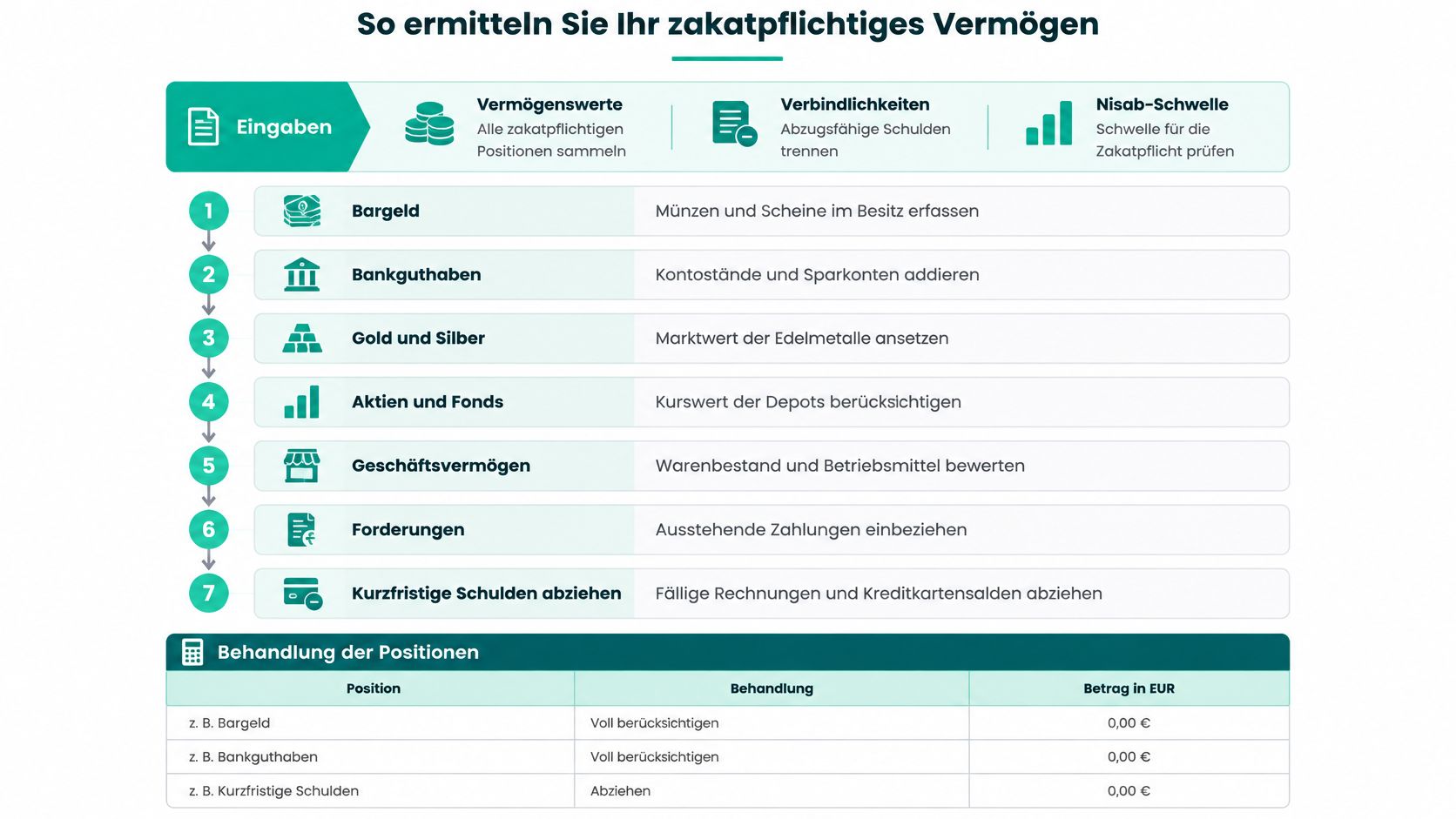
The infographic shows which documents and items you should first gather. You then check separately whether an item is actually included.
Recording your assets step by step
Gather cash and bank balances. Add up your balances on checking and savings accounts as well as any cash on hand. Don't forget accounts abroad, and convert foreign currencies consistently using the chosen reference date.
Value gold and silver. Record the weight, purity, and the relevant metal value. For jewellery, the original purchase price is not a reliable substitute for the current precious metal value. Whether your jewellery is included also depends on the view you follow.
List securities and cryptocurrencies separately. Note the holdings and market value on the reference date. For long-term holdings, the Zakat-relevant assessment basis may differ from a flat valuation of the entire portfolio. Clarify this question before adopting the value unchanged.
Check trade goods and receivables. Use the relevant sale value for goods intended for sale. Separate receivables that are likely to be collected from amounts whose repayment is uncertain. Not every operating resource is automatically a trade good.
Document deductions separately. List short-term due liabilities individually. Do not deduct all expected household expenses as a lump sum.
Finish the calculation. Check the remaining sum against the chosen Nisab and only apply the rate once the conditions are met.
A hypothetical example to work through
The following amounts are freely chosen example figures, not current Nisab values. In this scenario there are no additional receivables to include; Nisab and Hawl are considered fulfilled.
Assets and their treatment in the calculation example
| Asset | Treatment in the calculator | Example amount |
|---|---|---|
| Cash and bank balances | Fully included | 6,000 € |
| Gold and silver | At current market value, where included | 2,500 € |
| Securities and funds | Here, simplified, at market value on the reference date | 2,000 € |
| Trade goods | At sale value | 1,500 € |
| Collectible receivables | Only if collection is certain | None present |
| Short-term debts | Deduct the permissible amount | −2,000 € |
| Net assets | Basis for the rate | 10,000 € |
| Zakat | 2.5% of 10,000 € | 250 € |
The assumed asset items together amount to 12,000 €. After the assumed deduction of debts, the calculation basis shown in the table remains.
Avoid these mistakes in particular:
- Deducting debts twice: An invoice already debited from the account balance must not appear again as an outstanding liability.
- Recording jewellery at purchase price: Manufacturing costs and trade margin are not equivalent to the metal value.
- Counting uncollectible receivables: A nominal claim is not automatically available or realistically repayable wealth.
For additional explanations of terms, the German-language overview of Zakat is a good resource. The video explanation offers another way to understand the calculation:
Save your breakdown together with receipts, valuation method, and reference date. This way you can later tell whether your assets have changed or just an input value.
Determining the Nisab in euros correctly
There is no single correct euro Nisab independent of the method used. A calculator can use a current metal price and still leave a crucial question unanswered: why does it calculate the threshold based on gold rather than silver?
The SadakaNow article comparing the Nisab describes the common standards of 85 g of gold and 595 g of silver as well as alternative figures of 87.48 g of gold and 612.36 g of silver. When metal prices diverge significantly, the silver Nisab can be considerably lower, meaning the same person may be classified differently depending on the chosen standard.
The metal price alone is not enough
The conversion is mathematically straightforward:
Nisab in euros = reference weight in grams × price per gram on the reference date.
For this, the weight, metal, and price must match. Anyone using a fine gold standard needs a correspondingly matching price figure. A jewellery sale price or an undated price overview is not a clean basis for this.
Alternative weights are also not simply roundings that you should switch between as you please. Clarify which basis of calculation your school of law, community or religious advisor uses. A lower or higher result is not, on its own, an argument for changing methods.
Keeping the decision traceable
- Set the standard. Document the metal and reference weight, not just the calculated euro amount.
- Note the price source and time. Record the date and, if applicable, the time at which the price applies.
- Coordinate the religious classification. If in doubt, ask your community or a qualified scholar.
If your net worth lies between the gold and silver threshold, this choice directly affects the classification. The result should therefore show standard, price source and timestamp, rather than just a figure with a currency symbol.
Also check whether the displayed Nisab belongs to your personal valuation date or merely reflects today's price. If you are documenting an earlier calculation, you must not mix these figures unnoticed. A screenshot without a date is not sufficient for this.
Deducting debts and three calculation examples
The following hypothetical scenarios each start with an assumed zakat-liable wealth of €15,000. Only the assumed permissible deduction changes; Nisab and Hawl are considered fulfilled in all cases.
Zakat in three debt scenarios
| Scenario | Deduction | Net worth | Zakat (2.5%) |
|---|---|---|---|
| No debts | €0 | €15,000 | €375 |
| Short-term debts | €5,000 | €10,000 | €250 |
| Long-term loan, only the instalment for the next 12 months | €2,000 | €13,000 | €325 |
In the second example, the calculated Zakat is reduced by €125 compared to the debt-free case. This difference arises solely from the assumed deduction of short-term debts, not from a different rate.
The third row is an explicitly chosen example method, not a universally valid rule for long-term loans. Whether and which part of a financing arrangement is deductible must be clarified according to the view being followed.
Separating due debts from future expenses
The Zakat explanation from Barakah takes into account short-term due debts, but does not automatically deduct ordinary future expenses. A calculator should make precisely this distinction visible, rather than lumping all obligations together in a single debt field.
Separate groups help with your breakdown:
- Liabilities already due: This can include outstanding invoices, due credit card claims or unpaid rent. Check the actual outstanding amount and its deductibility.
- Long-term financing: Note the remaining debt, due dates and the individual components of the payments. Do not automatically take the entire loan amount as a deduction.
- Ordinary future living expenses: Planned grocery purchases, upcoming insurance premiums or future rent are not deductible merely because you want to set aside money for them.
With credit cards, the difference is particularly easy to overlook. An outstanding claim and an already-processed account debit must not reduce your calculation basis at the same time. Therefore, use the account statement and card statement with the same time reference.
The illustration shows a practical approach: sort invoices and loan documents separately and assign each planned deduction to a supporting document.

Why a long-term loan requires its own examination
A property financing arrangement can have a high remaining debt, even though only a limited portion is due on the valuation date. Anyone who enters the entire remaining debt into the debt field has already made a religious methodological decision. The calculator cannot replace this decision with more precise decimal places.
The term instalment also needs attention. Repayment and other payment components should not automatically be treated as identical. Therefore, get specific confirmation of which amount for which period may be deducted according to your view.
Check rule: A debt deduction should be explainable in terms of amount, due date, supporting document and the method applied.
The same care applies to securities and other modern holdings. An available stock price field does not answer whether, for a long-term investment, the entire market value or a differently determined basis of assessment is relevant. Likewise, with receivables you should distinguish whether a payment is merely delayed or seriously in doubt.
Building your own calculation transparently
Transfer your figures into the same structure as the example table: wealth, permissible deduction, net worth, result. Leave disputed deductions separate at first, rather than silently hiding them within a total sum.
Then check the remaining amount against the relevant Nisab. If it falls below this threshold, you may not pay out the mere multiplication result as due Zakat on wealth. Especially when the margin to the threshold is narrow, a clarified deduction method is more important than an elaborately designed results display.
Check the result and calculate Zakat now
A usable calculation must be explainable. Before paying, you should not only know the final amount, but also know which holdings, deductions, and valuation figures you used to determine it.
Go through your documents using this short checklist:
- Record the reference date and Hawl. Mark the relevant date in your calendar and keep the basis for your deadline determination.
- Document your Nisab decision. Add the standard, price source, and valuation date to your records.
- Check the time reference. Before paying, check whether the prices used match the relevant calculation date. Do not replace historical reference-date values with today's rates without checking.
- Clarify open questions specifically. Ask your community or a qualified religious advisor about the specific point of contention, such as a particular loan deduction or the valuation of a long-term investment.
Using the calculator as a computational aid
Our SadakaNow Zakat calculator delivers a result after three short questions, uses daily gold and silver prices, supports every currency, and follows Diyanet standards. Your entries remain in your browser.
This gives you a practical calculation aid with a named calculation basis. However, the calculator does not replace individual religious advice, especially for long-term loans, complex securities holdings, or unclear ownership circumstances.
If the underlying method does not match the view you follow, you should clarify this discrepancy before paying. Do not simply change individual entries until the desired final amount appears. Instead, keep the traceable calculation and the clarified decisions together.
After the calculation, you can pass on your Zakat to an organisation of your choice. In doing so, explicitly check whether the organisation accepts your payment as Zakat and uses it accordingly. A general donation option does not yet answer this question.
At SadakaNow, we offer you a Zakat calculator with which you can convert your asset statement into a traceable calculation. Visit SadakaNow, calculate your status today, and note your reference date. Clarify open debt deductions before paying, so that you have not only a final amount, but also an understandable calculation basis.