
Zakat Explained: Nisab, Calculation and Recipient Categories
The standard rate of Zakat is 2.5% of zakatable net assets. It becomes due once this wealth exceeds the equivalent of 85 g of pure gold or 595 g of pure silver and a full Islamic lunar year has passed above this threshold.
The usual question is: how much do I have to pay? The question that actually determines the amount is a different one: which items count on which day, and what may be deducted beforehand? Anyone who estimates instead of checking almost always ends up too high or too low.
This article therefore separates three things that are often conflated in everyday practice: the religious obligation, the calculation basis, and the method of payment. At the end there is a short checklist you can use to review your own calculation before settling on an amount.
Table of Contents
- Zakat at a glance
- Who must pay Zakat and why the Nisab is decisive
- Calculating Zakat step by step
- Calculation examples for typical assets
- The eight recipient categories of Zakat
- Zakat and Sadaqa in direct comparison
- Paying and documenting Zakat in Germany
- Reviewing your own Zakat and seeking guidance
Zakat at a glance
Zakat is a religiously obligatory levy on wealth. It becomes due as soon as your net assets reach the Nisab and a full Islamic lunar year, the Hawl, has passed above this threshold. The following overview brings together the key figures that every further check builds on.
| Key figure | Value | Meaning |
|---|---|---|
| Zakat rate | 2.5% | Standard rate applied to zakatable net assets |
| Nisab gold | 85 g pure gold | Threshold whose euro value must be documented on the reference date |
| Nisab silver | 595 g pure silver | Alternative threshold, depending on the legal view followed |
| Hawl | one Islamic lunar year | Assets must remain above the Nisab for this entire period |
| Calculation basis | Assets minus debts due | Wealth at market value on the reference date |
| Due date | after the Hawl has elapsed | annually once the conditions are met |
| Recipients | eight categories (Surah 9, Verse 60) | see the section on recipient categories |
The table deliberately gives no euro amount for the Nisab. Gold and silver prices move daily, and so does the monetary value of 85 g of pure gold. Anyone who does not note the price on the day of calculation will later be unable to substantiate their own threshold, either to themselves or to any organisation.
A second point that is easily overlooked: this overview is a map, not a decision. Schools of Islamic law differ on which debts are deductible, how jewellery is treated, and whether gold or silver serves as the benchmark. Anyone wanting to check their own situation will find the review steps at the end of this article. And if you also want to understand Zakat al-Fitr at the end of Ramadan, you will find the basics in our article on Zakat al-Fitr.
Who must pay Zakat and why the Nisab is decisive
Picture a water level marker on a river. As long as the water stays below it, nothing happens. Only once it crosses the marker does the actual measurement begin. The Nisab works the same way: it is a marker, not a tax-free allowance.
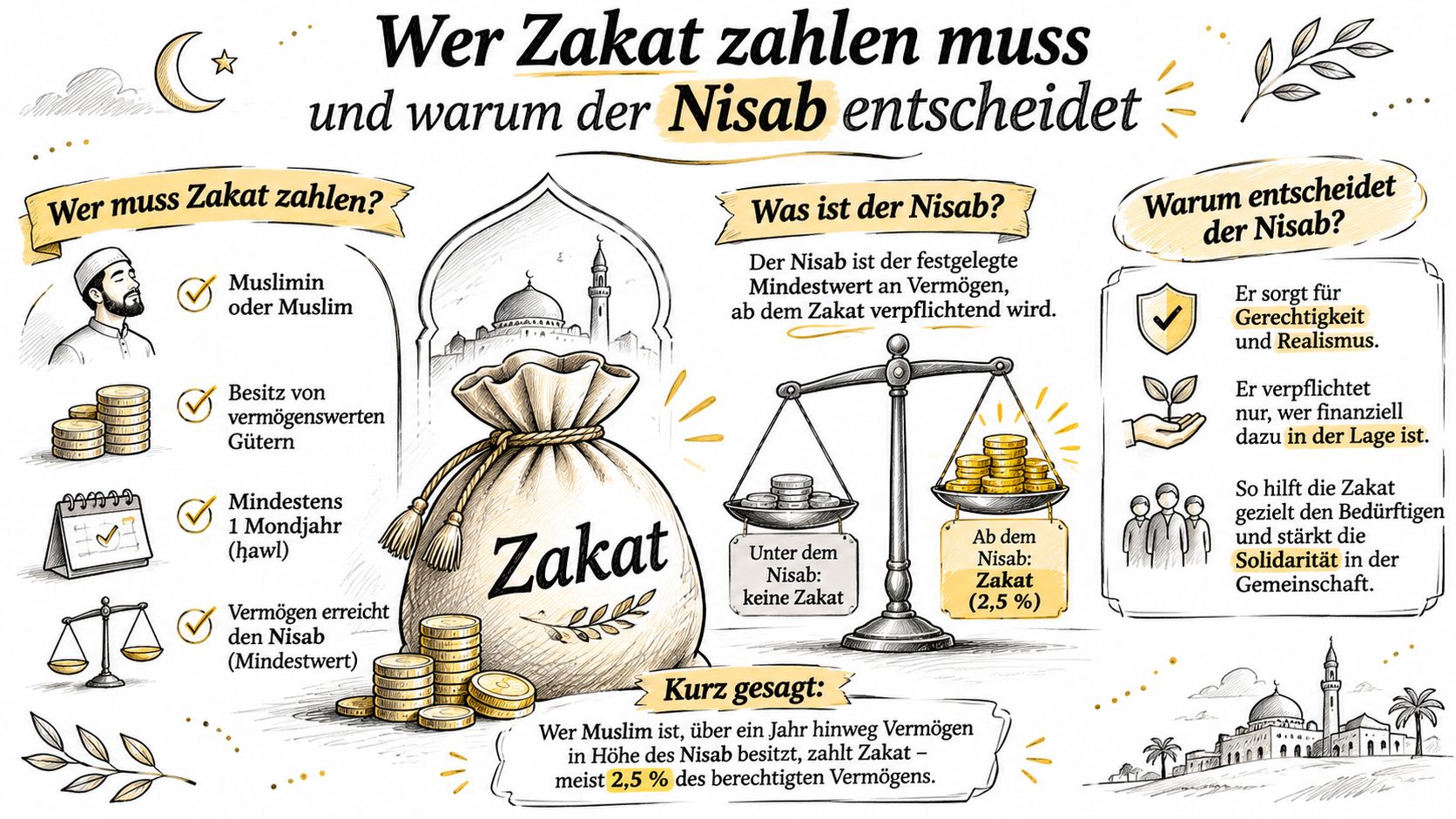
Once this marker is crossed, the calculation applies to the entire zakatable wealth, not just the amount above the threshold. This is exactly where the most common misunderstanding arises: many treat the Nisab like a tax-free allowance. In fact, it is an entry threshold.
Hawl, the lunar year as a time measure
The Hawl requires that the wealth remain above the Nisab for one full Islamic lunar year. A lunar year is about eleven days shorter than the Gregorian year, which is why a fixed date in the solar calendar falls a little earlier each year. Anyone who ties their payment date to a religious occasion, such as Ramadan, does not need to recalculate this shift themselves.
Zakat-liable items include cash, bank balances at home and abroad, investment gold, securities, liquid receivables and trading stock. Borderline cases are more common than clear-cut ones: the self-occupied home and household goods are exempt in most schools of law, rented properties are usually assessed via their income, and jewellery is treated differently depending on the school.
Research also emphasises that the calculation is not mechanical. The DIW Berlin study on Muslim donation behaviour classifies Zakat traditionally as a mandatory wealth levy and notes that the specific calculation depends on the types of assets, debts and the respective religious legal view. In Germany it is not collected as a state tax, but paid individually or through religious, charitable and social organisations.
Rule of thumb: The Nisab answers the question of whether you pay. The Hawl answers since when. Together, both determine whether any Zakat arises this year at all.
If you'd like to hear the terms explained calmly once, here is an overview of how Nisab, Hawl and rate relate to each other.
Calculating Zakat Step by Step
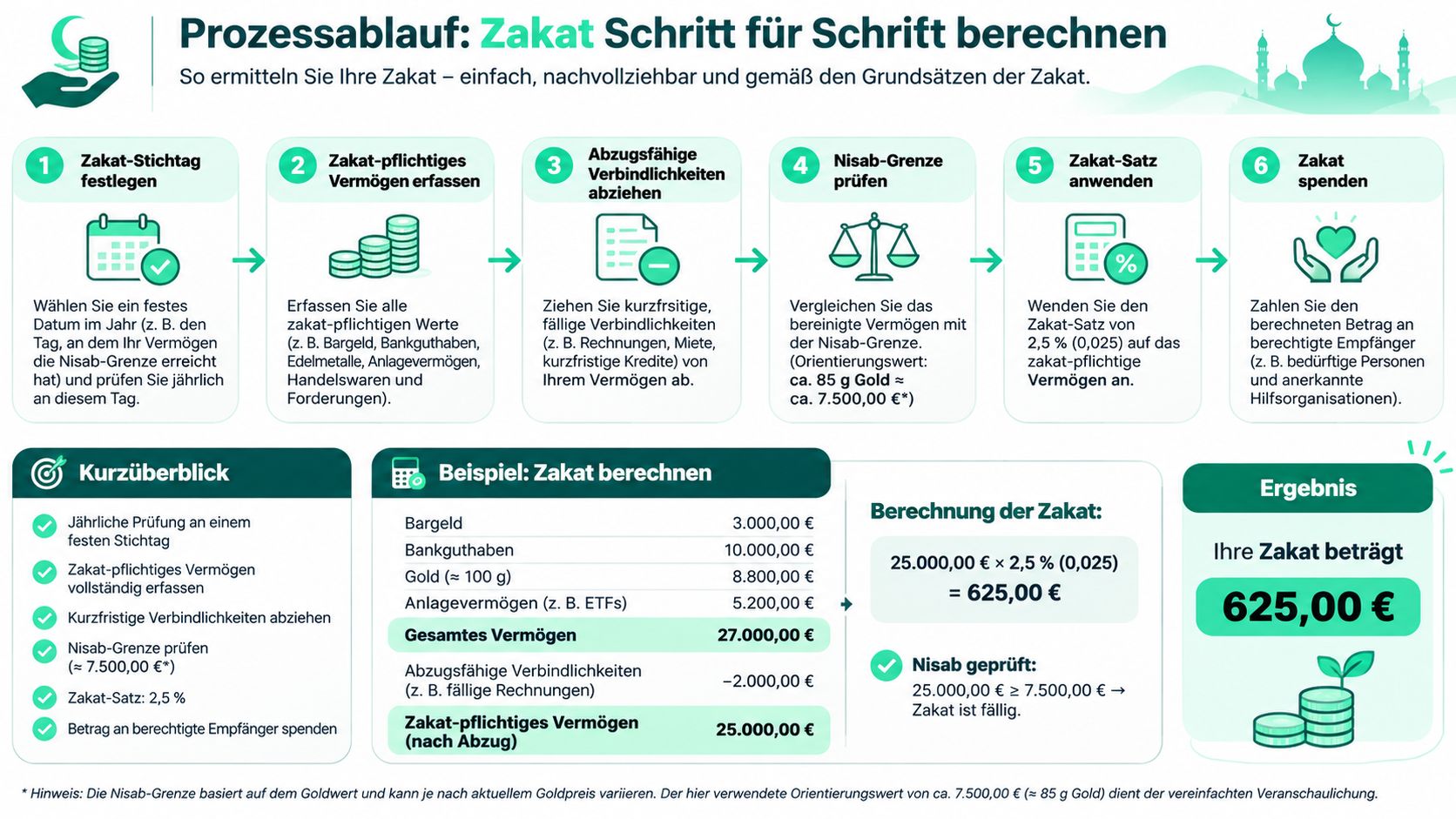
The calculation itself is unremarkable once the items are sorted. The following seven steps follow the structure described by Barakah NGO in their Zakat guide, and can be recorded in a document that later serves as proof.
Calculation rule: (zakat-liable assets minus permissible short-term liabilities) × 0.025
- Set a reference date. Choose a day and treat it as the measuring point for all items. One reference date per year is enough, as long as every single item really refers to that same day.
- Record assets at market value. Cash, domestic and foreign bank balances, investment gold, securities, liquid receivables and, where applicable, trading stock go on the list. What counts is the market value, not the purchase price.
- Document the rates. Note the gold price, silver price and any exchange rate used on the reference date. Without this note, the Nisab cannot be verified later.
- Deduct due debts. Immediately due liabilities may be deducted, while long-term obligations only according to the rules of the school of law applied. List these items separately instead of hiding them in a combined line.
- Check the Nisab. Convert 85 g of fine gold or 595 g of fine silver into euros at the reference-date rate and compare it with the net assets.
- Check the Hawl. Did the net assets stay above this threshold for a full lunar year? If this period is missing, no Zakat arises this year.
- Record the payment. Amount, date, recipient and purpose belong in the record, kept separate from voluntary gifts.
Three Mistakes That Distort Almost Every Calculation
- Accounts counted twice: A savings account that is fed from a current account appears twice on the list. This makes the amount larger than the actual assets.
- Debts deducted twice or not at all: An instalment debited in the current month has already been settled. Deducting it again understates the result.
- Euro prices without a date: A gold price from three weeks ago produces a different threshold than the rate on the reference date. Without noting the date, the calculation is worthless.
The Nisab remains a threshold, not a tax-free allowance. With €12,000 in zakat-liable net assets and a fulfilled Hawl, €300 is due, not 2.5% only on the amount above 85 g of fine gold. The formula shows the mechanics, but does not replace an individual religious decision about which items belong in your particular case.
Calculation Examples for Typical Assets
Numbers make the mechanics visible faster than any definition. The following overview assumes in each case that the Nisab has been reached and the Hawl fulfilled.
| Zakat-liable net assets | Zakat at 2.5% | Note |
|---|---|---|
| €8,000 | €200 | Only if the Nisab is reached on the reference date |
| €12,000 | €300 | The full amount is due, not just the portion above the Nisab |
| €25,000 | €625 | Without deductible debts, the calculation remains simple |
| €50,000 | €1,250 | Check the type of assets and school of law |
The line with €8,000 is the trickiest. If the gold price is such that 85 g of fine gold is worth less than €8,000, Zakat is due. If the gold price rises above this sum, the assets fall below the threshold and no obligation arises, even though the figure is in the table. At €25,000, the result depends on whether there are any deductible debts at all. At €50,000, it is worth looking at the composition: trading stock, receivables and property income follow their own rules.
A worked example shows how the items interact. €9,000 in cash, €14,000 in bank balances and €4,000 in investment gold add up to €27,000. Due debts of €3,000 are deducted, leaving €24,000. 2.5% of that is €600.
Practical rule: Round only at the end. Rounding interim sums down to whole hundreds shifts the result and can cause you to narrowly miss the threshold.
Only due, verifiable obligations are deductible. A letter of intent, a planned loan, or an invoice without a due date does not belong in the deduction line. The examples show the mechanics, not the decision about your own case.
The eight recipient groups of Zakat
Zakat is not a donation that can be distributed freely. The Quran names eight groups in Surah 9, Verse 60 to whom it may be given. Everything else remains Sadaqa.
| Category | Meaning | Example |
|---|---|---|
| Fuqarā' (the poor) | People in need with very low income | A single person without any savings |
| Masākīn (the needy) | People whose income is just not enough | A family with low wages |
| Administrators (Āmilīn) | People who collect and distribute Zakat | Staff of a Zakat committee |
| Reconciling hearts (Muʾallafa qulūbuhum) | People whose support or closeness to the faith is to be strengthened | New Muslims in financial hardship |
| Riqāb (liberation) | Liberation from bondage or debt bondage, depending on interpretation, related to hardship | Buying someone's freedom from a debt relationship |
| Ghārimīn (debtors) | People who have fallen into debt through no fault of their own | Settling necessary debts after an emergency |
| Fī sabīlillāh (public good) | Religious and charitable purposes, depending on interpretation | Supporting a charitable project |
| Ibn as-Sabīl (travelers) | Travelers in need who cannot afford their journey home | A stranded traveler |
Three of these groups need an explanation, because in practice they are the ones most often interpreted differently.
Riqāb historically means liberation from bondage. Today, many scholars apply the category to people in forced dependency or debt bondage. Anyone giving under this category should know which interpretation the organization applies.
Muʾallafa qulūbuhum describes people whose hearts are to be won over or strengthened. The group is closely tied to the community and is defined more or less broadly depending on interpretation.
Fī sabīlillāh is by far the most contested category. Some interpretations limit it to specific religious purposes, others open it up to charitable projects. According to the widespread view, construction projects and mosque buildings do not automatically fall under it, because Zakat is primarily meant to reach people.
A question to ask any organization: Under which of the eight categories is my contribution distributed, and where can this allocation be found in writing?
An organization that can answer this question without evasion has done its homework. Anyone who cannot name an allocation does pass on the money, but not in a way that can be traced.
Zakat and Sadaqa in direct comparison
Sadaqa is the broader term. It is voluntary, possible at any time, and open-ended in amount, extending even to a good deed that costs nothing. Zakat, on the other hand, has a fixed rate, a threshold, a specific time, and a fixed group of recipients.
| Feature | Zakat | Sadaqa |
|---|---|---|
| Character | religious obligation | voluntary gift |
| Amount | 2.5% once Nisab is reached | freely chosen |
| Threshold | Nisab and Hawl required | no threshold |
| Timing | annually after the Hawl has elapsed | at any time |
| Recipients | eight categories according to Surah 9, Verse 60 | broader group, also for public good and family |
For digital processing, a third distinction is important, one that has nothing to do with religion. The SSOAR documentation on Muslim donation behavior separates religious calculation, payment processing, and tax treatment: tax recognition depends on the recipient, their charitable status, the specific funding purpose, and the donation receipt. The religious obligation arises independently of whether a payment can be claimed for tax purposes.
The order that has proven effective in practice
Anyone giving both first settles their Zakat and then gives Sadaqa from their remaining assets. This order prevents a voluntary gift from unnoticeably adding to the obligation, and it keeps the amounts in separate lines. Anyone planning both during Ramadan can find suitable projects via our overview on donating during Ramadan. Platform tip: Sadaqa and Zakat should never disappear into a single sum.
Paying and documenting Zakat in Germany
How much Zakat actually flows in Germany cannot be officially verified. The study by Schrader on Muslim donation behavior in Germany shows in its sample that 89.7% of respondents perceive Zakat as a religious obligation and only 7.8% consider it a voluntary donation. Respondents gave an average of €452 in cash and in-kind donations per year for social and charitable purposes, and 52.4% had made in-kind donations in the preceding twelve months.
These figures are not the total volume of Zakat. The study captures broader Muslim donation behaviour, including voluntary giving, and there is no official statistic on Zakat in Germany, because census data does not systematically record religious affiliation. Individual organisations, however, publish concrete figures: Zakat Deutschland, Ergebnisse reports 238,667 € in Zakat donations for the reporting year 2025.

Payment methods and the receipt that counts
Three methods are common: transfer to a vetted organisation, payment via a donation platform, or personal handover to a mosque or aid centre. At SadakaNow, we do not handle the donated funds ourselves. The money is held in trust and paid out directly to the respective organisation.
- Payment receipt: amount, date and recipient, clearly identifiable.
- Purpose: the explicit note Zakat, so that the allocation does not have to be guessed afterwards.
- Calculation sheet: items, deducted debts and the gold price used, with date.
- Separation: Zakat, Sadaqa and platform tip on separate lines, otherwise double counting occurs.
Before paying, it is worth looking closely at the organisation: Is its non-profit status recognised, is the purpose clearly stated, and are there project reports showing what became of the money? Anyone donating online will find a practical overview in our article on online donations. Tax deductibility depends on the recipient and the donation receipt, not on the transfer itself.
Checking your own Zakat and seeking advice
Before paying, there remain three control questions that go beyond the mere calculation. First: Do all accounts, assets and receivables share the same reference date, and is every deducted debt verifiable? Second: Can the chosen organisation document the eight categories and make it transparent where the contribution goes? Third: Are the amount, date and the purpose Zakat recorded in the receipt and kept separate from Sadaqa?
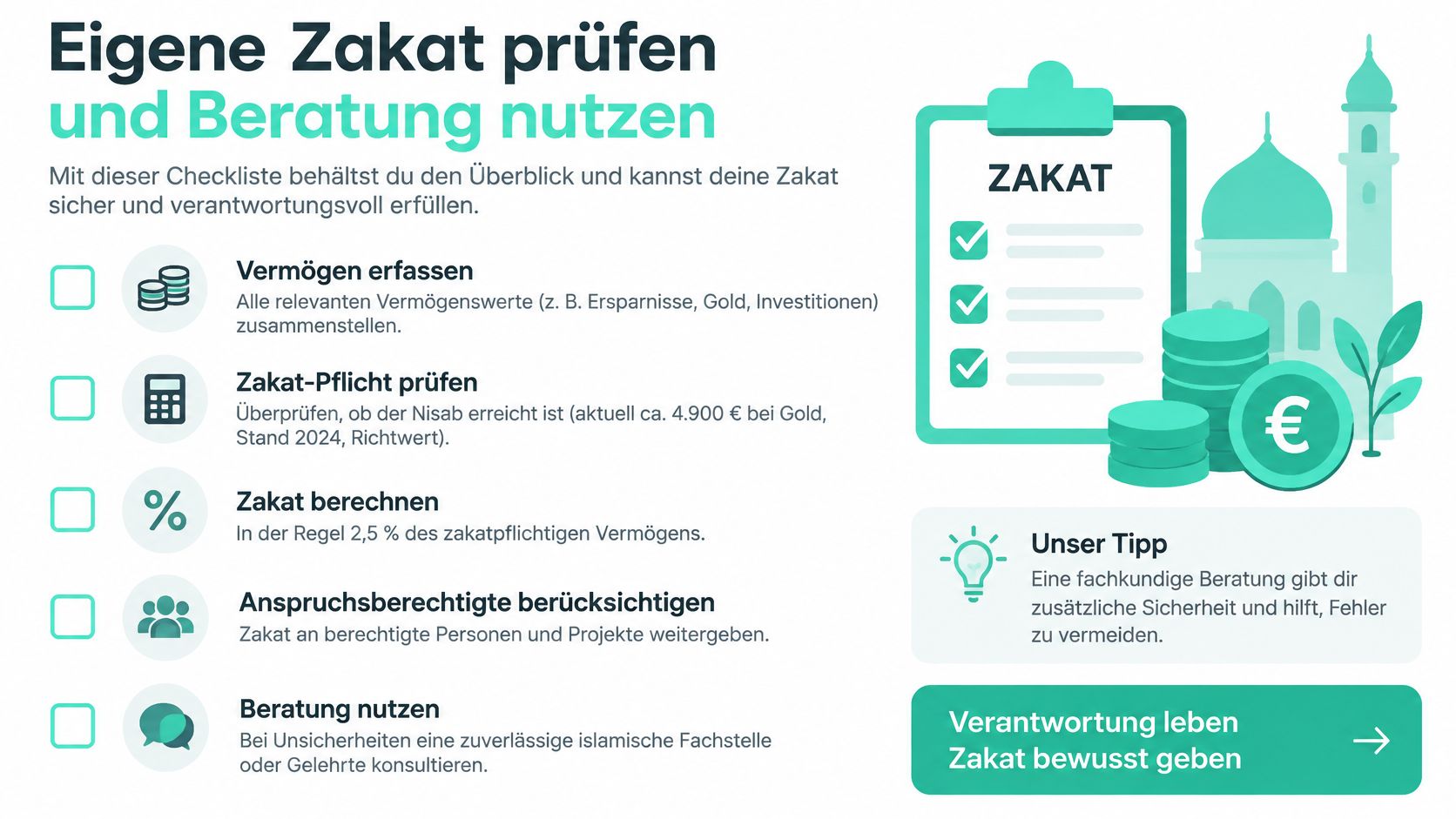
If any of these questions cannot be answered, that is no cause for concern but an indication of where a qualified person is needed. This applies particularly to four situations: jewellery, because schools of law treat it differently; trade goods and real estate, because it is unclear whether market value or yield counts; complex debt situations involving foreign currency or liabilities due later; and assets just above or below 85 g of fine gold or 595 g of fine silver, because in that case the day's gold price is decisive.
The right contact is someone with sound religious training, such as an Imam or a female scholar, who can place it within their own school of law and make the final decision. You should bring the reference-date overview, the price records, the list of debts and the payment receipts. At SadakaNow, projects carry a platform fee of 0%, with no setup fee and no base fee, so that the intended amount arrives in full; questions about donations and payment issues are answered at hilfe@sadakanow.de. This guide does not replace religious counsel.
If you would like to pass on your Zakat this year through a platform, you will find campaigns on SadakaNow from mosques, aid organisations and social initiatives, which are checked for their non-profit status before being activated. You can make your payment via SEPA, PayPal or credit card and follow on the project pages what became of the contribution. This way it stays traceable where your Zakat goes, kept separate from any voluntary Sadaqa.