
Zakat: Nisab, Calculation and Recipients Explained Simply
Zakat is the annual obligatory levy of 2.5% of zakatable net assets above the Nisab, and it differs from voluntary Sadaqa. But how can the same savings lead to different results depending on the calculation?
The decisive questions arise before the multiplication: Which Nisab applies? On what date do you value your assets? Which debts do you deduct, and does your jewellery count toward the calculation basis? Whoever keeps track of these decisions can calculate their Zakat transparently, instead of simply trusting a displayed sum.
Table of Contents
- What Zakat means and why it is obligatory
- Zakat, Sadaqa and Zakat al-Fitr compared
- Who must pay Zakat and which assets count
- Checking the Nisab, determining due date and calculating Zakat
- Calculation examples for different assets
- Who may receive Zakat
- Calculating Zakat correctly and giving it for its intended purpose
What Zakat means and why it is obligatory
Zekat, also written Zakat or Zakāt, refers to a religiously obligatory levy on wealth. Muslim men and women who meet its conditions give a fixed portion of their zakatable assets to designated recipients. The term carries the idea of purification: giving is also meant to shape how one treats the remaining property.
A community fund serves as a comparison. Those who possess sufficient wealth contribute according to a binding rule, so that people in need receive support. Unlike a spontaneous collection, it is therefore not generosity alone that decides whether and how much someone gives.
The illustration captures this connection between wealth, responsibility and support.

A religious obligation, not an arbitrary donation amount
Zakat is one of the fundamental acts of worship in Islam. It should therefore not be equated with a voluntary good deed, even though both can help people in difficult life situations.
In the 2020 published survey of Muslim people in Germany, 90% of respondents described Zakat as a religious obligation, while 8% classified it as a voluntary donation, as documented by the study by the Maecenata Institute on Muslim donation behaviour.
These results describe the surveyed group, not every Muslim person in Germany. However, they do help explain why a clear distinction between types of donations is important.
Basic idea: With Zakat, you don't just ask how much you want to give, but what obligation arises from your wealth.
For practical implementation, several decisions therefore belong together: the correct type of levy, a traceable statement of assets, and a permissible use. A good cause alone does not yet answer all of these questions.
Zakat, Sadaqa and Zakat al-Fitr compared
| Type | Status | Calculation | Timing | Recipient |
|---|---|---|---|---|
| Zekat al-Māl | Obligatory when conditions are met | Fixed share of the zakat-liable net wealth once the Nisab is reached | Annually after an Islamic lunar year | Defined recipient groups |
| Zakat al-Fitr | Obligatory payment with its own conditions | Amount per person based on the relevant local rate | At the end of Ramadan, before the festival prayer | People in need |
| Sadaqa | Voluntary | Freely chosen | Anytime | Freely chosen, no corresponding fixed recipient list |
The key difference lies in the basis of calculation. Zekat al-Māl concerns wealth. Zakat al-Fitr is a personal payment due at the end of Ramadan. With Sadaqa, you decide voluntarily on the amount and occasion.
Similar terms, different purposes
When people speak of Zekat in everyday life, they usually mean Zekat al-Māl, meaning the wealth due. A high or low monthly salary alone does not answer the question of whether this obligation applies. What matters are the assets that count toward it and the conditions that apply to them.
Zakat al-Fitr is not a simplified version of the same wealth calculation. You don't calculate it by adding up your accounts, trade goods, and debts. The specifics that apply to this payment are explained in the guide to Fitr-Zakat.
The common association with Ramadan can also cause confusion. The fact that someone gives during this month does not yet say which type of payment it is. A Ramadan payment can be voluntary Sadaqa, settle a wealth Zekat, or be intended as Zakat al-Fitr.
Sadaqa, on the other hand, gives you more flexibility. You can respond to an urgent need, support a social initiative, or regularly give a self-chosen amount. Its voluntary nature does not make it less valuable, but it serves a different purpose.
Classifying payments correctly from the start
Clear labels help with your records:
- Obligation is not automatically fulfilled: A voluntary gift does not fulfil your Zekat obligation simply because its amount was high enough.
- Clarify intention and classification: Do not retroactively reclassify a Sadaqa already given as Zekat without religious clarification.
- Distinguish purpose of use: A purpose suitable for Sadaqa is not automatically permitted for Zekat.
A typical misunderstanding arises with regular transfers. Someone who supports an aid project every month has not thereby clarified whether these payments were intended as Zekat and used accordingly. So make a note of which type of payment you intend at the moment you give.
This also simplifies your annual accounting. You can see which obligation has already been fulfilled and which amounts were given additionally and voluntarily, without accidentally counting the same amount twice.
Who must pay Zekat and which wealth counts
| Type of wealth | Treatment | Note |
|---|---|---|
| Cash and bank balances | Taken into account | Basis of the zakat-liable monetary wealth |
| Gold and silver held as an investment | Taken into account | Precious metals are also used to determine the Nisab |
| Trade inventory | Taken into account | Record the value of goods as of the reference date |
| Realistically recoverable receivables | Taken into account | Check irrecoverable receivables separately |
| Short-term liabilities | Can be deducted | Deduction according to the chosen method |
| Jewellery for personal use | Methodically disputed | Treatment depends on the respective school of law |
| Long-term debts | Treatment depends on method | Do not deduct the entire remaining debt without review |
| Shares | Treatment depends on method | Consider the form of investment and the religious-legal approach |
The table describes a common working basis, not a wealth statement identical across all schools of law. Especially with jewellery, securities, and loans, you need to know which method you are following. A calculator can reflect this decision, but it cannot settle the religious question for you unnoticed.
For the basic assessment, these conditions are central:
- Religious applicability: The Zekat obligation applies to Muslim owners of wealth; specific personal conditions may depend on the school of law.
- Sufficient net wealth: The wealth that counts toward it reaches the chosen Nisab.
- Relevant time period: The conditions regarding the Islamic lunar year are met according to the method applied.
Income is not the same as wealth
A salary is initially an inflow of money. Whatever is spent on rent, food, and other expenses is no longer available as savings. What you set aside, however, can become part of your zakat-liable wealth.
Suppose you transfer part of your salary into a savings account every month. For the calculation, you don't simply collect all your pay slips and treat their sum as assets. You record the funds actually on hand and check the timing of any added savings according to your method.
With receivables, the distinction is similarly important. Money that someone owes you and is likely to repay must be assessed differently from a claim whose repayment seems hardly realistic. So note not only the amount but also your assessment of its collectability.
Keeping disputed positions visible
For everyday jewellery, a note saying "gold present" is not enough. Record whether it is worn jewellery or an investment, and how your chosen approach treats this item.
The same applies to shares and long-term loans. For a loan, separate the total remaining debt from the short-term due obligations. For shares, you should document the purpose of the investment and the valuation method used.
An open methodological question belongs in your statement as a visible note, not as a silent assumption in the final total.
If you are unsure, qualified religious guidance that knows your actual financial situation can help. Keep its result together with your calculation so that you can proceed consistently next year.
Checking the Nisab, determining due date and calculating Zekat
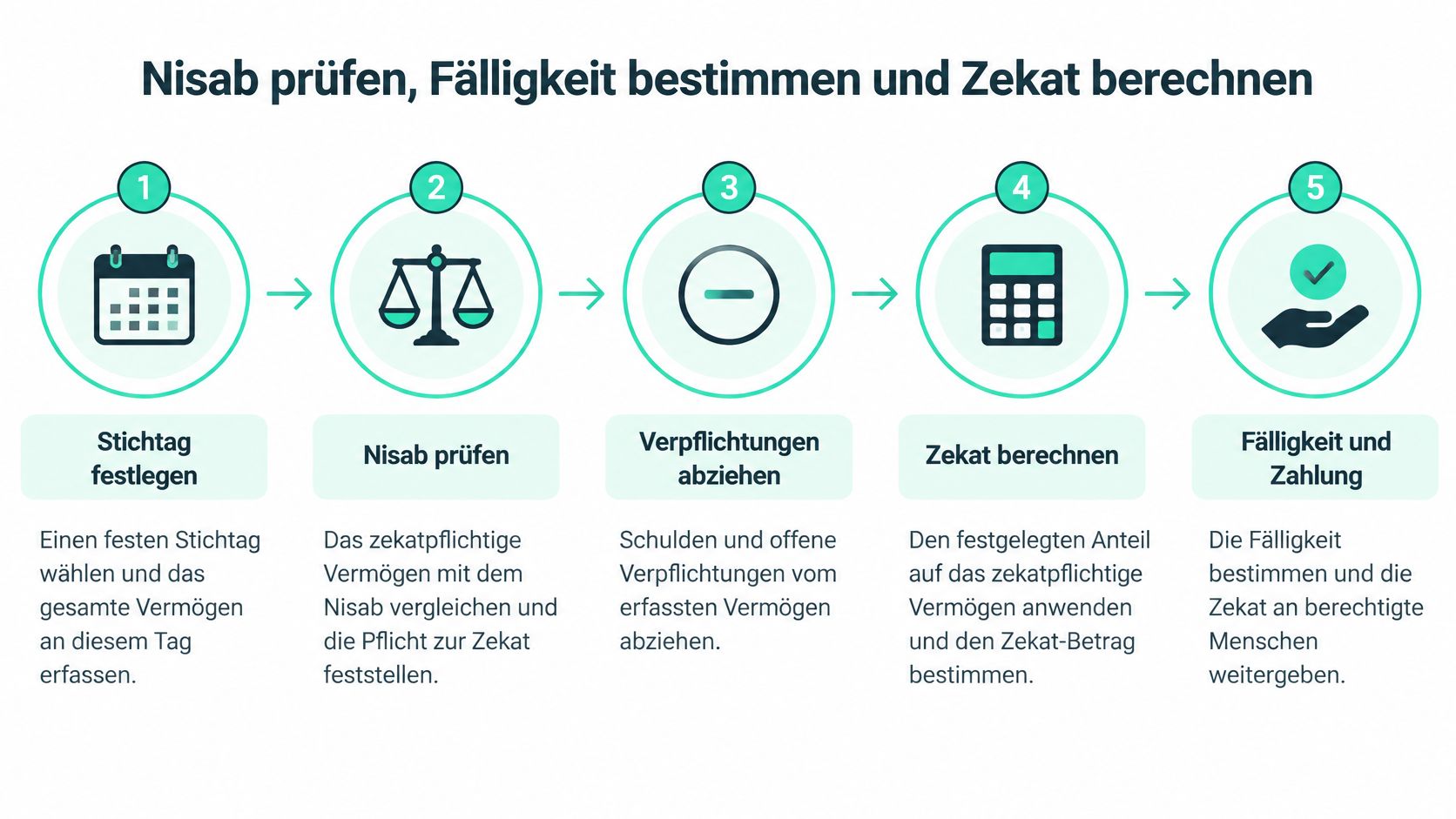
Set a reference date. Choose a traceable valuation date within your Zekat year and record your assets as of that date. Use account statements and portfolio overviews from the same day, so you don't mix holdings from different points in time.
Compile eligible assets. Add up cash, bank balances, relevant precious metal and investment assets, trading stock, and realistically collectible receivables. Avoid double counting, for example when a transfer from a current account to a savings account appears in both overviews.
Deduct permissible liabilities. Record short-term due obligations and take them into account according to your chosen religious-legal approach. Note down which debts you deducted and why.
Assess the Nisab in a traceable way. The guide to calculating Zekat in Germany cites 85 g of gold or 595 g of silver as references, along with the typical rate of 2.5% after one Islamic lunar year. Calculate the euro equivalent of the chosen metal as of the reference date, and note the price source, price unit, purity factor, and Nisab standard.
Determine the target amount. If the conditions are met, you apply the stated rate to the entire Zakat-liable net assets. The Nisab is an access threshold, not an allowance that you additionally deduct from the assessment base.
Check due date and course. Check when your relevant period began and whether its conditions are met. If the Nisab was temporarily undercut or larger asset inflows occurred in between, you should clarify the treatment according to your method rather than inferring the due date from a single account balance.
The infographic shows the process in condensed form. For the actual calculation, you compare the net assets determined according to your method with the Nisab.
Why gold and silver yield different results
The euro equivalent depends on the respective metal price. The silver standard usually results in a lower threshold than the gold standard. As a result, the same net assets may reach the threshold under one approach and fall below it under the other.
So don't choose the standard only after seeing which amount seems more convenient to you. Follow a well-founded religious approach and record it in your documentation. If you change it, document the reason.
Precision also pays off with the purity factor. A price for fine gold and a price for a particular jewellery alloy are not readily interchangeable. Note whether the price figure you use already accounts for purity, so you don't accidentally factor it in again.
Turning a sum into a verifiable calculation
A spreadsheet in Excel or LibreOffice Calc is sufficient for your documentation. Set up columns for asset type, amount, valuation date, evidence, and methodological decision. The Zakat calculator from SadakaNow can support you in the calculation; you should additionally keep your decisions on standard and asset items on record.
For your records: Save not just the final amount, but also the inputs and valuation assumptions. Only this way can you later see why your Zekat has changed.
For additional illustration, you can also watch this video.
Afterwards, set a recurring reminder for the relevant Islamic date. Any fixed day in the civil calendar does not automatically reflect the Zekat year correctly.
Calculation examples for different assets
The following amounts are hypothetical calculation examples, not current Nisab values and not a statement about any particular person.
Suppose a person has 20,000 € in savings and, according to their chosen method, may deduct 5,000 € in short-term debts. This leaves 15,000 € in Zakat-liable net assets. If the Nisab and time requirements are met, the calculation results in 15,000 × 0.025 = 375 € Zekat.
The debt deduction here is an assumption made for this example. If it is instead the long-term remaining balance of a loan, it must first be clarified which portion is actually deductible at all. The math remains simple, but the starting sum may change.
Example amounts with a fixed basis
| Net assets in the hypothetical example | Zekat if requirements are met | Calculation method |
|---|---|---|
| 10,000 € | 250 € | 10,000 × 0.025 |
| 20,000 € | 500 € | 20,000 × 0.025 |
| 50,000 € | 1,250 € | 50,000 × 0.025 |
| 100,000 € | 2,500 € | 100,000 × 0.025 |
| 3,000 € savings, everyday jewelry excluded according to the chosen method | 0 €, provided it is below the chosen Nisab | No payment obligation below the assumed threshold |
The table calculates the amount due; it does not check the Nisab. The last row in particular is not a general statement that savings of this amount are always below the threshold. Its result applies only under the explicitly stated assumption.
When jewelry or expenses change the result
For the last case, let's assume the person also owns gold jewelry worn daily. Their chosen method excludes this jewelry, and their remaining savings are below the Nisab determined for the due date. Under these assumptions, no asset Zekat is due.
If the person were to follow a method that includes jewelry, they would have to add its relevant value and check again. The label "everyday jewelry" alone therefore does not lead to a result that applies universally.
Money that has already been spent also may not continue to be counted as available funds. Anyone who uses a saved amount for a necessary bill must record the actual balance. Whether this also affects the relevant time period is a separate methodological question.
In practice, this means: update your asset statement when there are significant changes. Do not simply reuse last year's total just because that calculation was correct at the time.
Who may receive Zekat
| Recipient group | Who is meant | Practical example |
|---|---|---|
| Poor (Fuqara) | People without sufficient means | A family without sufficient work income or other support |
| Needy (Masakin) | People whose livelihood is barely secured | A pensioner whose available means do not cover necessary expenses |
| Zekat administrators (Amil) | Authorised persons who collect and distribute Zekat | Staff of a duly mandated Zekat office |
| Winning of hearts (Muallafat al-qulub) | People whose connection to the faith is to be gained or strengthened | Supporting someone newly come to Islam after religious examination |
| Freeing from bondage (Riqab) | Freedom from unfreedom or dependency | A religiously examined undertaking to secure freedom from unfreedom |
| Debtors (Gharimin) | People who, under recognised conditions, cannot settle their debts | An unsustainable debt burden following illness |
| In God's way (Fi sabilillah) | A category interpreted differently depending on the school of law | An undertaking whose specific permissibility has been religiously examined |
| Travellers (Ibn as-sabil) | Travellers who fall into hardship while on the road without accessible means | A stranded traveller without means to continue their journey |
These categories, named in the Qur'an in Surah At-Tauba, are not a list of arbitrary charitable purposes. The examples aid understanding but do not replace an examination of the individual case. A low pension or lack of work income alone, for example, does not yet prove neediness if sufficient other means are available.
Not every helpful campaign is suitable for Zekat
A project can be socially worthwhile and still not fit your Zekat method. Especially with general construction projects, ongoing organizational costs, and broadly defined educational projects, you should not infer permissibility from the good cause alone.
The German study on Muslim donation behavior addresses the relationship between religious duty and voluntary giving and names care for the poor and humanitarian aid as important areas of use. For your payment, however, what remains decisive is who receives the funds and on what basis.
Care is also needed when it comes to relatives:
- Observe your own maintenance obligations: Zekat is not meant to be used to outsource support you already owe. For parents, children and spouses there are particular restrictions and, in some cases, differing legal opinions.
- Do not assume a blanket family rule: Needy relatives can be permissible recipients depending on the relationship and the situation. Clarify the specific case.
- Safeguard the recipient's rights: Do not use the amount for your own household expenses, and afterwards designate it as help given to another person.
Asking targeted questions before transferring
A verifiable campaign description should state the recipient category, the distribution route, and the religious basis for its use. If the information is unclear, ask whether Zekat is kept separate from general donations and who assessed the Zekat eligibility.
A charitable organisation is not automatically a suitable recipient for every Zekat payment simply because it is charitable.
Keep a record of the payment date, amount, project and purpose. In the case of direct assistance, discreet personal documentation can be useful, without violating the dignity or privacy of the person being supported.
A receipt supports your personal bookkeeping. However, it does not automatically answer either the religious permissibility or the tax treatment of the payment.
Calculating Zekat correctly and giving it for its designated purpose
A sound decision consists of two separate checks: Has the amount been determined in a comprehensible way, and is the specific use permissible? A correctly calculated sum is of little help if it then ends up in a general donation pool without a matching designated purpose. Conversely, a suitable aid project does not replace a correct valuation of assets.
For digital giving, therefore, a simple payment process is not enough on its own. Before completing the payment, you should be able to see which type of levy you are selecting, which organisation receives the funds, and which records you can keep afterwards.
Combining digital convenience with traceability
The meta-analysis on digital Zakat usage describes trust and self-efficacy as important influencing factors. However, its international basis does not provide a reliable statement on what proportion of Zekat is currently paid digitally in Germany.
Such a market figure is not necessary for your decision either. Instead, check whether you can understand the information on calculation and use of funds yourself. For additional voluntary gifts, the guide to donating during Ramadan offers guidance, without equating them with your asset Zekat.
Distinguishing payment verification from religious eligibility
At SadakaNow, we do not handle the donated funds ourselves. The money is held in trust and paid out directly to the respective organisation. We automatically check every transaction for fraud, money-laundering compliance under § 4 GWG, and SEPA mandates, usually within seconds.
These technical and organisational controls are important, but they do not replace a check of the religious eligibility of the recipient. So even with secure payment processing, make sure to check the explicit Zekat designation of the respective campaign.
- Clarifying payment questions: If you have questions about donations or payment issues, you can reach us at hilfe@sadakanow.de.
- Clarifying religious doubts: Jewellery, particular debt situations and unclear recipient purposes belong in qualified religious counselling.
- Treating tax questions separately: Whether and how a payment can be taken into account for tax purposes in Germany should be checked individually with a tax advisor.
Your next sensible step is to prepare a complete asset statement for your relevant reference date. Settle any open methodological decisions before you determine the final amount and choose a suitable recipient.
On SadakaNow you will find Muslim projects and information to support you in your donation decision. For your Zekat, check the explicitly stated eligibility and purpose restriction of the respective project, and then give the amount you have determined using your documented method.