
Zakat Calculator: How to Calculate Your Zakat Correctly
Zakat amounts to 2.5 percent of the Zakat-liable net assets once the Nisab is reached. For 12,000 euros, that is 300 euros. For the gold basis, a threshold of 85 grams of fine gold applies; its euro value changes with the gold price.
Why do two Zakat calculators produce different amounts for the same account balances? Often they use different Nisab thresholds or reference dates and treat debts differently. So check which values and rules a calculator uses. This way, the result can be followed step by step instead of blindly trusting the final amount.
Table of Contents
- Calculating Zakat in Three Steps
- Gold, Silver, and the Reference Date
- Which Assets and Debts Count
- Example Calculations Step by Step
- Different Interpretations and Why Calculators Differ
- Checking the Result and Paying Zakat on Time
Calculating Zakat in Three Steps
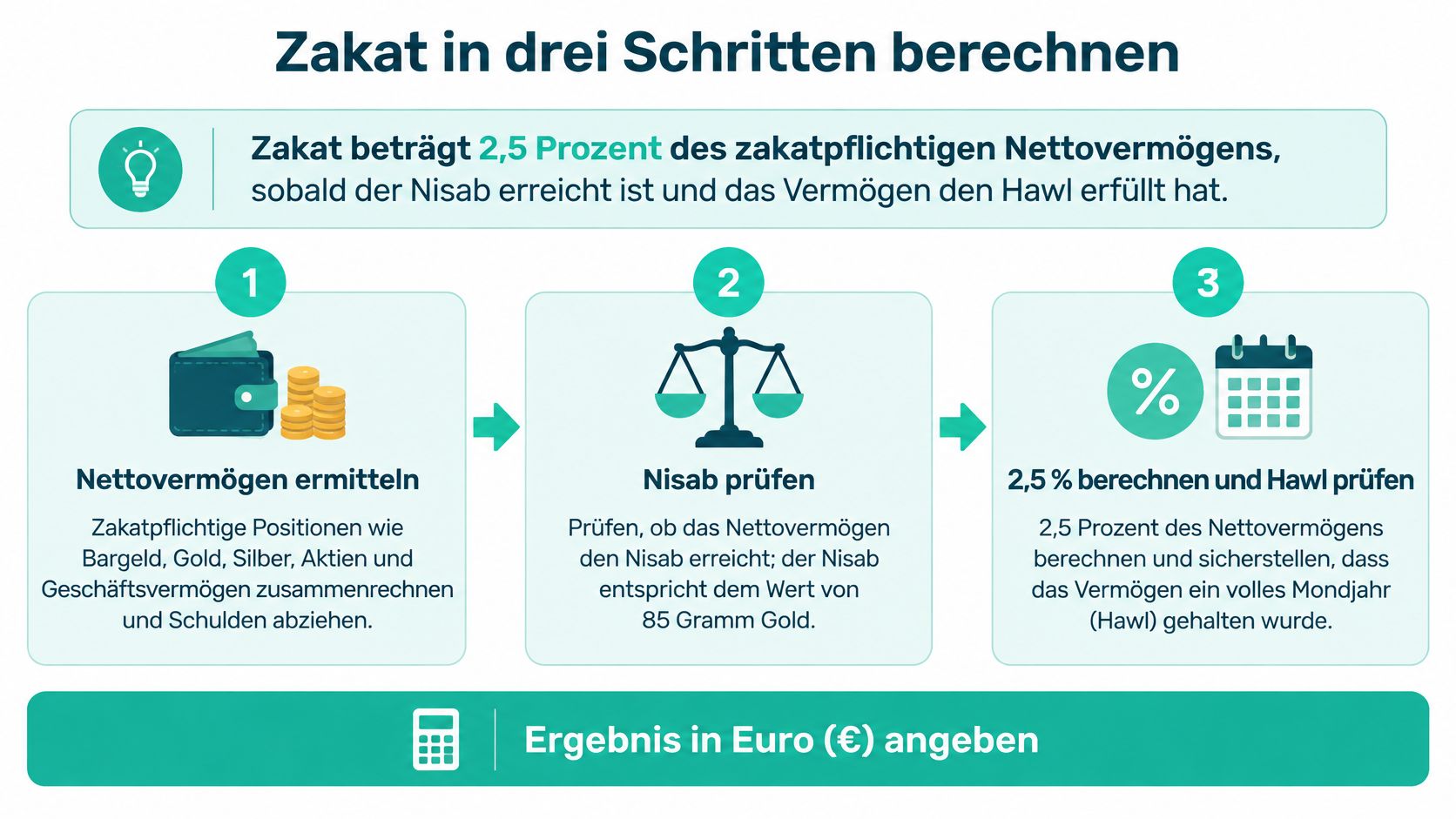
Zakat follows a calculation involving three decisions: a reference date, a threshold, and an assessment basis. Anyone who determines these three figures can complete the calculation with a calculator, a spreadsheet, or a Zakat calculator. The sequence always stays the same, whether you use 500 or 50,000 euros.
- Set a reference date and determine the Nisab in euros. Note the date on which you are calculating, and determine the threshold accordingly: 85 grams of fine gold or 595 grams of fine silver, multiplied by the metal price exactly on that day. The reference date prevents account balances from Monday and gold prices from Thursday from ending up in the same calculation.
- Add up Zakat-liable assets. Cash, checking account, fixed deposits, securities, gold and silver held as investments, and trade goods at sale value. Only assets that are saved, invested, or held for sale count here — not the car and not the sofa.
- Deduct outstanding debts and calculate 2.5 percent. Open invoices and installments currently due reduce the assessment basis. You pay 2.5 percent of the remaining net assets, provided the threshold is reached.
The Nisab therefore only decides whether an obligation arises at all. It is not an amount you deduct. How it arises in euros depends on the metal price and is shown with a concrete figure in the next section.
There is also a precondition that many calculators only mention in the fine print: the Hawl, the one-year holding period according to the Islamic lunar calendar. Only once the assets have remained above the threshold for this period does the obligation become due. How additions and sales within the year are treated depends on the legal opinion. A calculator should state this assumption openly rather than making it silently.
That demand for understandable calculation aids is high can be shown with figures. According to the Deutsche Islam Konferenz, around 5.5 million people of Muslim faith live in Germany, nearly 3 million of them with German citizenship, which corresponds to about 6.6 percent of the total population. A representative Bertelsmann study referenced there, covering 2,007 Muslims aged 18 and over living in Germany, found that about two-thirds attach high or very high importance to fasting during Ramadan as well as to Hijra, Zakat, dietary rules, and ritual purity. This does not prove equal payment amounts every year, but it does show a real need for comprehensible calculation methods.
Anyone planning to make their payment during Ramadan can find background information and project ideas on the topic of donating during Ramadan on our site.
Here is the process as a graphic, before we get to the numbers:
Gold, Silver, and the Reference Date
Nisab thresholds in euros by reference standard
| Standard | Reference Weight | Metal Price per Gram | Nisab in Euros |
|---|---|---|---|
| Gold | 85 grams of fine gold | 110.48 euros on 18.11.2026 | around 9,390 euros |
| Silver | 595 grams of fine silver | Daily price on the same reference date | depends on the silver price on the reference date |
The Nisab is the religious minimum threshold for zakat-liable wealth. It is set in grams of precious metal; only the respective metal price turns it into a euro amount. For 18 November 2026, the gold basis of 85 grams of fine gold and 110.48 euros per gram results in around 9,390 euros (zakat-deutschland.de on the Nisab). This amount is the threshold from which further calculation becomes relevant.
The Nisab is an entry threshold, not a tax-free allowance. It is not deducted from the wealth.
Why the euro amount shifts
The euro Nisab follows the metal price. If the gold price rises, so does the threshold. Households whose wealth was previously just above it can thus fall below it. If the price falls, the threshold falls accordingly.
A Nisab value from an older article is therefore not a reliable point of comparison. Check whether the calculator states the price per gram for the chosen reference date. Without this information, it remains unclear how the displayed euro amount came about.
The reference date acts like a single snapshot: what counts for the valuation is the metal price on that day, not an average of the prices over the whole year. This makes it possible to compare the threshold with the state of wealth on the same date.
Gold and silver result in different thresholds
The silver basis is 595 grams of fine silver, while the gold basis is 85 grams of fine gold. Since silver costs significantly less per gram than gold, the euro Nisab based on silver is typically much lower. However, the specific amount fluctuates with the silver price and must be determined for the same reference date.
This shows why calculators can arrive at different results despite the same inputs. With savings of 6,000 euros, a household may exceed the silver threshold while staying below the gold threshold. The total wealth is identical, but the chosen reference changes the result.
Which basis is authoritative depends on the school of thought and the practice of the community. For every calculator, check three pieces of information: the reference date, the metal price per gram, and the basis used. Only when these values are disclosed can you follow how the Nisab was derived and meaningfully compare calculators.
Which assets and debts count
Zakat-liable wealth and deductible debts
| Item | Zakat-liable | Note |
|---|---|---|
| Cash and checking account | yes | Balance on the reference date, including credit balance |
| Savings deposits and fixed-term deposits | yes | Including accrued interest |
| Gold and silver as investment | yes | Valued at market value on the reference date |
| Gold and silver jewelry | disputed | Exempt depending on the legal opinion, if worn |
| Securities and funds | yes | Portfolio value on the reference date |
| Trade goods | yes | At sale value, not purchase price |
| Self-used real estate | no | A home or house for personal use generally does not count |
| Rented real estate | yes, income | Rental income often counts, check interpretation |
| Due debts | deduction | Due liabilities reduce the wealth |
The clear cases are listed above in the table. Checking account, savings book, fixed-term deposit, gold bars, stocks and trade goods belong in the calculation, at the value they actually have on the reference date. For gold and silver, that is the market value, not the purchase price from ten years ago. For trade goods, the sale value counts, not the purchase price.
It becomes more difficult with jewelry. A worn necklace is exempted by some scholars, but not by others. If your calculator applies or omits an item here without explanation, no one tells you what assumption lies behind it. When in doubt, ask your community before silently disregarding a larger collection.
Practice also diverges for real estate. The self-used home generally remains excluded, because it is a consumable good and not wealth. For a rental property, many calculate using the rental income instead of the building value. Anyone who applies the full property value arrives at a result that no one can trace anymore.
Deducting debts correctly
Due liabilities are deducted: open invoices, the installment being debited this month, a credit card statement with a due date. Whether the entire remaining balance of a long-term loan may be deducted is disputed. Some calculators only deduct what is currently due, others count the installments for the coming year, and a minority deduct the full remaining balance.
Practical rule: Only deduct what is currently due, and note how the calculator handles long-term loans. This one assumption can shift the amount by several hundred euros.
A worked-through example shows how quickly this happens. Take 4,000 euros in the checking account, 2,000 euros in gold bars, and 1,500 euros in due debts. This results in net wealth of 4,500 euros. If the Nisab were below this, 112.50 euros of Zakat would be due. What matters is that all three figures come from the same day.
Before the calculation comes the Hawl. The wealth must have been in your possession for a full Islamic lunar year before it is calculated. How additions, sales and fluctuations within this year are to be treated depends on the legal opinion. The calculator should therefore state which counting method it relies on, so that you don't mix two systems together.
Example calculations step by step
A person owns 12,000 euros in wealth after deducting all due debts, broken down into 7,000 euros in a checking account, 3,000 euros in securities and 2,000 euros in gold bars. The gold Nisab on the same reference date is 9,390.57 euros, so the threshold is reached. The Zakat amounts to 2.5 percent of 12,000 euros, meaning 300 euros.
The calculation in three lines: wealth 12,000 euros, deductions 0 euros, net wealth 12,000 euros times 0.025 equals 300 euros. Anyone working with debts inserts the second line in between and continues the calculation afterwards. The Nisab amount must come from the same reference date as the account balances, otherwise you are comparing two different days.
Where the threshold lies
The most interesting cases lie right at the threshold. At 9,390 euros, the wealth is 57 cents below the Nisab of 9,390.57 euros, and no Zakat is due. At 9,500 euros, the threshold is exceeded, resulting in 237.50 euros. Between these two figures lies a difference of 110 euros in wealth and 237.50 euros in payment obligation.
This seems unfair, but it follows the logic of an entry threshold. Once it is reached, the entire net wealth is calculated, not just the portion above the threshold. This is exactly where many people confuse the threshold with a tax-law allowance. It's worth working through this point once with your own figures, because it makes the difference between 0 euros and a three-digit amount.
Zakat for various net wealth amounts (gold Nisab 9,390.57 euros)
| Net wealth | Nisab reached | Zakat (2.5 percent) |
|---|---|---|
| 8,000 euros | no | 0 euros |
| 9,390 euros | no | 0 euros |
| 12,000 euros | yes | 300 euros |
| 15,000 euros | yes | 375 euros |
| 20,000 euros | yes | 500 euros |
The case with 15,000 euros shows how deductions work. From 18,000 euros in wealth and 3,000 euros in debts results a net wealth of 15,000 euros and thus 375 euros in Zakat. Without the debt deduction it would be 450 euros. The difference of 75 euros is the reason why the treatment of liabilities must be openly documented in every calculator.
A shifted metal price changes the Nisab, not the calculation method. If gold rises and the threshold climbs above 12,000 euros, the same household slips out of the obligation without anything having changed in its wealth. It is therefore worth applying your own example with today's prices instead of using an old figure.
Different interpretations and why calculators differ
The most common user question is not "How much is my amount?" but "Why does the other calculator calculate something different?". Three adjustment points explain almost every discrepancy.
First, the Nisab basis. Gold at 85 grams and silver at 595 grams result in very different euro thresholds. The same amount of wealth triggers an obligation in one calculator and not in another. A current German calculator cites 85 grams of gold as the basis and emphasizes that the Nisab is not a deductible allowance but merely the entry threshold (zakat-deutschland.de on the calculator). Others additionally compare 595 grams of silver, without explaining the practical consequences of this choice for households with euro balances, gold jewelry or securities. With fluctuating precious metal prices, this very choice decides whether any Zakat is due at all.
Second, debts. If a calculator deducts the full remaining debt of a mortgage loan, the assessment basis drops sharply. If another only counts the currently due installment, significantly more remains. Both approaches can be justified, but only one of the two figures matches your legal opinion.
Third, the reference date. One calculator uses live prices, another a fixed daily value. If there is a price jump in between, the results differ from each other without there being an error. Therefore check which date appears in the result.
A reputable calculator shows the calculation method, not just the final amount.
In addition, there are differences between the schools of law and local practice, for example with worn jewelry or long-term loans. A helpful comparison view shows the gold Nisab in euros, the silver Nisab in euros on the same reference date, the difference between the two, and the underlying legal opinion side by side. If the silver value is missing, check the current price yourself instead of using a figure from the previous year.
Anyone who wants to read the full details of the Zakat calculation basics can find a detailed introduction to Zakat on our site. For complex cases, meaning mixed assets of real estate, crypto and company shares, ask your community or a trustworthy scholar. A calculator provides a number, not legal advice.
Checking the result and paying Zakat on time
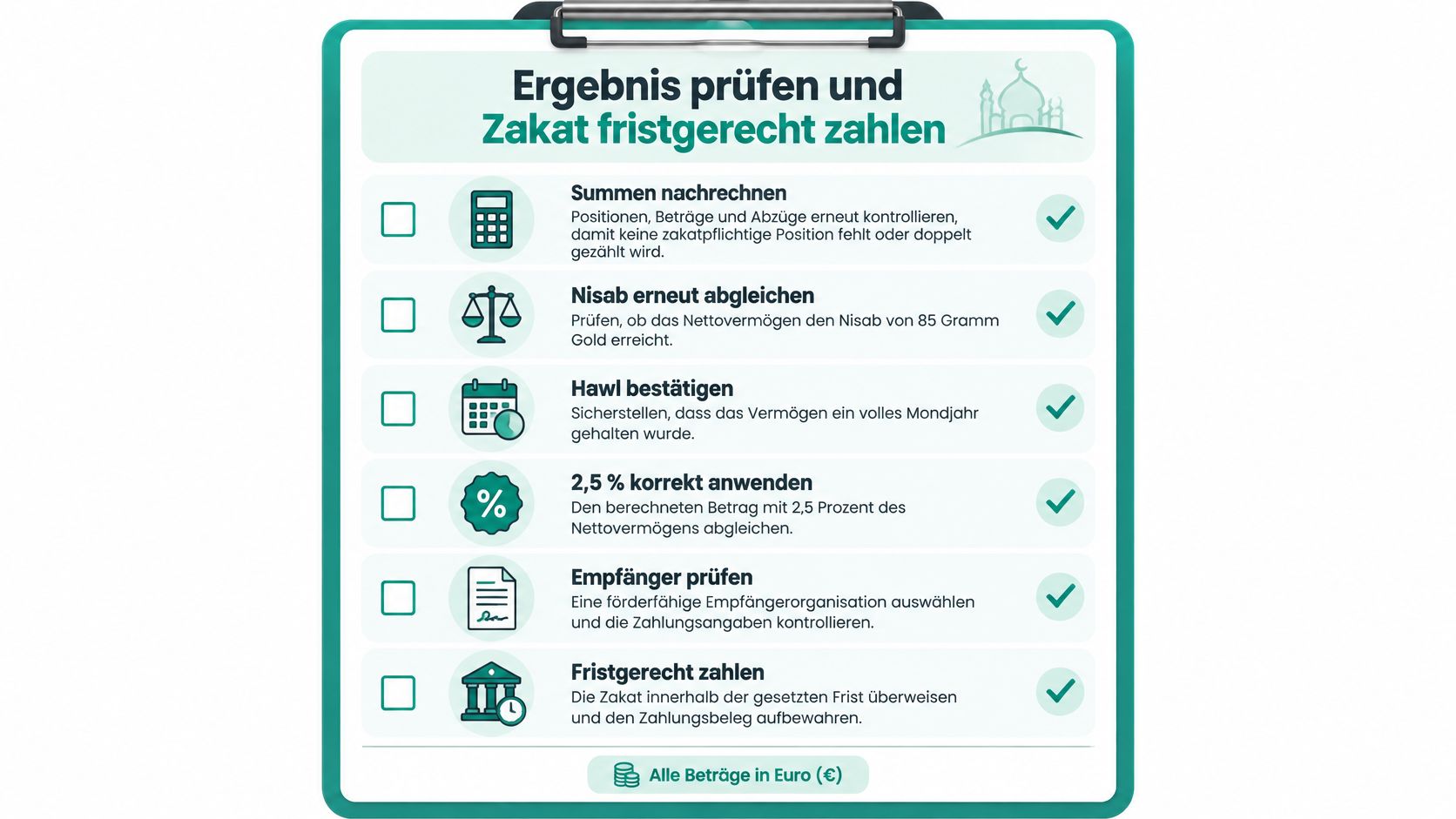
How can you check whether a Zakat calculator produces a traceable amount? Go through the calculation step by step before making the payment. These four points help with that:
- Recalculate the totals. Compare the recorded items, debts, and net worth with the result. A discrepancy may mean that something is missing or was entered twice.
- Record your assumptions. Note the reference date, the metal price per gram, and the Nisab basis. This way you can retrace the calculation later using the same assumptions.
- Clarify open questions. Discuss jewelry, long-term loans, or rented properties with your community or a scholar before making the payment.
- Secure the payment and the receipt. Carry out the transfer with a suitable reference and keep the confirmation.
Use this order as a checklist:
When donating through a platform, check before confirming what costs apply, how the money reaches the organisation, and whether you receive a receipt. SadakaNow charges a 0% platform fee for its projects and no setup or base fee. Donations are held in trust and paid out directly to the respective organisation. Only the costs of the payment service provider, shown in the donation form, are passed on.
Which recipients are eligible for Zakat and how the distribution takes place should be clarified with your community. Different rules apply to another type of donation: the overview on Zakat al-Fitr explains this obligatory donation given at the end of Ramadan.
You can find the formula and a short video on the calculation here:
Once all four checkpoints are ticked off, pay the amount whose calculation you can retrace yourself, rather than relying solely on an unexplained calculator figure. On the project overview of SadakaNow, you can see before payment which project is being supported and how the money arrives.