
When is Zakat due? Due date and Nisab explained
Zakat al-Mal becomes due as soon as your zakat-liable net worth reaches the Nisab and stays above it for a full Islamic lunar year of about 354 days, not automatically during Ramadan. Zakat al-Fitr, on the other hand, falls due at the end of Ramadan and must reach the designated recipient at the latest before the Eid prayer.
So why do so many Muslims in Germany still transfer their entire due reflexively in the final nights of the fasting month every year? This is exactly where confusion arises as soon as people search for “when is Zakat due” and mix up answers from two different obligations. In everyday life, the annual wealth levy and the time-bound Fitr donation often end up lumped together, even though each follows its own rules. Anyone who determines their individual wealth due date clearly and separates it from the Ramadan deadline fulfils both obligations without haste and without doubt about the correct date.
Table of Contents
- When Zakat becomes due and which date applies
- Nisab and Hawl as the pacesetters of the Zakat due date
- Example calculation from wealth to the Zakat due
- Ramadan is not automatically the payment date
- Paying Zakat al-Fitr in time before the Eid prayer
- Setting your own Zakat due date and paying on time
When Zakat becomes due and which date applies
For the question of the right time, the first thing that matters is distinguishing between two separate religious obligations. Zakat al-Mal depends on your personal wealth trajectory, while Zakat al-Fitr is firmly tied to the end of the fasting month. The following overview compares both obligations with Ramadan as a voluntary month of payment.
| Type of Zakat | Trigger for the due date | Due date | Payment deadline |
|---|---|---|---|
| Zakat al-Mal (wealth Zakat) | Net worth reaches the Nisab and stays above it for one lunar year | Annually on the personal due date (approx. 354 days) | On the due date; advance payment permitted according to some legal opinions |
| Zakat al-Fitr | End of Ramadan | At the end of Ramadan | Before the Eid prayer, to the designated recipient |
| Ramadan as the month of payment | Personal choice, not a due date | Possible during Ramadan | Early payment is permitted, but should be reviewed again on the actual anniversary date |
For concrete scheduling in Germany, the calendar is decisive: the guide to the Zakat calculator on SadakaNow points out that the relevant cycle according to the Islamic lunar calendar spans about 354 days and is therefore shorter than the 365-day solar year. While some legal opinions do allow a voluntary advance payment before your own due date, it does not replace the proper annual review on the actual date.
Why neither Ramadan nor New Year's Eve triggers the obligation
Many households base their finances on the Gregorian calendar, for example on 31 December or on the tax return in spring. However, a fixed calendar day such as the turn of the year does not trigger wealth Zakat in Germany, because Islamic law does not recognise a single uniform tax date for all believers. What matters alone is your personal account balance in relation to the minimum threshold.
Two common misconceptions almost always lead to incorrect payment dates: the assumption that Ramadan is automatically the mandatory deadline for one's entire wealth, and the conflation of the Fitr deadline with one's own personal wealth anniversary.
Before every transfer, briefly check which obligation currently applies to you. If the Festival of Breaking the Fast is imminent, you need to act now for the Fitr payment. If it concerns your savings, your need to act depends solely on your individual anniversary date in the lunar calendar.
Nisab and Hawl as the pace-setters for the Zakat due date
Think of the Hawl like a tree's annual ring: a new ring only grows fully as long as the conditions hold true throughout the entire cycle. In Islamic law, the Nisab represents this basic condition — the lower wealth threshold from which a person becomes liable for Zakat at all. Only once wealth reaches this threshold and sustains it for a full lunar cycle does the yearly obligation arise.
The graphic below shows both pace-setters and the variable valuation in euros at a glance.
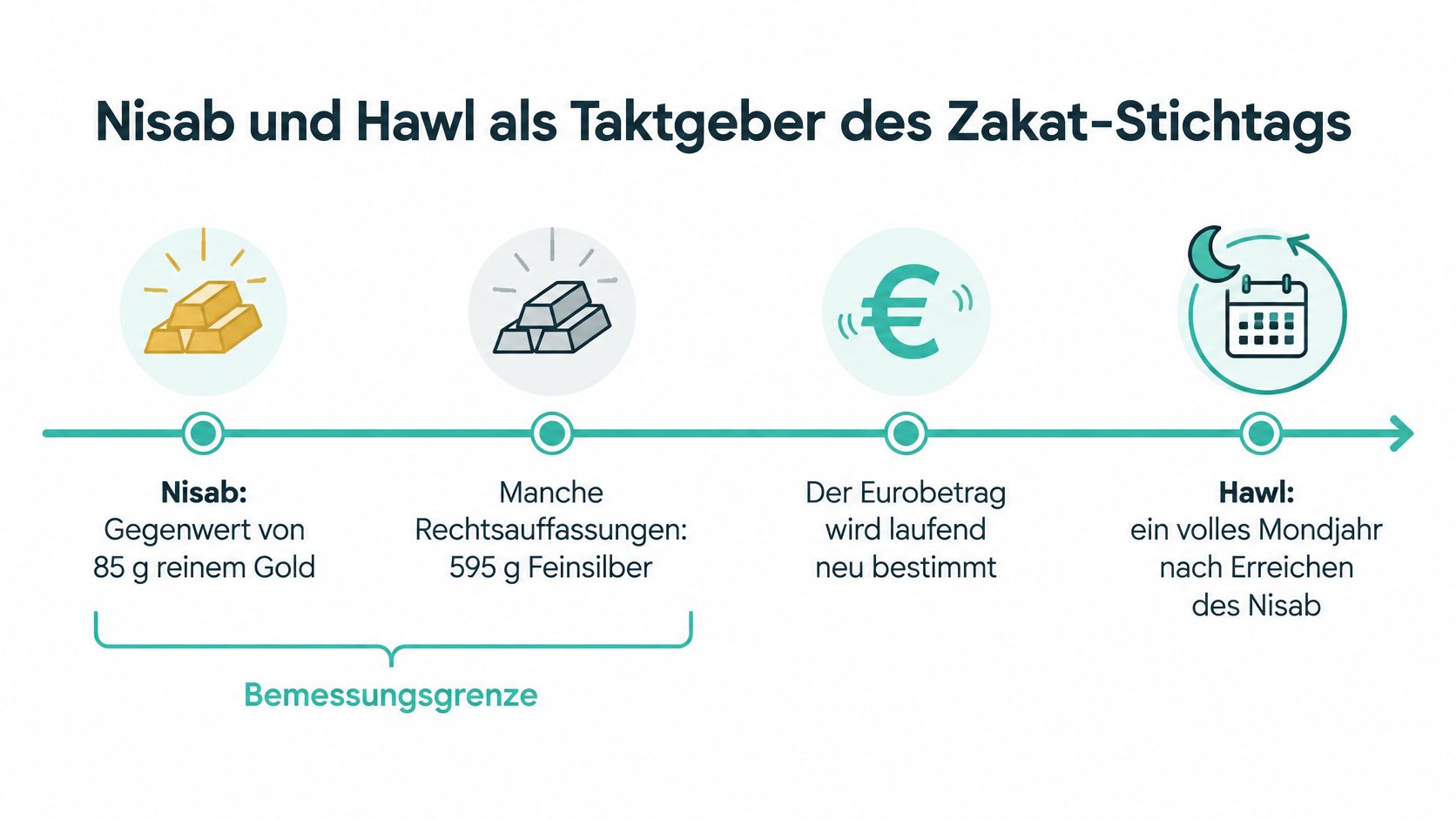
As the introduction to Zakat in the Islamische Zeitung explains, a common assessment threshold is the equivalent value of 85 grams of pure gold, while some legal views alternatively use the equivalent value of 595 grams of silver. Because gold and silver prices fluctuate daily on the market, there is no fixed euro amount for the whole year — only a threshold value current on the respective due date. The same publication also refers to a German study on donation behavior, in which 90 percent of respondents perceive Zakat as a religious obligation, and notes that the lunar year is about 11 days shorter than the solar year.
Four stages to the first due date
In everyday terms, the timeline is best understood as a clear sequence that requires no complicated calculations:
- First crossing the threshold: On the day your savings and other Zakat-liable assets first reach the euro equivalent of the Nisab, your personal clock starts. Note down the corresponding date in the Islamic lunar calendar immediately on that day.
- Passing through the lunar year: Now the Hawl begins to run. Since the lunar calendar moves forward by about eleven days each year relative to the Gregorian calendar, your future due date will fall slightly earlier each year in the German calendar.
- Checking on the anniversary: As soon as exactly one Islamic lunar year has passed, you look again on this date at your entire Zakat-liable net wealth. If your holdings are still at least at the level of the then-current Nisab, the obligation is confirmed.
- Determining the payment: Only at this fourth stage does the actual calculation follow, based on the documented daily values. Before the first lunar year has elapsed, however, there is as yet no payment obligation on the newly saved wealth.
When wealth falls below the Nisab in between
In practice, account balances rarely move in a straight line. A sudden car purchase, a deposit for a new apartment, or a larger medical bill can push your balance below the gold or silver threshold in the middle of the year. How this drop is assessed depends on the Islamic legal position followed: according to the Hanafi view, what matters above all is the beginning and end of the lunar year, as long as the wealth does not drop completely to zero, while other schools of law require that the Nisab be maintained without interruption, with a new cycle starting if it is not met.
Precisely because of these differences, it is worth making a brief written note of your personal method. Record your chosen reference metal, the documented rate on the due date, the Islamic date, and your approach to debts, so that you decide consistently the following year. Neither the start of Ramadan nor the turn of the (Gregorian) year automatically sets this personal rhythm in motion.
Example calculation from wealth to the Zakat due
Once your personal anniversary date arrives, a clear formula applies: Zakat-liable wealth minus permissible short-term debts gives the assessment base, of which 2.5 percent is paid as Zakat. The prerequisite is always that the Nisab check comes out positive first and that the lunar year has fully elapsed.
The following diagram summarizes the calculation path from total wealth to the amount due.
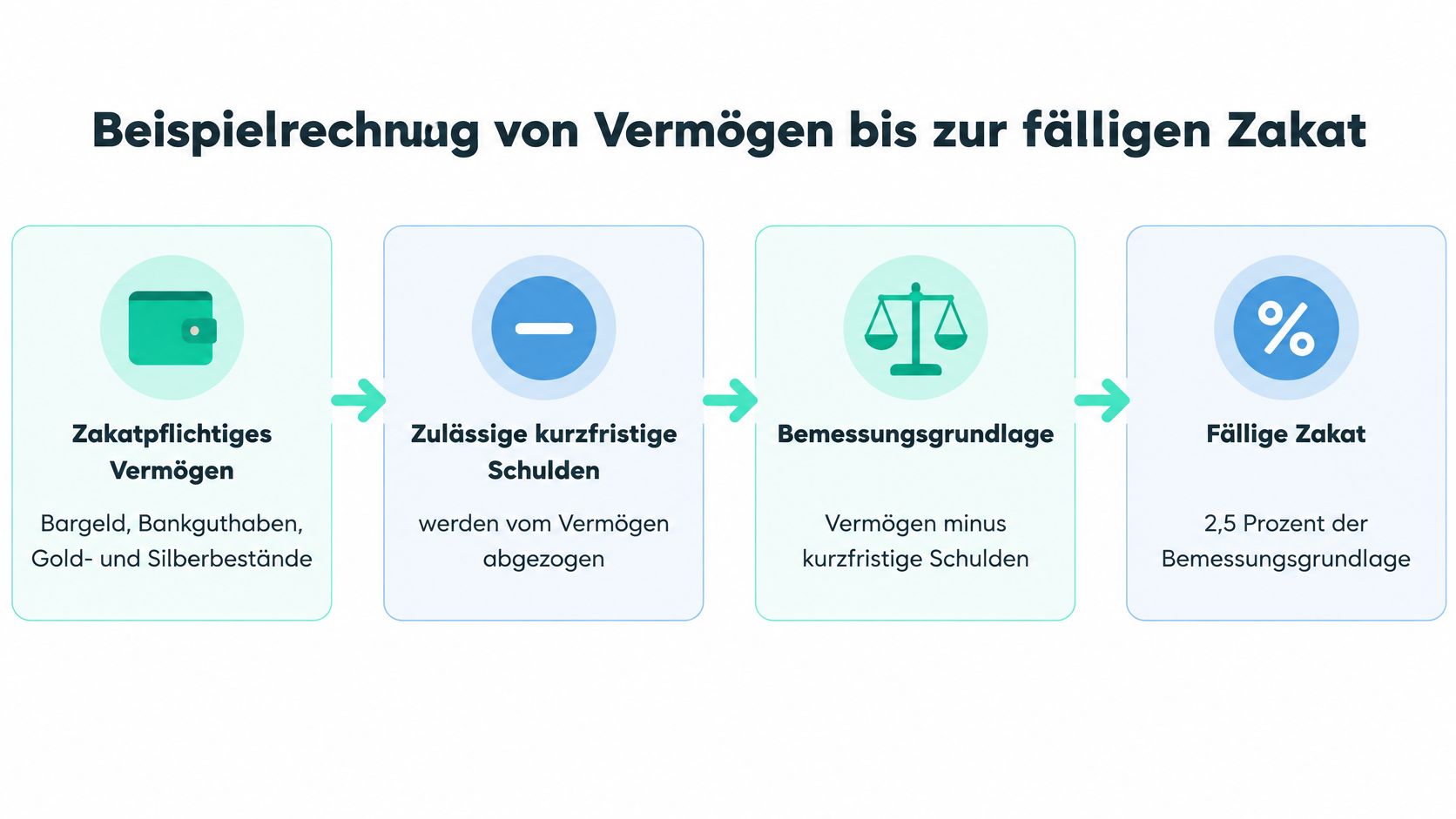
According to the practical guide to Zakat on SadakaNow, Zakat-liable assets include in particular cash, bank balances, gold, silver, and trade goods, each valued at the euro rate on the personal due date. Personal items for everyday use, such as the home you live in, your everyday car, or household furniture, are excluded, since they do not represent freely available growth in wealth.
Calculation example with deductible debts
Let's take a typical household scenario on the due date, which the guide mentioned above also addresses. An employee adds up all relevant items on the anniversary date from her checking and savings accounts, cash at home, and gold coins in a safe deposit box. This results in total Zakat-liable wealth of €12,000.
At the same time, she has short-term liabilities of €2,000 that are deductible according to her legal view, such as an outstanding craftsman's invoice and a remaining private loan amount that will be repaid this month. If she deducts this €2,000, a calculation base of €10,000 remains. Since this amount exceeds the Nisab on the reference date and the Hawl has been fulfilled, she multiplies €10,000 by 2.5 percent and arrives at a Zakat due of €250.
Mind the order of checking: Always compare your net assets first with the current day's Nisab value. If the calculation base after deducting debts falls below this threshold, no asset Zakat is due.
Reference table for typical assets
The following overview shows which amounts arise for various hypothetical net assets at the rate of 2.5 percent. All rows apply explicitly only under the condition that both the current day's Nisab has been reached and the full Hawl has elapsed.
| Zakat-liable net assets | Zakat (2.5 %) | Note |
|---|---|---|
| €5,000 | €125 | Only if Nisab and Hawl are fulfilled |
| €10,000 | €250 | Example: €12,000 assets minus €2,000 debts |
| €20,000 | €500 | Only if Nisab and Hawl are fulfilled |
| €50,000 | €1,250 | Only if Nisab and Hawl are fulfilled |
Anyone who holds several accounts, foreign currencies, or precious metal holdings should note each individual value separately on the reference date, rather than estimating roughly. Especially with liabilities, care pays off: which debts exactly may be deducted, for example ongoing monthly instalments versus long-term property loans, depends on the respective school of law. For a quick and error-free cross-check of your own figures, an online Zakat calculator can help, which directly incorporates current precious metal prices into the calculation.
Ramadan is not automatically the payment date
One of the most persistent misconceptions in German-speaking countries is that the annual asset Zakat must necessarily be paid during Ramadan. In fact, for many people the fasting month emotionally coincides with a willingness to give and a sense of community, so they place their entire annual payment there. Religiously speaking, however, it is solely the individual reaching of the asset threshold that determines the start of your deadline, not the beginning of fasting.
The following illustration shows how the personal reference date moves along the lunar calendar and detaches itself from the familiar annual grid.

As the HalalTimes guide on the Zakat due date points out, a blanket commitment to Ramadan creates a practical problem: anyone who pays without regard to their actual reference date risks unknowingly shifting their personal Hawl or making payments too late. If your true anniversary already falls in the month of Sha'ban, waiting until Ramadan would be an impermissible delay.
Conversely, there is a permissible bridge for anyone who wants to deliberately make use of the special blessing of the fasting month. If your regular Zakat anniversary falls after Ramadan, for example in the month of Shawwal or Dhu al-Hijjah, you may bring forward the anticipated sum during Ramadan. On the actual anniversary, you then check your balance again: if your assets have continued to rise by then, you pay the difference afterward; if they have shrunk, the surplus counts as voluntary Sadaka or can be offset depending on the legal opinion. Further suggestions for deliberately planning voluntary gifts during the fasting month can be found in the article on giving during Ramadan.
What belongs in the record for the personal Zakat anniversary
So that the question "Zekat ne zaman verilir" never causes guesswork in your own household again, a simple annual note in a table or a folder is enough. Record five specific points there:
- Personal reference date in the lunar and solar calendar: Note the exact Islamic date, for example the 15th of Muharram, together with the corresponding Gregorian date of the current year, so that the annual eleven-day shift does not escape you.
- Chosen Nisab reference: Note clearly whether you use gold or silver as the standard, and stick to this choice for consistency.
- Current metal price for the day: Save a screenshot or a short note of the gold or silver price in euros from the reference date.
- Assessment of liabilities: List short-term debts individually with due dates, so that next year you know exactly which items you deducted according to your school of law.
- Account history of the past twelve months: Archive the monthly balances of checking, savings, and investment accounts as a brief overview.
Deriving the reference date retroactively from account statements
Many working people face a very real question: what to do if you have had money in your account for years but never noted the day on which the Nisab was first exceeded? In this case, proceed pragmatically. Download the account, savings, and investment histories of the past twelve to eighteen months as a PDF from online banking and look for the month in which your total net assets stayed stably above the threshold.
If the exact day can no longer be reliably reconstructed, choose a plausible, tendentially somewhat earlier date in the lunar calendar as your fixed Zakat anniversary and recalculate cleanly from that point every year. This way you make sure you don't fall behind on your obligation and rely on dependable figures rather than mere gut feeling going forward.
Paying Zakat al-Fitr on time before the Eid prayer
While Zakat on wealth follows your personal annual rhythm, a strict, communal deadline applies to Zakat al-Fitr: it must be given at the end of Ramadan and reach the intended recipient at the latest before the Eid prayer. Its purpose is immediately social and practical. Families in need should have enough means on the morning of the festival marking the end of fasting, Eid al-Fitr, to celebrate the holiday with dignity and without worry.
Depending on the religious view, handing it over on the day of the festival itself may still be possible under certain circumstances, but a payment made after the festival no longer counts as a timely Fitr donation, only as a general voluntary donation. Precisely because this date applies to millions of people simultaneously, it strongly shapes everyday religious life in Germany. In the study "Muslimisches Leben in Deutschland 2020", cited by the guide to Zakat al-Fitr on SadakaNow, 56 percent of Muslim women and men stated that they fully observe the fasting rules, while a further 20 percent observed them partially; overall, 66 percent celebrated religious holidays such as the festival marking the end of fasting.
Reference amounts per household and checking for the current year
Unlike the percentage-based wealth levy, Zakat al-Fitr is calculated as a fixed minimum amount per person. Every economically capable household pays it not only for the adults but for all household members, including children and newborns born before the festival. For Ramadan 2025, DITIB in Germany stated a minimum amount of 15 euros per person. For a family of four, this results in a minimum amount of 60 euros.
| People in household | Minimum amount (DITIB, Ramadan 2025) | Deadline |
|---|---|---|
| 1 person | €15 | Before the Eid prayer |
| 2 people | €30 (calculated) | Before the Eid prayer |
| 4 people | €60 | Before the Eid prayer |
| 5 people | €75 (calculated) | Before the Eid prayer |
The values for two and five people are directly extrapolated from the stated rate of 15 euros per head and do not represent separately published table figures. Since the cost of living and the corresponding recommendations from associations and mosque communities can change every year, you should briefly check the current minimum amount for 2026 with your community or chosen organisation before transferring it. Detailed background on the recipients and practical implementation is also provided by the guide to Zakat al-Fitr in Germany.
Clear distinction between the Fitr donation and wealth Zakat
In everyday life, two costly mix-ups occur. Some people believe that with the 60 euros for the family at the end of Ramadan, their entire Zakat obligation for the year is settled, even though they hold substantial savings in their account. Others skip the Fitr donation because their wealth is below the Nisab, even though on the day of the festival they actually possess more than they need for their own basic needs that day.
Rule of thumb for families: Always plan Zakat al-Fitr as a separate, per-person obligation due at the end of Ramadan, independent of your personal wealth reference date.
Both levies exist side by side and do not replace one another. Anyone who consistently separates them in the calendar and in the household budget keeps both deadlines firmly under control.
Setting your own Zakat due date and paying on time
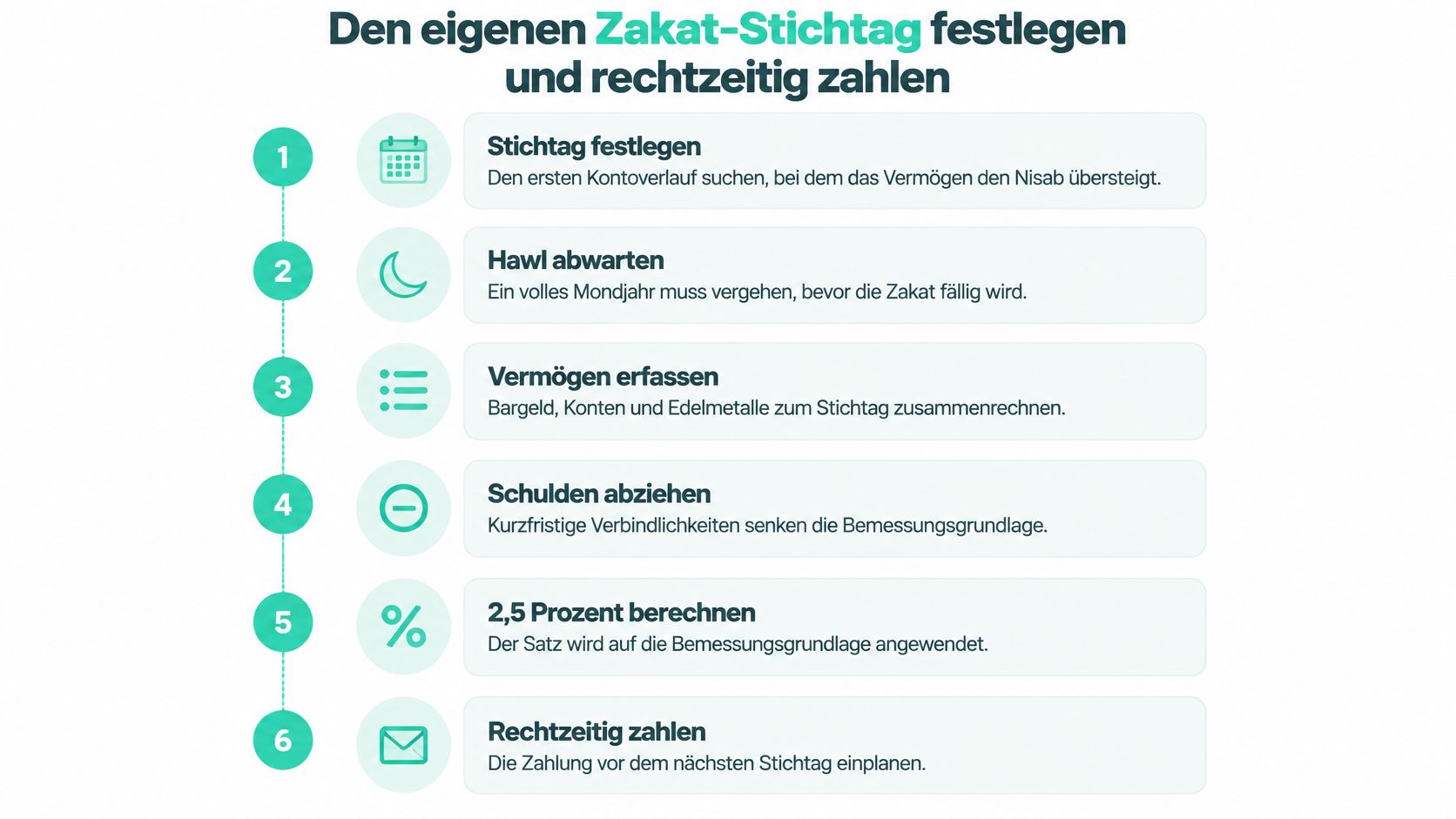
Anyone who has understood the rules mainly needs a simple process that can be repeated year after year. The following graphic summarises the entire process in six clear stages.
Six steps from taking stock to making the payment
- Set a reference date: Look through your account statements for the first point in time your zakatable wealth reached the Nisab, and note the corresponding Islamic date firmly in your calendar. This way, your annual review date is clearly fixed.
- Record your zakatable wealth in euros: On your personal anniversary date, gather an up-to-date overview of cash, current and savings accounts, gold, silver, and business trade goods. Only a complete overview prevents forgotten accounts from distorting the result.
- Deduct eligible short-term debts: Then deduct the short-term liabilities due that are deductible according to the legal opinion you follow. This way you determine your actual net wealth instead of an inflated gross sum.
- Calculate the amount due based on the current rate: Check with the current metal price on the reference date whether the threshold has been reached, and if the result is positive, apply the 2.5 percent formula. If you want to get this done quickly: Our Zakat calculator gives you a result after three short questions, uses up-to-date gold and silver prices in any currency you choose, and follows the standards of Diyanet, while all your entries stay exclusively in your browser.
- Plan Zakat al-Fitr separately: Set yourself a separate reminder for the last week of Ramadan, calculate the per-person amount for everyone in your household, and keep the money set aside separately from your wealth zakat.
- Schedule payment with enough lead time: Plan transfers early enough that the money actually arrives with the recipient before the respective deadline, rather than being credited only after the Eid prayer or after the reference date has passed.
If you would like to see the individual steps once more, clearly presented in context, the following video summarizes the key points on the timing of Zakat in a compact way.
Digital transfer, value date, and a clear purpose of payment
In Germany, donations and everyday payments are noticeably shifting toward digital channels. According to the guide on Ramadan donations by Dayaatech, the share of cash in all payments dropped from 58 percent in 2021 to 51 percent in 2023, while mobile payments reached 6 percent of transactions. With the shift to online banking and smartphone wallets, a very concrete practical question arises: does the moment you click “transfer” count, or the moment the amount actually arrives with the recipient?
Especially on weekends, holidays, or the night before the Eid prayer, the debit date and the credit date of a standard SEPA transfer can differ by one to two bank business days. Anyone who sends their Zakat al-Fitr only late on the eve of the festival via a standard transfer risks that the aid organization will no longer be able to distribute the money to those in need in time before the prayer.
So when making digital payments, pay attention to two simple safety nets:
- Check receipt of payment: Transfer several days before the deadline or use payment methods with instant confirmation, and then check the organization's confirmation of receipt. On our platform, donation amounts are also paid out in trust directly to the respective verified organization, and fraud protection as well as mandate verification usually run automatically within seconds.
- Keep the purpose of payment clearly separate: For every transfer, clearly state in the purpose of payment field whether it concerns “Zakat al-Mal” or “Zakat al-Fitr”, ideally as two separate transactions. Organizations are obliged to use earmarked donations exclusively for the stated purpose, and your own records stay clear and organized.
On the day of your payment, note the next date directly in the Islamic calendar, roughly eleven days earlier in the coming solar year. With this clear annual rhythm, you'll be able to answer the question “Zekat ne zaman verilir” in a few seconds in the future, combining religious diligence with stress-free financial planning.
Once you have determined your personal amount and want to reliably forward your Zakat or your Fitr payment, you can find verified mosque communities, water and aid projects across the DACH region on SadakaNow. Your donation goes directly to the respective organization in trust and without a platform fee, secured via SEPA, PayPal, or credit card, including an automatic confirmation for your records. Use our transparent project pages to send your payment on its way on time, for the intended purpose, and in a traceable manner.