
Zakat Calculator: How to Calculate Your Zakat Correctly
2.5 percent of the Zakat-liable net assets become due as soon as these assets reach the Nisab of 85 grams of gold or 595 grams of silver and a full Islamic lunar year, the Hawl of around 354 days, has been held above this threshold. If the net assets stay below this, no Zakat is due for that year.
So why do two Zakat calculators give different amounts for the same person? Not because of the formula. That consists of a fraction line and a percentage sign. The differences arise one level deeper, in the inputs: which debts count, which metal determines the Nisab, and when the Hawl begins.
That is exactly where the mistakes happen. No calculator can make the decision for you as to whether an installment loan with a 300 euro monthly payment reduces the base, whether an ETF savings plan counts in full, or whether your personal reference date falls in March or in Ramadan. But it can show you what each of these decisions does to the result.
Table of Contents
- Calculating Zakat in five steps
- Correctly recording assets, debts and special cases
- Converting Nisab into euros using gold or silver
- Determining the Hawl and reference date
- Separating Sadaqa and Zakat and checking recipients
Calculating Zakat in five steps
Zakat is an obligatory due on Zakat-liable net assets, not on income. Someone who spends their entire salary each month has nothing on the reference date for the due to apply to. Someone holding 12,000 euros in cash and bank balances and deducting 2,000 euros in short-term due debts continues the calculation with 10,000 euros and, if the conditions are met, arrives at 250 euros of Zakat.
A reliable Zakat calculator for Germany is therefore a multi-step verification process, not a single field with a euro amount. This is exactly how the Zakat calculator from Mina Juwelier describes its structure: first record the Zakat-liable values as of the valuation date, then deduct only permissible short-term liabilities, then compare the net assets with the Nisab, then calculate 2.5 percent, and finally document whether a lunar year was held above the threshold. If a step is missing, the figure cannot be verified.
The calculation process in five steps
The table walks through the five steps with example values. The Nisab column deliberately contains a formula, because the price per gram is only known on the valuation day.
| Step | Entry | Example | Note |
|---|---|---|---|
| 1. Zakat-liable assets | Cash, bank balances, gold, silver, trade goods | €12,000 | Determine reference date |
| 2. Deduction of due debts | Short-term liabilities | − €2,000 | Only according to the chosen rule |
| 3. Net assets | Assets minus debts | €10,000 | Basis of the calculation |
| 4. Checking Nisab | 85 g gold or 595 g silver × current price per gram | Euro threshold on the reference date | No comparison possible without the current price |
| 5. Calculating Zakat | 2.5% of net assets, if Nisab and Hawl are fulfilled | €250 | Only due if the threshold is exceeded |
The order is not arbitrary. Someone who calculates the percentage first and deducts debts afterward arrives at a different amount than someone who forms the base first. 2.5 percent is one fortieth, and a fortieth of too much is too much.
What the calculator needs to record
A result without a valuation date is not a calculation, but a claim. Besides the amount, the calculator should always record the valuation date, the price source for gold or silver, the weight used, the exchange rate, and the deduction logic. Without this information, the figure can neither be verified professionally nor properly substantiated to an organisation.
Practical rule: Before making your first entry, note down three things. The reference date, the price source for the metal, and the rule by which you deduct debts. These three details shift the result far more than any decimal place.
The following overview shows the process once again as an image, from assets to the percentage value.
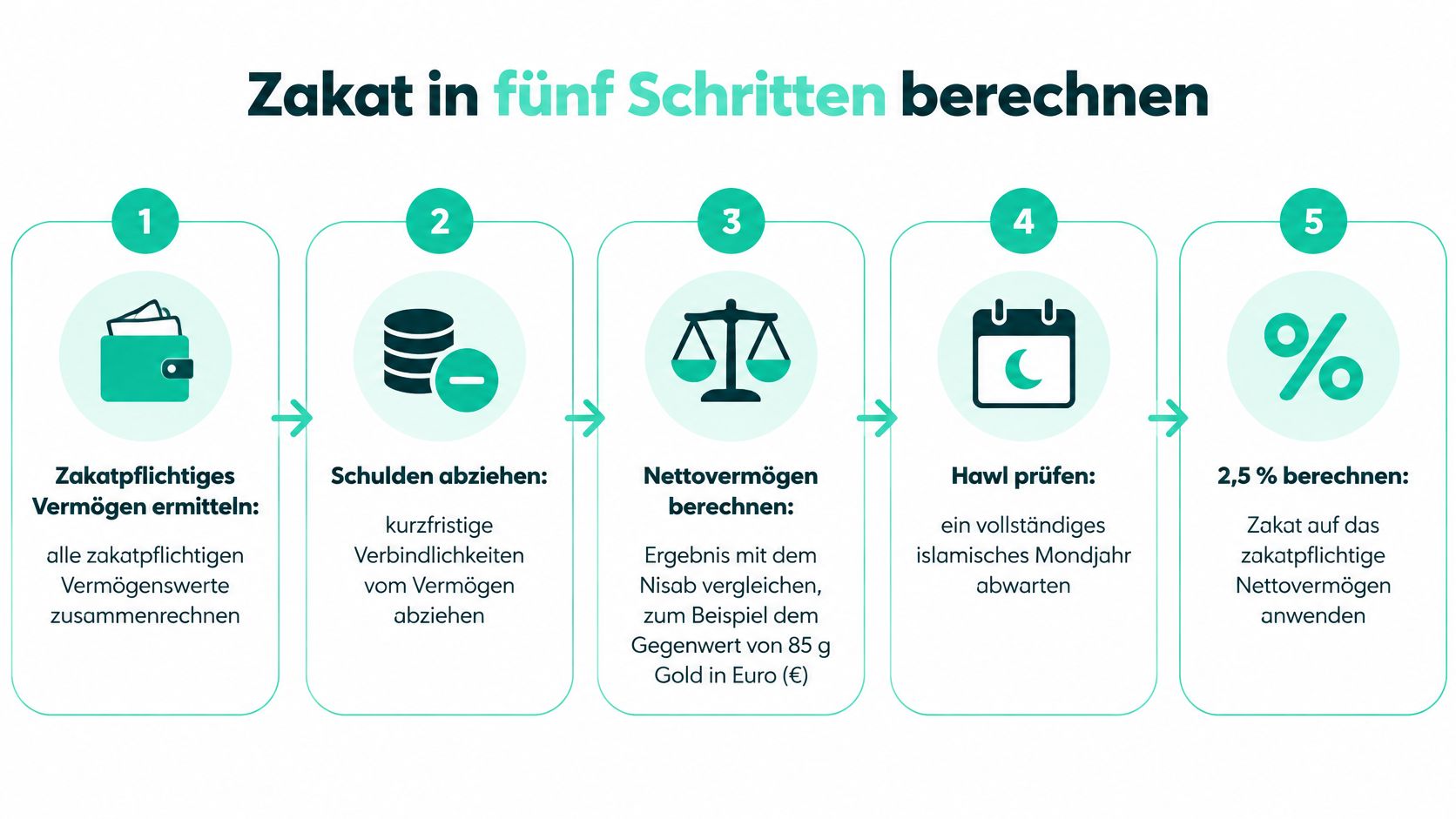
To get started, five figures are enough: cash, account balances, gold or silver value, short-term debts, and the metal price per gram on the reference date. This gives you the first check, namely whether the Nisab is reached at all. Everything else depends on the entries.
Correctly recording assets, debts, and special cases
Which assets count, and which debts may you deduct? The answer often depends less on the calculation formula than on how individual items are classified.
Zakat-liable assets include cash, bank balances, gold and silver, trade goods, and claims that can be realised in the short term. Your own home, car, clothing, furniture, and tools needed for work generally do not count as zakat-liable assets.
Debts by due date, not by loan amount
With debts, what matters is when they become due. If the monthly instalment of an instalment loan is 300 euros and is due now, according to some views this instalment can reduce the calculation basis. A home loan spread over 20 years, on the other hand, is not automatically deducted in full.
A loan of 300,000 euros is therefore not the same as a deduction of 300,000 euros. Depending on the view applied, only the instalment due immediately counts, or the next twelve monthly instalments count, or the entire remaining balance counts. The calculator should clearly show this choice, as it changes the result.
Where German practice becomes unclear
For ETF savings plans, company pension schemes, BAföG loans, instalment purchases, rental deposits, and jointly held accounts, general categories are often not enough. With shares and funds, for example, the question arises whether the full market value counts or only the zakat-liable portion. With pension provisions, it depends on whether the balance is already available. Information from Zakat Deutschland zur Nisab-Praxis makes clear that such individual cases cannot always be answered by a general calculator formula.
| Case | Record in the calculator as | Clarify in advance |
|---|---|---|
| ETF savings plan | Market value or invested portion, depending on the view | Align the method with a qualified religious opinion |
| Company pension scheme | Accessible balance, if available | Check payout rules and lock-up periods |
| Study or BAföG loan | Due instalments as a possible debt | Clarify deductibility according to the chosen rule |
| Instalment purchase | Due instalment or remaining debt, depending on the rule | Record the decision for the calculation |
| Rental deposit | Claim against the landlord | Check the timing and conditions of repayment |
| Joint account | Share according to actual allocation | Clarify ownership relationships |
| Business assets | Trade goods and claims, business debts separate | Match the balance sheet date with personal assets |
Keep a record for each item of the amount, currency, valuation date, and price source. In borderline cases such as pension provisions or joint accounts, a qualified religious opinion can help determine the appropriate rule. This keeps it traceable which classification underlies the calculated amount.
Converting the Nisab into euros using gold or silver
85 grams of gold or 595 grams of silver are weights, not sums of money. Only the price per gram on the valuation date turns this into a euro threshold that you can compare with your net assets. Barakah names exactly these two reference values for a Germany-based calculator and explicitly points out that the Nisab is not a permanently fixed euro amount, but must be converted into euros based on current gold or silver prices.
Where the weights come from
Behind this lies a historical ratio of 20 gold dinars to 200 silver dirhams, that is 1 to 10. The Zakat calculator from FreeToolForge works this out: one dinar at around 4.25 grams gives 20 dinars and thus about 85 grams of gold, one dirham at around 2.975 grams gives 200 dirhams and thus about 595 grams of silver. This derivation explains why German calculators almost always work with these two figures.
The euro threshold is then produced in a single step, namely weight times price per gram on the reference date.
| Standard | Weight | Threshold in euros |
|---|---|---|
| Gold standard | 85 g | 85 × gold price per gram on the reference date |
| Silver standard | 595 g | 595 × silver price per gram on the reference date |
| Alternative opinion, gold | 87.48 g | 87.48 × gold price per gram on the reference date |
| Alternative opinion, silver | 612.36 g | 612.36 × silver price per gram on the reference date |
Why the choice of metal tips the result
At the time of the Prophet, both thresholds were economically almost equivalent. Over the centuries, the market prices of the two metals have diverged widely. Today, the silver threshold is usually significantly lower than the gold threshold, because the historical ratio of 1 to 10 no longer reflects today's price gap.
For you, this means: the same wealth can be above the Nisab according to the silver standard and below it according to the gold standard. A calculator that only shows one threshold takes this information away from you. Ask for both values side by side, along with the price per gram and the time of the price query.
Before comparing: Decide which standard you follow, and write down this decision alongside the calculation. Without this note, in twelve months it will no longer be clear why the same account balance was once subject to Zakat and once was not.
Which standard applies to you is a religious decision, not a technical setting. If your wealth lies between the two thresholds, ask an Imam or local scholar instead of choosing the setting that results in the smaller amount. Anyone who wants to review the basics of Zakat once more at their own pace will find them in the article Understanding and correctly calculating Zakat.
Determining Hawl and the reference date
On which day does your Zakat year begin, and when should you assess your wealth? The Hawl begins as soon as your wealth reaches the Nisab. If your savings account reaches this threshold on March 1st, this date is the starting point. After one complete Islamic lunar year, you check again whether Zakat is due.
The lunar year is shorter than the solar year, so the corresponding date moves forward in the Gregorian calendar each year. Record the start of the Hawl precisely, instead of simply using the same calendar day every year. A fixed annual assessment day, for example during Ramadan, can make comparison easier, but it does not replace the date on which the Hawl began.
Two points in time that must be kept separate
The start of the Hawl marks when the Nisab threshold was first reached. The assessment reference date is the day on which you record account balances and assets. These dates can coincide, but they don't have to. If your Hawl began in March and you assess during Ramadan, note down both.
If the wealth falls below the Nisab in the meantime, it must be clarified whether the Hawl starts anew. There are different views on this question. Seek advice from a qualified scholar instead of treating a general calculator setting as a religious decision.
What you should keep as evidence
- Account statements at the start of the Hawl: They help record the date on which the threshold was reached.
- Portfolio statements at the assessment reference date: Record the value on the chosen reference date, not the highest balance of the year.
- Metal price record: Keep the price per gram, source, and time documented, so the threshold used can be traced later.
- Account balances from the same day: Record several accounts together, so that values from different assessment points don't end up in a single calculation.
A calculator can help with counting the time period. For the calculation, however, it is crucial that you correctly determine the start of the Hawl and the annual reference date. Zakat al-Fitr is a different obligation from Zakat on wealth. Read the explanation on Zakat al-Fitr and its rules.
Separating Sadaqa and Zakat and checking recipients
Zakat is a fixed obligation with a Nisab, a Hawl, and a rate of 2.5 percent. Sadaqa is voluntary, has no minimum limit, and can be given at any time in any amount. These two categories are constantly confused, and the confusion is costly, because it makes an outstanding obligation appear fulfilled.
The following overview classifies both forms and the recipient groups of Zakat.
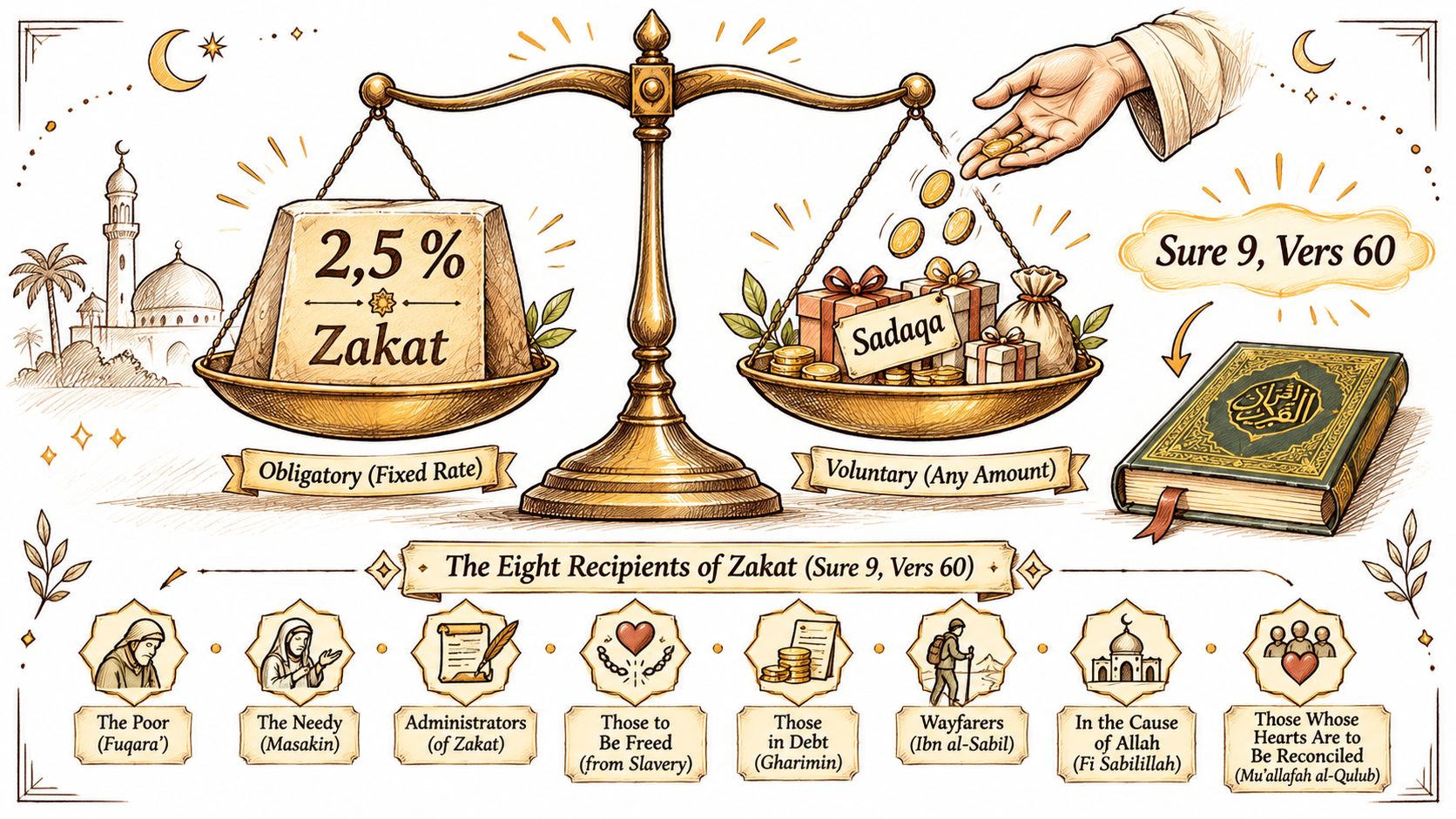
Suppose the calculator shows 400 euros of Zakat due, and you give 500 euros to a mosque construction fund. That is a generous Sadaqa. Your Zakat obligation is not thereby fulfilled, unless the organisation confirms that the funds are used for Zakat-eligible purposes. Zakat is bound in the Quran to eight recipient groups, and a general project donation does not automatically fall into one of these groups.
Four questions before every Zakat donation
- Purpose of use: Does the money go to one of the eight recipient groups or to a general construction or operating fund?
- Proof of Zakat eligibility: Is there an explicit confirmation from the organisation that Zakat funds are accepted and used separately?
- Proof of use: Do you receive feedback after donating on what the funds were used for?
- Contact person: Is there a reachable person who answers questions about Zakat funds?
Being listed on a donation page does not, by itself, prove Zakat eligibility. Without these four points, a project does not count as Zakat-eligible, even if it is charitable and pursues a good cause.
At SadakaNow, donations are held in trust and paid out directly to the respective organisation, so the platform account never touches the funds. The team answers questions about donations and payment issues at hilfe@sadakanow.de. Anyone who wants to donate during Ramadan and read up on the rules for these months will find them in the article Donating during Ramadan.
In the end, record the result together with the date, price source and standard, and decide on the amount and recipient yourself. The calculator provides a figure. Responsibility for the allocation remains with you.
SadakaNow is a donation platform from Germany through which, after your calculation, you can specifically support campaigns from mosques, water projects and aid projects in Germany, Austria and Switzerland. Before paying, you can see what the organisation uses the funds for, and the donation reaches the project without a platform fee. Take your time to work out your Zakat, and then choose a project whose use you can follow: SadakaNow.