
Zakat al fitr in Germany: Amount and Deadline
15 euros per person was set by DITIB for Ramadan 2025 as the minimum amount for Zakat al-Fitr in Germany. This is a recommendation from this association, not a legal rate for all Muslim households. Anyone looking for the right amount therefore needs more than just a figure: the Ramadan year, the issuing body and the unit per person all belong together.
For Ramadan 2026, no new association amount is listed here. This does not mean that no new recommendations have been published in the meantime. Check the current announcement from your community or the association whose religious guidance you follow, instead of using an older amount without verification.
Table of Contents
- Why the Fitra belongs to the end of Ramadan
- Recommended euro amounts for the German household
- Who pays for themselves and dependents
- The deadline before the Festival of Breaking the Fast
- Who may receive the Fitra
- Household examples with euro amounts and special cases
- Transferring the Fitra before the Eid prayer
Why the Fitra belongs to the end of Ramadan
When a family prepares its table for the Festival of Breaking the Fast, it plans food, shopping and visits. Zakat al-Fitr, also called Fitra or Sadaqat al-Fitr, broadens this view: people with little money should not be left without the essentials during the festival either. The image of an additional table being set describes well the social purpose of this payment.
The Fitra is a distinct, personal religious obligation at the transition from Ramadan to the festival. It is not the same as Zakat on wealth, which is calculated on the basis of zakat-liable assets. Anyone who has to make both payments should calculate them separately and clearly assign them when paying.
The following overview illustrates this distinction.
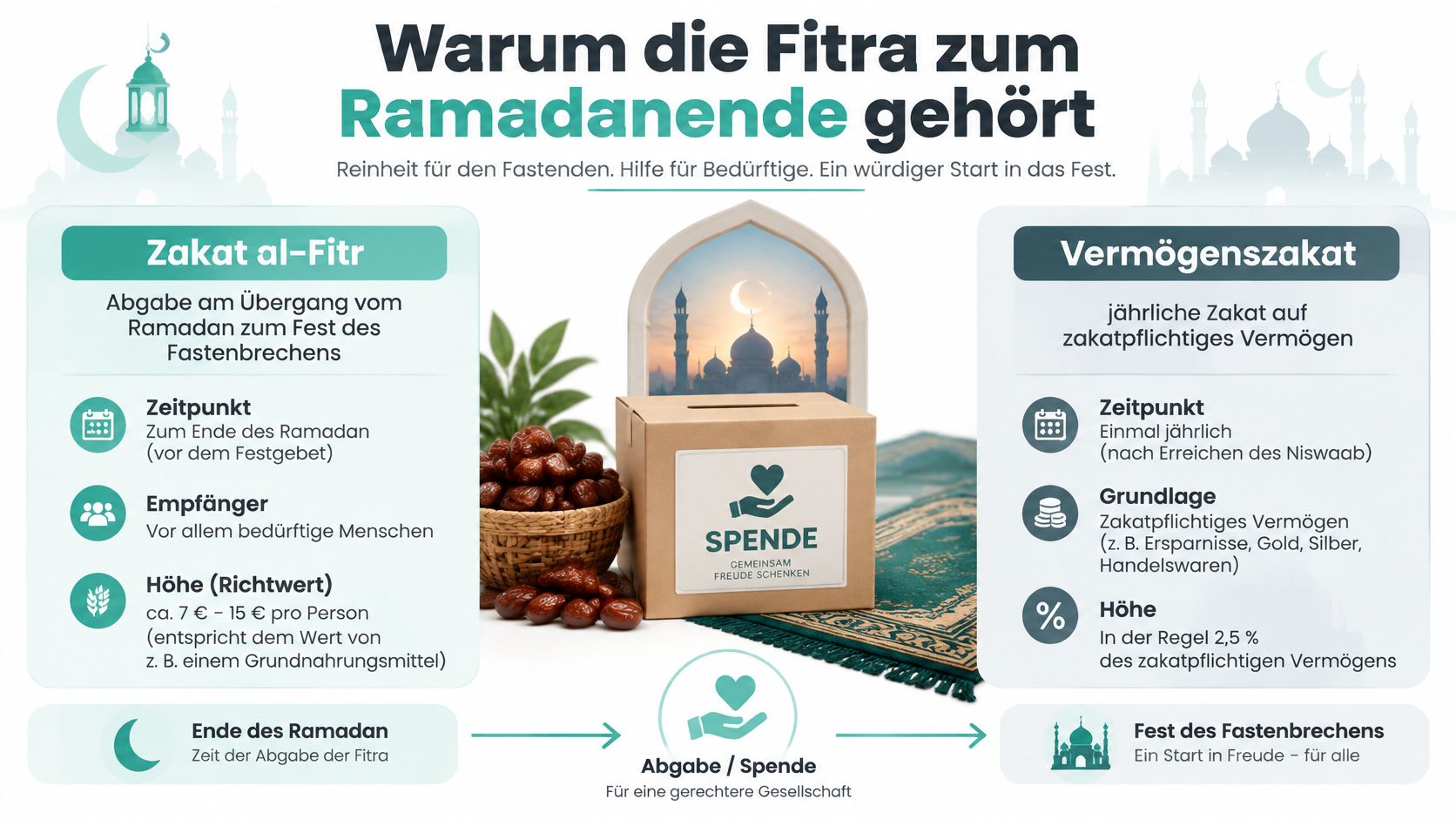
Religious practice and concrete responsibility
According to the study "Muslim Life in Germany 2020" presented by the German Islam Conference, 56 percent of Muslims in Germany observe the fasting rules fully and another 20 percent partially; 66 percent celebrate religious holidays such as the Festival of Breaking the Fast. These figures describe religious practice, not the number of Fitra payments actually made.
For a household, the practical question is therefore not how many other people pay. What matters is who falls under one's own maintenance responsibility and how the payment reaches those in need in time.
Guidance: The Fitra is part of the preparation for the festival, not a later settlement of the holidays.
Anyone who wants to help beyond this can plan their donations during Ramadan separately. A voluntary gift and a designated Fitra payment should remain clearly separate from each other.
Recommended euro amounts for the German household
German Fitra guideline values and household examples
| Recommendation | Minimum value | Unit | One person | Four people |
|---|---|---|---|---|
| DITIB Ramadan 2025 | 15 euros | per person | 15 euros | 60 euros |
| Zentralrat der Muslime Ramadan 2025 | 7 euros | per person | 7 euros | 28 euros |
| Classic food measure | about 2 to 3 kg | staple food per person | 2 to 3 kg | 8 to 12 kg |
The table sets the associations' guideline values against household examples calculated from them. The food amount is a practical approximation, not an identical weight for every food. It should therefore not be read as an additional, generally binding monetary rate.
What a minimum recommendation means
An association's recommendation helps communities and households put a religious due into practice. The association bases this on a calculation method and publishes a minimum value. The amount therefore answers a specific question under certain assumptions, not automatically every question for every place.
DITIB justifies its recommendation with the basic daily food needs of a person in need. Other bodies may use a different basket of goods or a different valuation method. The fact that the results differ does not therefore automatically mean that one body has calculated incorrectly.
A lower guideline value is not automatically a discount, and a higher one is not automatically binding for everyone. Do not choose based solely on the cheapest result. Orient yourself to a comprehensible religious recommendation and check whether your community uses it for the current Ramadan.
Not mixing up monetary value and food measure
With the food-based approach, type, quantity and procurement must match up. Rice, wheat and dates have different properties and prices. A rough weight figure therefore cannot yield a reliable euro amount without further assumptions.
For a monetary payment, you normally don't need to research prices in the supermarket yourself if you follow a current, clearly explained association recommendation. If, on the other hand, you put together food yourself, you should clarify with the distributing body which products are needed and how it determines the required quantity.
- Check the year: Does the publication actually relate to the Ramadan for which you are paying?
- Read the publisher: Does the figure come from your community, an association, or merely from an older article?
- Note the unit: An amount per person is multiplied by the number of people taken into account.
- Allocate extra amounts: Voluntary additional giving should benefit the intended recipient purpose.
For households in Austria and Switzerland, German recommendations provide a point of reference but are not an automatically transferable local standard. Use the publication of your relevant community instead of adopting a German euro amount without checking it.
The calculation method must also not be confused: anyone who wants to calculate their asset Zakat needs different figures than for the personal Fitra.
Who pays for themselves and dependents
The practical basic rule is: a religiously responsible person takes into account themselves and the people whose maintenance they are responsible for. Thus, the decisive factor is not solely who has the same address. A shared flat, for example, is not already a joint Fitra household just because everyone uses the same kitchen.
Responsibility should also be explicitly agreed upon within a family. If parents assume the adult child pays for themselves, and the child assumes a joint family payment, a person may accidentally be left out. Conversely, a brief agreement can prevent double payments.
The checklist shows the basic structure of maintenance responsibility.
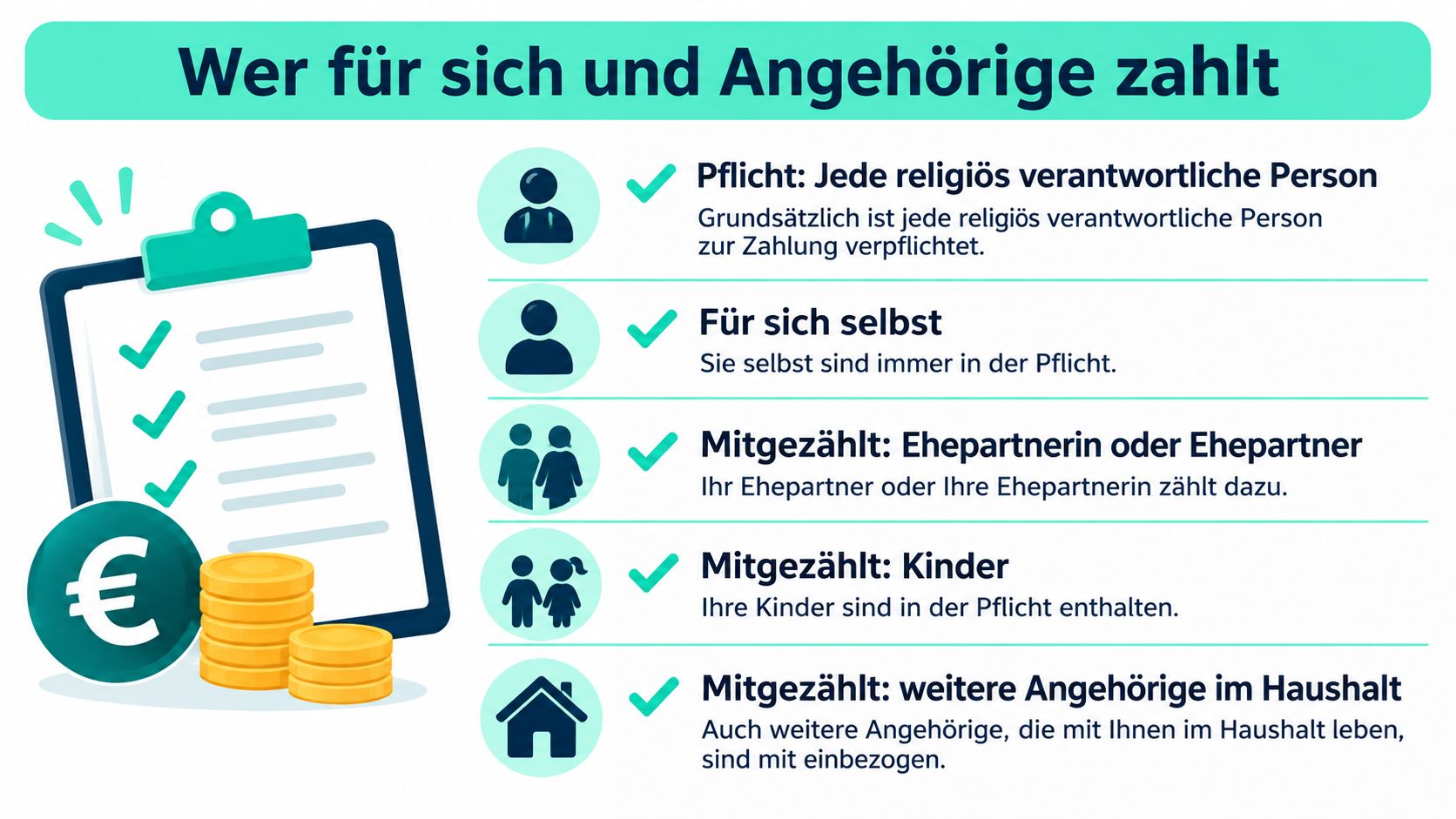
A list of names instead of a mere household number
Write down the names of the people for whom a payment is being considered. Add who is responsible for their maintenance and who actually takes on the Fitra. This creates a verifiable list instead of an estimated family size.
- Yourself: Note whether you pay yourself or someone else takes on the payment with your agreement.
- Children: Check which children you support and include in the joint payment.
- Spouse: Clarify responsibility based on maintenance obligations and your religious orientation.
- Other relatives: Consider not only the family relationship, but the actual provision of support and the relevant religious rule.
An adult child with their own income is a reason to ask, not to silently assume. Discuss whether they pay their own Fitra. A guest who only visits for the festival also does not automatically belong in your calculation merely by being present.
Carefully clarifying special life situations
In the case of a birth shortly before the festival, a death, or changing maintenance responsibility, the decisive point in time of liability can be crucial. Have such cases assessed by your community according to the school of law you follow. A blanket rule along the lines of 'everyone sitting at the table on the festival' is not sufficient for this.
Those who themselves barely have the essentials should also have their situation religiously assessed. The Fitra is meant to support those in need; people facing their own hardship require a careful review of their payment obligation, not a call to jeopardise their necessary provisions.
The accompanying video offers a further approach to the topic.
Fidyah is a different payment. Anyone who makes a Fidyah payment for fasting days that were not possible should not conclude from this that the Fitra is thereby automatically settled. Record both purposes separately so that your payment is correctly allocated.
The deadline before Eid al-Fitr
Plan the transfer before the Eid prayer. The practical guidance described, among others, by the Fitra offer from Barakah, links the payment to its timely completion before the prayer or on the day of the festival itself. For your own planning, the earlier point in time is the more cautious choice.
The purpose is immediate: those in need should receive support for the festival, not only once the purchases would already have been necessary. Anyone commissioning an organisation must therefore also take into account the time it needs for allocation, procurement and distribution. Clicking a payment button is not yet a transfer to the recipient.
Distinguishing the payment deadline from the distribution deadline
A community may close its collection earlier than you personally expect the festival to begin. This can be organisationally necessary if it purchases food or prepares a payout. Therefore ask about the cut-off for the specific Fitra distribution, not just the date of the festival.
The timeline makes clear why a lead time is necessary.
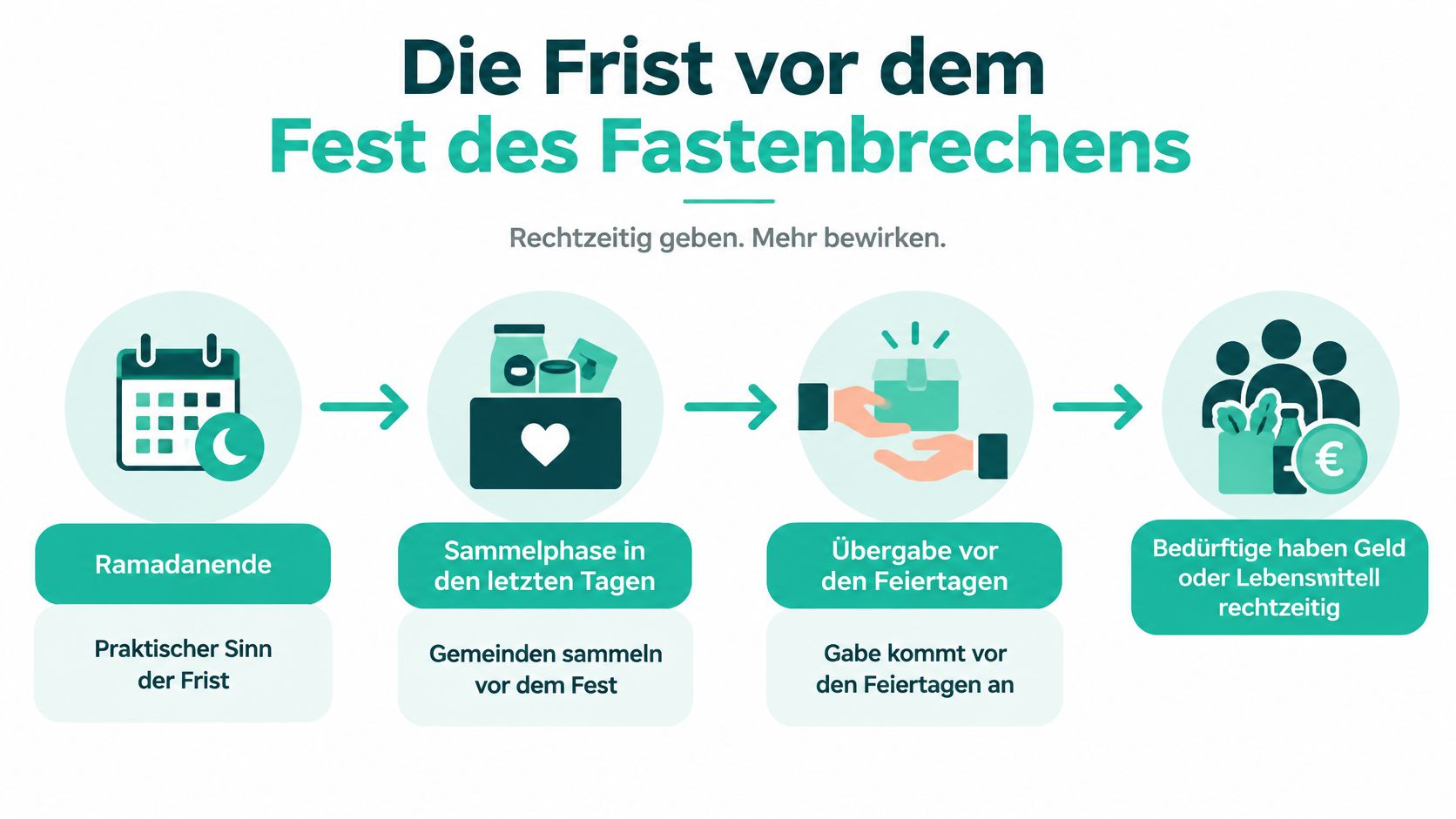
Check the date of the festival and the prayer time with your own community. If you are travelling or giving through an organisation in another location, clarify which schedule it uses for your payment. Do not rely solely on a general calendar found online.
A payment confirmation proves the payment. Whether those in need were provided for in time must be ensured by the distributing body through its own process.
If the payment is late
Anyone who has missed the deadline should still act and ask the community for a specific religious assessment. A later donation can still help. However, it should not be described as a timely Fitra payment without this being verified.
- For bank transfer: Take into account the processing time of the bank and the receiving organisation.
- For cash payment: Have the purpose and acceptance documented.
- For online payment: Check whether the ongoing campaign still guarantees timely distribution.
For organisations, this includes a clear explanation of whether they pay out money, procure food, or combine both approaches. Only then can donors understand what work is still required between the receipt of payment and the help reaching people for the festival.
Who may receive the Fitra
The Fitra is meant to enable poor and needy people to celebrate the festival with the essentials. This leads to the most important check for a donation appeal: does the body explicitly name this recipient purpose, or is it simply collecting generally for its work?
A mosque can receive and distribute Fitra. However, this does not make every payment to a mosque a Fitra payment. A building project, an association's invoice, and support for a needy household are different purposes, even if the same organisation is responsible for them.
The overview contrasts the recipient purpose with the distinction from general funding.
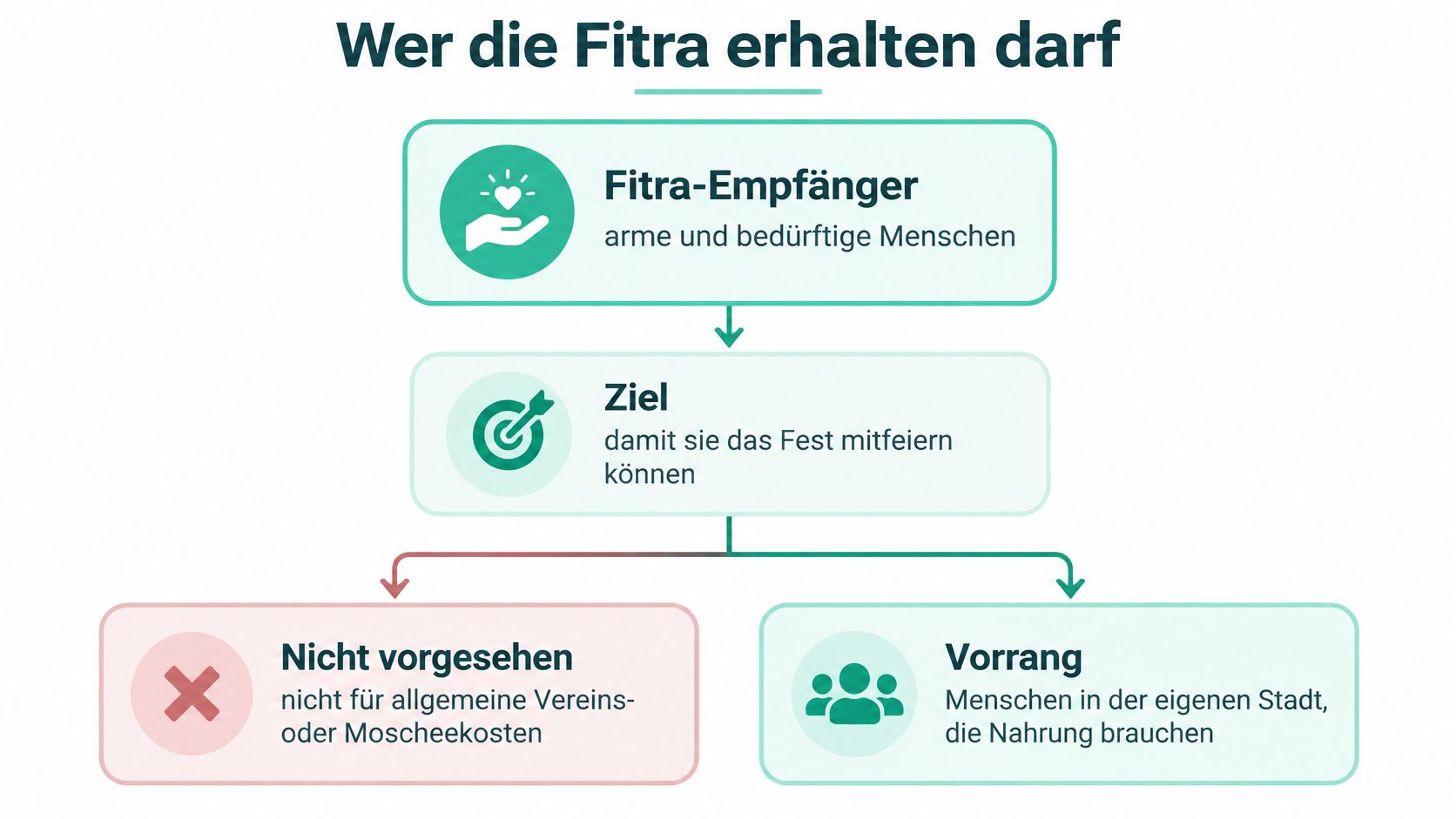
Direct help or distribution through a body
If you personally know someone in need, direct help can be a transparent option. In doing so, preserve that person's dignity and privacy. Need does not have to be made public for a gift to fulfil its purpose.
A community or aid organisation can take over the distribution if you do not know suitable recipients yourself. It should be able to explain how it assesses need, in what form it provides support, and how it ensures the funds are used for their intended purpose. A general promise to do good does not answer these questions.
Local aid has a practical advantage: the community can recognise hardship in its own surroundings and organise the transfer directly. However, without a religious assessment, this cannot be used to derive an absolute rule that passing it on to another location would be impermissible. In the case of cross-regional distribution, ask about the reason, the group of recipients, and the timeline.
Do not replace maintenance obligations with Fitra
Providing for one's own dependants and giving to Fitra recipients must be kept separate. Anyone who already has to cover a family member's food costs should not simply declare this expense as Fitra after the fact. A different assessment may apply for needy relatives outside one's own maintenance responsibility.
The form of help also needs clarity. Food and money are not assessed the same way religiously by all schools of law. Choose a distribution method that matches your religious orientation and that actually fulfils the recipient purpose.
- Don't simply reallocate: A general association donation does not become suitable Fitra merely through an internal bookkeeping note.
- No provision for the well-off: What matters is need, not membership or personal closeness.
- No unclear collection fund: The distributing body should be able to clearly assign the earmarked funds.
What matters is not how elaborately a campaign page is designed. What matters is who receives the help, what it is intended for, and when it arrives.
Household examples in euros and special cases
For Ramadan 2025, the Zentralrat der Muslime named at least 7 euros per person, while DITIB set 15 euros per person. For a household with five people taken into account, this results in 35 euros or 75 euros respectively. The following table calculates these reference values and the practical food range for different numbers of people.
Fitra amounts by number of people
| People | Zentralrat 7 euros | DITIB 15 euros | Food |
|---|---|---|---|
| 1 person | 7 euros | 15 euros | 2 to 3 kg |
| 2 people | 14 euros | 30 euros | 4 to 6 kg |
| 3 people | 21 euros | 45 euros | 6 to 9 kg |
| 4 people | 28 euros | 60 euros | 8 to 12 kg |
| 5 people | 35 euros | 75 euros | 10 to 15 kg |
| 6 people | 42 euros | 90 euros | 12 to 18 kg |
The euro amounts are calculation examples for the recommendations mentioned from that particular Ramadan, not an automatic guideline for a later year. The food column illustrates quantities; it does not replace a clarification about product, measurement, and distribution.
A family with a grandmother being cared for
Let's take a household in Dortmund: the parents provide for their children and the grandmother living in the household. The family first clarifies, according to their religious orientation, for whom they are taking on the Fitra. Only afterward do they choose the appropriate table row.
The sensible order is therefore not "We take the usual family amount," but "We name all the people taken into account and then calculate." The grandmother is neither automatically excluded because of her age nor included solely because of her registered address. What matters is the clarified maintenance and payment situation.
Voluntarily rounding up is possible. In doing so, the additional amount should actually be intended for the intended charitable purpose and not accidentally assigned to a different selection in the payment form.
Self-employed relatives and changes before the holiday
A person living alone in Hamburg does not need a family flat rate. They document their own payment and the chosen reference value. If a relative takes over the payment for them, this should be agreed upon.
In a household in Munich, the adult daughter with her own income pays for herself by mutual agreement. Her parents therefore remove her from their payment list, but not from the family. This way, double allocation can be avoided without deriving maintenance questions solely from income.
In the event of a birth or death shortly before the holiday, the family should not change the list based on feeling. They should inform the community of the specific situation and have it clarified which due date and which rule apply.
For your records: Note down the names, the chosen recommendation with the Ramadan year, and the total amount calculated from it.
Such a note is especially helpful for payments covering several households. Anyone transferring money for parents or siblings as well should be able to keep the individual orders separate. A single transfer can contain several clearly separated allocations, provided the receiving body supports this approach.
Transferring the Fitra before the Eid prayer
For the payment, you need a clarified list of people, a current reference value, and a suitable recipient. Take care of any open questions before filling out the form. Under time pressure shortly before the prayer, missing details about the distribution can hardly be reliably checked anymore.
- Assign people: Determine for whom you are paying, and coordinate with relatives.
- Choose a current reference value: Adopt the published recommendation of the body you are orienting yourself by, including the Ramadan year and unit.
- Calculate the total amount: Multiply the per-person amount by the clarified number of people and deliberately assign any voluntary extra amount.
- Pay with lead time: Follow the acceptance deadline of the distributing body and keep the confirmation.
Assigning correctly on-site and online
When paying in cash at the mosque, you should explicitly state Fitra as the purpose. Clarify whether the community keeps a separate list and what information it needs for allocation. A receipt or confirmation makes your own documentation easier.
Online, it should already be clear before paying who distributes the funds and whether the campaign accepts Fitra. The chosen payment method alone does not indicate this. The guide on online donations helps to transparently sort out payment and recipient.
At SadakaNow, we support Muslim projects in Germany, Austria and Switzerland. We do not touch the donation funds: the money is held in trust and paid out directly to the respective organisation. For the religious validity of a specific Fitra payment, its stated purpose and distribution process remain decisive.
Checking confirmation and purpose
After making the payment, read the confirmation. Do the recipient organisation, amount and selected purpose match your intention? If something is missing or incorrectly assigned, contact the responsible party immediately.
- Payment receipt: The transaction must actually be attributable to the organisation.
- Fitra purpose: A general Sadaqa selection is not automatically the same designated purpose.
- Distribution: A payment confirmation is not proof that the aid has already been disbursed.
Also make sure not to confuse voluntary support of the platform with an additional Fitra gift to those in need. If you wish to give more Fitra, this additional amount must be assigned to the corresponding recipient purpose. A regular Sadaqa likewise remains a separate undertaking and does not replace a separately planned Fitra.
At SadakaNow, you can discover and support Muslim aid projects in Germany, Austria and Switzerland. For your Fitra, check a campaign expressly intended for this purpose regarding its recipient purpose, current calculation basis and timely distribution, and then deliberately choose your project.