
Donation receipt from what amount: the 300-euro rule
For a single donation of up to and including 300 euros, a bank statement or transfer receipt together with a confirmation from the recipient regarding purpose and tax-privileged status is usually sufficient. For more than 300 euros per individual donation, you generally need a formal donation confirmation.
But does sufficient proof of payment already mean that the tax office will recognise your donation? This is exactly where the most common misunderstanding lies: Proof of a payment and its tax deductibility are two different questions. This applies equally to an occasional Sadaqa and to regular support for a mosque association.
The following rules relate to income tax in Germany. Anyone liable for tax in Austria or Switzerland should check the requirements that apply there.
Table of contents
- Proof required by donation amount at a glance
- Proof for small and regular donations
- How to get a donation confirmation from 300 euros
- How much you can deduct from your taxes
- When a donation is not deductible
- Securing proof and a checklist for your tax return
Proof required by donation amount at a glance
For the question "donation receipt from what amount?", what matters first is the individual donation, not automatically the annual total: the Bavarian tax administration's information on donation proof states the simplified form of proof applies up to and including 300 euros and, for non-profit organisations, also requires a suitable recipient receipt in addition to the bank receipt.
In everyday language, Spendenquittung, Spendenbescheinigung, and Zuwendungsbestätigung are often used interchangeably. For your tax return, what matters is whether you are allowed to use the simplified proof or need a confirmation following the official template. Any receipt of receipt is not automatically such a confirmation.
Proof required by donation amount and payment method
The overview distinguishes the payment receipt from the formal confirmation. The amount thresholds correspond to the official information mentioned above.
| Case | Proof | Formal donation confirmation required? |
|---|---|---|
| Bank transfer up to 300 euros per individual donation | Bank statement or transfer receipt plus confirmation from the recipient | No, generally not |
| Bank transfer over 300 euros per individual donation | Donation confirmation following the official template | Yes, as a general rule |
| Cash donation up to 300 euros | Cash deposit receipt with recipient, amount, date and a verifiable purpose, supplemented by the recipient receipt | No, if the requirements for the simplified proof are met |
| Card payment via platform up to 300 euros | Suitable payment receipt plus confirmation from the recipient | No, if the recipient and proof meet the requirements |
| Card payment via platform over 300 euros | Donation confirmation from the tax-privileged recipient | Yes, as a general rule |
| Collective donation or multiple partial payments | Each payment clearly documented | Check for each individual payment |
What lies behind the different payment methods
With a bank transfer, you can usually identify the recipient directly in your bank statement. With a platform payment, however, it may initially be the payment service provider that appears instead. For this reason, also keep the payment confirmation that shows the assignment to the beneficiary organisation.
For cash, you need to pay particular attention to documentation. A bank's cash deposit receipt is not the same as an anonymous drop into a donation box. Without a traceable link, your personal contribution may not be provable later.
For a joint collection, you should also record who actually donated. Anyone who merely collected and forwarded other people's money should not simply treat the total amount as their own donation.
Verification rule: Start with the actual payment transaction. An annual overview helps with sorting, but does not by itself decide which proof is admissible.
Proof for small and regular donations
Suppose you transfer 50 euros to a charitable mosque association. Your bank statement shows the name of the association, the amount, and the payment date. The payment reference might say Sadaqa for community work, for example.
This documents the payment. However, the payment reference you entered yourself does not yet prove that the association is tax-privileged. For small donations up to 300 euros, the Tax Administration of North Rhine-Westphalia requires, in addition to the payment receipt, confirmation from the recipient regarding its tax privilege and the purpose of use.
Combining the payment receipt and the recipient's confirmation
Check the association's documents for the following information:
- Organisation: The name and address match the association you donated to.
- Tax privilege: The document contains information on the exemption from corporate tax or the relevant notice.
- Purpose: The tax-privileged purpose of use is identifiable.
- Classification: The recipient clearly states whether it is a donation or a membership fee.
- Matching: The bank receipt and the recipient's documents can be clearly linked to each other.
The recipient's confirmation does not necessarily have to be an individually issued formal donation receipt. What matters is the required information and its connection to your proof of payment. Therefore, save the relevant documents from the association together with the bank statement, rather than relying solely on a website that may still be accessible later.
A printout from the payment platform can explain the payment transaction. However, it does not by itself replace the tax information of the beneficiary association.
Fully documenting regular Sadaqa
Let's consider another case: you support the same community every month with a small amount via SEPA direct debit. In that case, you should not only keep the first debit, but document every actual payment. Make sure the recipient remains identifiable despite possibly changing booking texts.
In practice, it helps to keep a folder per recipient with bank statements, payment confirmations, and the matching recipient's confirmation. Also check for reversed direct debits or refunds. An announced payment, or one that was later reversed, is not the same as a donation that was finally made.
The brochure from the Federal Ministry of Finance on volunteering and donations explains the simplified proof up to 300 euros; for a single contribution above that amount, an official donation receipt is generally required.
An annual overview makes it easier to reconcile with your bank statements. However, it should not lead you to delete the underlying payment receipts or overlook missing information from the recipient.
Can you tell from your documents who gave how much, when, to whom, and for which eligible purpose? If not, clarify the gap before filing your tax return.
How to obtain a donation receipt from 300 euros
The heading uses the common search phrasing. To be precise, however: right at the threshold, the simplified proof generally remains possible. You can still request a formal confirmation, for example if you want to keep your documents consistent.
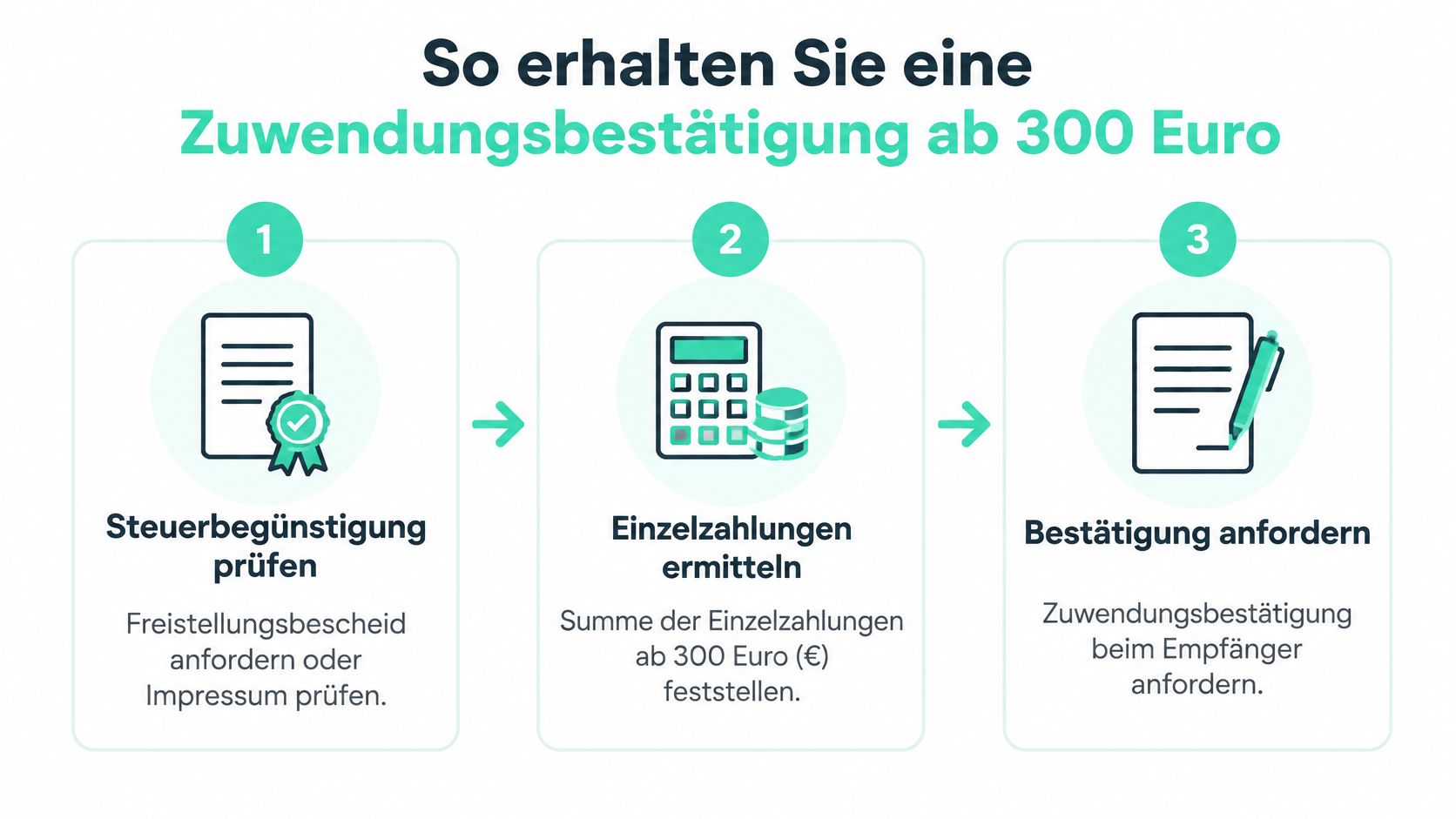
The graphic shows the path from checking the recipient to making the request.
From payment receipt to the correct confirmation
Check tax deductibility. Look at the recipient's information on charitable status and, if anything is unclear, ask for the current exemption certificate. A note in the legal notice (Impressum) is a starting point, but in case of doubt it does not replace clarification with the organisation.
Identify the specific payment. Open your bank statement and note the amount, booking date, and recipient. This way you avoid using a planned payment, an annual total, or a reversed direct debit as the basis of your request.
Contact the recipient. Provide your full name, your address, as well as the amount, date, and purpose of the payment. For platform payments, add the transaction reference so the association can match your donation.
Check the issued confirmation. Compare the name, address, amount, and payment date with your records and check the information on tax deductibility. The official guidance on donation receipts explains the significance of the confirmation according to the officially prescribed template.
File it together. Store the donation confirmation together with the corresponding payment receipt, and include the deductible donation in your income tax return as a special expense (Sonderausgabe). Have any errors corrected before using it.
Distinguishing between a platform receipt and an association confirmation
A common mistake is to already treat the automatic payment notification as the tax certificate. The platform can document a transaction; the tax-recognised donation confirmation must be attributable to the beneficiary recipient. Further explanations for communities and those responsible can be found in the article on the donation receipt for associations.
Ask early rather than assuming a certain processing time. Associations organise their administration differently, and missing address data may make a follow-up inquiry necessary.
As an additional explanation, this video is available.
How much you can deduct from your taxes
The donation confirmation does not determine your annual deduction limit. It serves as proof, while income tax law limits the extent to which you can take deductible donations into account as special expenses.
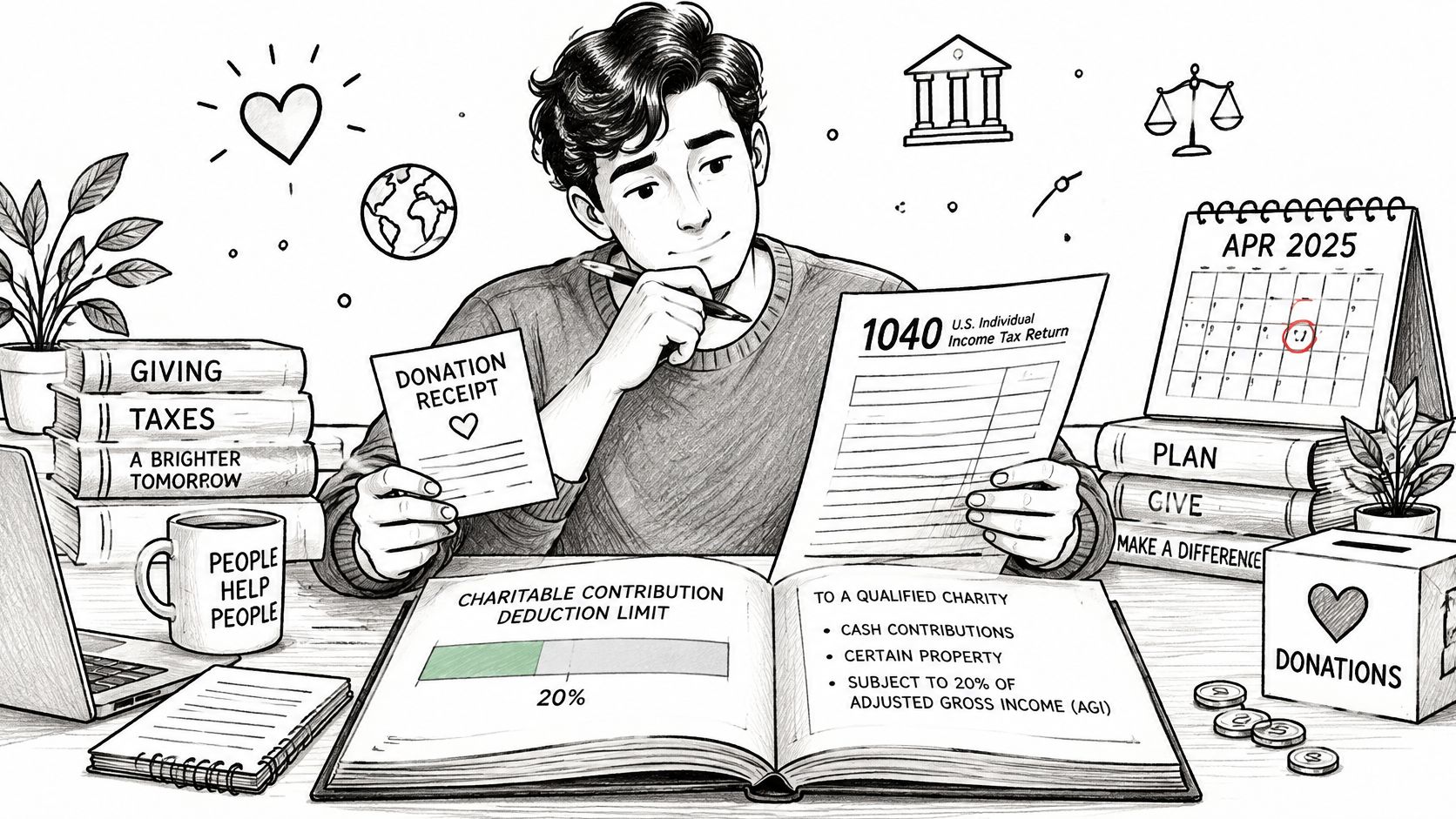
According to § 10b of the Income Tax Act in the official tax handbook, private individuals can generally claim such donations up to 20 percent of the total amount of their income; at 40,000 euros, this limit is 8,000 euros.
When sorting your tax documents, you should consider proof of donation and deduction limits separately.
Deduction limit at 20 percent of income
The following calculation follows the legal rule mentioned.
| Total amount of income | Deduction limit (20%) |
|---|---|
| 40,000 euros | 8,000 euros |
The total amount of income is a tax calculation figure. Do not simply use your net salary or the amount credited to your account from your salary payment for this. If you are not sure of the amount, refer to your tax documents or have it calculated.
A donation deduction is not a refund of the donated amount. The recognised special expense reduces the tax assessment basis; your actual tax savings depend on your personal situation.
Exceedances and special cases
If deductible donations exceed the personal deduction limit, the amount not taken into account can generally be carried forward to later assessment periods. This is something different from an unused limit: those who donate less cannot simply accumulate the remaining scope as a credit.
For companies, the legal regulation alternatively names a limit of four per mille of the sum of total turnover and the wages and salaries spent in the calendar year. Corporate donations should therefore not be treated unexamined according to the private calculation scheme.
Contributions to an association are also not deductible merely because the association is charitable. For this distinction, the explanation of when association membership fees are tax deductible is helpful.
When a donation is not deductible
A complete bank statement initially only proves that money has flowed. Whether this results in a donation deduction additionally depends on the recipient, the purpose, and the nature of the payment. The official guidance on donation deductions makes the recipient's tax-privileged status and the statutory proof requirements a precondition.
Four typical obstacles
The recipient is not tax-privileged. Direct help to a private individual can be very meaningful on a personal level, but it does not automatically fall under the donation deduction described here. The designation association or aid initiative alone also says nothing about the tax status.
You receive something in return. If you buy an event ticket, you are basically paying for admission. The fact that the organiser wants to use the proceeds for a good cause does not automatically turn your ticket purchase into a donation.
The payment does not serve a privileged purpose. A purely commercial payment does not become a deductible donation just because the booking text says donation. Political contributions can be subject to special rules and should not be assessed generally according to the rules for non-profit organisations.
The required proof is incomplete. If the clear assignment to the payment is missing or if necessary tax details are missing, the tax office can refuse recognition. Request missing documents or a correction from the recipient.
A good cause does not replace tax recognition
Suppose you support a non-profit-exempt leisure association with a bank transfer. Even if the amount, date and recipient are fully documented, the bank statement alone does not turn this into a privileged contribution.
The same distinction applies to mosque communities: the religious or social benefit of a project does not replace checking the specific legal entity. Anyone organising a campaign should therefore clearly state which association receives the money and which proof it provides.
You can find more on this classification in the article on donations for non-profit associations. If there is any doubt, clarify it directly with the receiving organisation before making the payment.
Securing proof and a checklist for your tax return
Start your filing with the payment receipt and assign the recipient's documents to it. A digital annual folder with subfolders for each organisation makes matching easier. Use clear file names with the payment date and recipient, rather than saving files only as receipt or download.
Filling in missing documents specifically
Before filing your tax return, check whether all finally made payments have been recorded. Pay particular attention to changing booking texts, refunds and payments made through different payment methods. Request the confirmations you need in good time and keep your documents even after submitting your return so you can answer follow-up questions.
With us, all campaigns are checked for non-profit status before being activated. For your personal tax return, you should nevertheless keep the documents belonging to the specific payment. You can direct questions about donations and payment issues to hilfe@sadakanow.de; this contact does not replace an individual tax assessment.
Checklist before filing
- Individual amount checked: You have looked at the actual payment and not just an annual summary.
- Proof selected: Payment receipt and recipient's receipt or formal donation confirmation are available as appropriate.
- Recipient checked: The tax-privileged status of the specific organisation is verifiable.
- Details matched: Name, address, amount, date and purpose are correct, as far as required for the respective proof.
- Receipts secured: The documents are complete, legible and clearly assigned.
If your case remains unclear, ask a tax advisor or your responsible tax office before filing your tax return.
On SadakaNow, you can select and specifically support mosque, water and aid projects. Before your next donation, check the privileged recipient and then file the payment receipt and the matching confirmation together. This way you combine your Sadaqa with traceable documentation for your tax return.