
Setting Up a Recurring Donation: Process, Tax and Payment Methods
Do you know, before the first click, how you can later change, pause and document your donation, or do you only know the way to payment? That exact gap makes many recurring donations unnecessarily fragile. Anyone who sets up amount, rhythm, payment method and receipts as a routine with checkpoints does not have to cancel and start over with every change in life. What matters is not the highest starting amount, but a recurring donation that you can keep up, review and adjust as needed in everyday life.
Table of contents
- What a recurring donation is and which rhythm fits
- Payment methods for recurring donations compared
- Setting up a recurring donation on SadakaNow in six steps
- Tax aspects and receipts for recurring donations
- Changing, pausing or ending a recurring donation
- Setting the right recurring donation now
What a recurring donation is and which rhythm fits
A recurring donation is a regularly repeating monetary donation made monthly, quarterly, half-yearly or annually, which generally runs for an indefinite period and can be cancelled at any time. You decide once on the purpose, amount and payment method. After that, the payment continues at the chosen interval until you change, pause or end it.
The calculation example is deliberately simple. At 20 euros a month, you reach 240 euros a year, without having to reconsider whether and how much to give with every fundraising campaign. A household giving 15 euros a month accordingly gives 180 euros a year, turning a good intention into a fixed item in the budget.
Choose the rhythm based on everyday life, not pressure
I would align the rhythm with your income and your account management, not with a preset form amount. Monthly payments suit a monthly salary and projects with ongoing needs. Quarterly or half-yearly payments are calmer if you want to see fewer transactions or want to cushion irregular income. An annual payment is more suitable for a fixed occasion.
| Rhythm | Payments per year | Annual total at 20 euros | Typical suitability |
|---|---|---|---|
| Monthly | 12 | 240 euros | Predictable support for ongoing projects |
| Quarterly | 4 | 80 euros | For those who want to keep an eye on their account balance |
| Half-yearly | 2 | 40 euros | For those who prefer larger debits less often |
| Annually | 1 | 20 euros | Occasion-based donation, for example for Ramadan |
The table also shows why the monthly amount alone says little. Anyone giving 20 euros quarterly supports with 80 euros a year, not 240 euros. So always check the annual total and ask yourself honestly whether you could also bear this amount in a more expensive month. A smaller, stable amount is better than an ambitious start that you end after just a few debits.
Why predictability helps both sides
That a fixed rhythm is not a niche model is shown by a look at donation behaviour in Germany. In 2024, 16.7 million people donated in Germany, a figure published by the Deutscher Spendenrat in its Spendenbilanz 2025. The average donation frequency in Germany reached seven donations per year in 2023, a figure published in 2024 as part of the Bilanz des Helfens of the Deutscher Spendenrat.
So many people do not give just once, but repeatedly. A recurring donation gives structure to this repetition. You do not have to wait for the next appeal, and the project can plan better with recurring income than with isolated, occasion-based amounts.
- Predictable income: Projects with ongoing needs can schedule expenses more calmly.
- Small amounts instead of large single sums: The annual contribution builds up in manageable steps.
- Less effort in everyday life: After setup, mainly checking the debits remains.
- Fixed routine: You make the basic decision once and review it again at intervals.
For many Muslim donors, the idea of ongoing support also plays a role here. Anyone looking into the meaning of Sadaqah Jariyah should, however, consider religious intention and practical payment form separately. Continuity arises organisationally through your instruction, your payment method, and your ongoing oversight.
Rule of thumb: Choose the amount so that it can still be collected in a weaker month without overdrawing your account.
Set the amount, interval, and payment method in the donation form and check whether you can change these details there later. No one should pressure you into a large sum. A good recurring donation starts affordable, stays understandable, and can be adjusted if your income, expenses, or priorities change.
Comparing payment methods for recurring donations
When it comes to payment method, what matters less is the quickest setup and more the question of which connection stays stable over months. On SadakaNow, donations can be made via SEPA, PayPal, or credit card. Each option has a different typical weak point that you should know before completing the setup.
| Payment method | Available on SadakaNow | Note |
|---|---|---|
| SEPA direct debit | Yes | Mandate is checked at setup, changing accounts requires new confirmation |
| PayPal | Yes | Check in the form whether the desired rhythm is available |
| Credit card | Yes | Regularly check the card's expiry date |
What to watch for with each payment method
- SEPA direct debit: You issue a mandate so that the amount can be collected at the chosen interval. This option usually runs smoothly as long as the IBAN, account holder, and funds are correct.
- PayPal: The PayPal account serves as the payment source. Check in the form whether your desired rhythm is offered there, rather than assuming availability.
- Credit card: The card must be valid and sufficiently funded. The expiry date is the most common stumbling block here, because a new card leaves the stored details outdated.
Typical mistakes are mundane and all the more annoying for it. An incorrect IBAN leads to a returned direct debit, a reached card limit stops the payment, and a change of bank requires a new mandate confirmation. The overview on SEPA direct debit collection is useful in this context, since the date and the mandate belong together when questions arise.
Take a donor who changes her bank and forgets to update it. The next direct debit fails, and she only learns of it from the bank's notice. The project does not receive the amount, even though her intention to donate hasn't changed. You avoid exactly such interruptions by immediately updating your account, card, or PayPal details in the donation process whenever something changes.
I would choose the payment method based on stability. Anyone who permanently uses the same account is usually best off with SEPA. Anyone who changes cards often should set a reminder before the expiry date. For questions about donations and payment issues, write to hilfe@sadakanow.de and state the project, date, and payment method so your request can be matched without follow-up questions.
Setting up a recurring donation on SadakaNow in six steps
A clean start takes more than an amount and a click. You choose a project, enter an amount, and pay by SEPA, card, or PayPal. With every transaction, our fraud protection, anti-money-laundering compliance under §4 GWG, and SEPA mandate verification run automatically, usually within seconds. This doesn't replace your own oversight — it complements it.
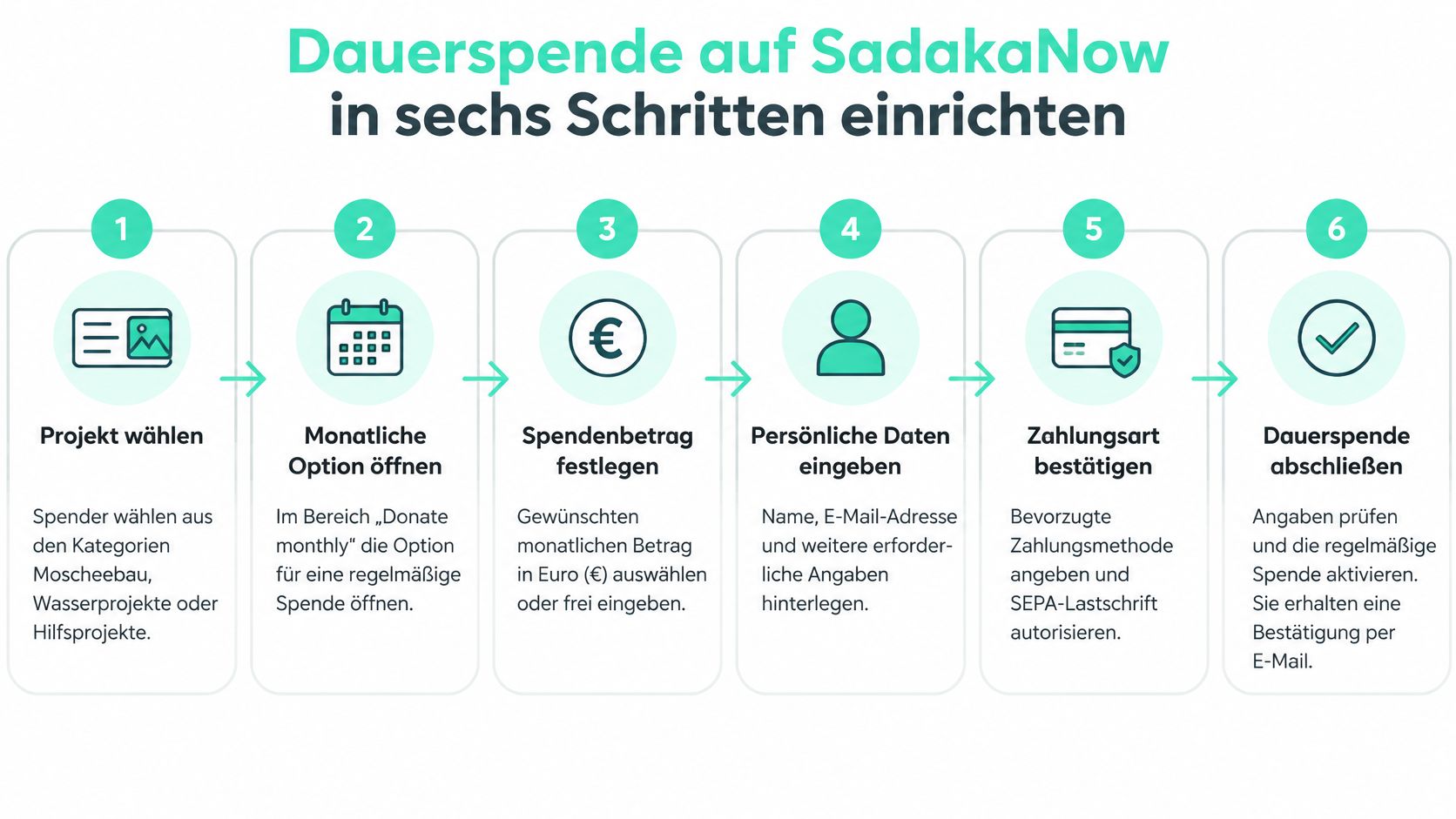
The six steps in the form
Choose a project: Decide on an undertaking from the categories mosque construction, water projects or aid projects. Read the goal and purpose before paying, because your recurring donation is tied to the chosen campaign. The typical mistake is a quick click on the first visible project, even though another purpose better matches your intention.
Open the monthly option: Open the Donate monthly section, through which you can give monthly. Check whether the recurring option is really active there. Anyone who accidentally completes the one-time donation will later wonder about the missing follow-up payment.
Set the amount and interval: Enter the amount and explicitly confirm the rhythm. Calculate the annual total before proceeding. Later corrections cost time and usually arise because the monthly amount and the annual effect were not thought through together at completion.
Choose the payment method: Choose SEPA direct debit, credit card or PayPal based on the stability of your payment details. An account you will soon close is not a good basis for a standing order. Have the details ready and enter them without transposing numbers.
Check the details: Check the project, amount, interval, name and payment method in a calm review before completing. An incorrect IBAN or an expired card otherwise leads to a returned direct debit or a stopped collection. This check is the most important point of verification before the first payment.
Secure the confirmation: Save the confirmation email and payment details in a dedicated folder. This way you can find the amount, purpose and start date again later if you want to make changes or sort receipts. If you have questions about payments, write to hilfe@sadakanow.de.
After setting it up, check the first debit date on your bank statement, card statement or PayPal overview. If the amount does not match the confirmation, clarify it immediately and do not wait several cycles. A correctly set up standing order means, in everyday practice, setting it up carefully once and then only checking it afterwards.
Check the first debit like a trial payment, even if formally the regular cycle is already running.
Tax points and receipts for recurring donations
The tax side of a recurring donation is not an additional topic for the end of the year, but part of setting it up. The following points do not replace tax advice. They show which proofs you should collect from the first payment onward and which classification you should not make hastily yourself.
| Case | Proof or limit | What to pay attention to |
|---|---|---|
| Individual amount up to 300 euros | Usually a bank statement or payment receipt | Keep the payment proof and recipient details complete |
| Amount over 300 euros | Donation receipt (Zuwendungsbestätigung) | State name and address correctly on the form |
| Annual deduction limit | 20 percent of income or 4 per mille of turnover and wages | Consider all donations of the year together |
| Zakat | No blanket equal treatment with voluntary Sadaqa | Clarify the tax classification with a tax advisor |
Donations to charitable recipients can be deducted as special expenses under § 10b EStG. The limits mentioned in the table apply here: 20 percent of income or alternatively 4 per mille of the sum of turnover and wages and salaries. For your records, this means you should not consider each debit in isolation, but all donations of a year together.
Organising receipts in everyday life
Create a folder for the calendar year and save the confirmation, payment receipts and, if applicable, the donation receipt immediately upon receipt. With each confirmation, check whether the project, amount and your name are correct. Errors in name or address are easier to correct early than shortly before filing your tax return. Background information on the donation receipt for associations additionally helps to correctly classify recipient documents.
An example shows the open issue. With 25 euros monthly, this results in 300 euros per year. Whether the individual payments or the annual total are decisive for deduction eligibility should be clarified with the tax office or a tax advisor before filing your tax return. Do not derive your own rule for the entire year from the amount of a single monthly payment.
Treat Zakat separately. Zakat is a religious obligation and is not treated the same as voluntary Sadaqa for tax purposes as a blanket rule. Have the classification checked before you enter payments accordingly in your tax return. Therefore, separate general Sadaqa from payments explicitly intended as Zakat already when donating, in your records.
Changing, pausing or ending a recurring donation
Do you already know the three points of the routine before completing it: change, pause, prove? A recurring donation does not have to run at the same amount indefinitely. Whether the amount or interval can be adjusted later is stated in your donation confirmation. If a clear statement is missing there, or if a debit is stuck, write to hilfe@sadakanow.de.
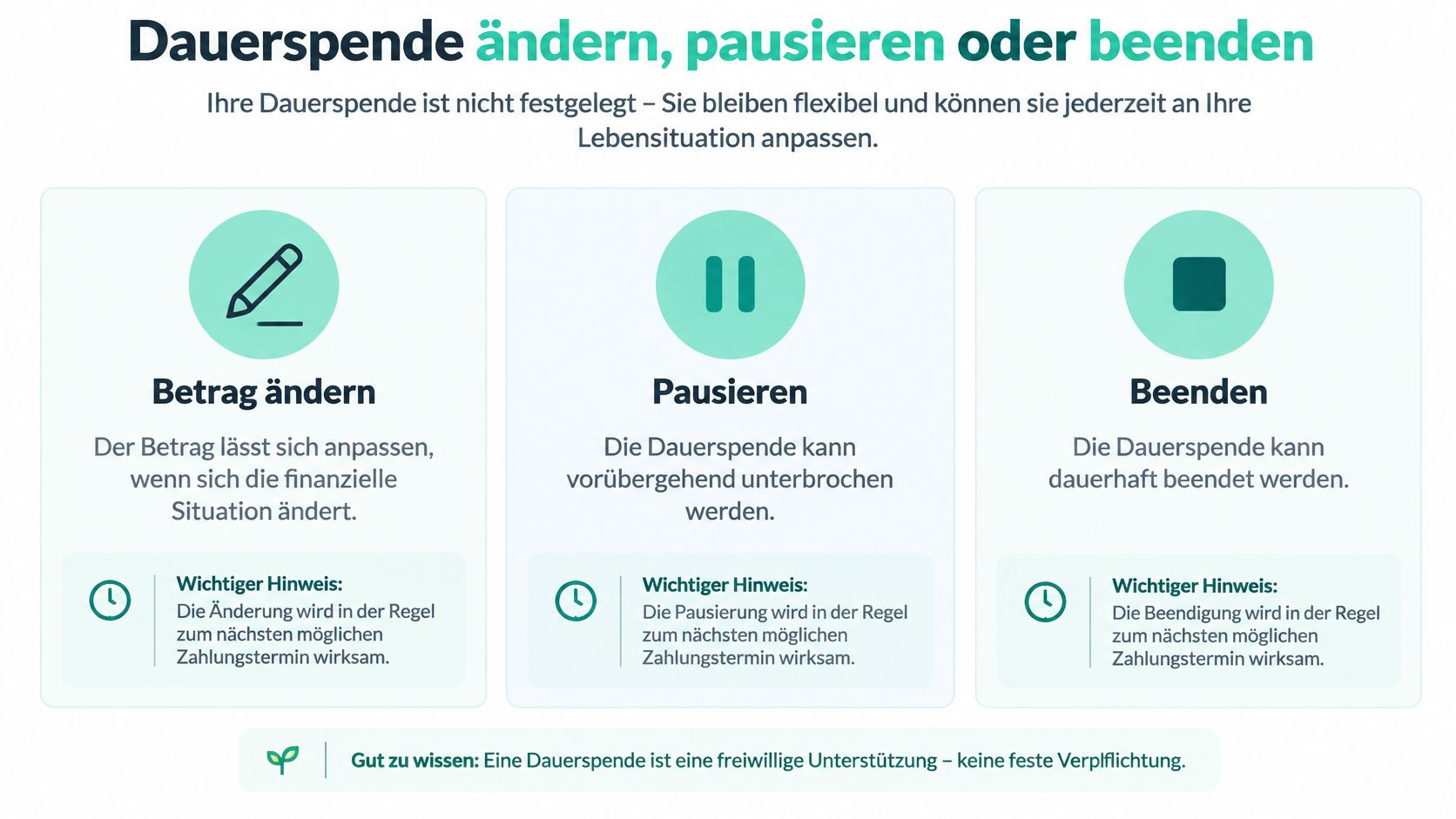
Addressing three cases separately
When changing your donation, you lower or increase the amount, or you switch the rhythm. If income decreases, a smaller amount often lasts longer than an immediate end. If the month is too tight, switching from monthly to quarterly often creates more breathing room than cancelling. Look for the way in the confirmation, not in an assumed function of the form. Expect that a debit already triggered will still be carried out. Only the new confirmation shows from when the changed amount applies.
When pausing, you interrupt the payments for a limited time without giving up the project entirely. After a job change, some households suspend the monthly donation for three months, for example, and resume it afterwards with a smaller amount. Whether a pause is possible, you clarify via the confirmation or by email to hilfe@sadakanow.de. Note the restart yourself. Otherwise the pause turns into a forgotten exit.
When ending your donation, you only stop future payments. Amounts already paid remain bound to the stated purpose. The organisation may only use them for that. Anyone who only wants to give on individual occasions is often better served with a one-time donation than with a standing order that would then have to be stopped again.
You can see the progress in the project updates, including images and videos on the respective project page. Amount, timing, and recipient remain traceable in your saved confirmations.
Before every adjustment, this brief check.
- Amount: Does the annual sum still fit your budget?
- Payment method: Is the account or card covered, and are the details still correct?
- Project: Is the undertaking still running, and does it still match your purpose?
- Receipts: Is a confirmation missing, or does a debit deviate from the agreed amount?
Open questions about donations and payment problems belong at hilfe@sadakanow.de.
Setting the right recurring donation now
Make the decision with three questions. First, which amount can you maintain for twelve months, even if expenses rise? Second, which rhythm fits your salary, account management, and your wish for an overview? Third, which payment method remains most stable for you, without you having to constantly renew details?
Your answers lead directly to the checkpoints of this routine. Amount and rhythm determine the annual sum, the payment method decides on the most frequent disruptions, and the pause and change options give you flexibility in case of a job change or a tighter budget. I would rather start small and reliable than large and with a bad feeling at every debit.
Two special cases should not be forced into a recurring model. Anyone who only wants to give occasionally is better advised with a one-time donation or a targeted Ramadan donation. Anyone who needs the tax reference collects receipts from the first month and clarifies uncertain allocations early on.
On SadakaNow you will find the monthly option in the Donate monthly section and choose projects by category. Donors can publicly see at any time how their donation is working, but you should not derive concrete impact promises from this. Choose your project now, enter a manageable amount, select the stable payment method, and save the confirmation immediately.
Set up your recurring donation on SadakaNow with an amount you can reliably maintain, and choose a verified project from mosque construction, water, or aid for it. You pay via SEPA, PayPal, or credit card, save the confirmation, and keep track of changes, pauses, and receipts from the start.