
Zekat hesaplama: So berechnen Sie Ihre Zakat korrekt
Die Zakat beträgt 2,5 Prozent des zakatpflichtigen Nettovermögens, also ein Vierzigstel. Fällig wird sie, wenn dieses Vermögen den Nisab übersteigt und ein islamisches Mondjahr lang darüber bleibt. Bei einem Goldpreis von 110,48 EUR je Gramm liegt der Nisab aus 85 g Feingold bei rund 9.390 EUR.
Zwei Menschen mit identischem Kontostand können zu unterschiedlichen Zakat-Beträgen kommen, und beide Ergebnisse lassen sich begründen. Der Unterschied liegt selten im Vermögen. Er liegt in drei Entscheidungen, die vor jeder Rechnung stehen: nach welchem Maßstab der Nisab bestimmt wird, zu welchem Stichtag die Werte bewertet werden und welche Schulden abgezogen werden dürfen. Wer diese Entscheidungen offenlegt, kann sein Ergebnis erklären. Wer sie übergeht, bekommt eine Zahl, die bei der nächsten Prüfung nicht standhält.
Inhaltsverzeichnis
- Zakat berechnen mit Formel und Schwelle auf einen Blick
- Nisab-Werte für Deutschland im Vergleich
- Zakatpflichtiges Vermögen Schritt für Schritt erfassen
- Abzugsfähige Schulden und Ratenzahlungen einordnen
- Rechenbeispiel mit 20.000 Euro Nettovermögen durchgehen
- Ergebnis prüfen und Zakat fristgerecht abführen
Zakat berechnen mit Formel und Schwelle auf einen Blick
Die Rechnung selbst passt in eine Zeile: zakatpflichtiges Nettovermögen × 0,025. Alles Anspruchsvolle steckt davor.
Die folgende Übersicht zeigt, welche Bausteine in diese eine Zeile einfließen.

Die Schwelle. Zakat wird nicht auf jedes Vermögen fällig. Das Nettovermögen muss den Nisab übersteigen, jenen Mindestwert, der sich aus einem Gold- oder Silbergewicht ergibt. Die Haltedauer. Das Vermögen muss ein islamisches Mondjahr lang über dieser Schwelle bleiben, den Hawl. Der Satz. Liegen beide Bedingungen vor, werden 2,5 Prozent des gesamten zakatpflichtigen Nettovermögens fällig.
Merksatz: Der Nisab ist eine Eintrittsschwelle, kein Freibetrag. Wer ihn abzieht, rechnet systematisch zu niedrig.
Der Unterschied ist erheblich. Bei 40.000 EUR zakatpflichtigem Nettovermögen sind 1.000 EUR fällig. Wer die Schwelle wie einen Freibetrag behandelt und nur den Betrag darüber versteuert, kommt auf einen Bruchteil davon.
Wann das Mondjahr beginnt
Die Zählung startet an dem Tag, an dem das Nettovermögen den Nisab zum ersten Mal erreicht. Fällt es zwischendurch darunter, beginnt das Jahr nach gängiger Auffassung neu; die genaue Regel kann je nach Rechtsschule abweichen. Ein islamisches Mondjahr hat rund elf Tage weniger als ein Sonnenjahr, deshalb wandert der Fälligkeitstermin im gregorianischen Kalender jedes Jahr um etwa elf Tage nach vorn.
Zakat und Sadaqa folgen unterschiedlichen Logiken. Zakat hat eine Schwelle, eine Haltedauer und einen festen Satz. Sadaqa ist freiwillig, kennt kein Mindestvermögen und kein Zahlungsintervall.
Wer zusätzlich die Fitra am Ende des Ramadan berechnet, findet die Grundlagen zu Zakat al-Fitr und Fitrana. Drei Stellschrauben entscheiden über das Ergebnis der Zakat: der Nisab-Maßstab, der Bewertungsstichtag und die Schuldenregel. Jede davon lässt sich unterschiedlich beantworten, und jede Antwort gehört dokumentiert.
Nisab-Werte für Deutschland im Vergleich
Der Nisab steht nirgends als Eurobetrag. Er ist ein Gewicht, das erst durch den Preis des jeweiligen Metalls am Stichtag zu Geld wird. Und schon bei diesem Gewicht gehen die Angaben auseinander.
| Maßstab | Gewicht | Hinweis |
|---|---|---|
| Gold, Standard-Nisab | 85 g Feingold | 85 × 110,48 EUR = rund 9.390 EUR |
| Silber, Standard-Nisab | 595 g Feinsilber | Silberpreis am Stichtag erforderlich |
| Gold, Diyanet | 80,18 g Feingold | 80,18 × 110,48 EUR = rund 8.858 EUR |
| Silber, Diyanet | 561,2 g Feinsilber | Silberpreis am Stichtag erforderlich |
The Zakat calculator from HalalAtlas notes that several religiously grounded thresholds circulate in Germany: often 85 g of pure gold or 595 g of pure silver, while Diyanet instead uses 80.18 g of gold or 561.2 g of silver. At a gold price of around €110 per gram, the difference between the two gold thresholds amounts to about €530.
This gap is not a footnote. A fortune of 9,100 EUR lies above the Diyanet Nisab and below the standard Nisab. Whether an obligation even arises depends there solely on the method chosen.
Why two calculators differ
Three causes explain the differences. First, the weight specification, that is 85 g versus 80.18 g and the corresponding silver values. Second, the price source: spot price, dealer price with a markup, and the time of retrieval all result in different gram prices. Third, rounding, which becomes visible with large sums when one calculator rounds to whole euros and another to cents.
The choice between gold and silver weighs more heavily than all three combined. The silver Nisab is significantly lower in euros, because silver costs far less per gram. Anyone who chooses the silver standard reaches the threshold sooner and pays earlier.
The open question about the standard
Whether lower-income households should apply the lower silver Nisab or whether the gold Nisab serves as the more conservative reference is not conclusively settled in the German discussion. A calculator that states only one value and conceals the alternative obscures this decision.
Anyone who wants to be able to explain their result later should note down four things: method, metal price, date, and source. The choice of legal school or institution is a religious decision. In case of uncertainty, it belongs with a qualified authority, not with an estimate. How the individual items are then assessed is shown by the guide to Zakat calculation.
Recording Zakat-liable assets step by step
The hardest part of Zakat is not the percentage calculation. It is the question of which items belong in it at all and at what value they stand on the reference date. The following order has proven effective.

The Zakat guide from Barakah recommends, for calculations in Germany, first fixing a uniform valuation date and then recording the Zakat-liable values: cash and bank balances, gold and silver, trade goods at current market value, outstanding receivables, and generally liquid or short-term realisable investment assets. The same guide warns against a common mistake: deducting the Nisab like an allowance, even though it only marks the entry threshold.
- Set a reference date. One date for all items, not a different one for each item. Otherwise you add account balances from Monday to gold prices from Friday.
- Cash and bank balances. Account balance on the reference date, including instant-access savings and cash in the drawer.
- Gold and silver. Pure weight times daily price. For jewellery, the pure content counts, not the total weight: 40 g of 22-karat gold corresponds to 36.64 g of pure gold.
- Trade goods. Current market value of the stock of goods, even if it is still on the shelf.
- Receivables. Nominal value, as long as collectability is certain. Check uncertain receivables individually.
- Securities and liquid investments. Market value on the reference date, with no discount for a long holding period in the case of short-term realisable positions.
| Asset type | Zakat-liable | Valuation on the reference date |
|---|---|---|
| Cash and bank balances | yes | Account balance on the reference date |
| Gold and silver | yes | Pure weight × daily price in EUR |
| Gold jewellery | yes, by pure content | 40 g of 22 karat corresponds to 36.64 g of pure gold |
| Trade goods | yes | current market value |
| Outstanding receivables | yes, if collectability is certain | Nominal value, check uncertain receivables individually |
| Securities and liquid investments | yes | Market value on the reference date |
| Owner-occupied residential property | usually no | not valued |
Where the typical mistakes lie
Valuing jewellery by total weight instead of pure weight inflates the fortune. Forgetting outstanding receivables lowers it. Overlooking saleable goods makes an entire part of a business disappear. All three mistakes arise for the same reason: estimating instead of checking on the reference date.
Because the gold price fluctuates daily, every item should be recorded with the amount, the source, and the date. A later recalculation with a different price can shift the threshold value, and without a record it is no longer possible to say which assumption applied first.
Anyone who wants to see the steps calculated through in detail will find the practical implementation here:
Classifying deductible debts and instalment payments
Debts are the point where Zakat calculators differ the most. An article on Zakat in Germany describes the problem: many calculators record cash, gold, securities, cryptocurrencies and receivables, but do not precisely explain which liabilities may actually be deducted. One available model deducts debts that fall due within the next twelve months. Other accounts speak only in general terms of short-term debts.
For households in Germany, Austria and Switzerland, this is not an edge case. Mortgage financing, student loans, car loans, credit card balances and buy-now-pay-later agreements each have different maturities, and each has a different effect on the assessment base.
Three categories instead of one flat rule
Due immediately. Open invoices, credit card balances, the amount payable on the reference date. These liabilities reduce assets immediately, because the money is already committed.
Due within twelve months. The sum of the installments actually due in the coming year, meaning twelve monthly payments of a car loan or the repayment portion of a mortgage. This category is the core of the twelve-month rule, and it is the only one that realistically reflects an ongoing burden.
Long-term. The remaining debt of a mortgage spanning 20 years, or a student loan with another decade to run. Deducting the entire remaining debt as a flat sum can massively reduce zakat-liable assets. Excluding ongoing installments entirely, on the other hand, ignores the real liquidity situation. Both miss the middle ground.
| Liability | Deduction | Note |
|---|---|---|
| Credit card balance or due invoice | yes, in full | due on the reference date |
| Installments due within the next twelve months | yes, proportionally | according to the twelve-month rule |
| Car loan | only due partial amounts | check installment plan with due dates |
| Student loan | only due partial amounts | check term and repayment schedule |
| Mortgage financing | not as a flat amount | only the portion due within twelve months |
| Buy-now-pay-later installments | yes, as far as due within twelve months | check installment plan |
| Debts owed to family members | only due partial amounts | clarify due date and agreement in writing |
Whoever deducts the entire remaining debt calculates themselves poor. Whoever deducts no installment at all calculates themselves richer than they actually are in liquid terms.
Receivables that may never arrive
On the asset side sits the mirror image. A loan to a family member or an open customer invoice is only to be recognized at face value if its collectability is realistic. For shaky receivables, no flat rule helps, only a look at the individual case: Is there a repayment agreement, a deadline, a prior payment history?
Four habits spare later trouble. Keep installment plans with due dates instead of reconstructing them from memory. State partial amounts for the coming year separately, rather than hiding them in the total debt. List receivables and liabilities separately so nothing is counted twice. And for unclear situations, involve a knowledgeable source early, before the figure is finalized.
Working through a calculation example with 20,000 euros net assets
Zekat Hesaplama means nothing other than zakat calculation in Turkish, and the order remains the same as in the German calculator. A worked-through example shows where the numbers come from.
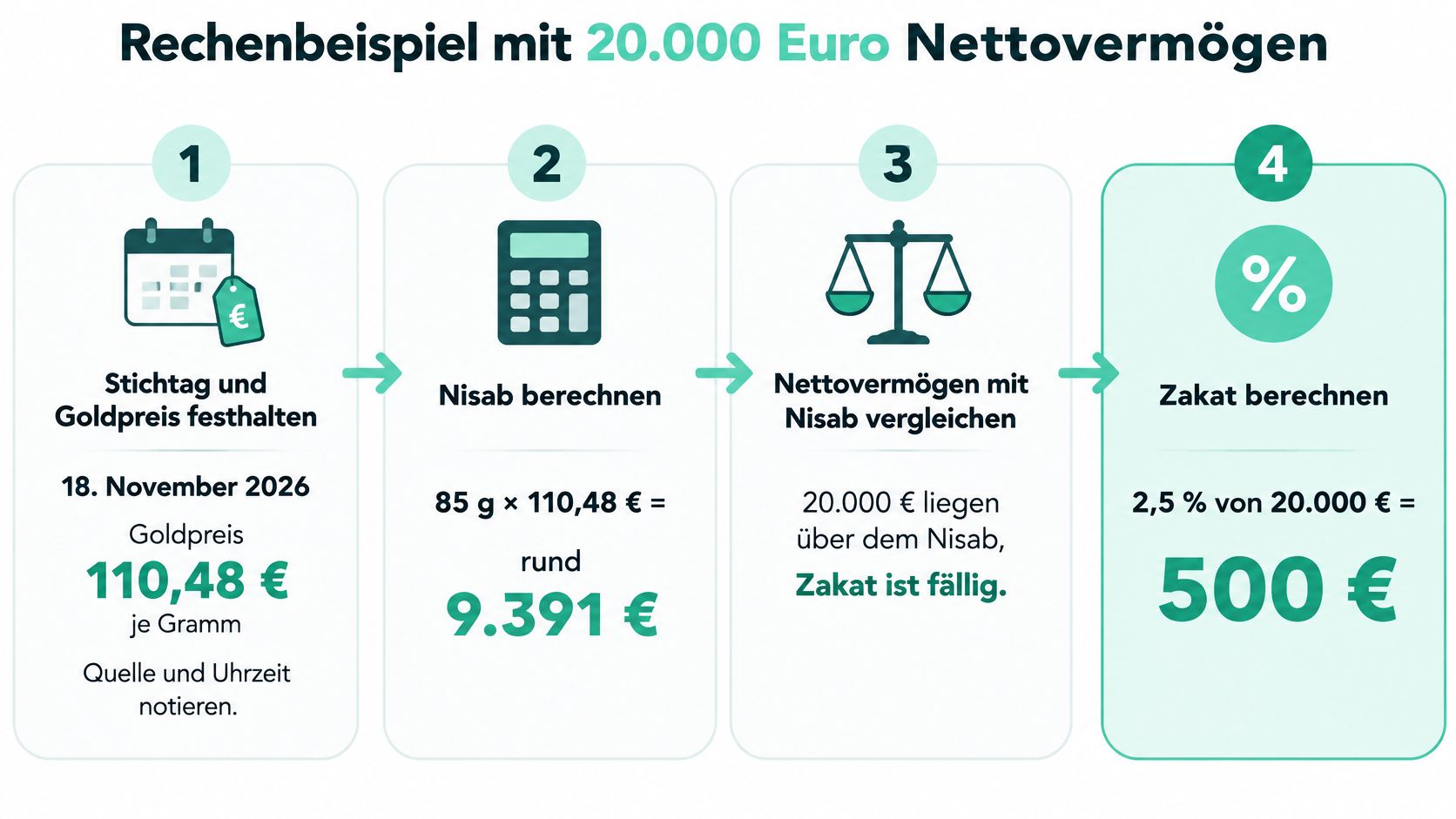
A gold price of about 110.48 EUR per gram as of November 18, 2026 serves as the reference, as stated by the calculation logic on the SadakaNow blog. This is a reference value for a calculation example, not a rate for every future reference date. Because the nisab in euros fluctuates daily, a calculation should record the metal price, source, timestamp, exchange rate and rounding rule; a subsequent recalculation with a different gold price can change the threshold.
Step 1, reference date and price. Record the date, note the price, add the source and time.
Step 2, nisab. 85 g × 110.48 EUR gives a gold nisab of around 9,390 EUR.
Step 3, record assets. Bank balance 14,000 EUR. Gold jewelry 40 g at 22 karat, meaning 36.64 g of pure gold × 110.48 EUR, around 4,048 EUR. Open receivables 3,000 EUR. Trading stock 2,000 EUR. Together 23,048 EUR.
Step 4, deduct debts. Due credit card debt of 2,000 EUR plus the installment portion of 1,048 EUR due within twelve months, together 3,048 EUR.
Step 5, net assets. 23,048 EUR minus 3,048 EUR gives 20,000 EUR. The figures are chosen so that this amount results, to make the rest easier to follow.
Step 6, comparison. 20,000 EUR is well above the nisab of around 9,390 EUR.
Step 7, holding period. Did the assets remain above the threshold for one Islamic lunar year? Only then does the final step follow.
Step 8, Zakat. 2.5 percent of 20,000 EUR is 500 EUR. This amount is also stated by the cited calculation logic for 20,000 EUR of zakat-liable net assets, provided nisab and hawl are fulfilled.
Under the Diyanet standard, the threshold would be lower. This does not change the result, since 20,000 EUR exceeds both thresholds. This is exactly why comparing methods is only worthwhile near the threshold.
Checking rule: A different gold price changes the nisab, not the assets. Both should be noted separately.
Checking the result and paying Zakat on time
Before the transfer, four questions arise. If each can be answered with yes, the figure is reliable.
- Is the Nisab documented? Method, price, date and source are recorded.
- Does the metal price match the reference date? For silver valuations, the silver price is entered as well, not just the gold price.
- Are only due debts deducted? Immediately due amounts and instalments for the next twelve months yes, long-term loans not across the board.
- Has the holding period been checked? The wealth stayed above the threshold for one lunar year.
A recalculation with a different price or a different Nisab method is permissible and leads to a different result. Those who know both variants can make a conscious decision instead of relying on a calculator's default setting.
When expert guidance is needed
Larger property assets, company shares and intertwined loan situations exceed what a formula can neatly capture. In such cases, the question belongs with a mosque community or with a scholar experienced in financial matters. This doesn't undermine the calculation. It prevents a wrongly chosen assumption from being carried along for years.
Paying and documenting
If the review results in a Zakat due, the payment goes to vetted, trustworthy recipients. The amount, date and recipient are noted so that it remains traceable the following year what has already been given. At SadakaNow, the platform does not touch the donated funds: the money is held in trust and paid out directly to the respective organisation. Those who prefer to give their Zakat during Ramadan can find suitable projects under Donating during Ramadan.
The calculation is repeated annually on the same reference date. Only this way does the Hawl remain traceable, and only this way does a one-time figure become a habit.
If you want to not only calculate your Zakat this year but also pass it on securely, you will find vetted projects from mosques and relief organisations in Germany, Austria and Switzerland at SadakaNow. The donation is processed without a platform fee via SEPA, PayPal or credit card, and the funds are held in trust and paid out directly to the respective organisation. Take your time to compare the project pages and choose the recipient that matches your calculation.