
Zakat al Fitr 2026: Amount, Deadline and Calculation
For 2026, the German Fatwa Committee sets Zakat al-Fitr at 10 euros per person. The recommendations of organisations that publish their own guideline values for the same Ramadan range between 9 and 13 euros per person.
Anyone who pays usually looks for a single figure and finds several. With each additional person in the household, the difference grows, and no one calculates it for you automatically. In Germany there is no state-set obligatory amount, no authority that prescribes a sum per head, and therefore no body to correct a wrong figure.
The way through this topic therefore runs through three stages: first the concept and purpose of the payment, then the conversion from the classic food measure into euros, then the deadline and the mix-ups that turn a well-intentioned donation into a late one.
Table of Contents
- Guideline values for 2026 and the amount for the household
- Meaning and purpose of Zakat al Fitr
- From the food quantity to the euro amount
- Who pays and by when the payment must arrive
- Correctly classifying money, goods in kind and Fidyah
- Check the guideline value and donate in time
Guideline values for 2026 and the amount for the household
The range of the guideline values given for 2026 runs from 9 to 13 euros per person. At first glance, this looks like a small difference. In a household of five people, however, this becomes 45 to 65 euros, a difference of 20 euros. The amount per person is therefore only half the calculation. What matters is how many people in the household are counted.
The German Fatwa Committee states 10 euros per person for 2026. The amount refers to the German food situation and serves as a guideline value, not an upper limit. lak24 reports on the Fatwa Committee's 2026 decision.
Other publications work with slightly different values. LIFE, referring to the CFCM, states 9 euros per person and gives a common range of 7 to 12 euros (LIFE on the importance of Zakat al-Fitr). barakah.ngo states amounts of 10 to 13 euros per person for Ramadan 2026 in Germany. For UNO-Flüchtlingshilfe, the overview lists a guideline value of 12 euros per person (UNO-Flüchtlingshilfe on Zakat al-Fitr).
The table shows how differently recommendations can turn out within the same Ramadan. It converts each amount for a household of five people.
| Source | Amount per person | Household of 5 people | Note |
|---|---|---|---|
| German Fatwa Committee | 10 € | 50 € | Guideline value for the German food situation |
| LIFE, referring to the CFCM | 9 € | 45 € | common range 7 to 12 € |
| UNO-Flüchtlingshilfe | 12 € | 60 € | Amount depends on local prices and eating habits |
| barakah.ngo | 10 to 13 € | 50 to 65 € | Recommendation for Ramadan 2026 in Germany |
Why several recommendations exist side by side
Several figures for one Ramadan are confusing at first. They become easier to understand if you treat them like different price indices. Each body bases its figures on its own assumptions, such as a different staple food, a different price level, or a different share of aid. The multiplication itself stays simple; the real decision lies in choosing the reference figure.
In practice, this approach helps: choose a source, note the amount per person, and multiply it by the number of people in the household. A child counts just the same as an adult or someone without their own income. The payment is calculated per head, not according to wealth.
Three households, calculated
The multiplication itself takes only a few seconds. But the range shows why it makes sense to set your own benchmark value beforehand.
- One person pays, depending on the benchmark value, 9 to 13 euros.
- A couple comes to 18 to 26 euros.
- A family of five lies at 45 to 65 euros, meaning a difference of 20 euros between the lowest and the highest benchmark value.
Whoever chooses the lowest value stays within the range mentioned. Whoever rounds up gives an amount that leaves more room. This is especially understandable when the chosen source gives its own range, such as LIFE with 7 to 12 euros or barakah.ngo with 10 to 13 euros.
Checklist for comparison: Without the calendar year, any figure is hard to classify, because benchmark values relate to a specific Ramadan.
- Note the year. 2026, not just "current".
- Record the benchmark value and source. So 9, 10, 12, or the range of 10 to 13 euros and the body that states the value.
- Check the basis of calculation. Does it state which food item and which price level are used as a basis?
- Multiply by household size. Every person in the household counts, not just the earners.
- Decide on rounding up. Yes or no, but consciously.
In the end, it's a simple calculation: amount per person times number of persons. Whoever notes the source can trace the sum later and compare it cleanly next year.
Meaning and purpose of Zakat al-Fitr
Zakat al-Fitr is often called Fitra or Fitrana in German. According to transmitted Islamic tradition, it was made obligatory in the second year after the Hijra (2 AH) and is therefore closely connected to the early community in Medina and the emergence of the Islamic lunar calendar (zakat.org on Fitrana).
Originally, the payment was not a sum of money but a Sa', traditionally about four double handfuls of a staple food such as dates or barley. Every Muslim was obligated, regardless of gender, age, and social status. From the very beginning, the payment was therefore directed at the individual person, not at the wealthy household.

A payment per head, not per wealth
The annual Zakat and the Zakat al-Fitr are often mentioned in the same breath, yet they are two different things. The annual Zakat is based on wealth and income; it has allowances and Nisab thresholds. Zakat al-Fitr has none of that. It is a payment tied to each person at the end of Ramadan, for which every person in the household counts individually, even a child, even someone without their own income.
The purpose is narrowly defined: those in need should receive support around the Eid festival, so that the celebration does not fail because of money. A family of five means five people, five payments, and a festive day on which no one goes empty-handed.
In German practice, the historical measure in kind is nowadays usually converted into a sum of money, because food prices and local distribution systems often replace a direct payment in kind. This is precisely why religious bodies and aid organisations publish their own benchmark values every year, and precisely why there is no uniform obligatory amount in Germany, but rather several values side by side.
The difference in one sentence: The annual Zakat asks how much you own. Zakat al-Fitr asks how many people live in your household.
Anyone who also wants to calculate the annual Zakat on their wealth can find the basics in the guide to Zakat on SadakaNow.
From the amount in kind to the euro value
The classic benchmark is a Sa' of a regionally common staple food per dependent person. A Sa' is a measure of volume, not a metric weight. It works like a measuring cup: how heavy the filled amount ends up being depends on what you put into it. Dates weigh differently than rice, so the conversion varies depending on the food and its density.
For Germany, typically 2.25 to 3 kg of rice, wheat, dates, or comparable staple foods per person are used, from which the local monetary value is derived. The UNO-Flüchtlingshilfe states for Zakat al-Fitr a benchmark value of 12 euros per person and at the same time emphasises that the amount and quantity depend on local eating habits and prices.
This is what the calculation looks like before it becomes a euro figure:
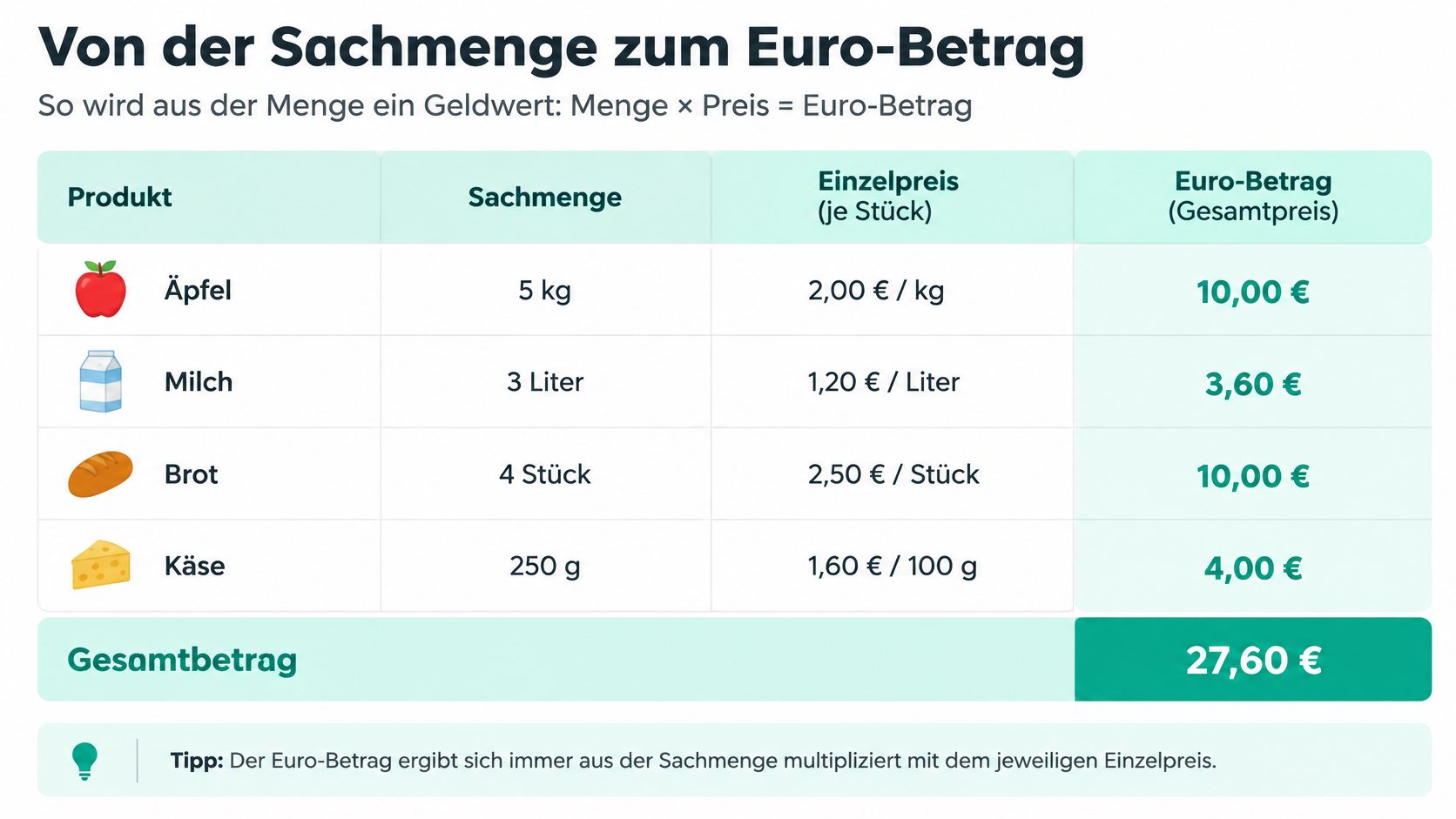
The amount can be read off for any household size.
| People in household | Amount at 2.25 kg per person | Amount at 3 kg per person |
|---|---|---|
| 1 person | 2.25 kg | 3 kg |
| 2 people | 4.5 kg | 6 kg |
| 4 people | 9 kg | 12 kg |
| 5 people | 11.25 kg | 15 kg |
For a family of four, this results in a quantity of roughly 9 to 12 kg. Only this value is then multiplied by a price per kilogram, and the result is the euro amount you transfer. At the stated reference value of 12 euros per person, this comes to 48 euros for the whole household.
The miscalculation in direct conversion
Anyone who translates the volume measure into euros without specifying the food item loses control over the quantity. A kilogram of dates and a kilogram of wheat differ widely in price, and a Ṣāʿ of dates weighs differently than a Ṣāʿ of rice. The difference disappears into the euro figure but never shows up on any receipt.
A transparent calculator or a transparent recommendation therefore shows at least the calculation year, the reference food item, the weight range, and the household size. If these details are missing, the figure isn't necessarily wrong, but it isn't verifiable either.
Five steps to your own figure
- Count the people. Everyone in the household, including children.
- Choose a reference food item. Rice, wheat, or dates — the important thing is that you name it.
- Multiply by the weight range. 2.25 to 3 kg times the number of people.
- Apply the local price. A community reference value or average price.
- Round up. A round amount, increased voluntarily, remains a valid payment.
A calculator should display the number of people multiplied by the regional reference amount and offer a rounding-up option. Anyone who can see the intermediate steps can pass the figure on without having to explain it anew each time.
A short video places the conversion in the context of the payment made at the end of Ramadan:
Who pays and by when the payment must arrive
The deadline is part of the obligation. The Zakat al-Fitr should reach those entitled to it before the ʿĪd prayer, or before the end of Ramadan, and it is not a time-unbound Sadaqa (Islamic Relief on Zakat). What matters is therefore not the moment you click "send," but the moment the money or food reaches a suitable recipient.
The following overview organises the situations that typically arise in a household here.
| Situation | Who pays | Latest point in time |
|---|---|---|
| Adult person in the household | the person themselves | before the ʿĪd prayer |
| Dependent child | household, per child according to the reference value | before the ʿĪd prayer |
| Online payment via SEPA direct debit | donor | submit early, credit may be delayed |
| Payment on the last evening of Ramadan | donor | before the ʿĪd prayer, ask the recipient about the acceptance deadline |
What goes wrong with SEPA and on the last evening
Payment methods have different crediting times. A SEPA direct debit needs lead time, a card payment is faster, and both routes don't end with the recipient but with an organisation that still has to forward the funds. Anyone who pays on the last evening has technically donated but still carries a risk: the distribution may no longer be organisable before the festival prayer.
You should ask the recipient three things before every payment: the acceptance deadline for Fitrana, the expected disbursement time, and the local time zone of the distribution area. A Ramadan guide from barakah.ngo describes exactly this gap. Many texts state that payment should be made before the Eid prayer, but don't explain how an online payment with processing time, weekends, and forwarding abroad fits into that.
What a household form must accomplish
The required amount is the same per person, regardless of income. A form should therefore record four things separately: household members, amount per person, payment status, and forwarding status. The last point is the most important and the one most often missing.
Rule of thumb: A payment is only fulfilled once the forwarding has been confirmed. Keep the confirmation with date and amount.
- Count the household.
- Set the amount per person.
- Pay early.
- Check the acceptance deadline.
- Keep the payment confirmation.
Classifying money, in-kind payment, and Fidyah correctly
Three terms lie close together and lead to three different mistakes. Anyone who keeps them apart ends up paying the right amount to the right place.
Fidyah is not Zakat al-Fitr
The Fidyah is paid for missed fasting days and is a separate obligation with its own basis of calculation. It does not replace the Zakat al-Fitr, and conversely, the Zakat al-Fitr does not cover a Fidyah debt. Anyone who owes both pays both separately and lists both items separately, even if both amounts go to the same organisation. The reason is simple: purpose, occasion, and group of recipients differ, and a mixed payment can no longer be cleanly attributed afterwards. How to calculate the Fidyah and distinguish it from the Fitrana is explained in the guide to Fidyah on SadakaNow.
What happens to the money
In Germany, the obligatory payment is usually paid as a monetary amount, which the receiving organisation then converts into food; Islamic Relief describes Zakat al-Fitr in this way. Whether the conversion actually happens depends on the respective recipient. Therefore, ask specifically whether your amount goes into food packages, vouchers, or direct distribution. An answer like "we distribute locally" is a start, but a specific region with a date is more reliable.
For projects abroad, proof matters
If the money goes to a project abroad, two more questions arise: Does it arrive in time before the holiday, and does it demonstrably reach needy households? A distribution report with date, region, and the form of aid, i.e. in-kind or cash, answers both questions at once. Without it, the donation remains a good intention with unclear impact.
The trust question: The decisive question is: When did which region receive food?
Check the guideline amount and donate on time
Anyone who knows their community's or organisation's guideline amount for 2026 can determine the amount for their household and submit the payment early. Nothing more is technically required. Three pieces of information should be noted at the end: the calendar year, the amount per person, and the number of people in the household.
In Austria and Switzerland, separate guideline amounts apply, which must be checked individually. Food prices and distribution channels differ, so German amounts cannot simply be transferred. There too, the calculation basis and year belong with the figure, otherwise it can no longer be classified by the next Ramadan.
How to plan a Ramadan donation so that it arrives before the holiday is explained in the guide to Ramadan donations on SadakaNow.
SadakaNow supports Muslim projects in Germany, Austria, and Switzerland and operates as a trustee: the company does not itself handle the donated funds; the money is held in trust and paid out directly to the respective organisation. Anyone who selects a Ramadan project there can see the goal and progress and can assign their own payment to a specific distributor.
Before each payment, check the submission deadline and payout time, regardless of the platform or organisation. Anyone who notes the calendar year, guideline amount, and household size and submits the payment early can fulfil their Zakat al-Fitr 2026 in a traceable and timely manner.
SadakaNow bundles Ramadan campaigns from verified mosques and aid organisations in the DACH region, with 0% platform fee and no deduction from the donation amount. Once you have calculated your Fitrana amount for 2026, you will find projects there with goals, progress, and updates, whose submission deadline is before the Eid prayer. Visit SadakaNow and choose a project whose distribution you can trace.