
Donations Austria: Tax Deductibility and Verified Projects
The most popular answer to the question of what a donation in Austria achieves for tax purposes is: up to 10 percent of income. The statement is correct and yet misleading, because it conceals the condition on which most donations fail. It describes the upper limit, not the starting point.
Anyone who wants to deduct donations in Austria first answers a different question: who is the recipient for tax purposes? It is not the good cause, not the charitable status, and not the platform that decides this, but the entry of the legal entity in the list of the Bundesministerium für Finanzen. The following sections guide you through this check, with the specific amounts, the requirements, and the cases in which a reputable project still has no tax effect.
Table of Contents
- When donations in Austria are tax-deductible
- How deductibility is regulated in Austria
- Recognising verified projects in Austria
- Platform, mosque, abroad, and SadakaNow compared
- Documenting the donation correctly after payment
- How Austria donates and what amounts are common
When donations in Austria are tax-deductible
Six cases cover almost everything donors encounter in everyday life. The table is sorted by recipient, not by amount, because that is exactly where the decision is made.
| Donation case | Deductible? | Upper limit | Requirement |
|---|---|---|---|
| Private individual to listed institution | Yes, as a special expense | 10% of total income | Recipient on the BMF list at the time of donation |
| Company to listed institution | Yes | 10% of profit before the profit allowance | Recipient on the BMF list and donation receipt |
| Charitable association without BMF listing | No | none, because not deductible | Charitable status alone is not sufficient |
| Mosque without a donation-privilege notice | No, without listing | none, because not deductible | Check the notice and listing of the organisation |
| Organisation from Germany or Switzerland | Not automatically | 10% of total income, but only with Austrian listing | Check Austrian recognition separately |
| Payment via platform to a listed organisation | Yes, if the organisation is listed | 10% as above | First and last name as well as date of birth are transmitted |
Two figures set the framework. Private individuals can claim eligible monetary donations of up to 10 percent of their total income as special expenses, companies up to 10 percent of profit before taking the profit allowance into account.
A calculation example makes the order of magnitude tangible. An employee with a total income of 40,000 euros can claim at most 4,000 euros as a special expense. If they give 5,000 euros to a listed institution, 1,000 euros remains tax-disregarded in that year.
Important for expectations: the recognised amount reduces taxable income, not the tax liability itself. How much actually comes back depends on the personal marginal tax rate. Anyone planning with the idea that the entire donation will be refunded is calculating too optimistically.
Order of the check: first the recipient, then the upper limit, then the formalities. Anyone who reverses this order optimises an amount that in the end does not count at all.
The table is therefore read from left to right as a filter. First the question of whether the legal entity is listed. Then whether the amount is within the limit. Only last the details of name and date of birth, which are needed for the report. The form of donation decides nothing here: cash, bank transfer, or card payment change nothing about the outcome, as long as the recipient is correct.
How deductibility is regulated in Austria
The BMF list works like a guest list in front of a hall. Those on it get in. Those missing stay outside, even if they have been doing the same work for years with the best of intentions. The list is therefore not a quality judgement about an organisation, but a snapshot of its tax status.
Charitable status alone is not decisive. According to the rules summarised by the Federal Ministry of Finance in the Spendenservice, contributions are only deductible if the institution is legally favoured or holds a valid donation-favouring notice at the time of the donation and appears on the BMF list. Private individuals can deduct favoured cash donations of up to 10 percent of their total income, companies up to 10 percent of profit before taking the profit allowance into account.
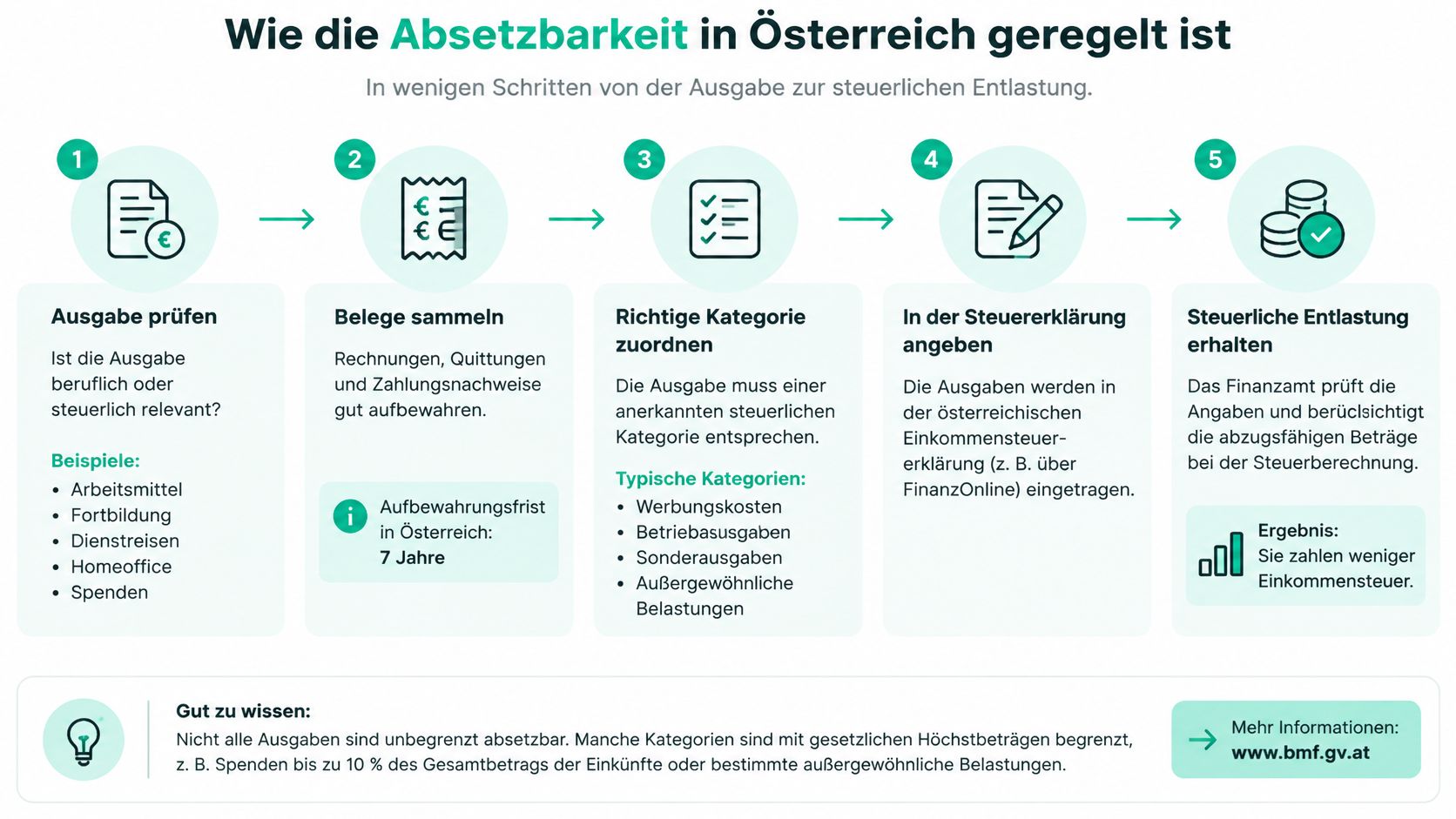
Four stages from payment to credit
The path of a favoured donation is a chain. If one link breaks, the donation does not arrive, even though the money has been transferred.
- The donation goes to the listed body. The recipient must be the recognised institution itself, not an intermediary.
- First and last name as well as date of birth are transmitted. This information creates the assignment to the taxable person.
- The body reports the donation electronically to the tax office. This happens collectively for the year, not per payment.
- The tax office includes the amount in the employee assessment. A separate application is not necessary as long as the data is correct.
The most common mistake occurs at stage two. A name spelled differently than in one's own records, or a missing date of birth, means the donation cannot be assigned to a person. It does not disappear, it simply does not arrive where it is supposed to take effect.
This short video allows you to go through the process once more at your own pace.
After the end of the year, it is worth checking your own tax records: the transmitted amounts appear in the employee assessment and in the notice, separated by organisation. If an entry is missing, the first step is to contact the body, not the tax office. That is where the report is held, and that is where a correction can be arranged.
Recognising audited projects in Austria
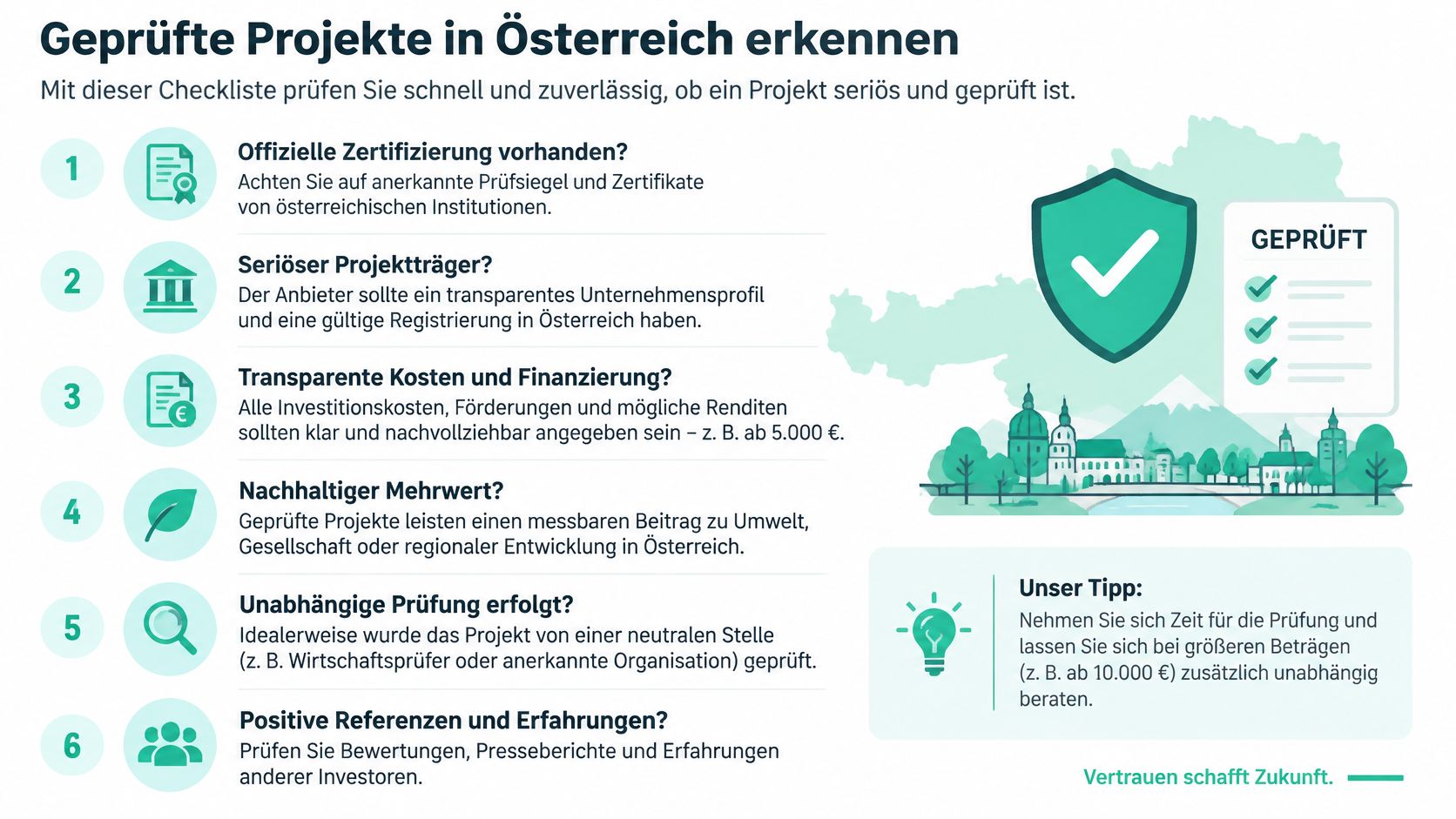
Two questions run in parallel with every donation and are often mixed up in everyday life: Is the project reputable? And is the donation tax-deductible in Austria? Both can be checked using a handful of details that are publicly accessible within a few minutes.
| Checkpoint | Where to find it | Why it matters |
|---|---|---|
| Entry on the BMF list | List of favoured institutions on bmf.gv.at | Only listed recipients make donations deductible |
| Donation-favouring notice | Request to the body, copy of the notice | Proves recognition at the time of the donation |
| Legal entity and imprint | Imprint of the platform and project page | Shows who actually receives the money |
| Platform's verification note | Project page and campaign description | Shows that charitable status was verified before publication |
| Purpose restriction | Project description and proof of use | Donations may only be used for the stated purpose |
| Project updates | Progress reports with images and evidence | Shows what happened with the donation |
The first point is the only one that decides on the tax treatment, and it is public. The list can be searched using the name of the legal entity; searching by the campaign name will not find anything. If the imprint names an association whose spelling or legal form differs from the entry, a second look is worthwhile, because it is always the legal entity that is listed, never the individual project.
Where the two checks diverge
A short email to the body helps with the notice. The donation-favouring notice is not a confidential document. Every recognised institution can provide a copy or at least state the registration number. If no answer comes, that is already an answer in itself.
The imprint and the project page should be read together. The imprint names the party responsible, the project page names the recipient of the money. If the two differ, the question arises as to which legal entity ultimately receives the donation. The platform's verification note states that charitable status was checked before publication. It says little about current listing, because an organisation's status can change.
Purpose restriction and updates are the softer part of the check, but not an unimportant one. A body may only use a purpose-bound donation for the stated purpose, so the project description should be able to name that purpose in one sentence. Progress reports with images, figures and evidence later show whether the money arrived there. Those who give regularly can specifically find donation projects that disclose this information from the outset.
A project can work reliably for years and still not be on the list. The two checks run separately and can arrive at separate results.
Those who only check reputability donate to a good project but may forgo the tax benefit. Those who only check the list have clarified deductibility but still know nothing about the work on the ground. Only both perspectives together make up an audited project.
Platform, mosque, abroad and SadakaNow compared
The common assumption is: anyone who donates to a non-profit project will also receive tax recognition for the donation. This is not correct. An everyday case shows why. A donor in Vienna transfers 50 euros via a platform to a mosque association in Linz. The project page states "non-profit", the association is registered in the register of associations, and the work is worthwhile. For tax purposes, however, only one question matters: is this association itself listed in the BMF list at the time of the donation?
The Federal Ministry of Finance states the condition unambiguously in its overview on the deductibility of donations: private donations are generally only deductible as special expenses if the recipient is either legally privileged or appears in the BMF list of tax-privileged institutions at the time of the donation. A payment made through a platform is therefore not automatically privileged.
Three roles that must be kept apart
The most common misconception arises because in everyday life three participants merge into a single address. For tax purposes, they must be treated separately.
- The platform processes the payment. It does not accept the money as the recipient but holds it in trust until it is paid out directly to the organisation.
- The campaign organiser presents the project, writes the text, and answers questions. This can be the organisation itself, a supporting association, or a community.
- The legal entity is the tax recipient. Only its listing counts.
In the example from Vienna, the platform is a service provider, the campaign organiser is possibly a support association, and the legal entity is the mosque association in Linz. If only the support association is on the list, that does not help if the money goes to the association. If the association is on the list, the donation is deductible, regardless of which page it was received through.
Why non-profit status abroad is not enough
Recognition in Germany or Switzerland does not necessarily replace the Austrian one. Non-profit status is regulated nationally, and the BMF list only includes institutions that have gone through the Austrian procedure. Anyone donating to an organisation based abroad should therefore check the Austrian recognition separately, instead of relying on the foreign seal.
There is also a practical point. The automatic inclusion in the tax assessment requires that the institution actually reports the data. For an organisation without an Austrian presence, this cannot be taken for granted. In this case, the confirmation with the name of the organisation, the name of the donor, the amount, and the date belongs in one's own records, since it may need to be presented personally in case of doubt.
How SadakaNow handles the processing
SadakaNow connects donors with projects by Muslims in Germany, Austria, and Switzerland. Donors choose a project, enter an amount, and pay by SEPA, card, or PayPal. All campaigns are checked for non-profit status before being activated, and project updates later show what has happened with the donation. The platform itself does not touch the donated funds. The money is held in trust and paid out directly to the respective organisation. The only deductions are the costs of the payment service provider, which are transparently shown in the donation form. Anyone wishing to start their own campaign can find the necessary steps in the guide on collecting donations on a platform.
This check answers the question of credibility; the tax question remains separate. Even a verified and regularly updated campaign is only deductible if the legal entity behind it is on the BMF list. For the donor from Vienna, this means specifically: she can rely on the verified non-profit status and must still check for herself which association stands as the recipient behind the campaign and whether exactly that association is listed.
For recurring donations: Check the legal entity carefully once, not again with every monthly payment. The status rarely changes, but one's own attention fades quickly.
When the platform is not the right choice
Not every donation needs an intermediary. Anyone who wants to support only a specific institution outside the platform should donate there directly and check the same legal entity on the same list. Anyone who needs a personal receipt with a signature for a one-time action is also better off going directly to the institution rather than using any online form.
The decision depends on whether the recipient is named, listed, and reachable. If any of these three points is unclear, the donation has not yet been decided.
Properly documenting the donation after payment
The tax side is not complete once the transfer is made. Five steps secure the result, and none of them takes longer than a minute.
- Save the receipt immediately. File the confirmation or donation receipt right after payment, with the date and amount in the file name.
- Enter the details exactly. Write first and last name as well as date of birth exactly as they appear in your own tax records. Discrepancies prevent automatic matching.
- Check that it was carried over. After the end of the year, check whether the donation appears in the employee tax assessment. That is the moment that shows whether the chain held.
- Have errors corrected by the organisation. If something is wrong, contact the organisation first. For questions about payments or data on the platform, our team can help at hilfe@sadakanow.de.
- Keep separate records for businesses. Because the upper limit is measured against profit, donation receipts belong in their own file separate from the bookkeeping.
An example shows why step two carries so much weight. A donor gives 300 euros, but her date of birth is entered incorrectly during registration. The donation goes through, the project is supported, but automatic consideration is lost. She has to correct the error herself, even though she did everything right. How a correct certificate looks and what an association must issue is explained in the guide to donation certificates issued by associations.
The decision facing anyone before their next donation is therefore simple: first check the legal entity on the list, then enter the amount.
How Austria donates and what amounts are typical
Austria's donation sector reached a total volume of around 1.07 billion euros in 2024, as recorded by the European fundraising survey by efa-net. This was 0.5 percent below the previous year's figure, yet still the third-highest result since the annual surveys began.
Looking at the long-term trend puts the slight decline clearly into perspective. Between 2008 and 2022, the annual donation volume rose from around 360 million euros to about 1.1 billion euros. This meant Austria crossed the one-billion-euro mark for only the third time. The decline starting in 2023 is linked to high inflation, economic stagnation, and several international crises.
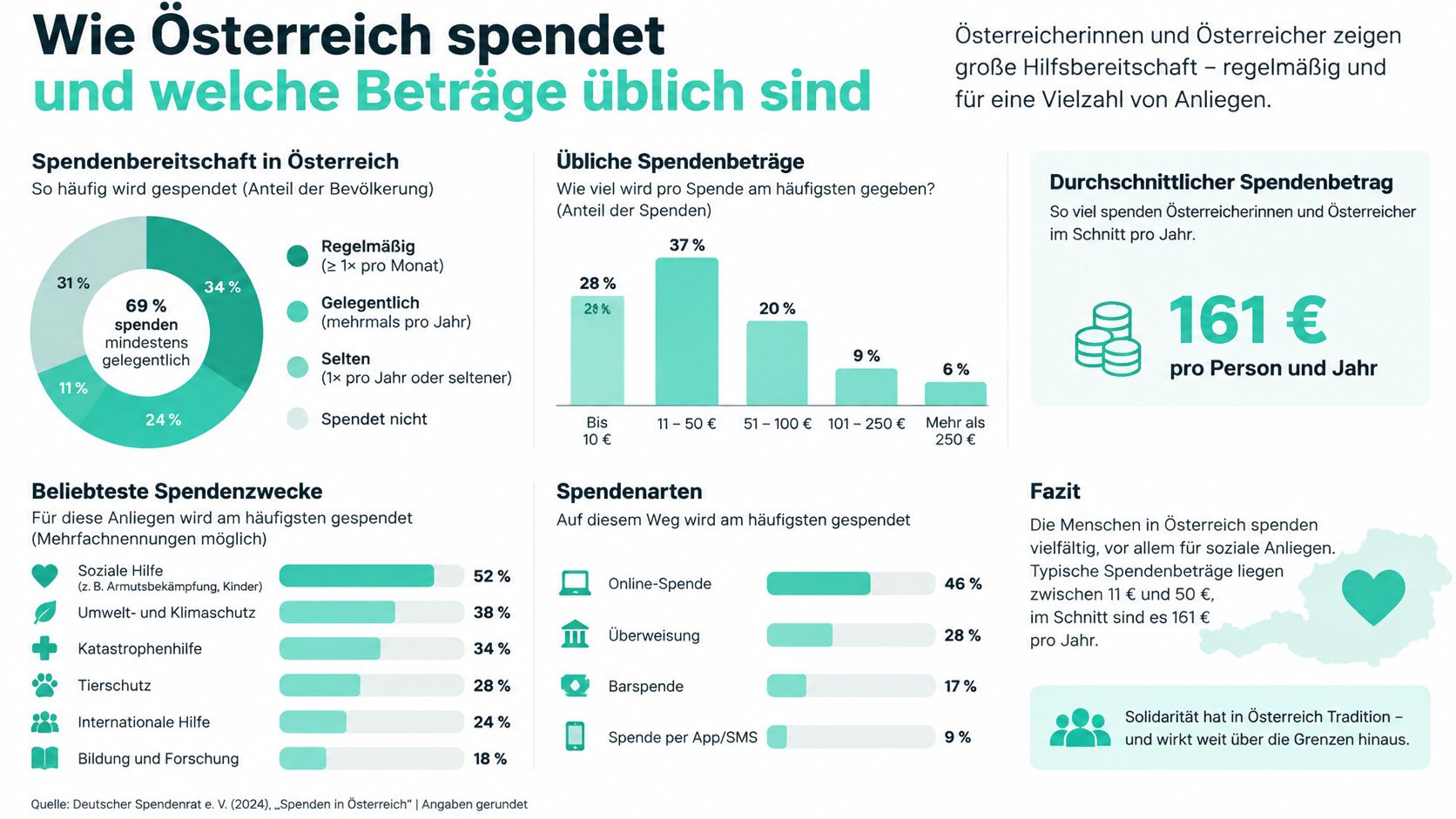
What stands out is how broadly this volume is carried. According to the donation report by the Fundraising Verband Austria, 79 percent of the population donated in 2024, the highest share ever measured. The amounts, however, remain small: 81 percent of all donations were under 200 euros, and only 2.6 percent exceeded 1,000 euros.
- West: average of 202 euros per donor
- Vienna: 119 euros
- Lower Austria and Burgenland: 109 euros
Crises shift resources between different areas. In 2024, flood relief as well as environmental and animal protection received particular attention, while development cooperation saw less support. For the individual donor, this leads to nothing surprising: small, recurring amounts are the norm, and a clearly stated designated purpose is exactly what keeps this norm functioning.
Anyone planning their next Sadaka donation should first check the legal entity and then choose a way that openly states this entity, its Austrian tax status, and how the funds are used. At SadakaNow, you can see before payment which organisation stands behind a campaign, and every campaign is checked for charitable status before it goes live. Visit SadakaNow and support a project whose recipient you can name.