Comparing Donation Apps: Fees and Security
More than half of digital donations were made via mobile devices, reports the Digital Fundraising Study in the 2025 Donation Report, based on the transaction data of participating non-profit organisations from Germany, Austria and Switzerland for 2024. A donation app therefore has to achieve more than a nice project directory: it must reliably map the path from the wish to donate to a traceable payment.
As a donor, three outcomes matter most to you: the lowest possible costs, a clearly named recipient and a usable tax receipt. What matters is not how quickly you can tap "Donate", but whether you know afterwards who receives which amount and who issues you the donation receipt.
Table of Contents
- Donation app criteria at a glance
- Fees and costs in direct comparison
- Payment methods by use case
- Checking security, escrow and data protection
- Verification of organisations step by step
- Securing tax receipts for donations
- Which donation app suits your situation
Donation app criteria at a glance
A donation app is suitable if fees, payment methods, organisation verification, flow of funds, data protection and receipts are clearly regulated. Compare these points for each app using the same grid. An unknown value is not proof of a bad offer, but it is a reason to look more closely before paying.
The following overview lists our reference values. It does not replace an independent security test or a review of the individual project.
Decision criteria for donation apps
| Criterion | What specifically counts | SadakaNow reference value |
|---|---|---|
| Platform fee | Share deducted from the donation amount | 0%, the donation amount is forwarded in full |
| Payment methods | Available methods and their suitability | SEPA, PayPal, credit card |
| Verification | Checking non-profit status before activation | Mandatory review of every campaign |
| Escrow model | Who holds and pays out the money | Fiduciary custody and payout directly to the organisation |
| Data protection and security | Encryption, payment standards and data protection rules | SSL, PCI-DSS Level 1 and GDPR compliance according to provider information |
| Tax receipt | Who issues the donation receipt | The legal recipient of the donation, or the responsible intermediary body, is decisive |
Why the criteria belong together
A low platform fee is of little help if the recipient remains unclear. Conversely, a well-known organisation does not automatically make an opaque payment process unproblematic. Costs, recipient and payment processing must fit together.
The Impact Report of the DZI Spendenberatung also offers a meaningful benchmark for trust: digital accessibility replaces neither traceable use of funds nor the careful assessment of an organisation. For your comparison, this means: check not only the app, but also the body behind the campaign.
The separation between platform and fund management is particularly important. If an operator itself collects money and distributes it later, different questions arise than in the case of a payout via an external payment service directly to the organisation. The term Treuhand (fiduciary trust) alone does not explain who is allowed to dispose of the money.
Checking rule: A comprehensible explanation of the flow of money is more valuable than a security logo without a traceable scope.
Your questions before the first payment
- Recipient: Which legal entity receives my donation?
- Costs: What is deducted, what is charged additionally, and what is voluntary?
- Payment methods: Does the offered method suit my one-off or regular donation?
- Oversight: Who checks the organisation, and how extensive is this check?
- Proof: Who issues me which certificate?
Save the answers together with the project description. This allows you to later cross-check the payment receipt, the donation purpose, and the recipient, instead of having to rely on a project page that may have since changed.
Fees and costs in direct comparison
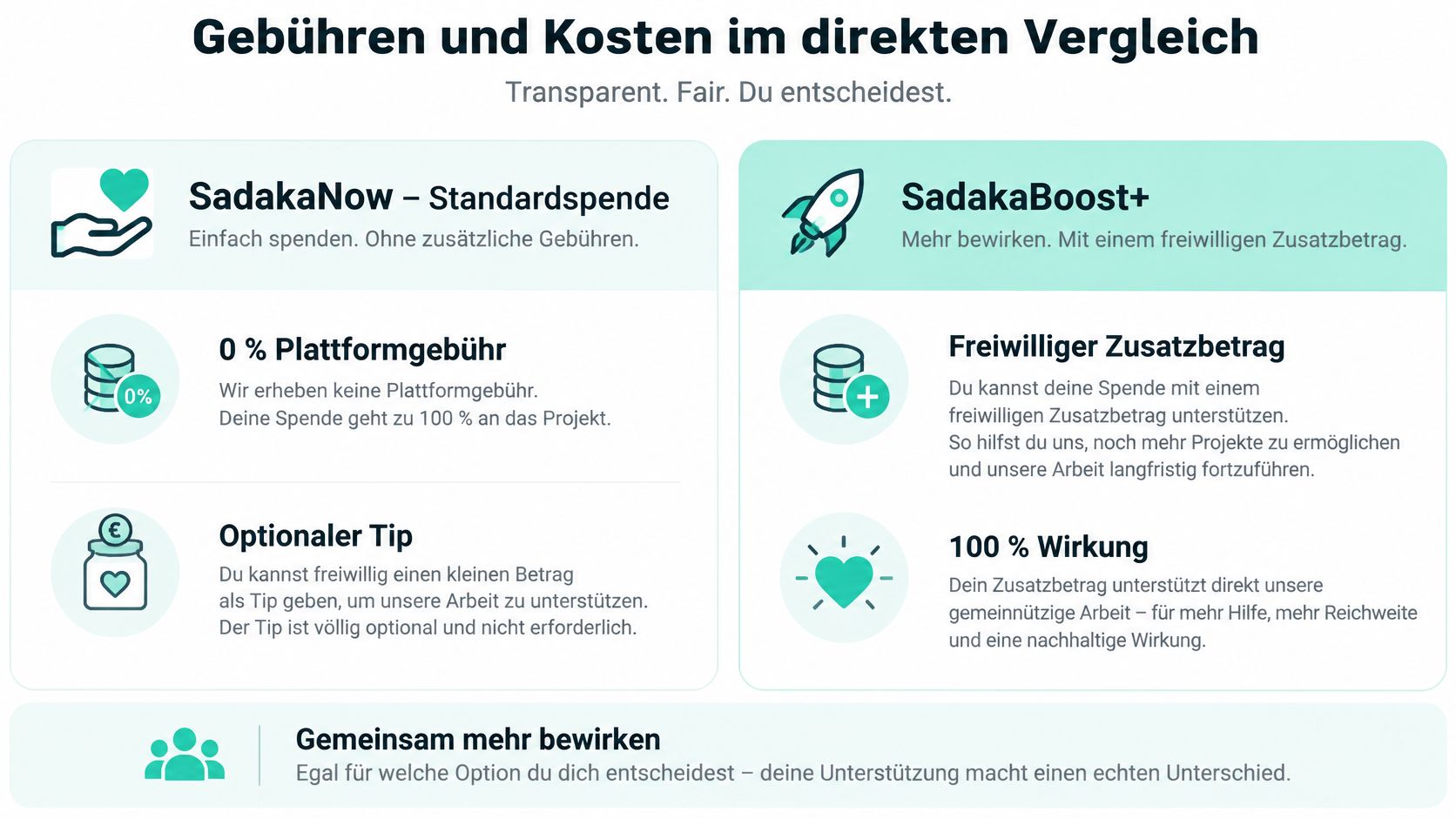
| Model | Platform fee | Additional costs for donors | What reaches the project |
|---|---|---|---|
| Our standard donation | 0 % | Optional voluntary tip | Full donation amount, undiminished |
| Our donation with SadakaBoost+ | 0 % | Voluntary additional amount | Donation amount undiminished; additional amount goes specifically towards advertising for projects |
| Our premium model for organisations | Individual offer; note the treatment shown in the donation form | One-off setup fee and ongoing monthly fee for the organisation, price on request | The offer and the processing stated in the form are decisive |
| Other donation apps | Check the respective provider's fee schedule | Record mandatory surcharges, voluntary contributions, and possible payment service costs separately | Donation amount minus costs actually withheld |
The table compares cost models, not independently tested providers. For other apps, specific fees remain unclear as long as no reliable price list is available. For our premium model, an individual offer is created after an initial conversation; the setup is charged once at the start, the monthly fee on an ongoing basis.
The annual statement instead of the small percentage
Calculate fees over your entire donation year. The following example is a hypothetical comparison calculation, not the price of another provider: with a donation of 100 euros and a 0 % platform fee, 100 euros of the donation amount remains; with an assumed 5 % deduction, 95 euros remains.
The difference becomes even clearer with regular payments. Suppose you donate 50 euros twelve times, i.e. a total of 600 euros per year. A hypothetical deduction of 5 % corresponds to 30 euros; 570 euros remains with the project, provided no further deductions occur.
However, this calculation only answers the question of the percentage platform deduction. A fixed amount per payment, an additional payment to the operator, or costs at the payment service change the result. A fee-free platform is not automatically a completely cost-free payment process.
A voluntary tip is not a mandatory fee
Our funding model allows you to voluntarily round up the donation amount and add a tip. Nevertheless, check deliberately in the form whether an additional amount is selected and what total amount you are authorising. Voluntary means that you decide the contribution yourself.
With the additional offer for project advertising, the voluntary amount has a specific purpose: it goes towards marketing for projects. This should be distinguished from the actual donation, even if both are selected during the same payment process.
Compare both the amount reaching the project and the total charge to your account. These are not always the same figures.
A small table or spreadsheet is enough for your own comparison:
- Determine the annual donation: Multiply the planned amount per payment by the number of payments.
- Calculate deductions: Multiply the annual amount by the stated fee share and add fixed deductions.
- Separate additional contributions: Note voluntary tips separately as their own expense.
- Consider the payment service: Check who bears any possible transaction costs and whether they reduce the project amount.
This way you compare offers based on your actual donation behaviour, not on an isolated promotional statement.
Payment methods by use case
Choose your payment method based on your intention, not the most eye-catching button in the form. With us, you choose a project, enter an amount, and pay via SEPA, PayPal, or credit card. Which method makes sense depends mainly on recurrence, account availability, and personal payment habits.
The Bundesbank analysis on payment behaviour attributes around 50% of online purchase transactions to electronic payment methods and 30% to direct debit or bank transfer. This is not specific donation-app data, but it illustrates why a single payment method does not cover different preferences.
Which method suits which donation
| Payment method | Suitable use case | Check before confirming |
|---|---|---|
| SEPA direct debit | Regular Sadaka from a suitable bank account | Mandate, interval, recipient, and option to cancel |
| PayPal | Spontaneous one-off donation on a smartphone | Stored payment source and final total amount |
| Credit card | Familiar card payment or donation from abroad | Accepted card, billing currency, and possible fees from the card provider |
SEPA is convenient if you want to plan regular support firmly. However, a mandate and a recurring donation order are not the same thing: check whether you are only authorising a single direct debit or actually setting up a recurring payment.
PayPal suits a spontaneous donation appeal that you open on your phone. Anyone who already has an account does not need to re-enter their bank details in the donation form. Still, check which payment source PayPal is using.
The credit card is an alternative for people who prefer to pay by card or who do not have an account suitable for the offered direct debit. However, an address abroad alone does not guarantee a successful payment. What matters is the accepted card and the terms of the payment service.
How to simplify your ongoing administration
Ask yourself these questions before choosing:
- Recurrence: Should the donation stay a one-off or run regularly?
- Account access: Can and do I want to grant a SEPA mandate?
- Foreign connection: Which offered method works with my account or my card?
A payment process limited solely to a mobile wallet excludes people who specifically want to donate by direct debit. Conversely, a lengthy account entry is unnecessarily cumbersome for a spontaneous phone donation.
I would use a fixed payment method for each regular donation relationship wherever possible. This makes it easier to match debits and queries. Any fees charged by the payment service provider should be checked separately; a flat figure would not be reliable without specific conditions.
Checking security, escrow, and data protection
An encrypted connection protects the transmission, not automatically the trustworthiness of the recipient. Therefore, check technical security and the flow of money separately. A professionally designed form does not yet answer who processes your data or who can access the donation funds.
What the security terms actually explain
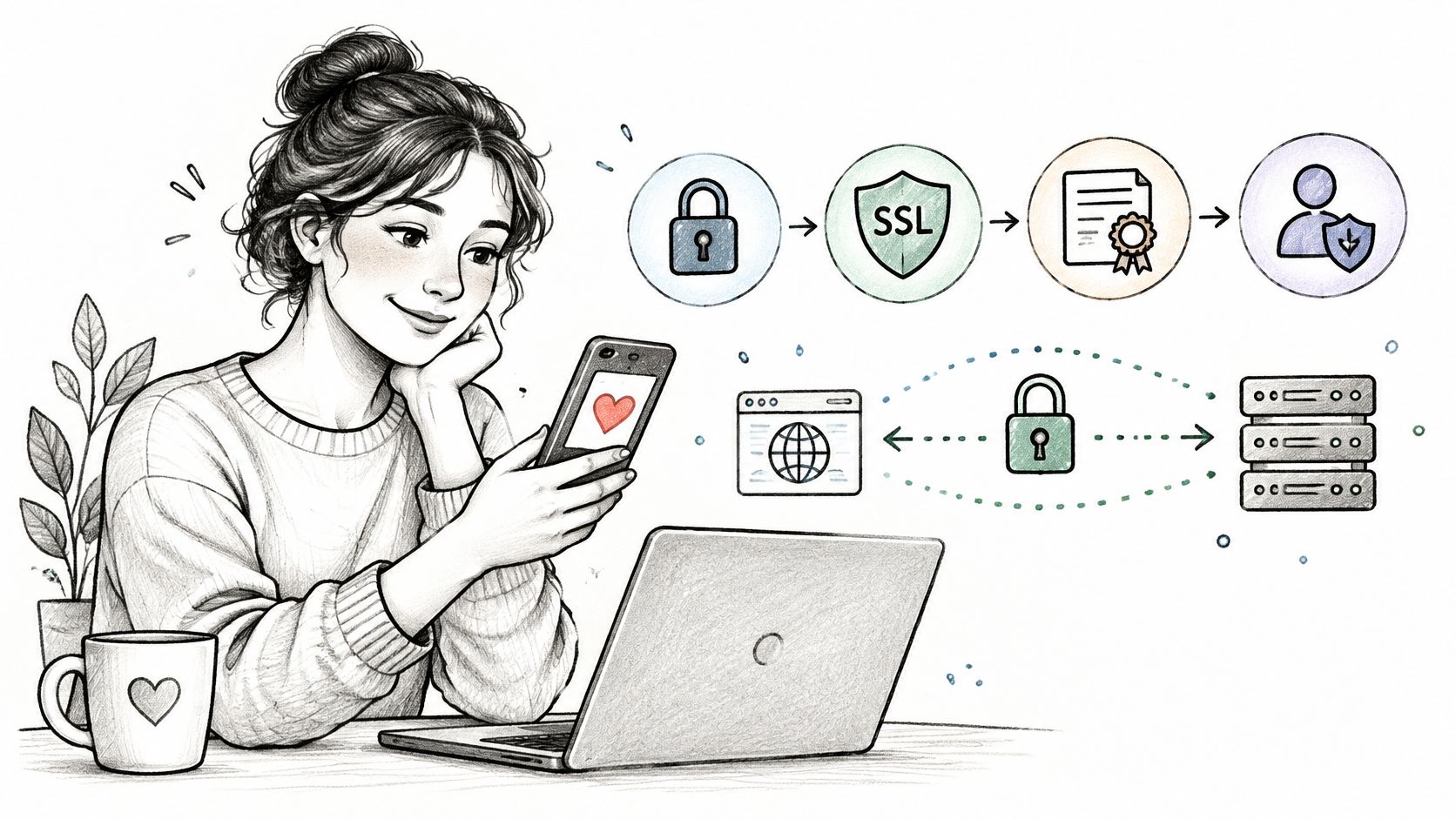
SSL is the common term for the encrypted connection; technically, TLS protocols are used for this today. Look for HTTPS and your browser's connection information. Depending on the browser, a lock or another symbol will appear; you should not ignore a warning about the connection.
PCI-DSS concerns the handling of payment card data. Our security information states PCI-DSS Level 1. To interpret such a statement correctly, it is important to know which payment service or technical area it refers to, since it does not provide a general guarantee for every function of a platform.
GDPR compliance cannot be read off from a single symbol. Read the privacy policy to find out who is responsible, which payment service providers receive data, and how you can request information or deletion. Statutory retention obligations can prevent immediate complete deletion.
Who holds the money and who can access it
With us, donation funds are held in escrow and paid out directly to the respective organisation. We do not touch the donation funds ourselves. The organisation alone is the payment service user vis-à-vis the payment service provider; MoreDonate GmbH has no access to the donation payments.
This division of roles is more concrete than the word escrow. With every app, you should be able to determine who is the contracting party of the payment service and to whom a payout is made. Do not transfer money to a different recipient just because their account details were sent to you afterwards by message.
Security decision: If the project sponsor, payment details, and legal notice do not plausibly match, clarify the discrepancy before making the payment.
The operator of our platform is MoreDonate GmbH, Carl-Zeiss-Straße 2, 33758 Schloß Holte-Stukenbrock. Compare such details with the legal notice of the website you actually opened, not just with a search result.
Clear checkpoints are enough for your review:
- Legal notice: The operator, address and contact details must be verifiable.
- Privacy policy: The responsible party and payment service provider should be identifiable.
- Security information: Pay attention to the scope rather than just the logos.
- Flow of funds: Clarify who is the payment service user and who is the payout recipient.
You can find further practical checkpoints in our guide on safe online donating.
Verifying organisations step by step
An organisation check is a trust signal, but not a guarantee for every statement made in a campaign. With us, all campaigns are checked for non-profit status before being activated. For your decision, it also remains important whether the project description, the operator and the evidence all fit together.
How to check a specific project
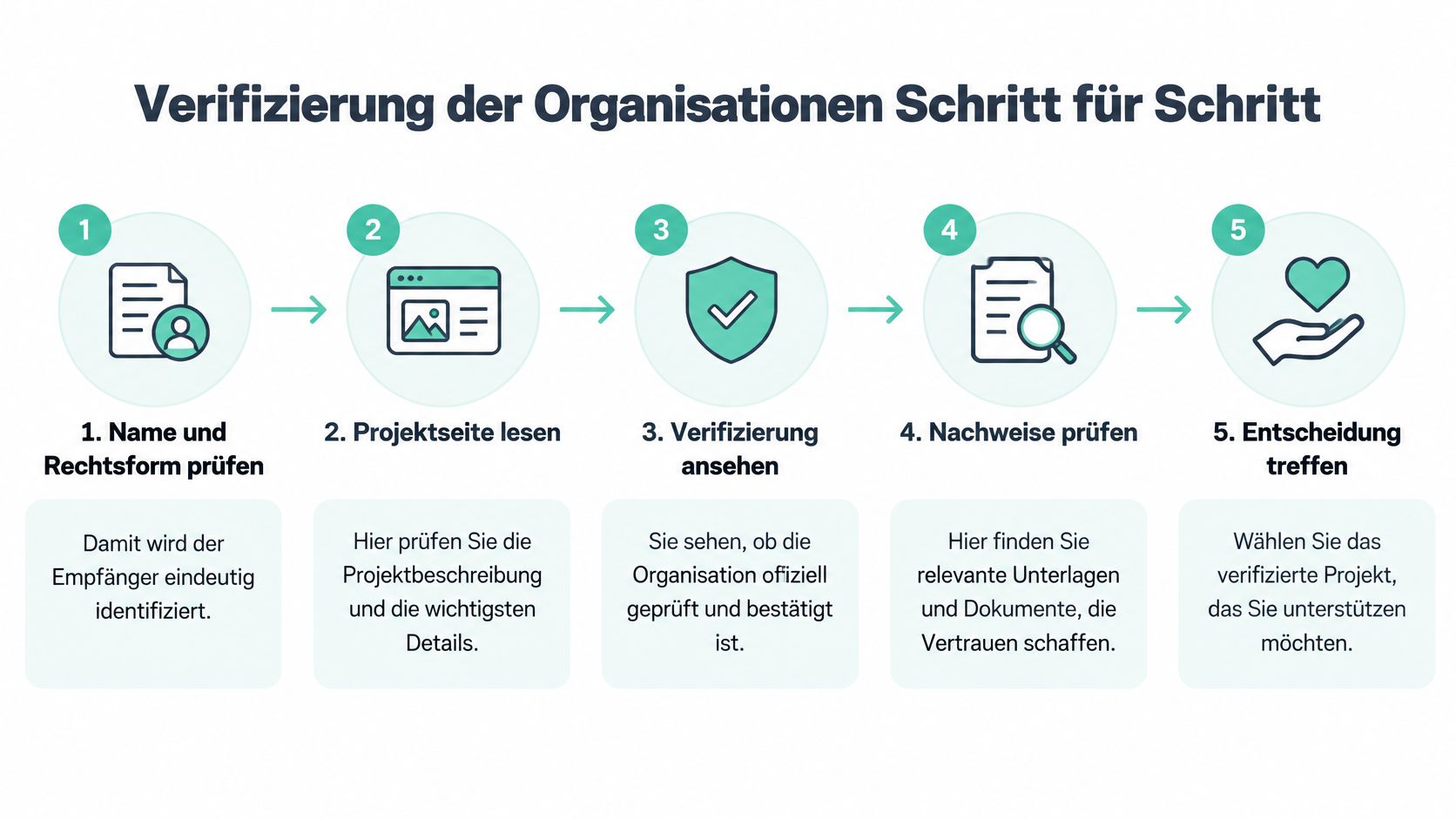
Read the name and legal form. Look on the project page for the full name of the operator. A mosque may have a different name from the association that runs it. This distinction helps you identify the actual recipient.
Put the verification into context. Check what exactly a confirmation refers to. Our mandatory review concerns non-profit status before activation. You should not infer from this a comprehensive assurance about the later implementation of every single project goal.
Compare the project goal with updates. Don't just read the headline and the progress bar. If, for example, a water project is being promoted, the description and later reports should make clear which measure is being funded and how the operator documents progress. A full donation bar alone is not proof of completed implementation.
Request evidence specifically. If the identity remains unclear, ask for the association register entry or a current proof of non-profit status. These documents answer different questions: a register entry identifies the association, while tax-exempt recognition must be assessed separately.
Report irregularities specifically. If you have questions or notice contradictions, write to hilfe@sadakanow.de. Name the project, the statement in question and the reason for your doubts. A specific report provides a verifiable basis for a renewed review.
Our article on verified donation organisations helps you tell apart organisation status and project transparency.
Where the review has its limits
The non-profit status check must be distinguished from a complete legal and factual content review. MoreDonate is not obliged to check donation appeals for all legal or factual statements before publication. After publication, a review is usually carried out when there is a specific reason or following a report.
A donation appeal can also be rejected after publication. Reasons include, among others, doubts about authenticity or transparency, legal or rule violations, as well as contradictions between the purpose, the organisation and the submitted evidence.
Therefore, decide based on verifiable information, not solely on a verification mark. Missing updates are initially a reason to ask a question. Contradictory recipient details or irreconcilable documents, on the other hand, should be clarified before making a payment.
Securing tax evidence for donations
A bank statement is not sufficient in every case, and a note about tax deductibility is not itself proof. According to the income tax guidelines of the Federal Ministry of Finance on § 10b, donations must generally be proven by a donation confirmation in the officially prescribed format; a machine-generated confirmation requires the designated procedure, which must be registered with the tax office.
The following notes concern German tax evidence. Anyone liable for tax in Austria or Switzerland must check the requirements there separately.
Donation confirmation by recipient type
| Recipient | Certificate | Issuer | Check in advance |
|---|---|---|---|
| Registered non-profit association | Donation confirmation according to the official template | The association | Proof of non-profit status |
| Mosque or public-law corporation | Donation confirmation according to the official template, if duly authorised | The legal recipient | Legal form and tax status in the individual case |
| Collective donation via a platform acting as a pass-through body | Donation confirmation only from the pass-through body | The pass-through body | Whether it is actually a pass-through donation and who the pass-through body is |
| Campaign without tax-deductible status | No tax-deductible donation confirmation | Not applicable | Status of the campaign and of the recipient |
The recipient decides on the proof
With a non-profit association, the association is the contact point for the confirmation. Registration as an e. V. alone does not answer the question of non-profit status. So clarify the tax status, not just the name of the association.
A mosque first of all refers to the institution, not necessarily to a specific legal form. The recipient might, for example, be a supporting association. Even with a public-law corporation, you should check the specific recipient and its authorisation to issue a confirmation.
With a collective donation via a pass-through body, what matters is the legal handling. Not every platform that provides a form is automatically such a body. An ordinary payment confirmation from the platform is therefore not the same as a tax donation confirmation.
A campaign without tax-deductible status can still pursue a worthwhile cause. However, this does not create any entitlement to a tax-deductible certificate.
Organising digital documents and regular Sadaka
For a digital confirmation, the requirements of the permissible issuing procedure must be met. An automatically sent email with payment details is not, on its own, a valid tax proof. Ask explicitly for the donation confirmation, not just a receipt confirmation.
In particular, check the name and address of the issuer and of the donor, the amount and date of the donation, as well as the details on the tax-privileged use according to the relevant official template. A list of this data that you compile yourself does not replace the prescribed document.
- Collect payments: Export your payment overview regularly, for example monthly.
- Organise documents: Archive confirmations by recipient and tax year.
- Clarify gaps: Reconcile the overview with the confirmations received in good time.
Our guide on the donation confirmation of an association will help you prepare. If the pass-through arrangement is unclear, if recipients are abroad, or for specific tax questions, you should consult a tax advisor.
Which donation app suits your situation
For regular donations to vetted projects, our platform is a suitable choice if the fee model, organisation vetting, and direct debit fit your plans. From this, no single best donation app can be derived. For a well-known local association, its own donation channel can be just as sensible or even simpler.
Recommendation by situation
| Your situation | Suitable choice | Decisive reason |
|---|---|---|
| Regular Sadaka to vetted mosques and aid projects | Our platform | Fee model, mandatory vetting, and direct debit suit regular donating |
| Organisation is launching a campaign | Our campaign launch service | Support with the launch, possible within 24 hours according to the provider's information |
| Organisation needs its own page and analytics | Our Premium offer | Individual offer after an initial conversation, price not published |
| Donation to a well-known local association with its own donation channel | Check a direct donation to the association | Can be simpler and more transparent without an additional platform |
| Large individual donation with a request for a certificate | First clarify the recipient and certification process | The responsible issuer and tax status must be established before payment |
If you want to give Sadaka regularly
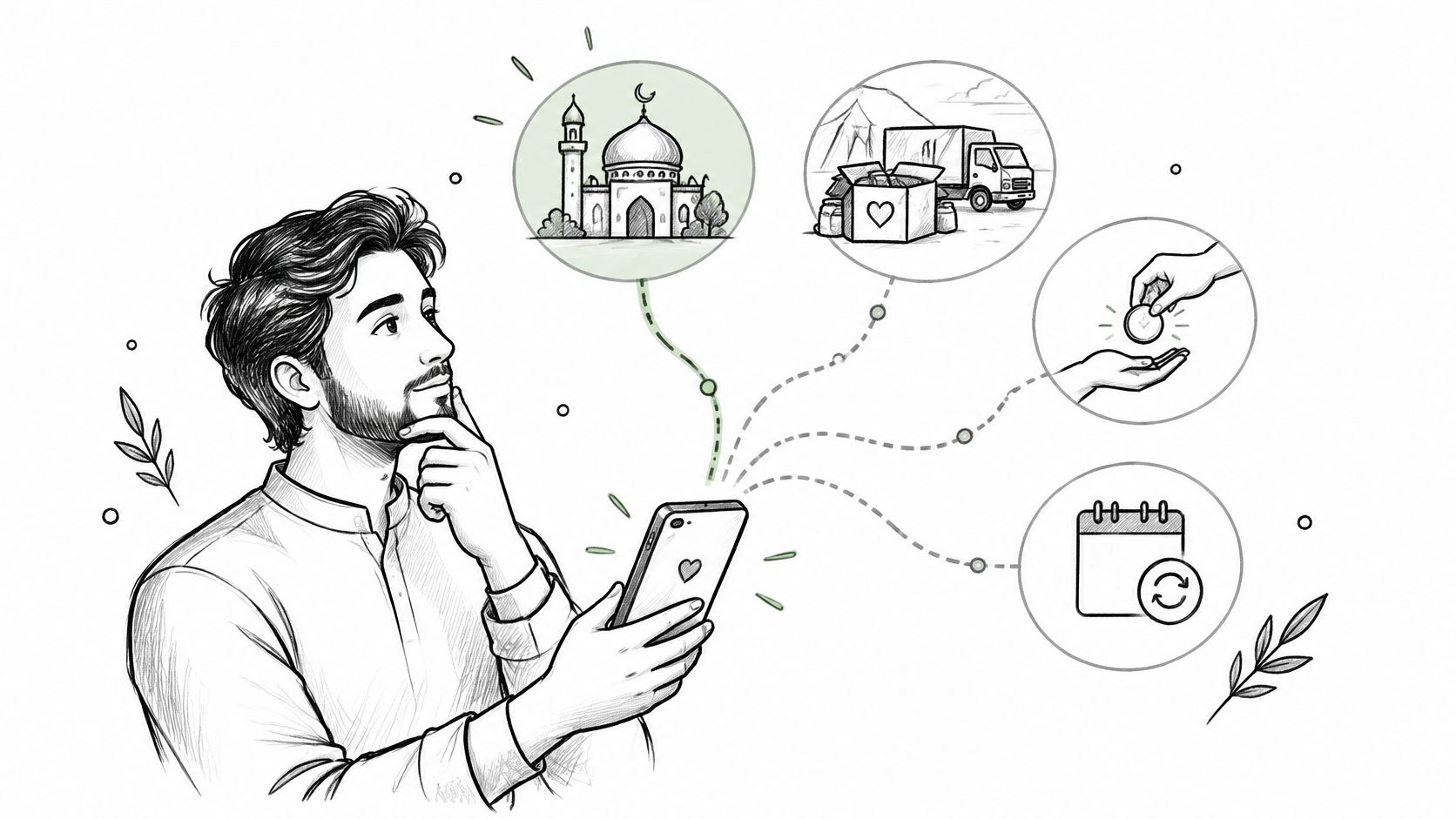
For ongoing support, what matters most is whether you can manage the donation well. Choose an organisation whose work you want to follow, and an interval that fits your budget. A regular donation should not be set so high that it crowds out your other necessary expenses.
Our platform focuses on mosque construction, water projects, and aid projects. This specialisation helps if you want to specifically support Muslim projects. Anyone looking for a different thematic area should choose a provider suited to that, or go directly to the relevant organisation.
According to our own figures, we have supported more than 50 Muslim projects in Germany, Austria and Switzerland; in addition, according to our own figures, more than 307,000 donors trust us. These figures are not independently verified here. They do not replace your own review of the selected project or an individual cost decision.
If your organisation wants to collect donations
To launch a campaign, you don't automatically need an extensive additional solution. Our project offer includes a listed project page, a donation form, project updates and automatic payment confirmation emails. For a clearly defined donation appeal, this scope may be sufficient.
Support at the start must be distinguished from activation. An announced quick accompaniment does not mean that a campaign goes online without complete documents or without review. Therefore, prepare organiser details, project description, intended use and evidence in an organised manner.
Premium is more suitable if you want to permanently operate your own digital donation page and evaluate campaigns. Included are a page with your own look and feel, an embeddable donation form, additional media functions, marketing support, personal guidance as well as monthly reports and analyses.
Decide based on the actual work required. A dedicated presence is not worthwhile simply because it looks more professional. It should take concrete work off your organisation's hands or provide a function that was previously missing.
When a direct donation or prior clarification makes more sense
If you already know your local association and it publishes a clear donation channel of its own, compare this first. Check the recipient account, the allocation of the intended use and the certification procedure. An additional platform makes sense if it offers you a concrete added value, not just another intermediate step.
For a large individual donation, I would clarify the certification process in writing before authorisation. Have it confirmed who legally receives the donation and who issues the donation receipt. A subsequent change of the certificate issuer cannot simply be resolved by a request to support.
Finally, hold the review checklist up against the information provided by your preferred app. Mark open points and clarify the decisive gaps before you pay. The right solution is the one whose costs, recipients and evidence you can explain clearly.
At SadakaNow, you can select verified mosque, water and aid projects and support them via SEPA, PayPal or credit card, without a platform fee on the donation amount. Visit the project overview, check the organiser and clarify your desired certification process before setting up your one-time or regular Sadaqa.