
Are Membership Fees Tax-Deductible? The Rules
Membership fees are only tax-deductible if the recipient is tax-privileged and the fee does not predominantly finance a private benefit in return. Genuine donations must be assessed separately and can be deductible even when membership fees to the same association are not.
The widespread advice that any payment to a mosque or Islamic association can be deducted from tax therefore falls short. What matters is not simply where the money goes or how the payment is described in religious terms. What counts is who receives it, what purpose it serves, and whether the paying person receives an individual benefit in return.
Questions arise especially often when someone pays an annual membership fee, donates toward a mosque construction project, and pays Zakat at the same time. These payments may feel similar, but for tax purposes they are not automatically classified the same way. A donation receipt alone does not turn a mandatory fee into a deductible donation.
Three questions help with the assessment: Is the recipient tax-privileged? Is it a membership fee, a voluntary donation, or Zakat? And can the purpose of the payment and the supporting documentation be clearly traced? Separating these points makes it easier to judge what can be taken into account in the tax return and which documents are worth securing before making the payment.
Table of Contents
- Why the question of tax deductibility so often falls short
- Correctly classifying membership fees, donations, and Zakat
- Checking the requirements for the special expenses deduction
- Understanding maximum amounts and the real tax saving
- Typical cases where the deduction fails
- Securing evidence and comparing donation channels
- Conclusion and the next step for your tax return
Why the question of tax deductibility so often falls short
Two transfers to the same Islamic association can be treated differently for tax purposes. A mandatory annual fee and a voluntary contribution toward a mosque construction project do not automatically meet the same requirements. The designation "mosque", "community", or "Islamic association" provides no blanket answer to this.
Uncertainty often arises when a person pays membership fees, donates money toward a construction project, and also pays Zakat. These payments have different backgrounds. For the tax assessment, what counts is how the payment actually comes about and what it is used for, not merely the purpose stated on the transfer.
Three check questions instead of one blanket answer
First check who receives the money: Is the specific recipient of the payment tax-privileged? Then consider the payment itself. Is it mandatory due to membership, or voluntary? Does the member receive a personal benefit in return?
The purpose of the payment and the supporting documentation also play a role. A fee that predominantly finances a specific offer for a member may need to be treated differently for tax purposes than a voluntary contribution for a privileged purpose. Section 10b of the German Income Tax Act (EStG) governs the deduction of donations and certain membership fees, in each case subject to the applicable requirements.
Practical rule: What matters is the actual nature of the payment, the status of the recipient, and the purpose the money finances. The text in the transfer reference field alone does not decide this.
Thus a voluntary construction contribution may be classified differently from the mandatory annual fee of the same association, even though both payments go to the same account. If in doubt, ask before making the transfer how the association records the payment and what kind of receipt it can issue.
Correctly classifying membership fees, donations, and Zakat
A membership fee is linked to membership. The member pays it according to the rules of the association, for example regularly or in a fixed amount. For tax purposes, it must be checked whether the association and the specific purpose are tax-privileged and whether the contribution does not predominantly finance a private consideration.
A donation, on the other hand, is a voluntary contribution for which the donating person expects no individual consideration in return. The Federal Ministry of Finance generally classifies donations to tax-privileged churches, associations and communities as privileged, provided no consideration is expected (BMF information on tax benefits for volunteering and donations).
Zakat is a religious obligatory due. However, its religious significance alone does not determine its tax treatment. What matters is still who receives the money, what purpose it serves, and whether the tax requirements for a privileged contribution are met. Anyone dealing with the religious calculation should separate this from the tax classification; a practical explanation of this is offered in the article Calculating Zakat.
An everyday scenario in comparison
Suppose a person pays an annual fee to a mosque association, additionally contributes to a voluntary collection for a building project, and transfers Zakat. The annual fee remains a membership fee, even if the person understands it as religious support. For the building donation, what matters is whether it is actually voluntary and without personal benefit, and whether the recipient is tax-privileged.
The same basic tax review applies to Zakat, but its religious designation does not replace it. A transfer marked as Zakat does not become a tax-deductible donation merely because of that label. Likewise, a donation receipt does not turn an obligatory membership fee into a voluntary contribution.
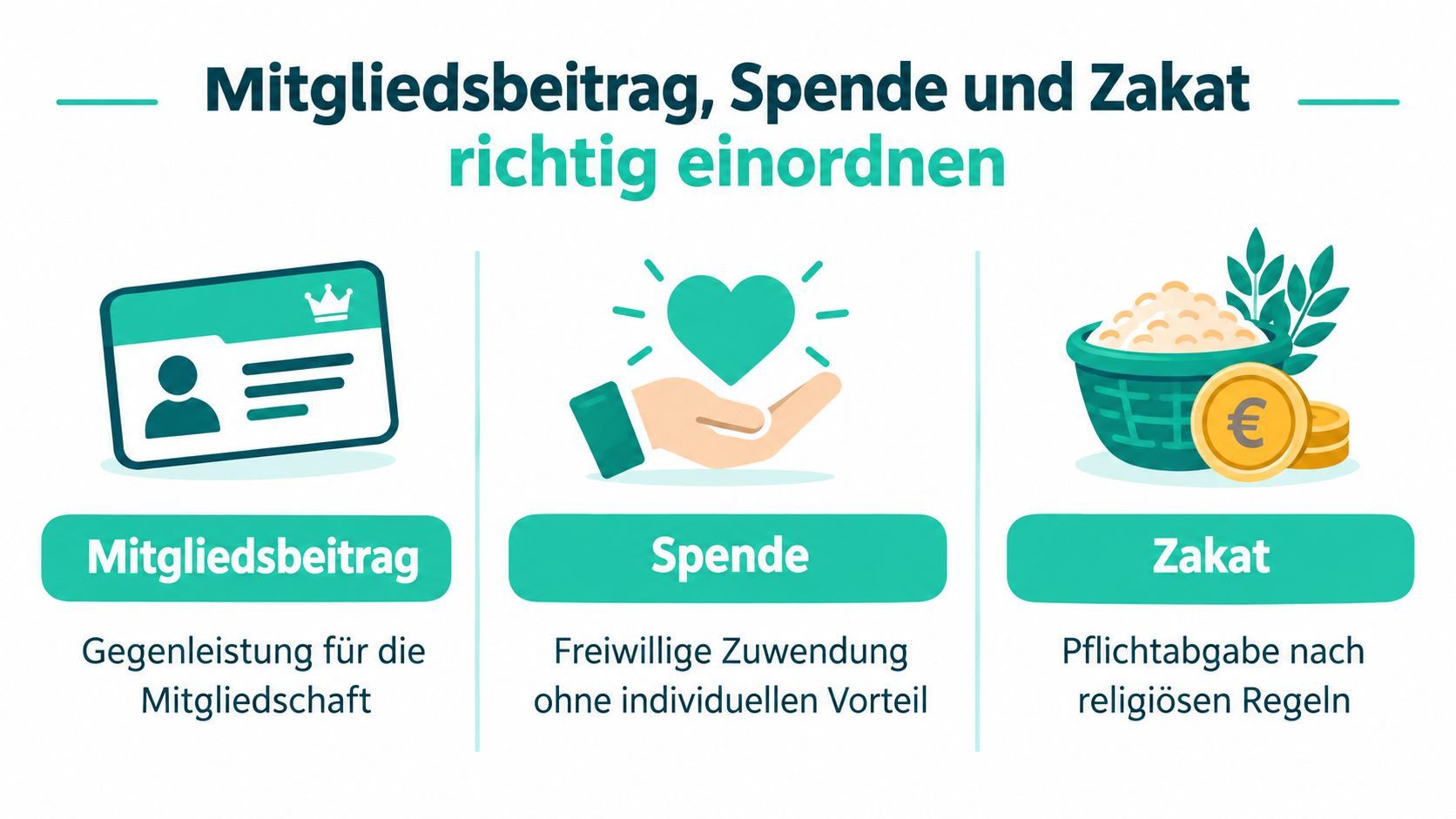
As a memory aid, the distinction can be summarised as follows: fee means payment connected with membership, donation means voluntary support without individual benefit, and Zakat refers to a due according to religious rules. Only the tax review of the recipient and the specific purpose of the payment determines whether a deduction is possible.
Checking the requirements for the special expenses deduction
Whether a payment can be taken into account for tax purposes can be checked in a sensible order. Don't start with the question of whether you receive a receipt, but with the recipient and the actual purpose. A receipt documents a payment, but it does not replace the requirements for the deduction.
First determine the recipient of the payment
Compare the name of the recipient on the bank statement with the name of the tax-privileged entity. A donation to a private individual or to another organisation does not automatically become privileged just because it is intended for a community's project. Ask which entity legally receives the money.
Also ask for a valid exemption notice or a corresponding confirmation of tax-privileged status. Such evidence helps with the review, but it is not the only question: the statutes and actual management must also match the privileged purpose.
Then clarify purpose and consideration
Read the description of the payment and ask what the association uses it for. A genuine membership fee can in principle be privileged, provided the legal conditions are met. However, if it mainly finances a personal offer, such as lessons, use of premises or leisure activities, it must be checked whether a private consideration predominates.
Also clarify whether it is actually a voluntary donation. A payment that is obligatory due to membership does not become a donation simply through a separate entry or certificate. For further background on supporting tax-privileged associations, you can refer to the information on Donations for non-profit associations.
Finally, secure the evidence
Keep the type of payment and the purpose recorded separately. For multiple payments to the same association, the transfer and the documents should show whether it is, for example, an annual fee or a voluntary contribution. Clear documentation makes later tax classification easier.
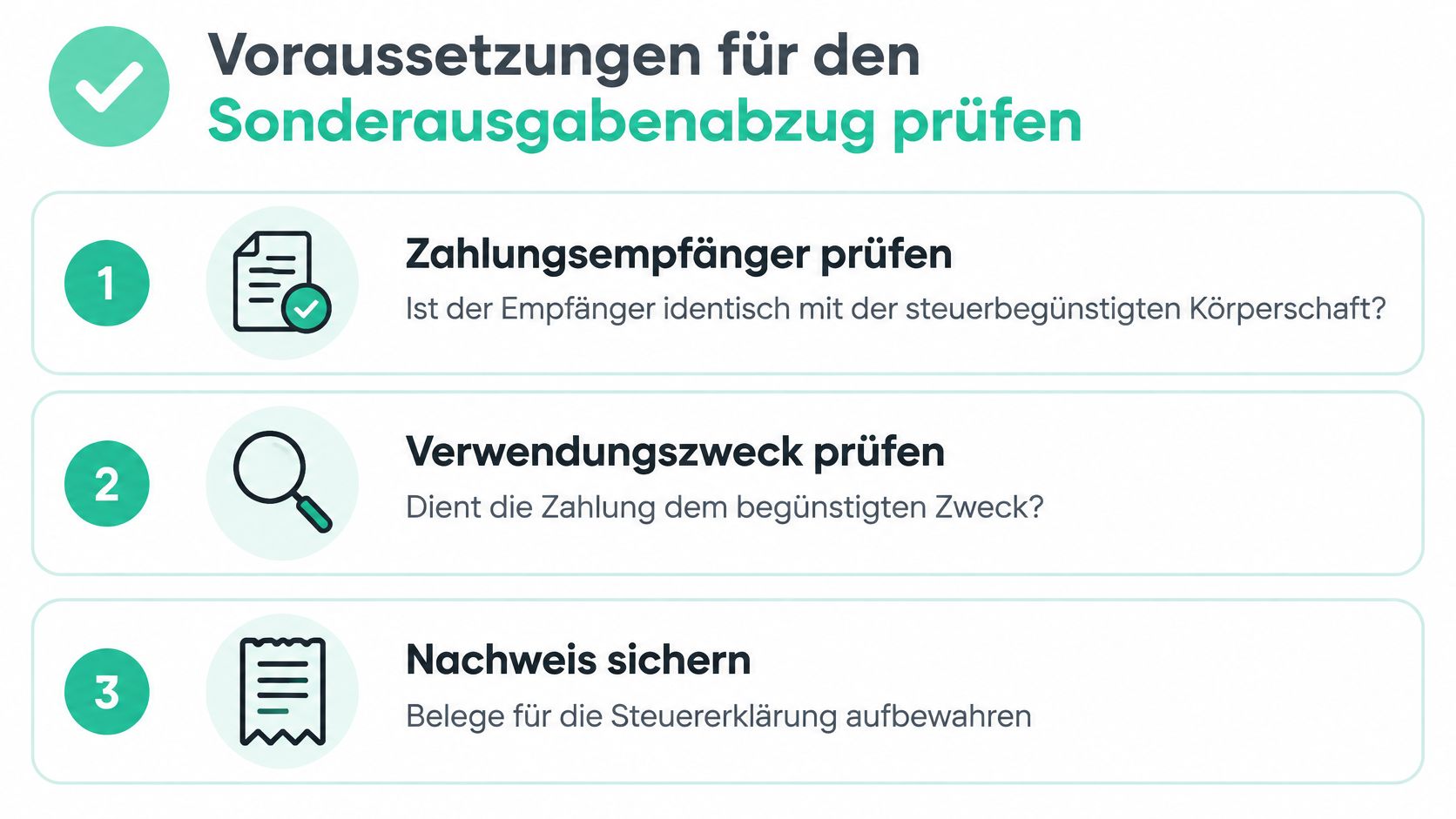
Before you pay, you can work through these points:
- Check the recipient: Is the payment directed to the tax-privileged entity itself?
- Clarify the purpose: Does the fee or donation support a privileged purpose, and does the money not predominantly go towards a private consideration?
- Distinguish the type of payment: Is the payment an obligatory membership fee, a voluntary donation, or Zakat?
- Keep records: Keep proof of payment and the donation receipt, if one is issued.
Understanding maximum amounts and the actual tax savings
A recognised contribution or donation does not automatically reduce your tax by the same amount. Maximum limits apply to the deduction: favoured membership fees and donations can together be taken into account up to 20 percent of the total amount of income. For certain corporations, an alternative limit of 4 per mille of total turnover as well as wages and salaries paid out during the calendar year applies instead. These limits are set out in Section 10b of the German Income Tax Act (EStG).
| Limit | Reference value | Note |
|---|---|---|
| 20 percent | Total amount of income | Shared limit for donations and favoured membership fees |
| 4 per mille | Total turnover as well as wages and salaries paid out during the calendar year | Alternative limit for certain corporations |
If an amount is not taken into account in one year because of the maximum limit, it can generally be carried forward to later years. However, the limit does not make a payment deductible in the first place: it must first meet the tax requirements. A Zakat payment therefore does not become a deductible donation simply because of its religious designation.
The deduction is not a refund
A special expenses deduction reduces taxable income, not the tax bill directly. How much tax you save as a result depends, among other things, on your personal tax rate and your individual situation.
Let's take a mosque community that receives a tax-privileged donation. If the amount is recognised, taxable income is reduced by the recognised sum. The tax saving, on the other hand, is usually smaller and cannot be calculated as a flat figure without details of the personal tax situation.
Important: "Deductible" means that a payment can be taken into account for tax purposes under the legal conditions. It does not mean that the tax office fully refunds the amount paid.
In everyday language, the term "tax deduction" often sounds like a repayment. For the purposes of calculating tax, it is more like a deduction from the income on which the tax is calculated. So do not directly compare the recognised amount with an expected refund.
Typical cases where the deduction fails
In everyday community life, the same association can pursue favoured purposes while also offering services that must be assessed differently for tax purposes. The Federal Fiscal Court (Bundesfinanzhof) focuses on the activity being funded: if a non-profit corporation funds a cultural activity that primarily serves leisure purposes alongside a favoured purpose, the membership fees as a whole remain non-deductible. An additional favoured purpose does not remove this exclusion (decision of the Federal Fiscal Court on membership fees and leisure activities).

Case one with lessons
A member pays an annual fee to a community that offers religious services while also providing certain members with lessons or other personal services. What matters is not that the association also pursues religious purposes. It must be examined whether the fee predominantly funds an individual service and how the funded activity is classified for tax purposes.
If the payment is tied to membership and funds specific services, a blanket assumption of deductibility is risky. The statutes, the fee regulations, and the actual use must all be considered together in the assessment.
Case two with leisure events
An association organises events or cultural activities that primarily serve leisure purposes. If such activities are funded alongside a favoured purpose, this can be decisive for the deductibility of membership fees. An additional religious or charitable purpose does not automatically make the membership fee deductible.
Case three with a construction donation
A person voluntarily pays for a mosque construction project without receiving a personal benefit in return. This is assessed differently from a mandatory membership fee. The donation deduction may remain possible within the general maximum limits even if membership fees to the same corporation are excluded. The requirement remains that the recipient and the payment meet the tax conditions.
In practice, you should therefore not combine construction payments, membership fees, and payments for specific services into one unspecified transfer. A clear designation makes the assessment easier, without pre-determining the outcome.
Securing evidence and comparing donation methods
Documentation begins before the transfer. Note whether you are paying a membership fee, a voluntary donation, or Zakat, and phrase the payment purpose so that it matches this classification. Keep the transfer receipt together with the documents on the recipient's tax status.
A donation receipt is helpful if the payment can actually be recognised as a donation. However, it does not change the nature of a mandatory payment. If a membership fee is not deductible due to the activity or the service provided in return, it does not become deductible simply because of a donation receipt.
Direct payment or platform
With a direct payment to a mosque, you can directly check the recipient and the purpose of use. If you use a campaign via a platform, you should additionally clarify which organisation ultimately receives the money and whether the donation receipt is issued by this tax-privileged entity.
With a standing arrangement, the clear allocation of each payment also matters. Check whether the order concerns regular donations or membership fees, and keep the payment statements. For later filing and tax classification, the guide on the Donation receipt for associations offers additional guidance.
SadakaNow brings together donation campaigns from mosques, aid organisations and social initiatives, shows public project information and forwards donations without a platform fee. Before making a payment, you should still check yourself who the legal recipient is and whether a donation receipt will be issued for your specific payment.
| Payment method | What you should especially check |
|---|---|
| Directly to the association | Payment recipient, purpose of use and confirmation of tax-privileged status |
| Via a campaign | Legal recipient of the donation and responsibility for the receipt |
| Regular payment | Whether a standing order represents a donation or a mandatory contribution |
Good record-keeping therefore does not just connect a bank statement and a receipt. It also shows why you paid and which organisation received the payment. This is especially helpful if you provide several types of support to the same community.
Conclusion and the next step for your tax return
Whether association fees are tax-deductible cannot be decided solely based on the association's name or religious designation. First check the tax-privileged status of the recipient, then the actual type of payment, and finally the purpose as well as any possible consideration received in return. Only after that do the maximum amount and the tax effect come into play.
Separate membership fee, donation and Zakat in your own documentation as well. A mandatory fee does not become a donation through a different label, and a Zakat payment is not tax-deductible solely because of its religious character. A voluntary donation, on the other hand, can be privileged under the statutory requirements, even if membership fees to the same entity are excluded.
The concrete next step is simple: ask the association for its statutes, its fee regulations and proof of its tax-privileged status. Also ask in writing whether your payment is treated as a membership fee or as a voluntary donation, and who issues the donation receipt. Keep these documents together with the proof of payment in your tax records.
If the payment concerns membership, personal services and donation purposes at the same time, have the individual case reviewed for tax purposes. This way you avoid a religiously or communally important payment being incorrectly classified in your tax return.
If you would like to support mosques, aid projects or social initiatives, you can find campaigns with public project information and vetted organisations on SadakaNow. Clarify the legal recipient and the question of a donation receipt before making the payment, so that your documentation is correct from the start.