
SEPA direct debit chargeback deadline: 8 weeks to 13 months
With an authorised SEPA core direct debit, you have eight weeks from the date the account was debited to have the transaction reversed through your bank. If a valid mandate is missing, the deadline is up to 13 months after the debit. Two figures, one identical starting point, and between them lies the distinction that almost every explanation skips.
The usual question is: How much time do I have? The question that actually helps is different: What does a chargeback prove about the recipient? Legally, nothing. A debit you agreed to can be reversed within eight weeks without giving any reason, and that says nothing about whether the organisation operates reputably.
That is exactly why a second look at the SEPA direct debit chargeback deadline is worthwhile. It protects you in both directions: as a tool against an incorrect debit, and as an explanation for why a donation sometimes disappears again from a bank statement.
Table of contents
- Return deadlines at a glance
- The decisive difference
- Eight weeks for authorised core direct debits
- Up to 13 months for unauthorised debits
- Assessing a suspicious debit
- Initiating a chargeback and securing deadlines
Return deadlines at a glance
With an authorised SEPA core direct debit, consumers can have the direct debit returned eight weeks from the account debit without giving any reason. With an unauthorised direct debit, meaning a debit without a valid mandate, the deadline is up to 13 months after the debit. Between the two there is no goodwill gesture from the bank, but a single preliminary question: is there a mandate or not?
The following overview organises the three cases that actually occur in practice.
| Case | Deadline from debit | Reason required | Refund |
|---|---|---|---|
| Authorised SEPA core direct debit | 8 weeks | No | Amount is credited back to the account |
| Unauthorised direct debit without a valid mandate | Up to 13 months | Report immediately after discovery | Refund no later than the day after the notification |
| SEPA business-to-business direct debit | No equivalent right of return after the debit | Not applicable, because no return can be claimed after the debit | No right to a refund after the debit |
The most important value in this table is when the deadline starts. Both deadlines run from the date the account was debited, not from the day you read the bank statement or open the banking app. If you don't check for three weeks, you have still used up those three weeks.
A mandate given in advance does not prevent the return. It only proves that the debit was permitted, and that is exactly why the short eight-week deadline applies in this case. The debit was correct, and the return is still possible.
The SEPA business-to-business direct debit falls outside this pattern. According to the Deutsche Bundesbank, this procedure generally does not come with the same right of return after the debit. It applies to business accounts, not to the private account from which a donation is made.
Whether a debit even lands on your account at all depends on the recipient's collection rhythm. The article on when a SEPA direct debit is collected shows how to identify the timing in advance.
Which deadline applies to you is therefore decided neither by the bank nor by the amount, but solely by the question of the mandate. What a mandate is and how to recognise it is the next step.
The decisive difference
A mandate is a consent given in text form. Anyone who gives a recipient a SEPA mandate allows them to collect amounts in their name in future. The image for this is a house key that you hand over yourself so that someone can regularly check on the flat. The key is the permission, not every individual action.
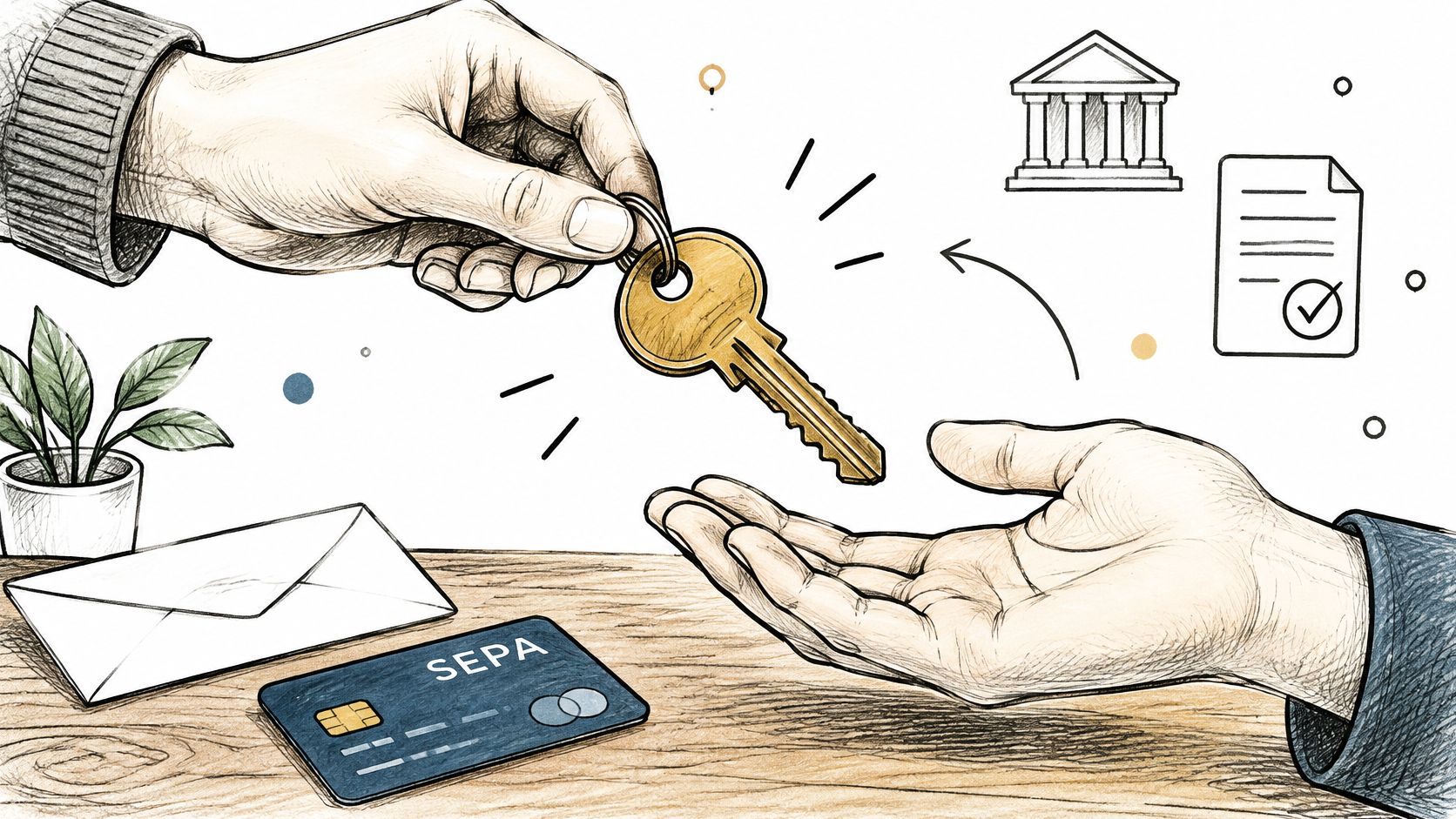
An unauthorised debit is the duplicate key. Nobody took the key from you; it was made without your permission. In everyday life you encounter both: the membership fee to the mosque association, the donation to an aid organisation, the subscription to a streaming service. All three run via a mandate, and all three can be reversed within eight weeks.
There are three paths into the unauthorised category. The IBAN was misused, a mandate was never given, or a cancelled mandate continues to be used. The third case is the most common one that is disputed, because the recipient honestly assumes an existing instruction still applies.
The deadline does not depend on how reputable the recipient is, but on whether the mandate exists.
A chargeback is therefore not proof of fraud. It is the normal legal case when someone does not want to keep an authorised direct debit. How a mandate should correctly look and what information it must contain is explained in the guide to the SEPA direct debit form.
Which feature do you check first: the recipient's name on the statement or the creditor ID next to it?
Eight weeks for authorised basic direct debits
Take a direct debit that is charged on 1 March 2026. The deadline ends on 26 April 2026, meaning 56 days later. Up to this date, the account holder can have the booking reversed by their bank without giving a reason. The bank then credits the amount back to the account, as stated by the Deutsche Bundesbank in its explanation of the SEPA direct debit.
Recurring payments are the point where things become confusing. Donations, membership fees, and subscriptions generate a new charge every month and thus a separate deadline. Someone who wants to reclaim a January payment cannot rely on the deadline of the March booking, and vice versa. Each debit gets its own eight weeks.
One mistake keeps coming up: the deadline is calculated from the date the bank statement arrived in the mailbox or the email with the payment confirmation arrived. What is correct is the debit date, meaning the day the bank lists in the booking line.
Practical rule: When you first look at the statement, note the debit date, not the date of your look.
Two misunderstandings need to be addressed at this point. First: anyone who returns an authorised direct debit within the deadline is not making any statement about the recipient. The return is a consumer right, not suspicion of fraud, and the bank does not ask for a reason. Second: conversely, a familiar recipient name does not protect against mistakes. A debit that seems unfamiliar to you deserves scrutiny, even if the name sounds reputable afterwards. The eight weeks run while you are weighing it up.
For organisations, the rule has an unpleasant consequence. A confirmed donation via SEPA direct debit, despite a valid mandate, can still be reclaimed afterwards and is only considered finally available once the eight weeks have passed. For recurring donations by direct debit, it is therefore worth looking at the regular standing donation, because there each individual amount is assessed anew.
After 26 April, a return under this rule is no longer possible. The amount stays where it is.
Up to 13 months for unauthorised debits
Without a valid mandate, a different, significantly longer clock runs. The deadline then extends up to 13 months after the account debit, as summarised by the Verbraucherzentrale on the Europe-wide SEPA rules. However, the long deadline does not change the reporting obligation: anyone who discovers an unauthorised booking must report it without delay, meaning as soon as they notice it and have been able to assess it.
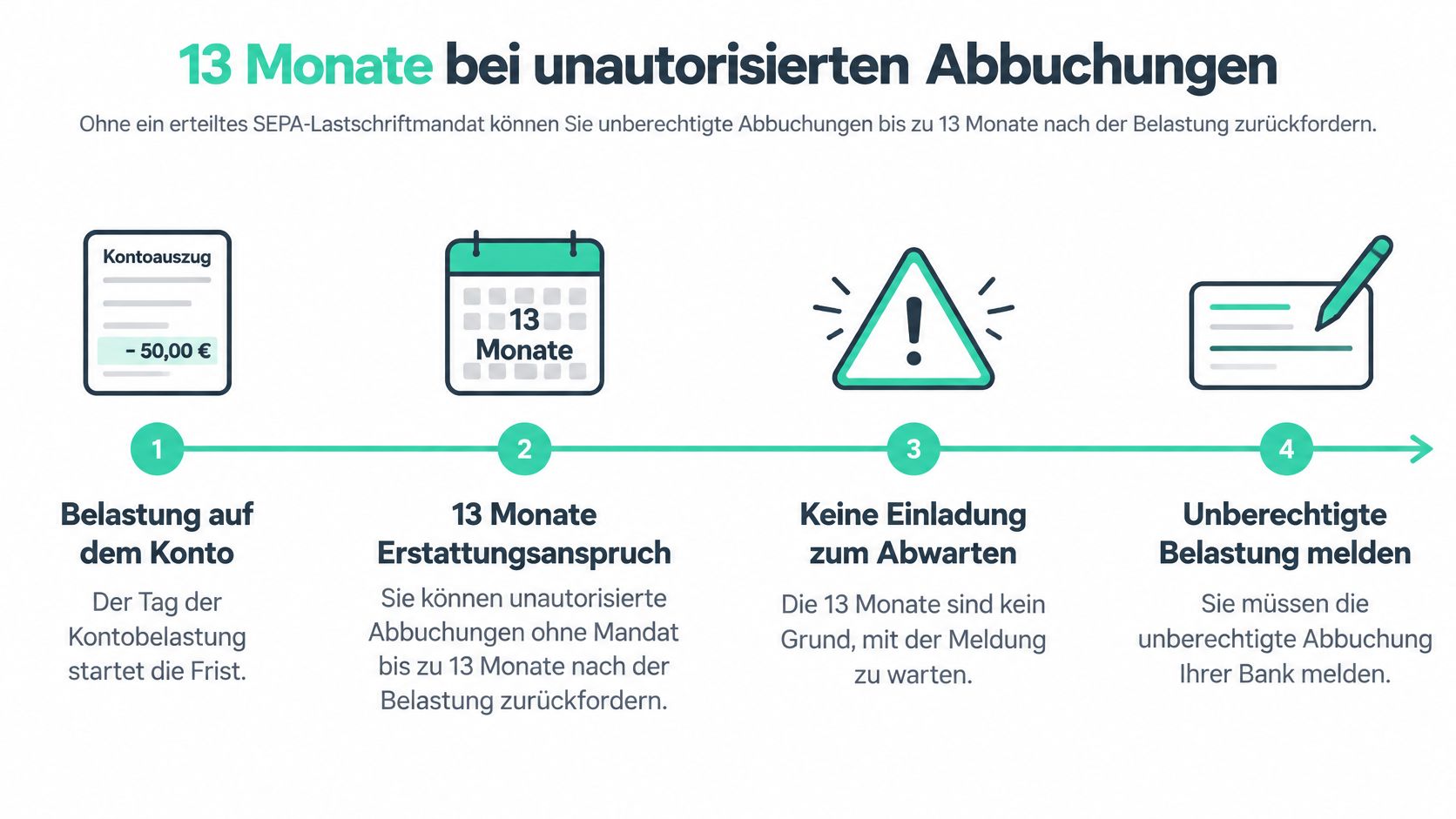
So two clocks run in parallel.
One begins with the debit and ends after 13 months at the latest. The other starts the moment you discover the booking and requires a report without delay. An example shows the sequence:
- 10 January 2026: The direct debit is charged. This is where the first clock starts.
- February 2026: You discover the booking and find that no mandate exists. Now the second clock runs.
- Immediately after discovery: You report the case to your bank.
- Following that: The bank refunds the amount and resets the value date to the original debit date.
- 10 February 2027: With the end of this day, the right to reimbursement generally lapses.
After the report, a clear obligation of the bank applies: it must generally refund the amount without delay and correct the value date as if the debit had never taken place. The 13 months thus set an outer limit to the claim. The reimbursement itself begins as soon as you report it.
Two misjudgements belong to this deadline. First, a completed chargeback still proves nothing about the recipient. It remains a consumer right, and a missing mandate can also be due to a recording error. Second, a recipient name that seems familiar is no seal of approval. Even then, every unclear debit should be reported and compared against the mandate.
For payees, this means: document and retain mandate and collection data. Anyone who can quickly answer queries from the bank or donor proves the authorisation of the collection and resolves the case in hours instead of weeks.
Classifying a suspicious debit
Before you call anyone, classify what you have observed. The following table links what you see with the likely cause and the first step.
| Observation | Likely cause | Immediate response |
|---|---|---|
| Unknown donation name on the bank statement | Purpose or recipient not identified | Compare mandate and confirmation, check creditor ID, ask the organisation via an official channel |
| Amount differs from the confirmed donation amount | Incorrect entry or duplicate debit | Save receipts, contact the organisation, inform the bank |
| Campaign has ended, debit continues | Mandate is still being used | Check mandate, arrange a reversal within eight weeks for authorised debits |
| Direct debit with no authorisation at all | Possible IBAN misuse | Contact the bank immediately, report without delay, keep the 13-month deadline in mind |
The verification trail is in the last column, and it follows a fixed order. First, compare the mandate or payment confirmation with what was actually debited. Then check the IBAN and creditor ID, since these clearly identify the party collecting the payment. After that, save the bank statement and emails from the organisation before making any inquiry anywhere.
In 2026, BaFin explicitly warned that fraudsters use IBAN data for unauthorised direct debits, and recommends contacting the bank quickly. If there is no direct debit authorisation, there is generally a right of reclaim for up to 13 months, as stated in the BaFin consumer notice on unauthorised account debits.
Two statements need to stand side by side here. Reversibility is a legal protection, but not proof that a donation platform is dubious. And an unknown debit must not be ignored just because the recipient falls into a trustworthy category. Contact the organisation through an official channel, never through a link in an email or message.
Arranging a reversal and securing deadlines
The process is short if the order is right. What jeopardises it is rarely the bank. It's a detail that comes to light too late. And one thing always applies: reversing a debit is a legal right, not a judgement on the recipient. Precisely for that reason, every unknown debit should be checked, even if the name on the bank statement sounds trustworthy.
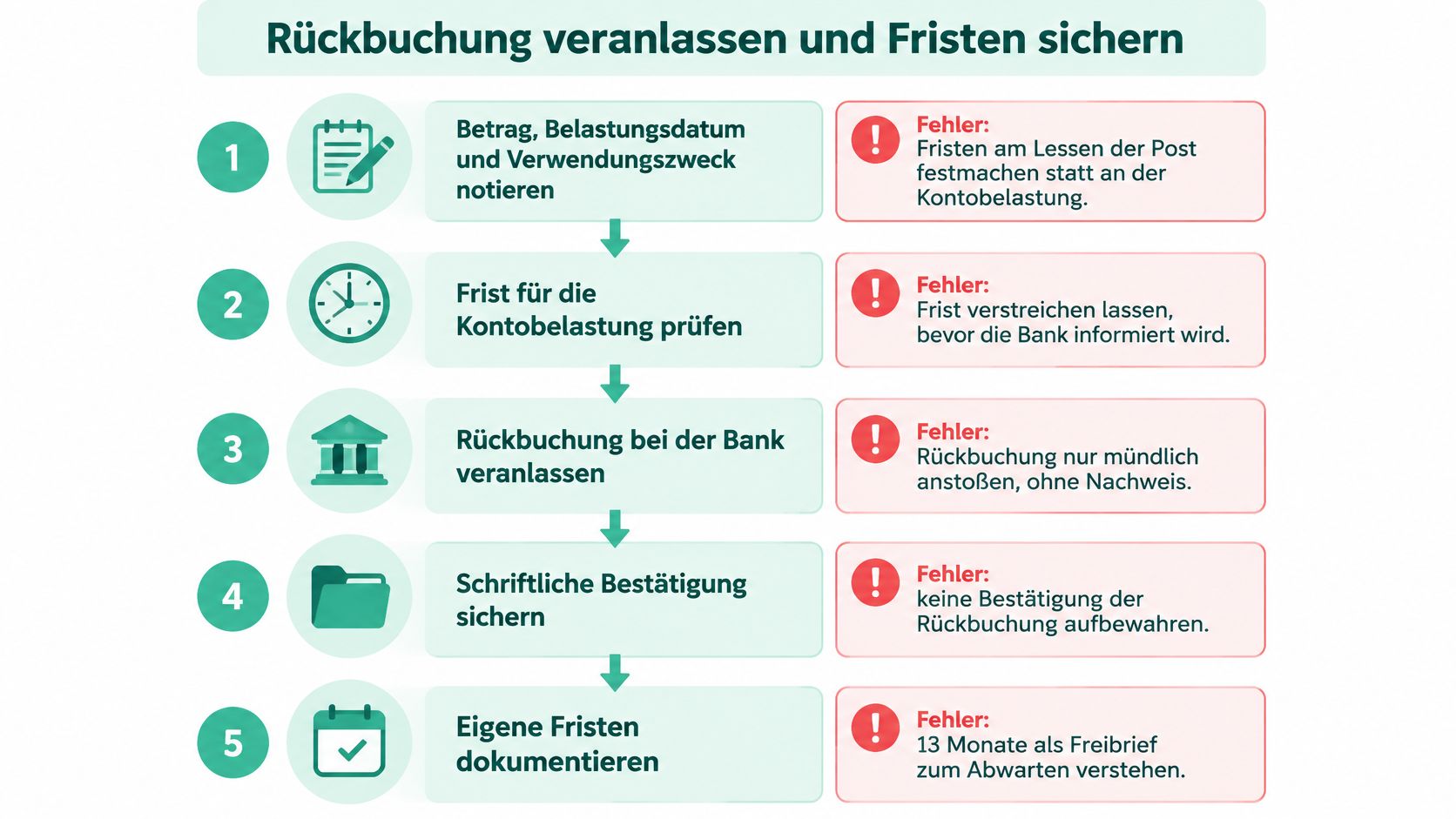
- Note the amount, debit date and purpose. The mistake next to it: basing deadlines on when the post was read instead of on the debit date. Without the debit date, you cannot calculate a deadline.
- Have the documents ready. Mandate confirmation, payment confirmation, bank statement, emails from the organisation and the creditor ID all belong in one folder. If the confirmation is missing, clarification takes considerably longer.
- Classify the case. A valid mandate means eight weeks without giving a reason. A missing mandate means up to 13 months, but only if reported without delay.
- Arrange a reversal through the bank. For a debit on 1 March 2026, this runs until 26 April 2026. You don't need to state a reason, and you shouldn't invent one that won't hold up later.
- Report an unauthorised debit immediately. An entry from 10 January 2026 generally remains contestable until 10 February 2027, and according to BaFin the bank generally refunds the day after notification. Don't wait until shortly before the deadline on 10 February 2027.
- Ask the organisation for specifics. Clarify which debit belongs to which donation, and use the official channel for this. At SadakaNow, that is hilfe@sadakanow.de. Clarification with the organisation and the reversal at the bank run in parallel; only both together distinguish an operating error from a third-party debit.
- Document the deadlines. Enter the debit date plus eight weeks and plus 13 months in your calendar, and keep the bank's confirmation of the reversal. If you don't record the confirmation, a completed reversal will be hard to prove later.
Ask your own bank in advance about the fees for a reversal. They vary from institution to institution, and no reversal is free just because it's permitted.
For a SEPA business direct debit, according to the Bundesbank, there is generally no equivalent right of reversal after the debit. Anyone holding a business account should therefore have the debit checked beforehand rather than relying on a reversal.
A brief look at the process shows what the check looks like on the recipient's side:
With every transaction, SadakaNow automatically checks the SEPA mandate, fraud protection and anti-money-laundering compliance under § 4 GWG, usually within seconds. This does not replace a bank refund, but it does make it traceable which debit belongs to which donation. Clarify questions about the donation itself with SadakaNow; the decision on the refund is made by your bank.
Anyone who wants to pass on a Sadaka donation securely will find vetted projects from mosques, aid organisations and social initiatives at SadakaNow, funded without a platform fee. Every donation there goes through an automatic mandate check, and if you have questions about a debit, the team at hilfe@sadakanow.de will help you further. Visit SadakaNow and choose a project you would like to support with SEPA, PayPal or credit card.