Recognising and carrying out online donations securely
27 percent of donors became aware of donation opportunities on the internet, according to a representative Bitkom survey from 2022. This describes the discovery of a donation appeal, not the subsequent payment method. For a community, that's exactly what matters: people can learn about a project after Friday prayers and support it later from home. Donating online complements the collection on site when recipient, payment and proof fit together in a clear way.
Table of contents
- What online donations mean in the donation market
- Payment methods for online donations compared
- Security standards from SSL to GDPR
- Recognising trustworthy donation platforms
- Donation receipt and tax for Sadaqa
- Online donations alongside the community collection
- How to donate on SadakaNow
What online donations mean in the donation market
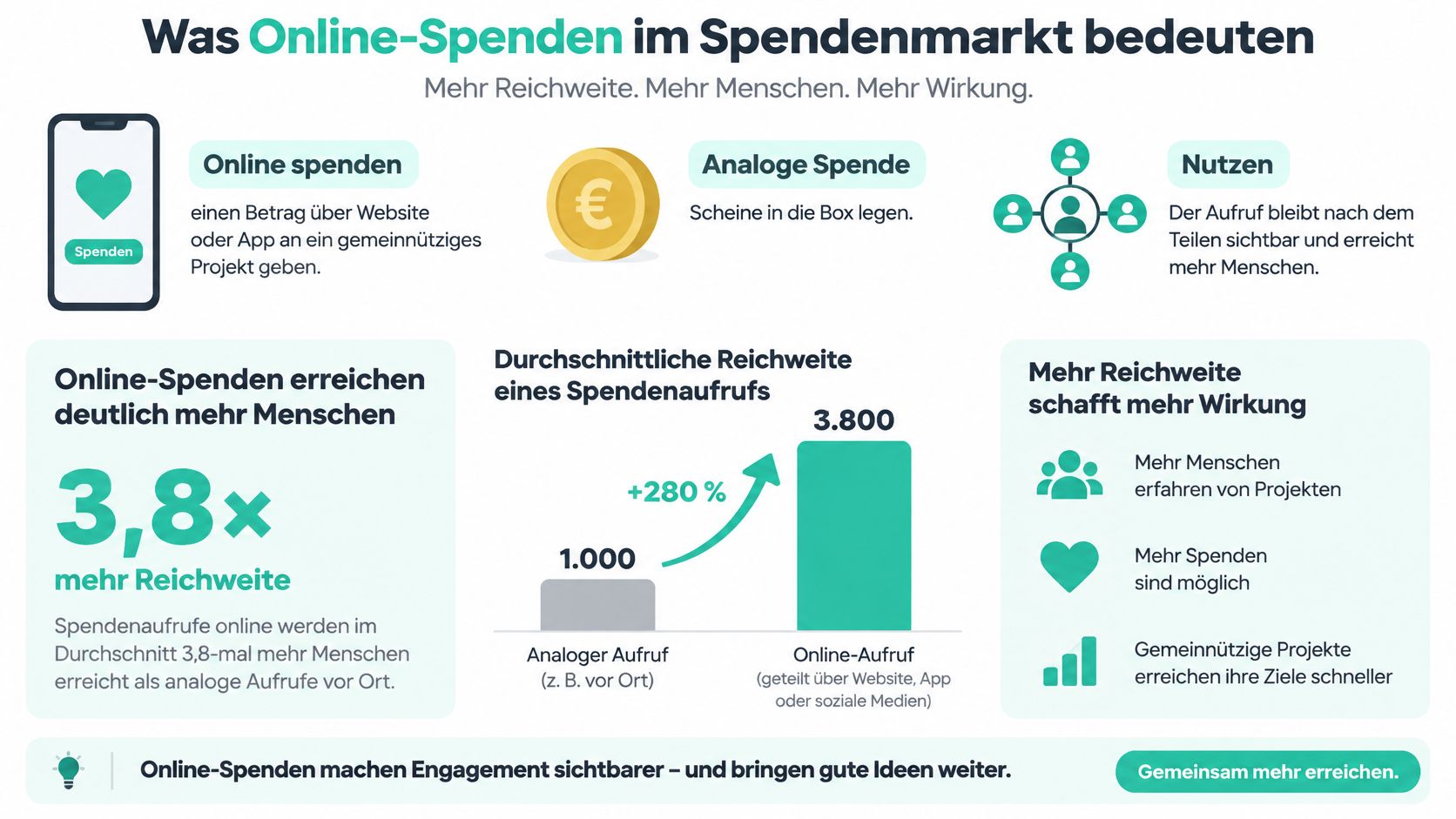
Donating online means giving money for a project via a website or app. Instead of putting a note into the collection box, you choose an amount and an electronic payment method. The personal occasion can stay the same: a community member talks about a water project after prayer, and afterwards the appeal is also available digitally.
According to the Deutsches Zentralinstitut für soziale Fragen, German monetary donations reached around 12.8 billion euros in 2023. This figure explicitly covers the entire volume of monetary donations for charitable purposes, not just digital transactions. It is therefore a benchmark for society's willingness to donate, not a measure of the size of the online donation market.
The appeal remains accessible after the gathering
Take a mosque community that wants to create barrier-free access. During the event, the board explains the project and collects cash. A digital project page additionally allows those who were absent to read the description and lets relatives pass the appeal on.
The benefit is not that a payment made on a smartphone is fundamentally better. The donation appeal is no longer tied to the place and time of the collection. Anyone who first wants to think it over or ask questions can decide later.
A good digital donation page answers the same questions as a responsible person standing next to the collection box: who is collecting, for what purpose, and how is the use made traceable?
Several roles need to be distinguished here. The community or aid organisation is responsible for the project, the platform provides digital access, and a payment service handles the transaction. This separation helps you later find the right contact for project questions, payment issues and tax receipts.
Payment methods for online donations compared
| Payment method | Suitable use | Proof | Fee situation | Limit |
|---|---|---|---|---|
| SEPA direct debit | Monthly Sadaqa and fixed amounts | Mandate and bank statement | Check service provider costs in the form | Chargeback possible |
| PayPal | Quick one-off donation without entering bank details into the donation form | PayPal receipt and, if applicable, email | Note the service provider fee | No automatic substitute for a donation receipt |
| Credit card | Spontaneous donation, even from abroad | Card statement | Costs of the payment service, shown in the form | Bank may require additional authorisation |
| Apple Pay or wallet | Mobile donation with an already set-up payment method | Payment overview and card statement | Check the costs of the connected payment processing | Not available on every platform |
| Bank transfer | Larger amounts with your own reference | Bank statement | Check account model and possible transfer costs | IBAN must match the stated recipient |
| Cash at the community | On site without an online account | Request a receipt from the collecting body | No online payment fee | Without a receipt, difficult to attribute personally later |
Matching the payment method to the occasion
For regular support, SEPA direct debit is practical. You give a mandate, meaning the permission to collect payment, and don't have to transfer the agreed amount again each time. Before finalising, check whether you are selecting a one-off payment or a recurring payment. For timing, our explanation of when a SEPA direct debit is collected can help.
For a spontaneous one-off donation, PayPal or credit card can be suitable. What matters less is the name of the method than the question of what you already know how to handle confidently. Setting up an additional payment service account just for a single donation isn't always the simplest way.
A wallet like Apple Pay uses a payment method already stored on your device. This means you have to type in fewer details yourself when donating on mobile. Whether this option is shown to you also depends on the device and the payment processing offered.
Considering amount, purpose and proof together
For a larger designated donation, a classic bank transfer can make sense. You can check the recipient, IBAN and reference at your own pace and carry out the transfer yourself. Use the bank details from a reliable publication by the organisation, not unverified from a forwarded message.
Cash remains a distinct option. If you need personal proof, arrange the receipt directly with the collecting body. A public announcement about the total sum collected does not prove how much you personally gave.
Rule of thumb: Regular Sadaqa can be organised well via SEPA, a spontaneous one-off donation with a familiar mobile method. For a larger bank transfer, the recipient and reference deserve special attention.
A payment receipt initially shows that money was moved. It does not automatically answer whether the payment is recognised for tax purposes or how the organisation used it. So keep the project name and payment confirmation too, instead of only photographing a screen with the success message.
At SadakaNow, the payment follows a simple process: you choose a project, enter the amount and pay by SEPA, card or PayPal. Take time before the final click to review the summary, especially the payment frequency, total amount and recipient.
Security standards from SSL to GDPR
A padlock in the browser is helpful, but it is not a verdict of trust about an aid project. Technical security protects different things: the connection, card data, personal details and access to payment management. Only together do these protective measures result in a traceable payment path.
The Digital Barometer of the Federal Office for Information Security illustrates why this is relevant: 11 percent of internet users became victims of cybercrime within a year. No specific fraud rate for donation platforms can be derived from this. But a concrete task follows for donors: not judging payment pages and messages solely by their familiar appearance.
What you can recognise in the payment form
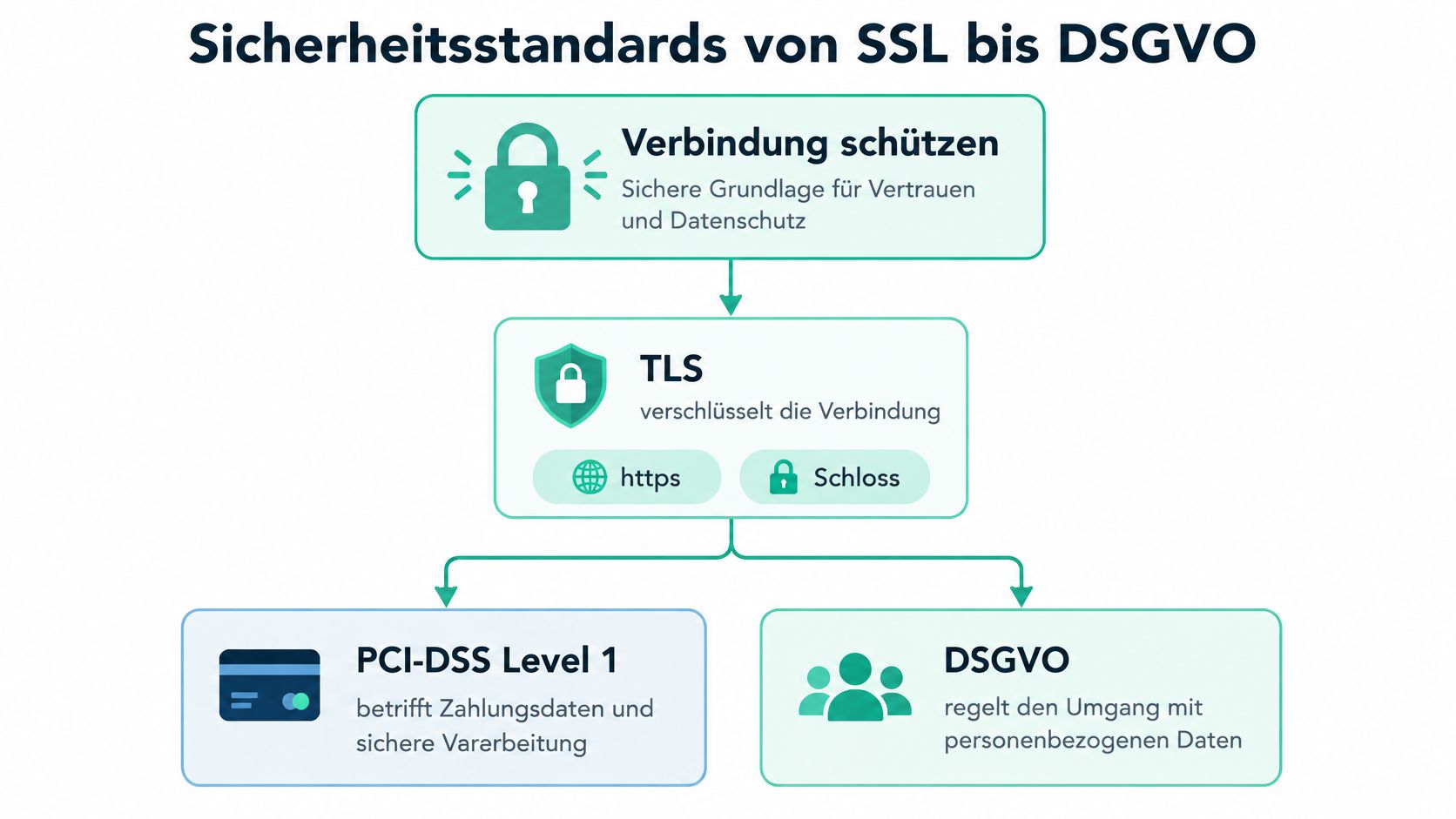
TLS encrypts the connection between your browser and the server. In everyday usage, the term SSL is still often used for this. Watch for a secure connection and don't ignore any certificate warning. However, even a fraudulent site can have an encrypted connection.
| Standard | Protects | Visible to donors | Typical gap |
|---|---|---|---|
| TLS or SSL | Transmission between browser and server | https and the browser's connection information | Certificate warning is bypassed |
| PCI-DSS Level 1 | Secure processing of card data | Traceable information about the certified payment service | Unclear who processes the card data |
| GDPR | Personal data | Purpose statements, privacy notices and contact for information | Unnecessary mandatory fields or unclear data use |
| 3-D Secure | Authentication for card payments | If applicable, approval via the bank | An unknown approval request is confirmed without checking |
| Mandate documentation for SEPA | Traceability of the direct debit authorisation | Mandate text before completion and documented details | No traceable proof of the mandate |
The GDPR concerns how your personal data is handled. Pay particular attention to who is responsible and what your details are needed for. Consent to advertising should not be confused with the actual donation decision.
With 3-D Secure, your bank may request an additional confirmation. Check the amount and payment recipient in the bank app. Not every legitimate card payment triggers a visible extra prompt, so its absence alone does not prove a security flaw.
What should happen behind the form
A platform should ideally have card data processed via a suitable payment service rather than storing it itself. However, entering full card details into an embedded form does not automatically mean that the platform operator receives this data. What matters is who technically provides the form and processes the data.
Administrators should use specially protected accounts and only be able to access the data they actually need. Payment confirmations must be technically checked for authenticity. Conspicuous payment transactions should be flagged for review.
If a donation appeal arrives by message, also check the sender and the target address. The guide by GSL Groß GmbH helps you to recognise typical warning signs of phishing. If in doubt, open the organisation's known website yourself instead of using the payment link that was sent to you.
Recognising trustworthy donation platforms
Trust begins with the named responsible party, not with the donation bar. An appealing photo and a high displayed donation total explain neither the legal responsibility nor the flow of money. So before making your first payment, check the operator, the organisation and the project separately.
Distinguishing between operator and project sponsor
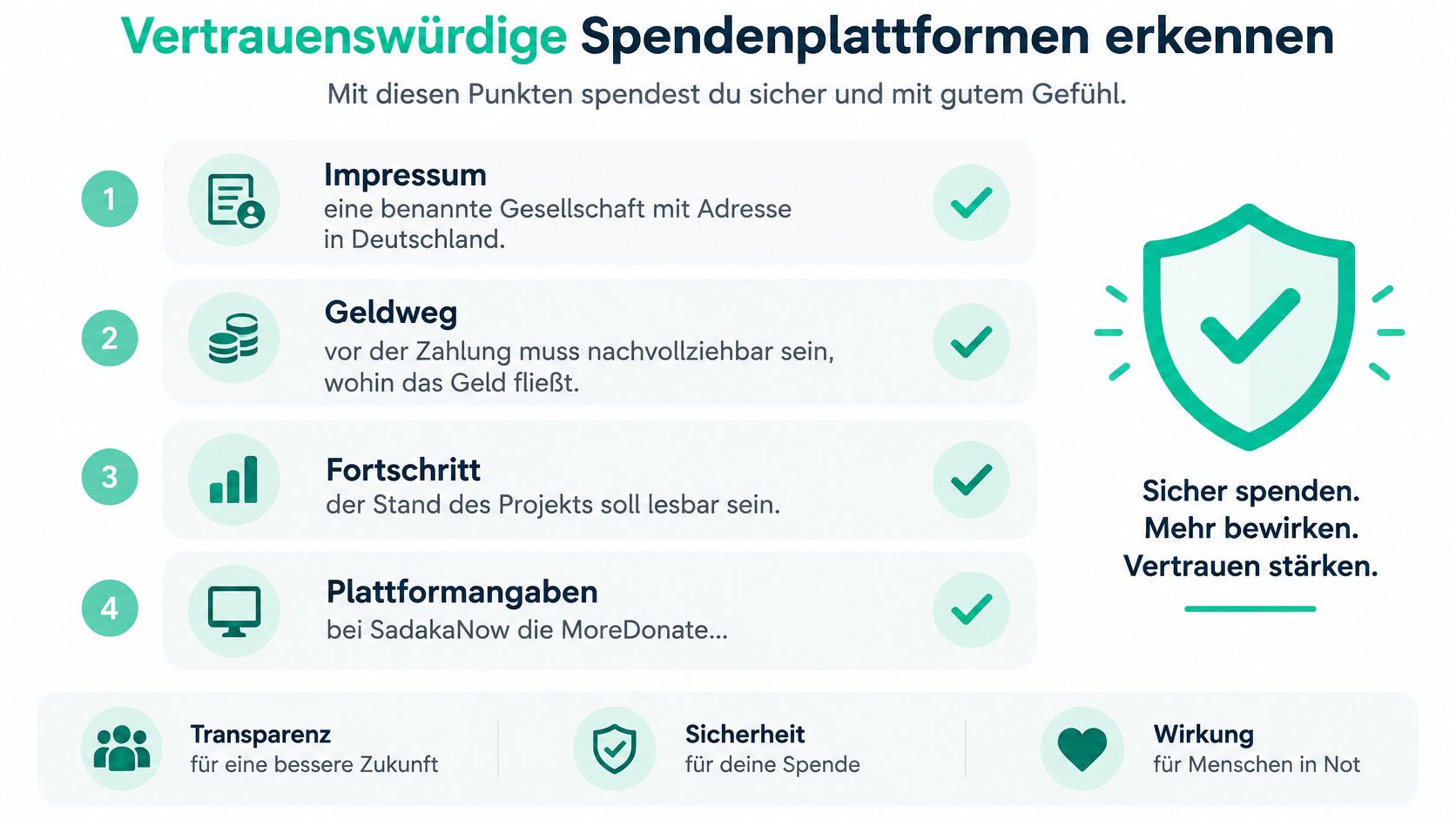
Start with the legal notice (Impressum). It should clearly state who operates the platform and how that party can be reached. SadakaNow is operated by MoreDonate GmbH, Carl-Zeiss-Straße 2, 33758 Schloß Holte-Stukenbrock.
Next, look on the project page for the organisation responsible for the initiative. The platform brand is not automatically the charitable recipient. Likewise, a label such as mosque association or aid initiative alone is not enough to assess an organisation's tax status.
To help you classify this, our guide on verified donation organisations can assist you. Pay attention not just to whether a review is mentioned, but also to what was reviewed. Verification of charitable status is something different from an ongoing check of every single project expense.
Checking the flow of money and progress
With us, SadakaNow does not touch the donation funds. The money is held in trust and paid out directly to the respective organisation. This information is more important than a vague statement that a platform passes donations on in some way.
With us, donors can always publicly track how their donation has an effect. Read project updates and progress reports with the specific initiative in mind: Which work has been completed, which steps are still pending, and who explains any delays? Public insights make assessment easier but do not replace an independent financial audit.
A representative Bitkom Research survey of internet users found that 62 percent trusted online retailers not to misuse their personal data. This is a data protection signal from online retail, not an assessment of donation platforms. What counts for your decision is therefore the concrete design: understandable data purposes, a clear confirmation, and ideally no unnecessary account creation.
- Sponsor named: You can find the full name of the responsible organisation.
- Flow of money explained: You understand who processes the payment and to whom it is paid out.
- Project status public: You can read the goal, progress and updates.
- Questions possible: There is a reachable contact person for content-related questions.
Missing organiser names, promises of returns, or pressure to pay immediately into a private account are reasons not to pay. An urgent emergency can explain a quick appeal. It does not justify evasive answers to simple questions about responsibility and use.
Donation receipt and tax for Sadaka
Sadaka, Zakat, and tax-deductible donations do not describe the same thing. Sadaka refers to a voluntary, religiously motivated gift, Zakat a religious obligation. Tax recognition, however, depends on the requirements of tax law, in particular on the recipient and the structure of the payment.
A voluntary Sadaka given without consideration to a tax-privileged organisation can meet these requirements. The religious label alone, however, does not determine this. Even a payment labelled as Zakat must not be classified for tax purposes solely because of its name; the specific recipient and the requirements of the gift remain decisive.
Who issues the tax receipt
According to the guidance of the Finanzamt NRW on donations, tax-privileged organisations can issue donation confirmations; due to the obligation to retain receipts, these must generally be kept and only submitted upon request from the tax office. Therefore, clarify before making a payment which organisation issues the confirmation and what information it needs from you.
In the register of recipient organisations (Zuwendungsempfängerregister) of the Federal Central Tax Office, you can check whether an organisation is authorised to issue a donation receipt. A registered association is not automatically charitable simply because of the suffix e. V. Our article on the donation receipt of an association helps with matching the association, payment, and receipt.
| Type of donation | Issuing body | Proof | Submission |
|---|---|---|---|
| Individual donation to a registered association | The association itself, check authorisation in the recipient organisations register | Donation confirmation from the authorised association | Submit upon request |
| Monthly Sadaka as a recurring payment | The same tax-privileged organisation | Possibly an annual certificate as well as bank statements | Submit upon request |
| Collection without charitable status | No tax-privileged body | Bank statement only proves the payment transaction | Not deductible as a tax-privileged donation |
How typical cases differ
For an individual donation to a mosque association, you need clarity about its tax authorisation. If this is given, the association is the right point of contact for the donation confirmation, not the person who shared the appeal.
For a monthly Sadaka, an annual certificate can summarise the payments. Nevertheless, keep the individual payment records and reconcile the details. If different organisations are supported, each gift must be assigned to its respective recipient.
For a private collection without charitable status, your contribution can be humanly and religiously valuable. However, a bank statement does not turn it into a tax-privileged donation.
For the tax receipt, the legal recipient is what counts. Confirmation of a payment received is not automatically a donation confirmation.
At SadakaNow, only the organisation is the user of the payment service vis-à-vis the payment provider. MoreDonate has no access to the donation payments. The tax information relates to Germany and does not replace individual advice, especially for cross-border gifts.
Online donations alongside the community collection
Digital is not automatically more trustworthy or more accessible to everyone. The Deutsche Bundesbank on payment behaviour in Germany still describes cash as an important channel for donations; at the same time, more than two-thirds of the recorded donation value came from online, app, or telebanking payments. This concerns the recorded value, not the number of people donating.
For community work, this does not result in an either-or. Some people want to hand over donations in person, others prefer to transfer the money themselves, and yet others want to pay on their smartphone. Offer options without assuming the preferred payment method based on age or outward appearance.
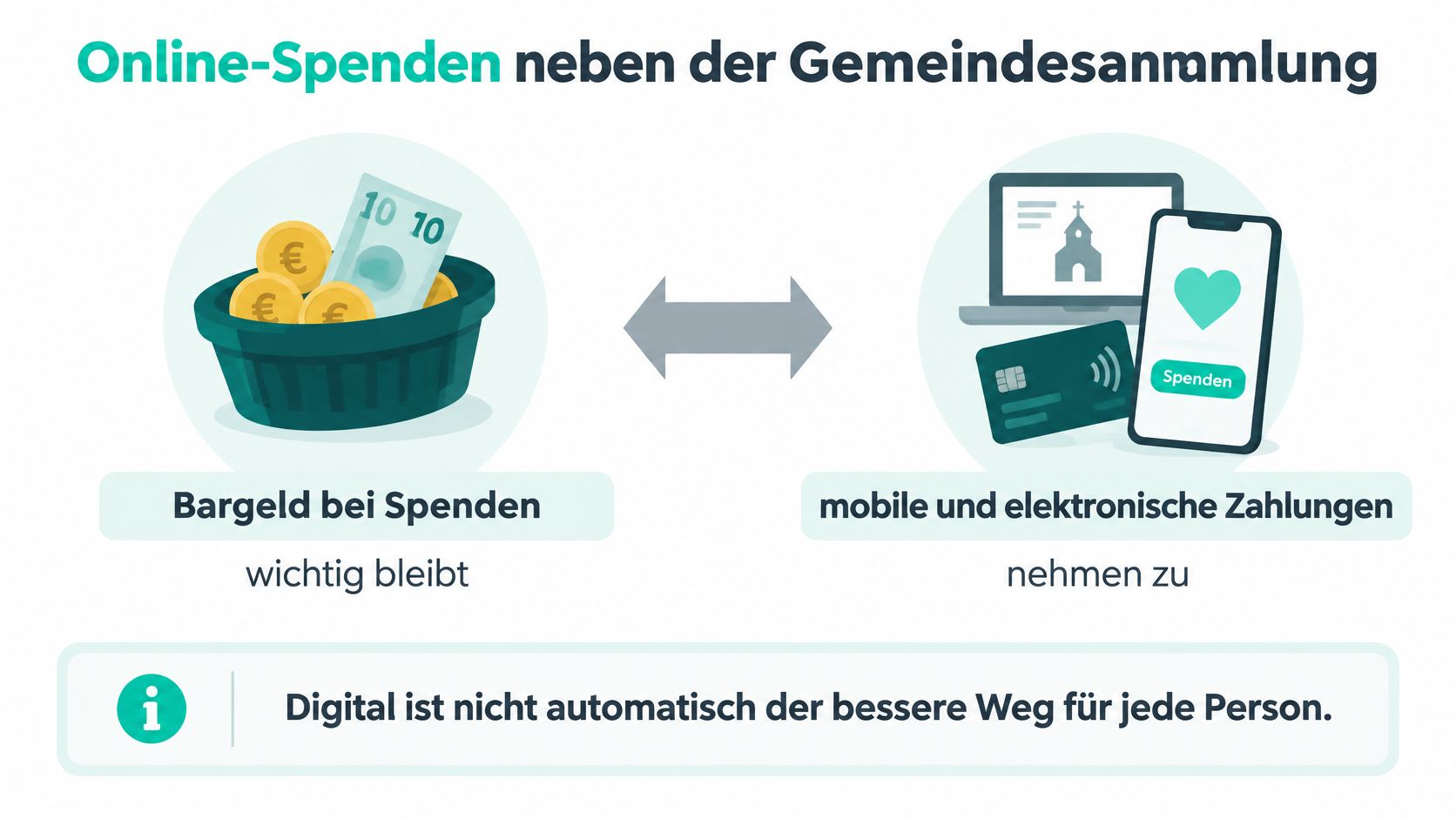
Shared purpose with different access points
At Friday prayers, the collection box stays in its usual place. Alongside it, a QR code leads to the project page. Also print the project name and the responsible organisation legibly on the sign, so visitors don't have to open a code blindly.
For a water project, absent community members can receive the appeal digitally. The personal connection remains intact if the message explains why the community supports this particular initiative. An uncommented payment link, however, leaves important questions unanswered.
After Ramadan, a regularly scheduled Sadaka can help continue your personal support. No one should have to set up a recurring mandate under time pressure during an event. Give interested people the chance to choose the rhythm calmly, at home.
Keeping responsibility local
For the organisation, it is important to cleanly assign cash income and digital receipts. Anyone who publishes a shared progress status should internally document which payments are included in it. This helps the community avoid accidentally counting the same pledge and the later payment receipt twice.
- Offer access: Allow cash, bank transfer and digital payment side by side.
- Name a contact person: Visitors should know who answers questions about the project.
- Make the status clear: Distinguish an announced contribution from an actually recorded receipt.
A digital confirmation does not replace a personal conversation about how funds are used. Conversely, a trusting relationship does not mean everyone should donate exclusively in cash. Online donations are the accessible infrastructure between meetings, while the community retains responsibility for its communication and its collection.
How to donate on SadakaNow
Open a project and read the details. Take a look at a project in mosque construction, water projects, or aid projects, for example. Check the goal, current status and responsible organisation before going to the form.
Enter your amount. Decide consciously whether you want to support once. For a regular Sadaka, use the section for monthly donations and check the chosen rhythm.
Decide on a voluntary tip. You can optionally round up your amount. This voluntary contribution is part of our business model and supports operations; it is to be distinguished from your actual donation.
Choose the payment method and confirm the summary. You can pay via SEPA, PayPal or credit card. For SadakaNow projects, only the costs of the payment service are passed on, which are shown transparently in the donation form before completion.
Keep the confirmation email. Check that the project and amount are correct. If you need a donation receipt for tax purposes, contact the receiving organisation.
If something remains unclear at checkout
If you have questions about your donation or payment problems, you can reach us at hilfe@sadakanow.de. For identification, please provide the project name, the payment date and the email address used. Do not send complete card details or login credentials.
Our platform supports Muslim projects in Germany, Austria and Switzerland. Don't choose based solely on the highest donation total, but on whether you can understand the purpose and responsibility. If it's unclear after an error message whether the payment went through, first check your confirmation and payment overview before donating again.
On SadakaNow you will find vetted Muslim projects, publicly traceable project statuses and several digital payment methods. Choose a project, read the details about the responsible organisation, and then decide how you would like to support it with your Sadaka.