
Donating monthly: How to set up Sadaqa standing orders
You want to give Sadaqa regularly without having to think about it every month. At the same time, it should be clear where the money goes, how you document the payments, and what you do if your financial situation or a project changes. A standing payment can help with this, as long as you set it up deliberately and review it regularly.
The practical approach is simple: decide on a project and an affordable amount, choose a suitable payment method, archive the receipts, and take time once a year to review the recipient and the mandate. That way, giving regularly remains a conscious decision rather than an unchecked direct debit.
Table of contents
- What donating monthly in Germany really means
- The most important payment methods compared
- Setting up a Sadaqa standing order in a few minutes
- Deducting from your taxes without nasty surprises
- The annual donation check for more control
- Pausing, cancelling and dealing with failed payments
- Your plan for the next 30 days
What donating monthly in Germany really means
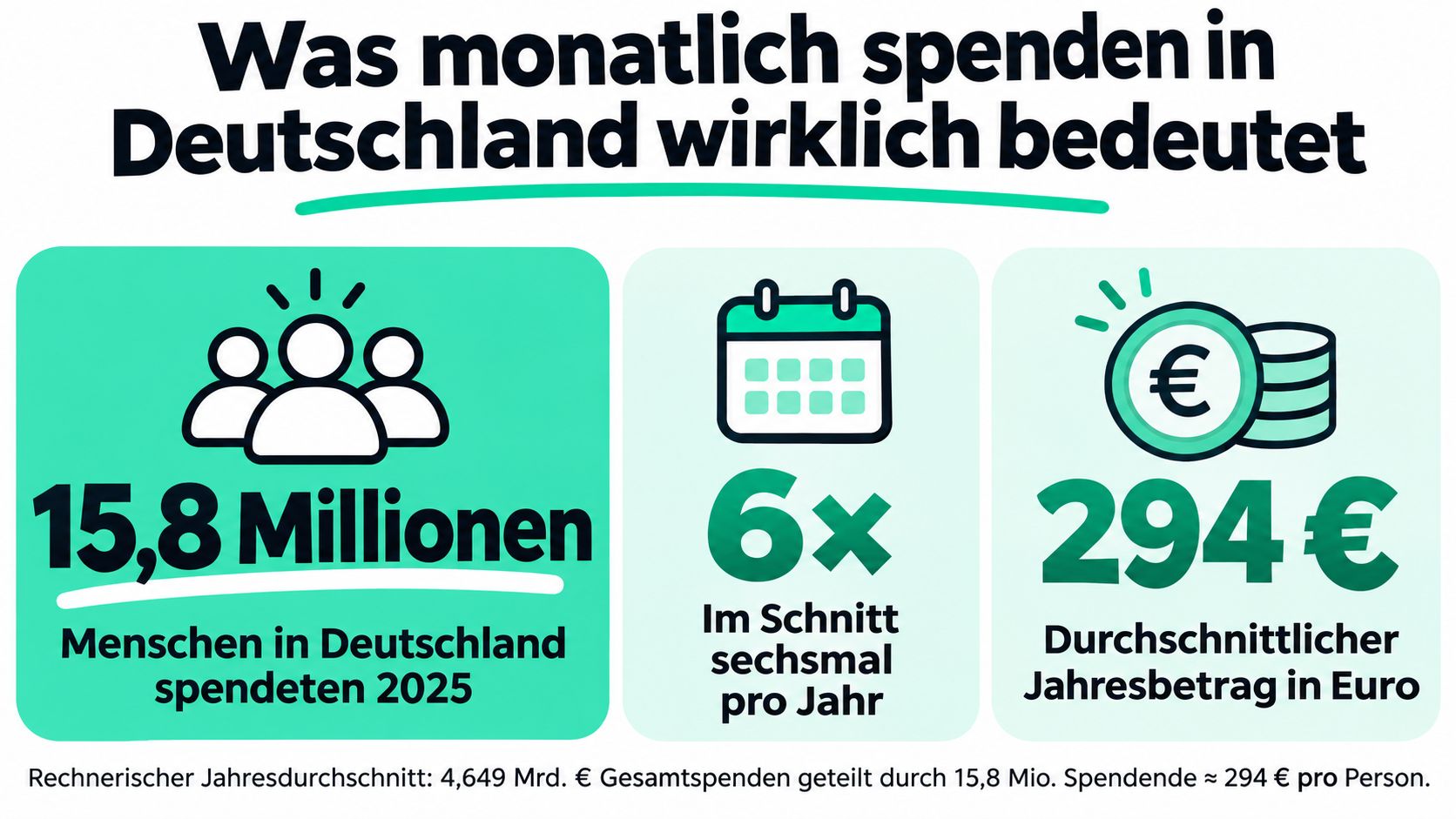
In 2025, 15.8 million people donated in Germany. They donated an average of six times a year, and the average contribution was 46 euros per donation, as reported by the Deutscher Spendenrat's report on the 2025 donation year. This describes a donation practice that is often tied to individual occasions. A monthly Sadaqa doesn't turn this into an obligation, but into a reliable way of giving regularly.
You don't need a complicated strategy for this. Proceed in this order: choose a project, set an amount you can afford even in a tighter month, decide on a payment method, and keep the receipts safe. After that, determine when you'll review the standing payment again. The reason for this order is practical: a simple, affordable amount is more sustainable than a high commitment that you'll soon have to change.
A monthly contribution of 10 to 25 euros is an illustrative calculation, not a recommendation for everyone. Over twelve months, that would be 120 to 300 euros per year. You should understand these amounts as cumulative annual contributions, not as a single large donation. They also show why payment frequency matters: many people donate several times a year, but not necessarily every month. A standing payment spreads the contribution more evenly and can help an organisation plan recurring support better. The figures on donation frequency refer to private monetary donations in Germany, not to corporate, major, or party donations.
If you want to explore the religious idea behind ongoing giving, also read about Sadaqa Jariyah and its meaning. What matters is your own informed decision: regularity can be useful, but it is not a measure of how devout or generous someone is.
My clear recommendation: Set the amount so that you can give it without feeling pressured. A deliberately chosen Sadaqa is better than a standing payment you keep running out of a bad conscience.
The most important payment methods compared
For a monthly contribution, what matters most is control, traceability, and how failed payments are handled. There is no single best method for everyone. Choose the payment method whose management you understand and whose receipts you can reliably keep safe.
| Criterion | SEPA Direct Debit | PayPal | Credit Card |
|---|---|---|---|
| Who it suits | For a regularly recurring payment directly from a bank account | For people who already use PayPal and want to manage payments there | For donors who like to bundle their expenses on a card |
| Strength | The collection happens once a mandate has been granted, so you don't need to manually execute the transfer every month | The payment can be tracked in the PayPal account and can be convenient for online payments | The payment can be linked directly to the card account |
| What you should watch out for | Changing accounts, checking coverage, and keeping an eye on the mandate status | Keep the PayPal receipt and bank statement neatly filed; check how a recurring payment is managed | A new card or expired card details can cause a charge to fail |
| For tax filing | Keep the bank statement or payment receipt | Save the payment confirmation and bank statement | Archive the card statement and donation confirmation |
SEPA direct debit is often the obvious choice if you want a stable monthly collection and keep your bank account up to date. It saves you from manually transferring money, but it requires a valid mandate and sufficient available balance. Check the confirmation before assuming the order is active.
PayPal can be practical if you already manage your online payments there. Don't rely solely on the transaction staying visible in the app for your records. Save the payment confirmations so you can later assign them to the calendar year and the recipient.
With credit cards, you should pay particular attention to changes in card details. A card replacement or an expiry date can interrupt a recurring payment. This isn't a reason to rule out the method altogether, but you need to keep the payment source up to date.
Don't decide based on the number of options offered. Choose the method where you're most likely to notice if a payment fails, and whose receipts you can find again without effort.
Setting up a standing order for Sadaqa in just a few minutes
Don't set up a recurring payment as an afterthought. Take a moment to consciously check the recipient, the payment frequency, and the receipts. The specific labels on a platform can change, so when setting it up, follow the information displayed to you in the respective payment process.
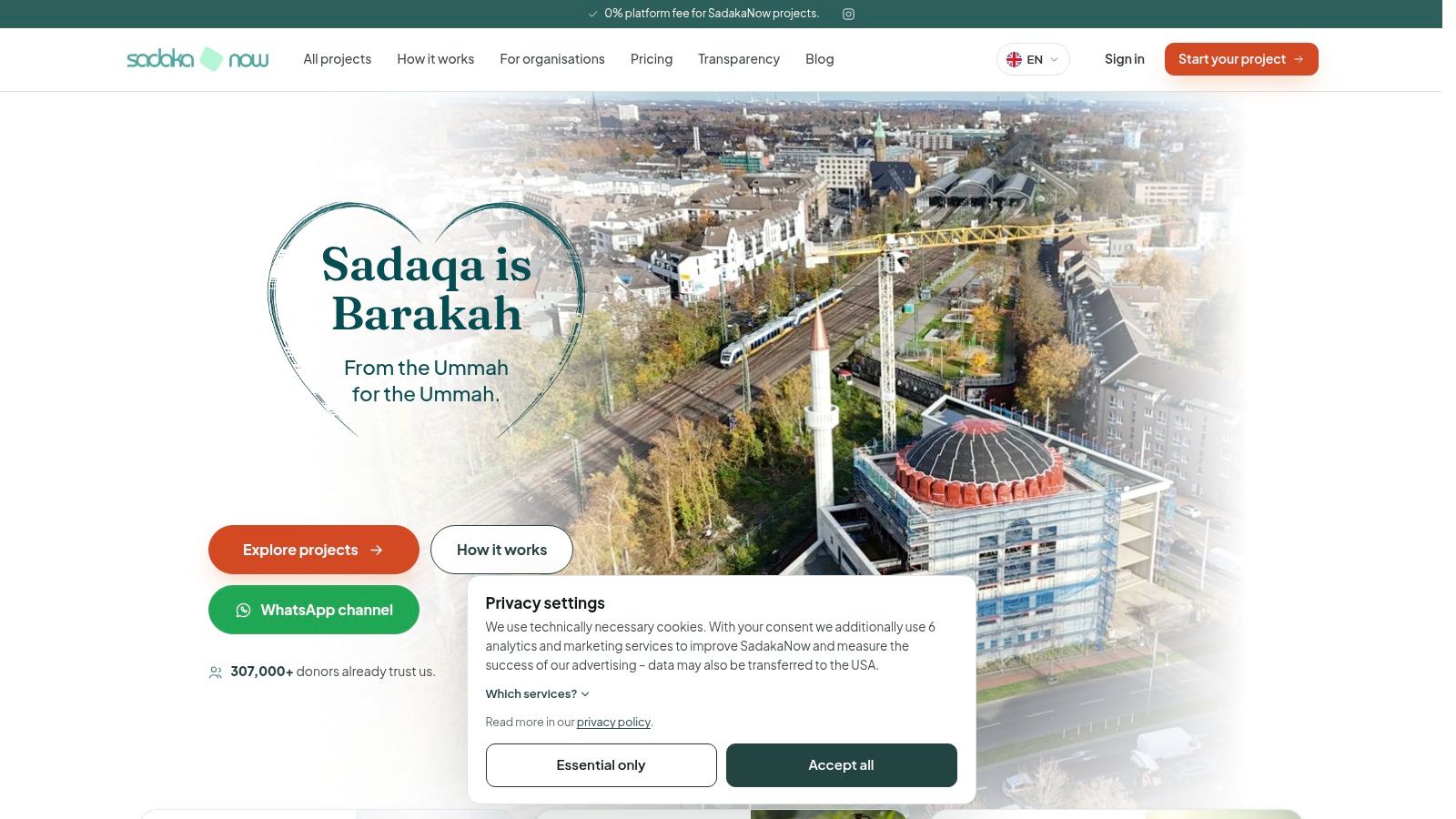
First, choose the right project
Open the project catalogue and read the description before you donate. Pay attention to whether you want to support a specific campaign or whether your contribution should be used as general Sadaqa. Project progress, donor numbers, and updates can help you gauge the status of a campaign. However, they do not replace your own check of whether the purpose matches your intention.
If you select a project-related payment, keep the project name together with the confirmation. This way, you can later trace which campaign you supported. For a general donation, note the stated purpose or recipient instead.
Set the amount and frequency
Enter an amount you can regularly afford, even if a month is financially tighter. Explicitly choose the monthly option if it's offered in the payment process. Before confirming, check that the amount, frequency, and project match. An accidentally one-time contribution or an incorrect campaign selection can be avoided more easily if you briefly review these details.
Confirm the payment and secure your records
Choose a payment method and review the conditions shown. For a SEPA direct debit, make sure you actually grant the mandate. For PayPal or credit card, check that the payment is marked as recurring if you want to set up a monthly order. A confirmation email or payment overview belongs in your receipt file.
An anonymised live donation feed such as "Sadaka Pulse" can show that donations are currently coming in on a platform. It replaces neither the payment confirmation nor the project report. For your own documentation, what counts is the confirmed order and the payments actually executed.
Claiming tax deductions without nasty surprises
A donation doesn't come back fully as a tax refund. The Federal Ministry of Finance explains that donations to tax-privileged recipients are considered as special expenses (Sonderausgaben). This can reduce your taxable income. The actual tax effect depends on your personal situation, so you shouldn't equate a tax refund with the amount donated.
For individual donations up to 300 euros, a simplified proof is usually sufficient, such as a bank statement or payment receipt. You can find the relevant guidance in the brochure by the Federal Ministry of Finance on tax benefits for volunteering and donations. For higher individual donations, a donation confirmation (Zuwendungsbestätigung) is generally required. What matters is that the recipient is tax-privileged. A religious intention alone does not make a payment tax-deductible.
How to organise monthly payments
Create a folder for the calendar year and save each receipt with date, amount, recipient, and payment method. For a SEPA direct debit, you can save the bank statement; for PayPal, also save the transaction confirmation; for credit card, keep the card statement and the respective proof of payment. If you support several organisations, keep them separate so the totals don't get mixed up.
At the end of the year, add up the payments actually processed and compare the total with your receipts. A set-up monthly order is not automatically the same as twelve successful payments. Returned direct debits, interrupted orders, or a changed amount must be visible in your overview.
For a mosque or an association, check in advance whether the organisation is recognised as tax-privileged and can issue a donation confirmation. If you're unsure which certificate an association should provide, you can find more information on the donation confirmation for an association.
The annual donation check for more control
"As long as it's regular" is not a sufficient criterion. A standing payment can reliably support a helpful project, but it can also keep running even though the goal has changed or you can no longer follow how the organisation reports on its work. Regularity does not replace review.
The Deutscher Spendenmonitor 2025 surveyed 5,008 internet users in Germany and names transparency and trust as important donation factors. The information on the Spendenmonitor from the Deutscher Fundraising Verband offers a suitable starting point for this. For you, this doesn't mean constantly questioning every transfer. It means occasionally comparing your contribution with the current purpose and the available information.
Check recipient, project, and mandate
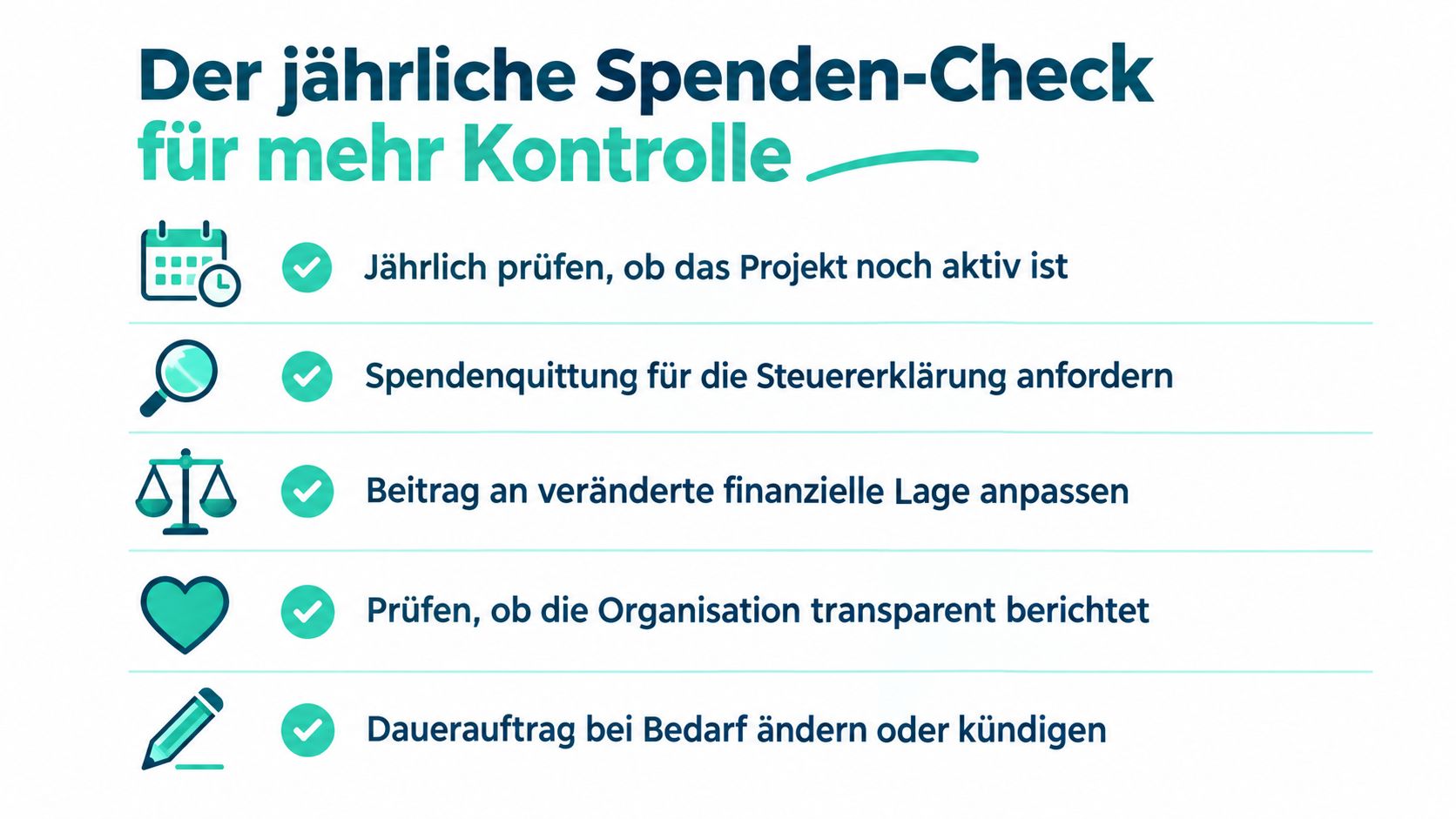
Set a fixed date once a year and go through these points:
- Check non-profit status: Check whether the recipient is still tax-privileged, in case you want to claim the donation for tax purposes.
- Review project status: Read current project reports and check whether the original goal is still active.
- Assess progress: Compare the described activities and the use of funds with the purpose you wanted to support.
- Check payment mandates: See which SEPA, PayPal, or card payments are still active and whether you still want them.
- Adjust your contribution: Change the amount or recipient if your financial situation or your trust has changed.
If you're looking for new projects, compare purpose, transparency, and reports instead of just looking at an impressive campaign description. The tips on how to find donation projects can help you review your selection. A pause or change doesn't make your Sadaka any less sincere. It shows that you're deciding consciously whom your money is entrusted to.
Pausing, cancelling, and handling failed payments
If a payment fails, first clarify whether it's a one-time problem or a changed payment basis. Check your account or your payment app, read the recipient's notification, and update bank or card details if necessary. Don't ignore a message about a failed direct debit, otherwise it will remain unclear whether the order is still active.
For a SEPA direct debit, the mandate you granted is the basis for the collection. Read the mandate terms and your bank's information if you want to return a payment, stop the collection, or revoke the mandate. Return options and deadlines depend on the circumstances and the applicable terms. So don't rely on a blanket deadline, but check it directly with your bank or payment provider.
When switching providers: Set up the new order and check that the first payment was successful before ending the old order, if you want to avoid an interruption. Keep an eye on both mandates so you don't accidentally donate twice.
If you want to pause, look for the management option in your account or contact the provider before the next collection is due. For a cancellation, you should secure a written confirmation and then check that no further payments are announced. If you move or change your account, update your details in time instead of waiting for the next collection.
Regularly check your active mandates and change them if you no longer want to support the recipient. If a payment fails, you don't have to automatically give up permanently. First clarify the cause, then consciously decide whether you want to continue, pause, or cancel.
Your plan for the next 30 days
Turn the intention into a simple process that you control yourself. You don't have to do everything at once. Start with a clear selection and then set up your filing system.

- Choose a project: Read the purpose and decide whether you want to support a specific campaign or general Sadaqa.
- Set a manageable amount: Choose a sum that fits your financial situation, and decide on the payment method.
- Keep the confirmation safe: Store payment confirmations and receipts so you can later assign them to the right recipient and calendar year.
- Schedule a donation check: Choose an annual date to review project status, receipts, and active mandates.
If you follow these steps, you create a system that combines regular giving with overview and control. Your Sadaqa remains your decision, even if your amount or recipient changes later.
SadakaNow brings together verified projects from mosques, aid organisations, and social initiatives and enables payments via SEPA, PayPal, and credit card without a platform fee. Take a look at the project information, choose a purpose that fits your Sadaqa, and visit SadakaNow to set up your support deliberately.