
Donating Kaffara: Calculation, Recipients and Payment
Why do two donation websites list completely different amounts for the same intentionally broken Ramadan fasting day, and which of them actually fulfils your obligation? This very question determines whether donating Kaffara is a comprehensible act of atonement for you or simply an adopted campaign figure. The amount alone is rarely decisive. What matters is whether the occasion, meal value, recipient group and proof all fit together, and whether a qualified religious authority has assessed your case beforehand.
Table of Contents
- Kaffara amounts per fasting day compared
- When Kaffara applies and when Fidya or Qada does
- Eligible recipients and forms of fulfilment
- How to calculate your Kaffara in six steps
- Proof and tax deductibility for Kaffara donations
- Donate Kaffara now via SadakaNow
Kaffara amounts per fasting day compared
How can Kaffara amounts be compared when organisations state different sums? The overview below places the amounts mentioned in this section side by side. However, the calculation basis is not documented for every figure. This means the table does not allow you to conclude that every organisation uses the same meal value or the same calculation method.
Kaffara amounts per intentionally broken fasting day
| Organisation | Amount per day |
|---|---|
| German Doctors | 780 € |
| Aktion gegen den Hunger | 600 € |
| LIFE | 540 € |
| United for Humanity | approximately 780 € |
Why the range exists
There is no uniform German standard amount. The amounts differ, and the calculation behind them is not always disclosed. A total sum alone therefore does not reveal which meal value it is based on or how the obligation is meant to be fulfilled.
A higher amount is not automatically more religiously correct. What matters is whether the calculation can be followed and whether it fits your own case.
Before donating, check:
- Meal value: Is the price per meal stated?
- Target region: Does the calculation relate to the place where the meals are distributed?
- Form of fulfilment: Are meals being served, food distributed, or money passed on?
- Religious classification: Is it clear for which case and which opinion the amount is set?
Calculating your own case
First, work out the amount for one day. Then multiply it by the number of days affected. For three days, 3 × 600 euros comes to 1,800 euros; for 3 × 780 euros it is 2,340 euros. The difference results from the daily amount used.
Next, check whether the calculation basis is comprehensible. If only a round total sum is given, it is impossible to tell which meal value lies behind it. If needed, clarify your religious classification with a trustworthy religious authority.
When Kaffara applies and when Fidya or Qada does
Not every missed fasting day is a Kaffara case. The Kaffara explanation by German Doctors describes Kaffara as an act of atonement for intentionally breaking the fast during Ramadan or for breaking an oath, while Fidya applies to people who are unable to fast due to permanent health or age-related reasons.
Kaffara, Fidya and Qada by case
| Case | Term | Compensation |
|---|---|---|
| Deliberately breaking a Ramadan day | Kaffara | Feeding 60 needy people or the monetary equivalent |
| Breaking an oath | Kaffara | Ten meals or an equivalent provision |
| Permanent inability to fast due to illness or age | Fidya | Feeding per missed day |
| Missed days without fault | Qada | Making up the fasting days, no monetary payment |
The difference lies in the reason
Kaffara presupposes culpable behaviour, such as a Ramadan day that someone consciously breaks without a recognised reason. Fidya, on the other hand, concerns a permanent inability where making up the day is not possible even later. Qada simply means fasting missed days at other times once the person is able to do so again.
An example clearly separates the cases. A person pauses due to an illness, recovers, and makes up the days later. That is Qada, not Kaffara, because there is no deliberate breach. Another person deliberately eats on a Ramadan day without an excuse. This day falls under the Kaffara assessment.
Where confusion becomes costly and wrong
Anyone who equates the three terms may end up paying money for days that should instead be made up, or may donate under the wrong designation. Donation pages worsen the problem if they only show an amount without stating the applicable case next to it. Make sure, therefore, that campaigns clearly distinguish between the meal rate and the religious case.
In case of uncertainty, it is not the donation form that decides, but an assessment of the case by a qualified religious authority. Bring concrete details to this conversation: what happened, on how many days, for what reason, and whether you are able to fast or make up the days. Only with this clarification will you know which term applies to your payment.
Eligible recipients and forms of fulfilment
Kaffara meals are intended for people in need. The Fidya and Kaffara page of LIFE describes feeding 60 people or financing 60 meals. The specific form of fulfilment can vary depending on the religious classification of the case.
Checklist before payment
Check a campaign against these six points:
- Needy recipient group: Is it clearly stated who receives the meals?
- Location and country: Is it clear where the distribution takes place?
- Cost per meal: Is the calculation value disclosed?
- Distribution date: Is it documented when the distribution took place?
- Combining several days: Was this agreed with a religious authority beforehand?
- Anonymised proof: Does the report show quantities and process without identifying recipients?
Whether money instead of direct food distribution is permissible, and whether several days may be combined, should be clarified in advance with a trusted religious authority. The overview on Zakat al-Fitr also addresses comparable questions about the structuring of religious dues.
Four steps to reliable fulfilment
First, have your case classified religiously. Then choose a form permissible for this case, such as direct feeding or financing meals. The organisation should then document the distribution and publish anonymised proof of impact.
Practical rule: Without details on the number of meals, the place of distribution and the date, even a correctly calculated sum remains unproven.
For a distribution in a region with lower costs, the report should show how many meals were actually given out. Identifiable photos of recipients are not necessary for this; quantity and date information make the distribution verifiable. A broken oath is a separate case. Clarify its form of fulfilment separately with your trusted religious authority.
How to calculate your Kaffara in six steps
The following overview leads from the religious classification to the secured proof.
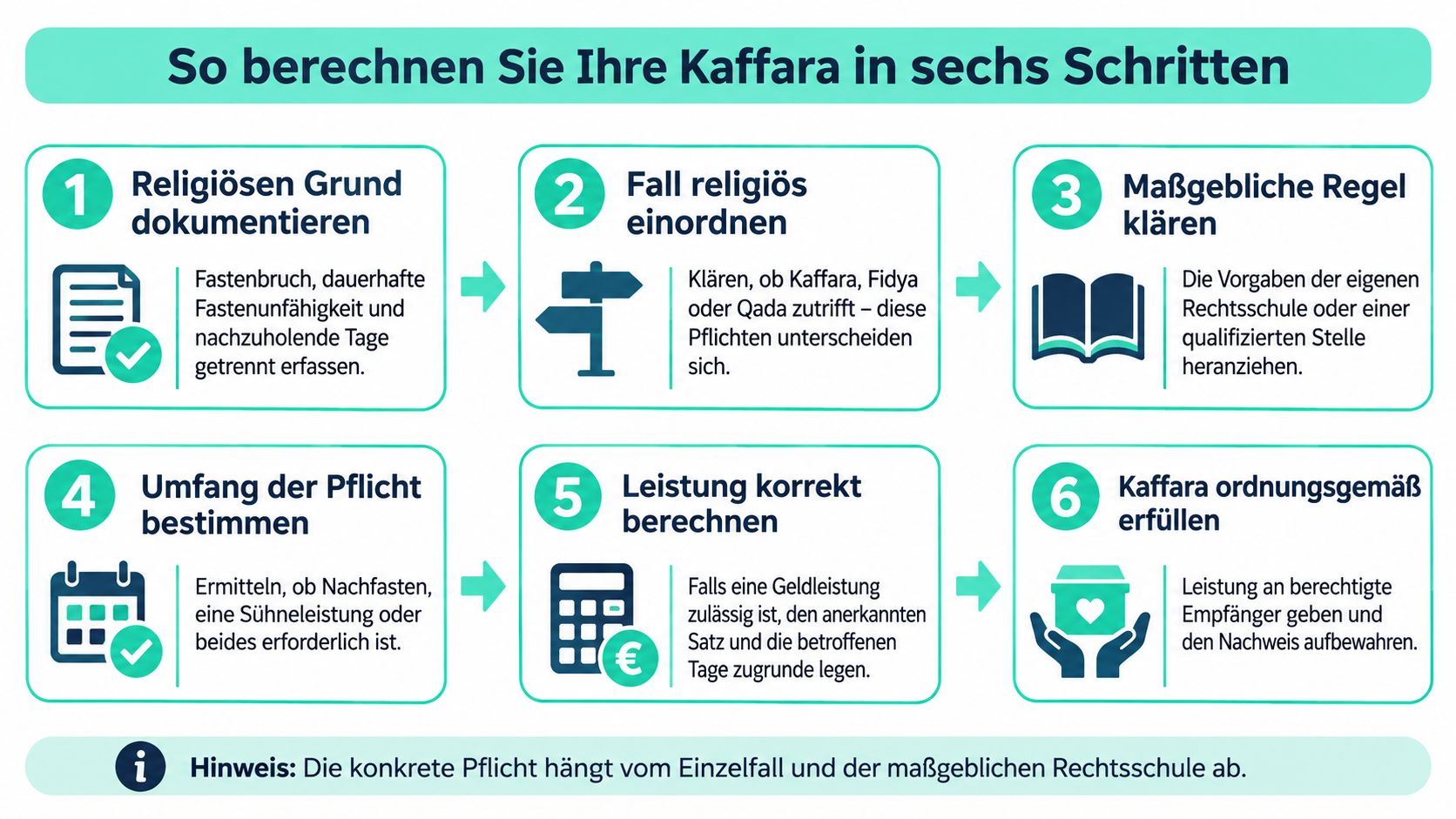
Steps 1 to 3
- Document the religious reason: Note separately whether a Ramadan day was deliberately broken, whether there is a permanent inability to fast, or whether days simply need to be made up. This separation prevents you from later misclassifying a payment.
- Ask a qualified religious authority: Have the school of law and the compensation confirmed for your specific case. A campaign page may state an amount, but it knows neither your situation nor your religious affiliation.
- Determine the number of days: Only count the days that, after confirmation, fall into your category. Make-up days and cases of permanent inability do not automatically belong in the same calculation.
Write down these three points before looking at any amount. Anyone who starts with the sum easily adopts someone else's classification. Anyone who starts with the case can specifically filter out campaigns.
Steps 4 to 6
- Choose form and daily amount: Clarify whether money is accepted instead of directly providing meals in your case, and whether several days may be fulfilled in a bundle. Compare the assumed meal value with the costs in the target region and ask for the formula behind the daily amount.
- Calculate the total: Multiply the confirmed number of days by the confirmed amount per day. Note both values separately, so that a later review doesn't only see the final sum.
- Pay for the specific purpose and keep receipts: Note down the occasion, number of days, calculation basis, recipient country and execution date. Keep the payment confirmation and the later confirmation of fund usage together.
A simple standard form helps you not to forget anything. It needs fields for occasion, number of days, calculation basis, recipient country, execution date and confirmation of fund usage. Fill it out before payment and add the organisation's proof after distribution.
The most common mistake happens in step 4: someone adopts a campaign's amount without checking its calculation. If in doubt, ask directly about the shopping basket, local meal costs and the planned distribution interval. An organisation that cannot answer these questions is not a reliable choice for a purpose-bound Kaffara.
Proof and tax deduction for Kaffara donations
Religious purpose-binding and tax law are two separate matters. A donation does not become tax-deductible just because Kaffara is stated as the purpose. According to the official information in the Federal Government's service directory, donations can generally be considered as special expenses up to 20 percent of the total amount of income, if legal requirements and proof are met, and from 300.01 euros the platform should actively refer to an official donation confirmation.
Proof per donation amount
| Donation amount | Proof | Requirement |
|---|---|---|
| Up to 300 euros | Bank statement or cash deposit receipt | Recipient and tax-privileged purpose are traceable |
| From 300.01 euros | Official donation confirmation | Tax-privileged receiving organisation |
| Deduction limit | Up to 20 percent of the total amount of income | Legal requirements and proof met |
What to look out for in the organisation
The recipient must be a tax-privileged corporation, otherwise even the finest religious proof won't help you for tax purposes. How a proper confirmation is structured is explained in the guide on donation confirmations for associations. Request the confirmation right after payment, rather than looking for it only when filing your tax return.
Control risks arise when Kaffara funds are mixed with general Sadaka funds, exchange rates remain unclear for foreign projects, meals are counted twice, or the purpose is changed retroactively. A reliable approach consists of an audit protocol including receipt review, spot checks of recipient lists, reconciliation of payment and disbursement data, as well as a public final report. If in doubt, clarify your personal tax question with a tax advisor.
Donate Kaffara now via SadakaNow
How do you recognise whether a project fits your calculated Kaffara? First, compare the intended purpose of use with your calculation basis. A project name alone does not prove how an organisation uses the funds.
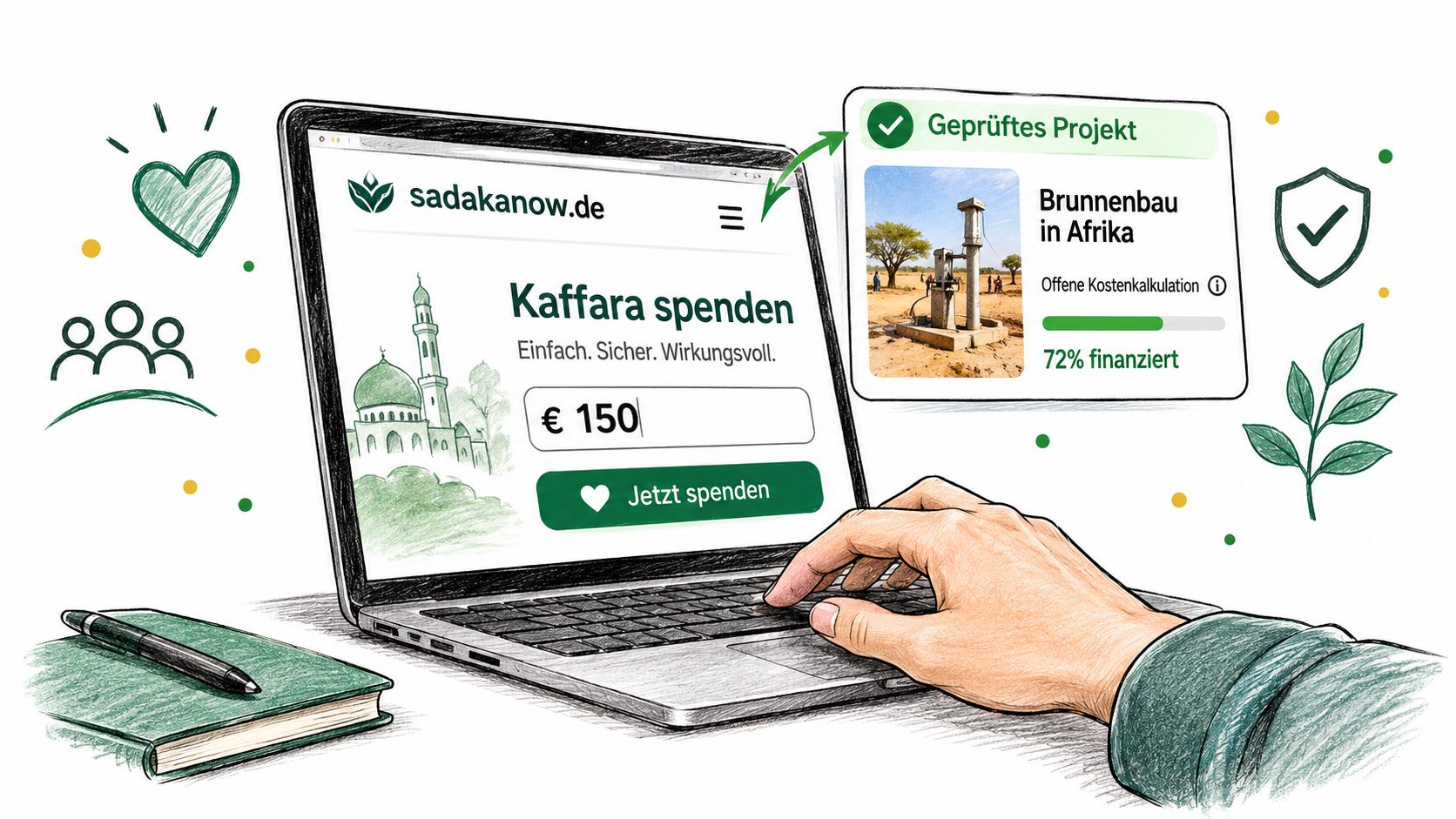
Proceed step by step:
- Select a project: Search SadakaNow for a suitable project from the categories mosque construction, water projects, or aid projects. Check whether the information on the purpose of use supports your calculated Kaffara.
- Enter the amount: Transfer the amount you have determined based on your number of days and the confirmed calculation basis.
- Choose a payment method: Donate via SEPA, PayPal or credit card.
- Check the confirmation: Keep the confirmation email. Ask the organisation if you need proof of how the funds are used.
SadakaNow forwards donations without a platform fee. The funds are held in trust and paid out directly to the respective organisation.
A brief explanation of the process can be seen in the following video.
Before submitting, check once more the number of days and amount as well as the purpose of use of the chosen project. Anyone who wants to read up on the general process of digital payments can find more information on online donations. For questions about donations or payment issues, you can reach SadakaNow at hilfe@sadakanow.de.
Count the affected days, calculate the amount based on the values used, and then choose a suitable project. This keeps it traceable how your Kaffara donation came about.