
Friends of Older People: Counteracting Loneliness in Old Age
A good one in three people aged 65 and over in Germany lives alone, and yet people aged 65 and over who live alone feel lonely often less frequently (17.6 percent) than younger people living alone, as the Federal Statistical Office reports. Loneliness, then, cannot be read off a doorbell nameplate. It affects people with a full calendar, with family in the same town, with neighbours who greet them every day.
Time, money and attention are the three currencies with which support can be paid for. Anyone who knows what each one achieves finds it easier to choose.
Table of Contents
- The association Freunde alter Menschen at a glance
- Why loneliness in old age is so widespread
- How a visiting partnership works
- Where a visiting service reaches its limits
- Planning donations sensibly and using proof of donation
- Choosing the right way to help
The association Freunde alter Menschen at a glance
Freunde alter Menschen e.V. has been active in Germany since 1991, with its headquarters in Berlin. Its roots reach back further: the German association grew out of the international movement "les petits frères des Pauvres", founded in Paris in 1946. What has become of it is set out as figures in the 2024 Annual Report of Freunde alter Menschen, figures that reveal an underlying attitude. The association does not merely visit older people, it builds relationships.
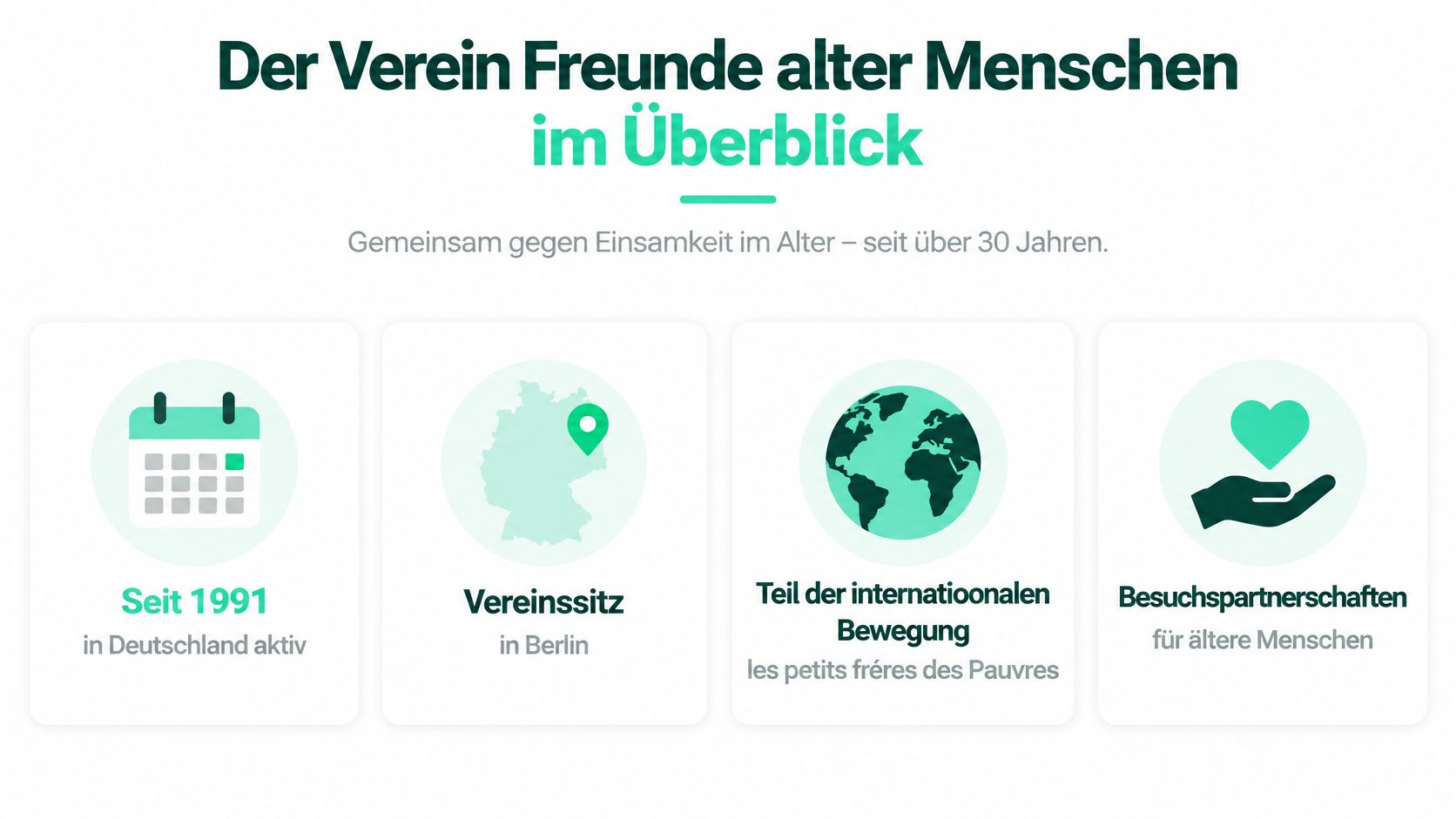
The work is spread across five German locations: Berlin, Hamburg, Cologne, Frankfurt am Main and Munich. The following overview summarises what happened there in the reporting year.
Key figures for the association in 2024
| Key figure 2024 | Value |
|---|---|
| Locations | Berlin, Hamburg, Cologne, Frankfurt am Main, Munich |
| Older people reached | 958 |
| Younger people reached | 1,023 |
| Existing visiting partnerships | 459 |
| Shared time in visiting partnerships | around 15,606 hours |
| Average duration of a partnership | 24.9 months |
| Newly arranged visiting partnerships | 194 |
| Participants in the Generation Nachbarschaft programme | 500 |
| Permanent employees | 25 (equivalent to 14.4 full-time positions) |
The most telling figure in this overview is the duration. On average, a partnership lasted 24.9 months in 2024. A service that visits people once a quarter does not produce such figures. They arise when an appointment becomes a relationship, when someone knows the other person's birthdays, witnesses their illnesses and senses which stories the other no longer wants to tell.
How an appointment becomes a bond
Before a pair is formed, someone listens. In 2024, 25 permanent employees were available for matching and support, equivalent to 14.4 full-time positions. They conduct initial conversations, match interests, mobility and place of residence, and remain available when a visit falls through or a person is admitted to hospital. That year, 194 partnerships were newly arranged, along with 125 initial conversations with older people and 242 with volunteers.
The fact that more volunteers than older people have an initial conversation is worth a second look. Not every inquiry immediately becomes a partnership, and anyone who wants to get involved sometimes has to wait until a suitable person comes along.
Alongside this are offers that work without a pair. In 2024, around 500 people took part in the "Generation Nachbarschaft" programme. One image helps to understand the whole: the association works like a matchmaking service for friendships, including follow-up support when things don't go smoothly. Anyone who wants to check before donating how to recognise a cleanly run association will find the criteria, from the statutes to the donation receipt, in our guide on Donating to non-profit associations.
Why loneliness in old age is so widespread
The first thread that thins out is contact with peers. In 2021, 61.7 percent of people over 75 saw their friends or neighbours at least once a month. Among 18- to 29-year-olds, the figure was 86.9 percent. The numbers come from the Loneliness Barometer 2024, which is based on representative data from the Socio-Economic Panel for the years 1992 to 2021.
Monthly contact with friends or neighbours by age
| Age group | At least monthly contact |
|---|---|
| 18 to 29 years | 86.9 % |
| 30 to 50 years | 81.6 % |
| 51 to 75 years | 71.2 % |
| Over 75 years | 61.7 % |
The withdrawal happens quietly, and it doesn't only affect friendships. Family contact also decreases with age: 69.9 percent of people over 75 saw family or relatives at least monthly, compared to 75.4 percent among 51- to 75-year-olds. The Social Report 2024 also notes that around 10 percent of people aged 65 and over often felt lonely, with 12 percent among women in this age group.
A rule of thumb for practice: A net doesn't hold together through a single knot, but through many meshes. Every regular contact that falls away tears open a mesh.
Why frequency matters and a single visit changes little
One visit a year is an event. A fixed appointment every week is a framework. Between the two lies the difference between an afternoon people still talk about long after, and a routine they can rely on.
One caveat belongs here: very old people and residents of care and nursing homes were underrepresented or excluded from the survey. The actual burden on particularly vulnerable groups is therefore likely higher rather than lower. Anyone planning to offer support should therefore not only ask how many people are reached, but how reliable the contact is in everyday life.
How a visiting partnership works
The path from the first inquiry to a fixed appointment follows a pattern that protects both sides: first check, then match, then accompany. Four to five steps are typical.
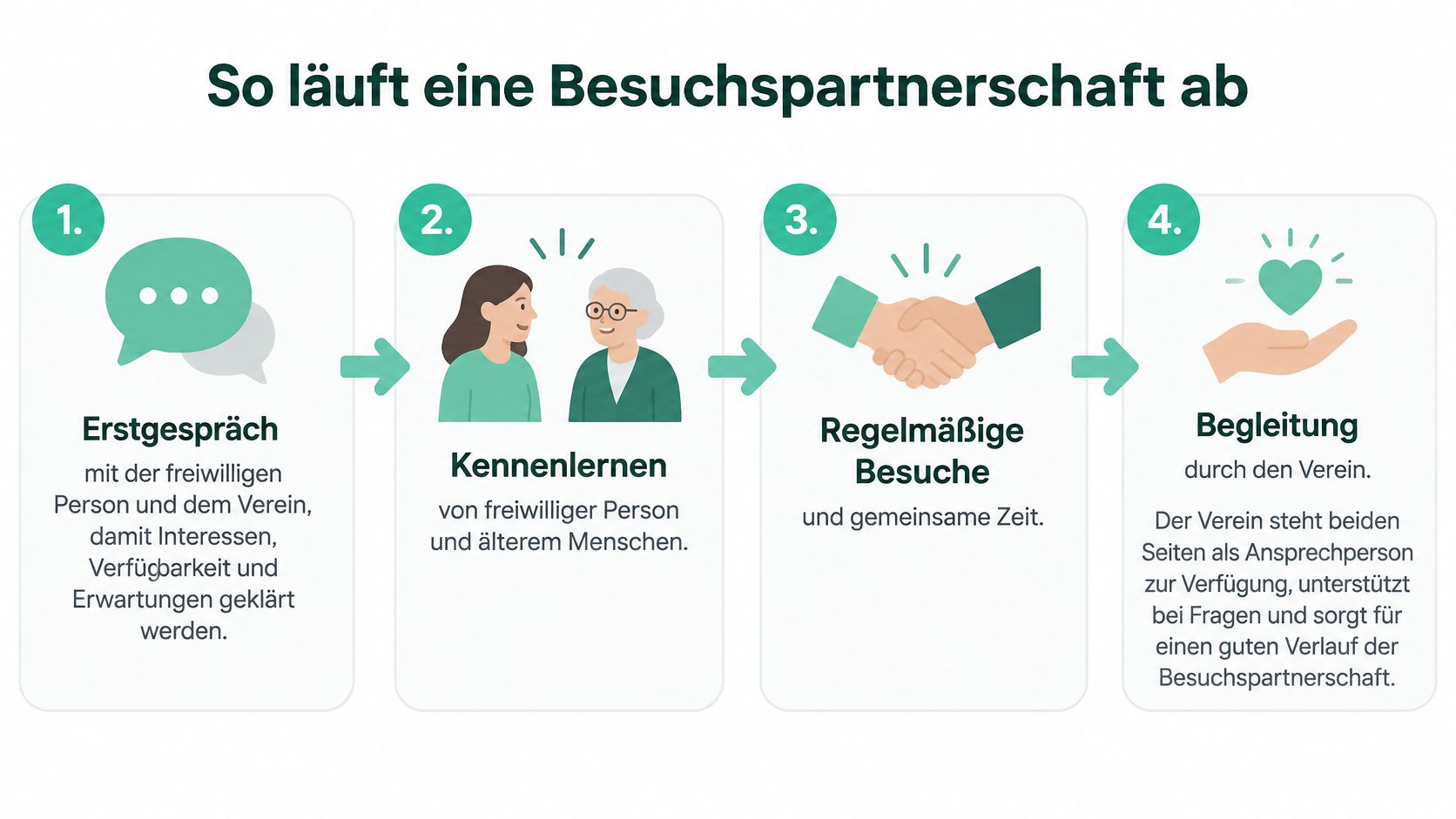
- Initial conversation with the volunteer and the association. Interests, time slots and expectations are clarified, including the question of whether someone can cope with dementia. Being honest here saves disappointment later.
- Matching by the full-time staff. They don't look for the most similar pair, but the right fit: proximity, mobility, pace of conversation. Rapport can't be planned, but the framework conditions can.
- First meeting. Usually a visit at home or a walk, an hour, no programme. This is where it becomes clear whether the two get along. A second meeting is not a failure, but normal.
- Fixed appointments at an agreed rhythm. Weekly or every two weeks, with a time slot that holds even in the rain. Reliability is the active ingredient, not the length of the visit.
- Support and exchange with the association. The coordination remains reachable, for questions, for concerns, for the case of a hospital stay. This backing is the reason why volunteers stay.
There are worlds of difference between a volunteer visit and paid one-to-one care, including in terms of responsibility. Anyone who works professionally with older people and wants to draw a clean line will find guidance in the advantages of 1:1 care 2026 on when personal attention belongs in professional hands.
The most common beginner's mistake: Wanting too much at once. A two-hour outing in the first month overwhelms both sides. A fixed coffee on Tuesday carries further.
How you can tell the partnership is working
- The appointments take place. Cancellations don't pile up, and if something comes up, a new arrangement is made.
- Both sides look forward to the next visit. This doesn't show in words of thanks, but in the fact that nobody postpones the appointment.
- The older person starts talking about themselves. Anyone who begins sharing about their own life has built trust. That is the most reliable indicator.
Where a visiting service reaches its limits
Loneliness isn't always visible from the outside. Even someone living in a care facility or regularly seeing people can feel alone. A visit can create closeness, but it does not replace care, psychotherapeutic treatment, or crisis support.
Around 35 percent of older people in care homes are considered lonely, while the proportion in private households is significantly lower, as reported by the Federal Ministry for Family Affairs on loneliness research. Offers such as visits, walks and phone calls can enable social contact. But they don't automatically reach everyone who needs support.
Adjustments that make the difference
A visit at the front door doesn't work for everyone. With limited mobility, a conversation at the kitchen table may work better than an outing. For hearing problems, a quiet room and eye contact help. Those who are hard to reach digitally may be reached more easily with a phone chain or a handwritten card.
The right form therefore depends on the person. A visiting service can enable encounters, but it cannot take over professional care.
The boundary is clear: care, therapy and crisis assistance belong in the hands of professionals. Volunteers accompany and listen. If these tasks are mixed up, volunteers can become overwhelmed and necessary help may fail to arrive.
In cases of acute care needs, after a fall, with increasing confusion, suicidal thoughts, signs of violence or financial hardship, the right specialist service is needed. This includes the family doctor's practice, a care service, or a counselling centre for older people. In an emergency, the emergency medical service is responsible. Those interested in the professional role of care workers will find an overview in the article on salary as a carer in a nursing home. Besides personal visits, financial donations can also help, for example for coordination and support. What matters when it comes to donating to a good cause depends on which form of support one chooses.
Planning donations wisely and using receipts
Money is the currency that works without a calendar. For a transfer to have an impact, a sequence of steps helps.
- Check non-profit status. A look at the legal notice shows the legal form and headquarters. Those who want to be sure can ask for the tax office's exemption notice.
- Choose a purpose. Matching, accompaniment, training or general work: a designated amount is allowed, while an unrestricted donation gives the association more flexibility.
- Decide on a one-off or ongoing donation. A fixed monthly amount makes planning easier, as coordination becomes more predictable.
- Only use the official account. Account details are listed on the association's website and should never be noted on a piece of paper from a phone call.
- Keep the donation receipt. Donations to non-profit organisations can be tax-deductible; the certificate belongs in the same folder as your tax documents.
Those who want to have a long-term impact can also remember an association in their will. This is a decision for years, not for a moment's impulse, and it should be part of legal advice.
How to recognise a reputable appeal
A phone call that refers to an association but does not provide verifiable account details is not a donation appeal, but an advance of trust. Anyone asking for money at the front door should be able to provide a certificate and a phone number for the association. If both are missing, a call back to the association itself helps. At SadakaNow, we check every organisation's non-profit status before a campaign becomes visible, so that donors don't have to research this themselves.
Checklist before making a transfer
- Recipient clear: the name and location of the association match the website.
- Purpose stated: you know whether your amount goes towards matching, accompaniment or public relations.
- Receipt secured: you have a donation certificate or know how to obtain one.
- Amount reviewed: after twelve months, review the standing order like a subscription and adjust it if your budget changes.
For your records, it's worth taking a look at our explanation of the donation certificate for associations, which lists what information must be included.
Choosing the right path to provide support
Time, money and attention open up different ways to counteract loneliness in old age. Even people who don't appear isolated can feel lonely. What matters is choosing a form of help that fits one's own everyday life.
Comparing ways to provide support
| Option | Effort | Impact | Getting started |
|---|---|---|---|
| Visiting partnership as a volunteer | Regular visits over months | Personal relationship; partnerships lasted an average of 24.9 months in 2024 | Initial conversation with the association |
| Participation in the Generation Nachbarschaft programme | Low to medium | 500 participants in 2024 | Enquiry to the association |
| Attending an information event | One-off, a few hours | Insight into the association's work | Ask the location for a date |
| Donation, one-off or regular | Low to medium | Funds matching and support provided by 25 staff members | The association's donation account |
| Recommending it to others | Low | Reaches more volunteers and older people | Personal conversation |
Those who can regularly spare one to two hours a week can start with an initial conversation and be matched with someone. Those with little time can support the full-time work that sustains visiting partnerships with a donation. An information event or a conversation among friends can also make it easier for others to access the association's work.
Volunteering is widespread in Germany. In 2024, 36.7 percent of the population aged 14 and over was involved in volunteer work, around 26.97 million people, as shown by the Report on the State of Engagement and Volunteering issued by the federal government. For your own decision, it helps to organise the options according to what you can give: time, money, or attention.
Three steps to a decision
- Check the location. On the association's website, you can check whether there is a location near you. Berlin, Hamburg, Cologne, Frankfurt and Munich are covered; some things can also be arranged by phone.
- Get in touch. Request an initial conversation if you want to learn about a visiting partnership, or ask about an information event if you first want to listen.
- Define your own contribution. Decide whether time, money, or both fit into your everyday life. A small standing order and one visit a month can be a possible way to split it.
A contact in your own neighbourhood can count too. Anyone who knows older neighbours can keep in touch, accompany them while shopping, or point them towards the association. Those interested should ask the association directly about registration and deadlines, as these differ depending on the location.
SadakaNow is a transparent donation platform from Germany. It brings together campaigns from mosques, aid organisations and social initiatives, and forwards Sadaqa donations to vetted projects without a platform fee. On SadakaNow, the campaign pages show goals, progress, number of donors and updates. Tens of thousands of Muslims in Germany already trust SadakaNow.