Fitr Zakat clearly explained for the DACH region
Table of Contents
- Understanding Fitr Zakat at a glance
- Why the distinction matters
- What donors should specifically check
- Fitr Zakat as a fixed duty during Ramadan
- Zakat as a wealth-related obligation
- Sadaqa as a voluntary gift
- The infographic in direct comparison
- What to watch out for in the terminology
- Your own household as the starting point
- Fitr Zakat in larger households
- Classifying guests and unclear cases
- Checklist for your own calculation
- The monetary value makes the calculation understandable
- Why the amount is confirmed locally
- How to check an online donation
- The timeline until Eid
- How to recognise the right recipient
- Different approaches within the DACH region
- Transferring Fitr Zakat online
- The final confirmation step
- Fitr Zakat is not the same as Zakat
- The euro amount does not apply equally everywhere
- Money or food – both can be appropriate
- Donations abroad are permitted
- A tip does not replace Fitr Zakat
- Payment becomes traceable responsibility
- Can Fitr Zakat be paid in food?
- What amounts apply in Germany, Austria and Switzerland?
- How do I recognise a purpose-bound online donation?
- Does a tip or monthly Sadaqa replace Fitr Zakat?
Fitr Zakat is firmly tied to the end of Ramadan. It is calculated per person, so that those in need can truly join in celebrating the Festival of Breaking the Fast. Unlike the wealth-related Zakat, it does not depend on savings – and unlike Sadaqa, it is not a voluntary gift either.
Understanding Fitr Zakat at a glance
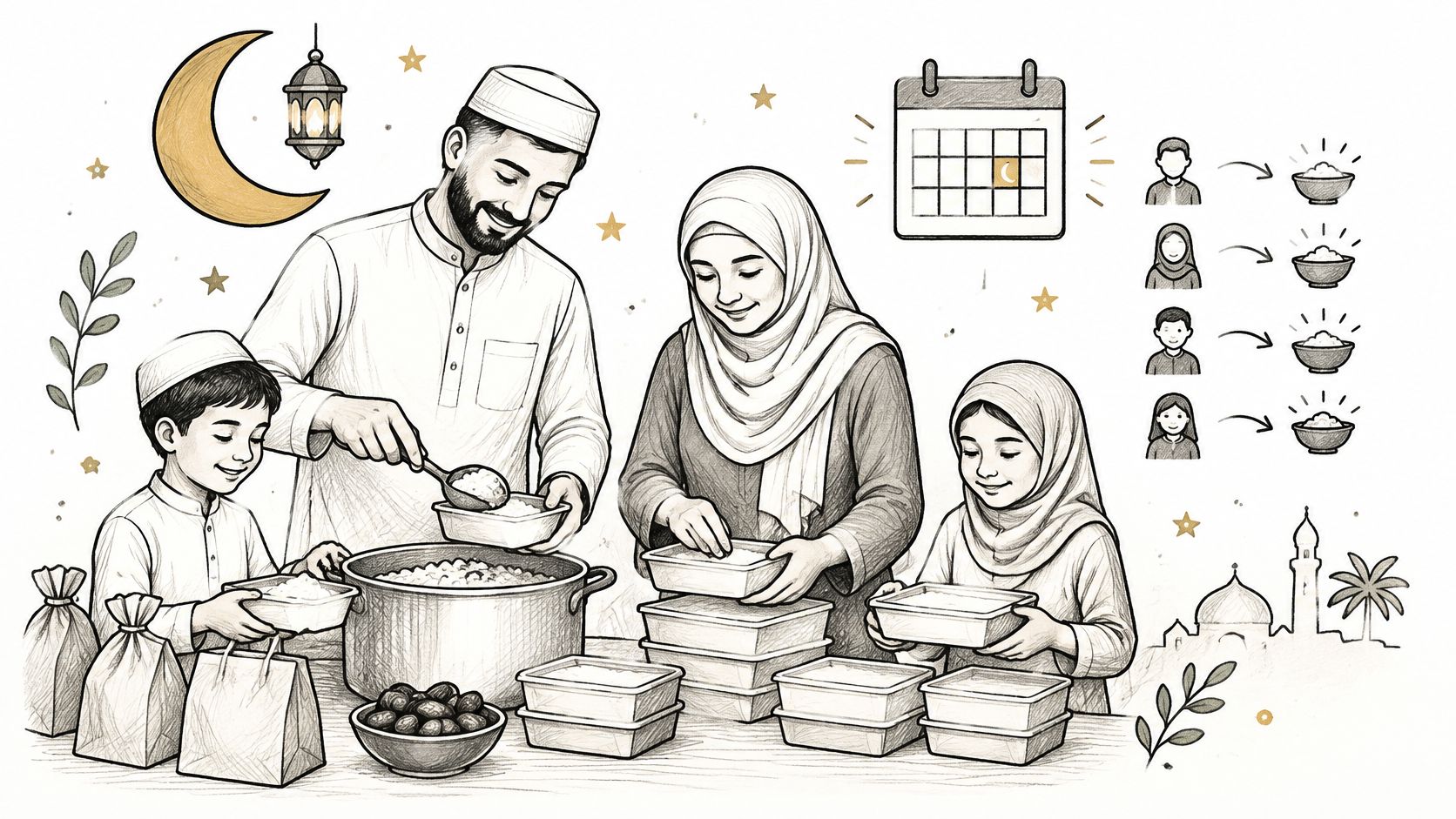
Fitr Zakat is a distinct religious duty. It is not just about a sum of money, but about ensuring that poorer people can afford a proper festive meal and everything that goes with it at Eid.
Here are the most important points in brief. This way you have everything at a glance before we go into detail.
| Question | Short answer |
|---|---|
| Who pays? | For every person for whom a household, according to traditional rules, takes on the Fitr Zakat. |
| When is it paid? | Usually before the Eid prayer and the start of the festival. |
| In what form? | Mostly in money, sometimes also in suitable food items. |
| What is it for? | To support people in need for the Festival of Breaking the Fast. |
| How much is it? | The amount follows a local reference value and is calculated per person. |
The table already shows the basic principle very clearly: what matters first is always the number of people, and only then the total amount.
The decisive feature: Fitr Zakat is paid for individual people. That is why the number of people taken into account must be correct before a total amount is calculated.
In everyday life we hear quite different terms. Some say Fitr Zakat, others Zakat al-Fitr or Sadaqa al-Fitr. The same thing is meant.
In Germany, Austria and Switzerland, mosques and aid organisations sometimes recommend different amounts. This is due to food prices and local interpretations.
Why the distinction matters
Classical Zakat is based on wealth and other personal conditions. Fitr Zakat, on the other hand, is tied to Ramadan and to the number of people in the household. Sadaqa remains voluntary and is always given in addition.
You can think of it this way: Fitr Zakat is a fixed household duty, Zakat is the regular settlement of wealth, and Sadaqa is a freely chosen gift. None of these three replaces the other.
The handover must also fit the purpose. Money is not strictly required; food can even be more sensible for the holiday. What matters is that the recipient organisation explicitly accepts the payment as Fitr Zakat and passes it on for that specific purpose.
Further guidance is available in the overview of donating during Ramadan. There you'll find more about timing, choosing a recipient, and good preparation.
What donors should specifically check
- Number of people: For whom are you covering the payment?
- Amount: What local reference value does your mosque or a trustworthy organisation recommend?
- Timing: Will the handover arrive reliably before the Eid prayer?
- Recipient: Who accepts the donation as Fitr Zakat and uses it for its intended purpose?
These four points combine knowledge and practice. This turns an abstract concept into a donation that arrives on time and fulfills its purpose.
So check the local amount now, count up the people in your household, and choose a transparent recipient who explicitly uses the Fitr Zakat for its intended purpose, for people in need, in time for Eid.
Fitr Zakat, Zakat, and Sadaqa constantly appear together in everyday giving. Still, each term stands for something of its own – with different rules and a different purpose.
Fitr Zakat as a fixed duty in Ramadan
Fitr Zakat is an obligatory gift traditionally paid toward the end of Ramadan. It is calculated per person, ideally early enough so the aid arrives before the Eid prayer.
Think of it like a fixed household duty: for every person one is responsible for, an amount is due. The sum is based on the local reference value for a measure of staple food.
Fitr Zakat is not a general wealth levy. What counts here is the timing and the number of people.
Zakat as a wealth-based obligation
The classical Zakat depends on wealth – and on further conditions. These include property, available funds, outstanding debts, and the duration of ownership.
Think of it like an annual settlement: first, one's own finances are assessed. With Fitr Zakat, on the other hand, the number of people involved is fixed from the start.
So a payment can be Fitr Zakat without being calculated from wealth in the sense of Zakat. And conversely, a Sadaqa donation does not automatically replace the obligation of Fitr Zakat.
Sadaqa as a voluntary gift
Sadaqa means voluntary giving. It comes in addition to the obligatory gifts and is bound neither to a fixed time nor to a specific number of people.
The image of a freely chosen gift fits best here: valuable, but voluntary. Even a voluntary tip on a donation page therefore does not automatically count as a Fitr Zakat payment.
The infographic in direct comparison
The following overview places Fitr Zakat, Zakat, and Sadaqa side by side and shows what matters for each form.
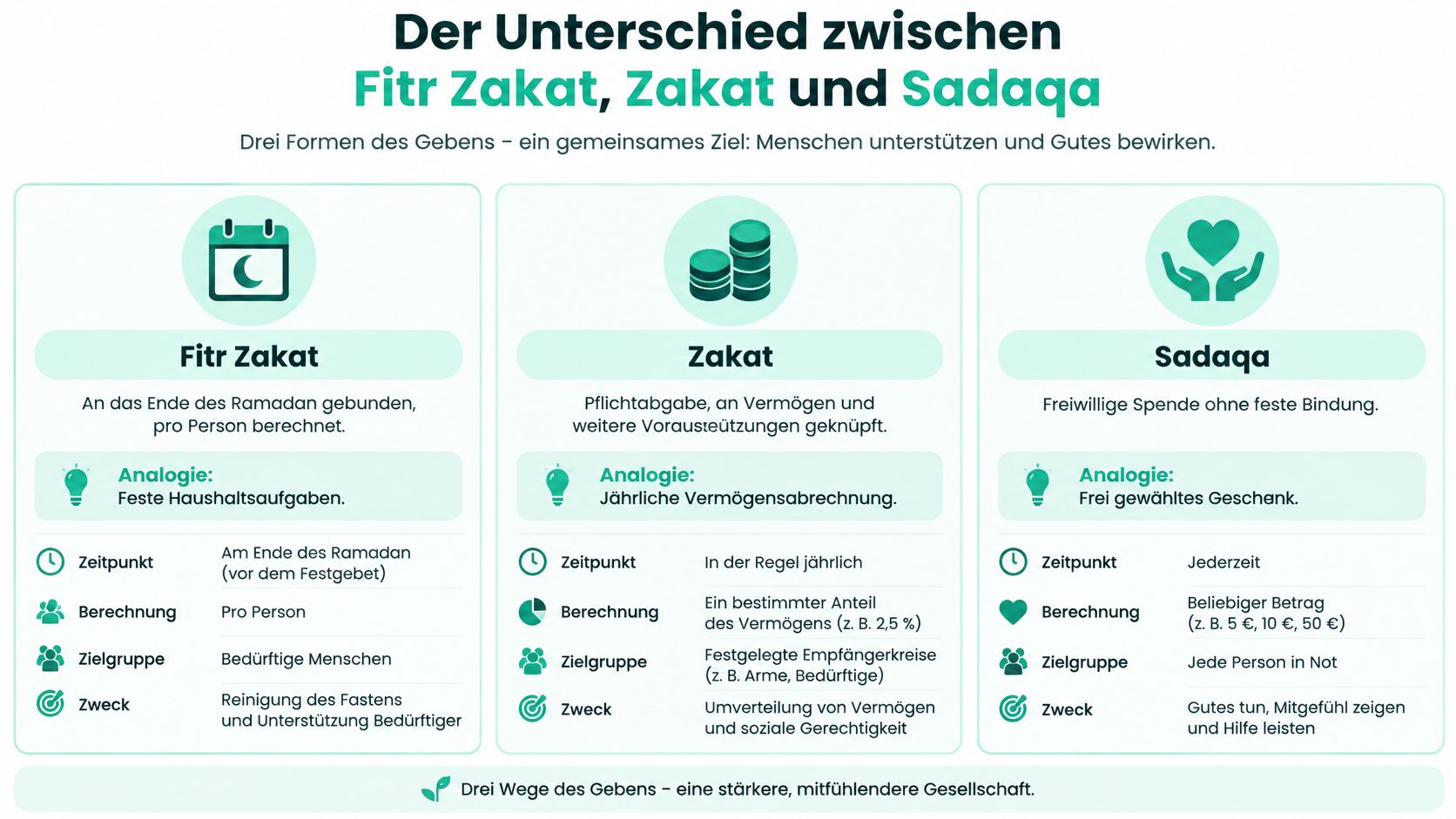
In short: Fitr Zakat is person-based and tied to Ramadan, Zakat is wealth-based, and Sadaqa remains voluntary. That is exactly why the label on a donation page is so important.
What to pay attention to regarding the label
- Fitr Zakat stands for a payment for a fixed group of people at the end of Ramadan.
- Zakat describes a wealth-based obligation with clear financial requirements.
- Sadaqa is a voluntary donation that can be given additionally at any time.
- Earmarking ensures that the gift actually ends up in the stated category.
Those who want to dive deeper will find further explanations on Zakat and Sadaqa in the detailed Zakat guide from SadakaNow. SadakaNow itself does not set any amounts, but is a crowdfunding platform for Muslim projects in Germany, Austria, and Switzerland.
So before you donate, take a quick look at the category, purpose, recipient, and timing. Then it's clear whether your payment is treated as Fitr Zakat, as Zakat, or as voluntary Sadaqa.
Who has to pay Fitr Zakat?
Fitr Zakat is not calculated only for yourself. It is an obligation that the household takes on for all people whose support it provides. It can be thought of more as a joint settlement than as an individual donation.
Your own household as the starting point
If you live alone, you generally only pay Fitr Zakat for yourself. For a family, the number increases accordingly: parents then also pay it for their dependent children.
Think of it like a joint account from which several people benefit. The household pays the amount for all eligible members and then passes it on to the appropriate organisation.
| Household situation | People to be considered |
|---|---|
| Single person | The individual themselves |
| Parents with one child | Parents and child |
| Parents with two children | Parents and both children |
| Larger household | All people with corresponding eligibility |
The central rule: What matters is not only who pays, but for whom it is paid.
Fitr Zakat in larger households
In a larger household, Fitr Zakat is not simply set as a flat rate "for the family". Every person entitled to maintenance counts individually. That's why it's worth taking a calm look at who belongs to this group – parents, children, or other people in the household.
A quick look at your own daily life usually helps already:
- Which people live permanently in my household?
- For whom am I responsible for maintenance?
- Is there someone who might pay the amount themselves?
- What amount does my mosque or community recommend in this case?
The last point in particular is important, because not every life situation is assessed the same way. For guests, relatives living separately, or if someone cannot pay themselves, it's best to get a concrete assessment.
Classifying guests and unclear cases
You don't automatically have to include guests who are only visiting briefly. The classification is also sometimes unclear for separated spouses or adult children with their own income.
Your mosque, an imam, or a recognised aid organisation can help you classify such cases. This isn't an individual fatwa, but it does give you reliable guidance for your planning.
Checklist for your own calculation
- Check household members: Count all the people for whom you take on Fitr Zakat according to the traditional rule.
- Clarify maintenance relationships: Think of children and other people entitled to maintenance.
- Address exceptions: Ask about guests, family members living separately, or lack of ability to pay.
- Have the amount confirmed: The responsible mosque or a recognised institution will tell you the appropriate local reference value.
- Check the recipient: Make sure the payment is explicitly accepted as Fitr Zakat and passed on for its intended purpose.
It's best to write down now all the people you're paying for. Then clarify any open questions with your mosque and have the amount and recipient confirmed before you prepare the payment.
There is no fixed euro amount for Fitr Zakat that applies everywhere in the world. The basis is a classic food measure, roughly a Sa'a.
For Germany, a reference value of 13 euros per person was given for Ramadan 2026. This is not a global requirement, but the conversion into money for this place and this year.
This measure is traditionally described using rice, wheat, dates, or raisins. In practice, this corresponds to roughly 2.5 to 3 kilograms.
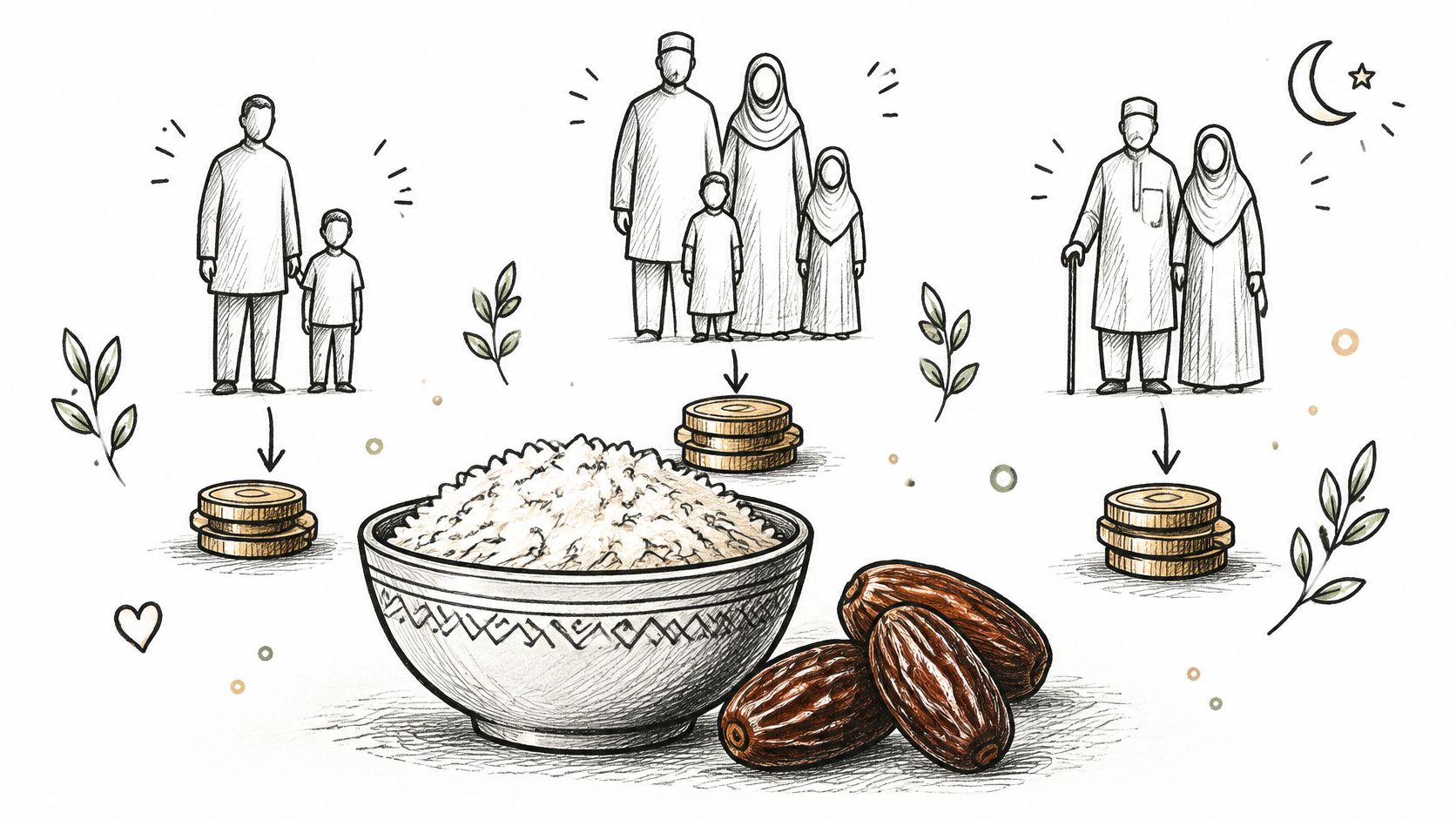
The monetary value makes the calculation understandable
You can think of it like a shared shopping list. The reference value covers what is intended per person in basic foodstuffs.
For a single person, this comes to 13 euros. For four people, that becomes 52 euros, and for six people, 78 euros. The calculation is simple, but it depends entirely on the correct number of people.
Reference value for Fitr Zakat 2026
The examples show how the value of 13 euros per person stated for Germany scales up.
| Household | People | Calculated amount |
|---|---|---|
| Single person | 1 | 13 euros |
| Four people | 4 | 52 euros |
| Six people | 6 | 78 euros |
If the number of people is right, the total amount is right too.
Why the amount is confirmed locally
Food doesn't cost the same everywhere. That's why a different city might set a slightly higher or lower amount.
Interpretation also plays a role: which basic food item is used as the basis, and how exactly is it converted? This is exactly why the short local check is worthwhile.
It's best to ask your mosque, community, or a recognised aid organisation about the amount for 2026. The 13 euros is a good reference point, but it is not a rule for all countries.
Another point is the form of the payment. Some communities prefer to accept food directly, because it can be passed on immediately. Others work with a monetary amount that corresponds to the local value of the goods.
How to check an online donation
On a donation page, it should be immediately clear: Is this really Fitr Zakat, what amount per person applies, and by when will the money be handed over? The recipient and purpose must also be stated clearly.
When making an online donation, pay attention to four points above all:
- Amount: 13 euros per person, multiplied by the number of people.
- Deadline: The handover must happen in time before the Eid prayer.
- Recipient: The organisation explicitly accepts the donation as Fitr Zakat.
- Purpose: The money is intended for people in need for the festival.
SadakaNow can process project-related donations via SEPA, PayPal, or credit card. For relevant projects, the platform fee is 0 percent; voluntary tips are shown separately. This keeps the actual Fitr Zakat amount clearly identifiable.
Check the local reference value, count the people, and choose a suitable recipient.

With Fitr Zakat, one thing matters most: the timing. It must reach those in need before the Eid prayer. Only then can they truly celebrate the festival of breaking the fast with a full table.
That's why campaigns during Ramadan always heat up in the final stretch. Anyone who pays only at the last minute risks losing that very purpose.
The schedule leading up to Eid
Basically, the process is quite simple. Have the amount confirmed, calculate it for every person in the household, and then send it to a place that actually accepts the gift as Fitr Zakat.
- Time window: The common period is the days before Eid, often the last week of Ramadan.
- Deadline: Many organisations give a clear cut-off date for payments to arrive.
- Handover: What matters is that everything is distributed before the Eid prayer.
Rule of thumb: Better to transfer a few days too early than on the night before the Eid prayer.
How to recognise the right recipient
A payment only counts as Fitr Zakat if the name and purpose are clearly stated. Otherwise, it is simply a regular donation.
So take a close look at four points on the project page:
- Designation: Is the donation explicitly accepted as Fitr Zakat?
- Recipient: Who is behind it — a verified organisation or mosque?
- Purpose: Does the money really go only to those in need for Eid?
- Deadline: By when must your payment be recorded?
Different paths across the DACH region
In Germany, Austria and Switzerland, three approaches have become established. Mosques usually collect directly on-site and pass on food or cash in person.
Aid organisations, on the other hand, work with central collection points and an organised distribution. And social initiatives often launch their own campaigns for a specific project for the festival.
Transferring Fitr Zakat online
SadakaNow brings such campaigns together on a platform for Muslim projects in Germany, Austria and Switzerland. On every project page you can see the progress, the duration and the recognised organisation behind it.
The money is held in trust and paid out directly to the respective organisation. Earmarked funds may only be used for the stated purpose.
For SadakaNow projects, the platform fee is 0 percent. Anyone who wants to can voluntarily round up — but this amount is not part of the Fitr Zakat and is shown separately.
Important: A tip does not replace the Fitr Zakat. It is always an additional gift.
The final step of confirmation
Have the recommended amount briefly confirmed by your mosque or a recognised body. And calculate it properly for the correct number of people. Then the handover will be timely, transparent and purpose-bound.
Mosques, initiatives and aid organisations may go about it differently, but the goal is the same everywhere: those in need should be able to afford a dignified meal for the festival.
So check the deadline, choose the right recipient, and transfer now so your help arrives in time for Eid.
Many mistakes with Fitr Zakat don't happen out of ignorance. They happen because people assume something too quickly. Anyone who briefly checks what is being paid, what it is intended for, and who receives it keeps a clear overview of their own donation.
Fitr Zakat is not the same as Zakat
Fitr Zakat is calculated per person, regardless of wealth. Classic Zakat, by contrast, depends on wealth and other conditions.
Checking question: Is the payment explicitly recorded as Fitr Zakat for a specific number of people?
- Fitr Zakat: per-person, tied to Ramadan
- Zakat: wealth-based and tied to further conditions
- Sadaka: voluntary and possible as an extra at any time
The euro amount does not apply equally everywhere
For Germany, the guideline value for Ramadan 2026 is 13 euros per person. Other amounts may apply in other countries, because food prices and interpretations differ.
Checking question: Which amount does my mosque, community or a recognised aid organisation confirm for my location?
And be careful with large numbers: an account statement citing millions of people does not prove that so much Fitr Zakat has actually come in. Such calculations show what would be possible — not an actual donation total.
Money or food — both can work
Fitr Zakat is usually paid in money, but suitable food is also possible. What matters is that the gift fits the purpose and that the recipient clearly accepts it as Fitr Zakat.
Checking question: Is my gift accepted as a monetary value, as food, or as both, and used specifically for those in need for the festival?
Donating abroad is allowed
Fitr Zakat does not have to stay within your own country. Through a trustworthy organisation, it can also reach people in another country.
Especially with international projects, it's worth taking a close look:
- Recipient: verified organisation with clear accountability
- Use: exclusively for the stated purpose
- Delivery: documented distribution to those entitled
- Timing: passed on before the Eid prayer
A tip does not replace Fitr Zakat
A voluntary surcharge or a tip is an additional Sadaka. It does not replace either the amount of the Fitr Zakat or its designated purpose.
At SadakaNow, such tips are shown separately. Servers, team, and payment processing are financed through voluntary surcharges and funding grants, while a platform fee of 0 percent applies to project donations.
Check question: Is the Fitr Zakat amount shown in full and designated for its purpose, without a tip being credited towards it?
From payment to traceable responsibility
Anyone who wants to avoid mistakes checks five points before making the transfer: the number of people, the local amount, the recipient, the intended use, and the deadline. This turns a general donation into a traceable fulfilment of the Fitr Zakat.
Further guidance on compensation payments is provided in the article Fidya payments explained clearly. It outlines which cases require their own religious and legal review.
Important: The correct amount alone does not make the payment a valid Fitr Zakat. The designation, recipient, purpose, and timely handover must also be correct.
So count now the number of people you are paying for. Have the local amount confirmed, transfer it before the Eid prayer, and choose a transparent recipient who uses the money exclusively for those in need for the holiday.
Can the Fitr Zakat be paid in food?
Yes, that is possible. Instead of money, suitable staple foods can also be given.
Which foods qualify is decided by the body that receives your gift. The local monetary value of these foods usually serves as the benchmark.
What amounts apply in Germany, Austria, and Switzerland?
Before the holiday, it is worth doing a quick check of three things: the reference amount, the number of people, and the deadline.
If the figures differ from one another, simply ask directly at the mosque, in the community, or with the respective organisation.
- Amount: What monetary value is recommended for 2026?
- People: For whom in the household must you pay the Fitr Zakat?
- Deadline: By when must the gift arrive at the latest so that it still arrives before the Eid?
How do I recognise a designated online donation?
The donation page must clearly state that it is Fitr Zakat – and which organisation it goes to.
The designation, recipient, intended use, and deadline should be clearly stated. A public project page with regular updates also helps to trace the path of the donation.
- Recipient: Who explicitly accepts the donation as Fitr Zakat?
- Use: Does the money really only go to those in need for Eid?
- Fee: Is the donation amount clearly separated from the voluntary tip?
At SadakaNow, the platform fee is 0 percent. The money is held in trust and paid out directly to the respective organisation.
Does a tip or monthly Sadaqa replace the Fitr Zakat?
No. A voluntary tip is an additional Sadaqa, not a substitute for the obligatory gift.
Likewise, a monthly Sadaqa does not automatically replace the Fitr Zakat. It can indeed run through the monthly donation option, but it must then remain recognisable as a separate, voluntary purpose.
Important: Tips and regular Sadaqa are additional gifts. The Fitr Zakat must be recognisable as its own person-related amount for the chosen organisation.
The Refugee Zakat Fund can serve as a point of reference, while Sadagaat documents the distribution of food to families in need. Both examples show: transparency and a clear designated purpose are decisive.
It is best to also get confirmation from your mosque or a recognised body. It should confirm that your gift is accepted as Fitr Zakat and used for its designated purpose.
Check the amount, the number of people, and the recipient now. On SadakaNow you will find verified projects for Fitr Zakat in Germany, Austria, and Switzerland. Payment by SEPA, PayPal, or credit card is possible; the platform fee for the relevant projects is 0 percent and is shown transparently.