
Starting a Crowdfunding Campaign: The Complete Roadmap
The board has already made the decision: the community needs money for the renovation, winter aid or a new relief project. Someone is supposed to set up a donation page, gather pictures and send out the appeal. But before the campaign goes online, crucial questions remain open: How much is actually needed? Who receives the money? And is the association allowed to issue a donation receipt if supporters receive a thank-you gift?
If you want to start a crowdfunding campaign, you should answer these questions before the first public appeal. A charitable donation campaign is subject to different requirements than product pre-orders or investments with a return. A solid roadmap therefore combines cost calculation, donation law, secure payment methods and communication that can be sustained even after the launch.
Table of Contents
- The start sequence in six phases
- Deriving the target amount and budget from a cost model
- Planning the story and funding tiers
- Clarifying rewards and donation deductibility
- Clarifying imprint, data protection and personal rights
- Choosing payment methods by donor type and building trust
- Promotion, updates and closing in time windows
- Frequently asked questions before launching on SadakaNow
The start sequence in six phases
The sequence is more important than a polished story. Anyone who writes an emotional appeal first and checks the costs afterwards may have to rework the target amount, images and promises. First determine which clearly defined need the campaign is meant to finance.
A mosque community, for example, might be planning an extensive renovation. For the first campaign, however, it chooses only the section it can commission and complete independently. Only once the scope of work and costs are fixed does the team formulate the public appeal.
A work plan with clear approvals
The following time windows are planning suggestions for your team, not measured averages or guaranteed processing times. Only shorten them if documents, responsibilities and decisions are already in place.
Phases of launching a campaign
| Phase | Duration | Result |
|---|---|---|
| Define goal and purpose | 1 to 2 weeks as a planning buffer | A sentence with purpose, target amount and deadline |
| Calculate budget | About 1 week as a working window | Target sum with cost blocks and reserve |
| Write story and campaign page | 2 to 3 weeks as a working window | Text, images, video and funding tiers |
| Clarify incentives and donation law | About 1 week as a working window | Written decision on rewards |
| Set up payment channels and complete review | In parallel from the budget phase onward, until all documents are reviewed | Approval after review of non-profit status |
| Launch and accompany the campaign | 4 to 8 weeks as a planned runtime | Regular updates and active outreach |
The phases may overlap. Legal exclusion questions still belong at the start: if you want to offer products or the recipient is still unclear, don't wait with this until the campaign page is finished. The later written approval then confirms a decision that has already been reviewed.
The overview helps to keep preparation and publication apart.
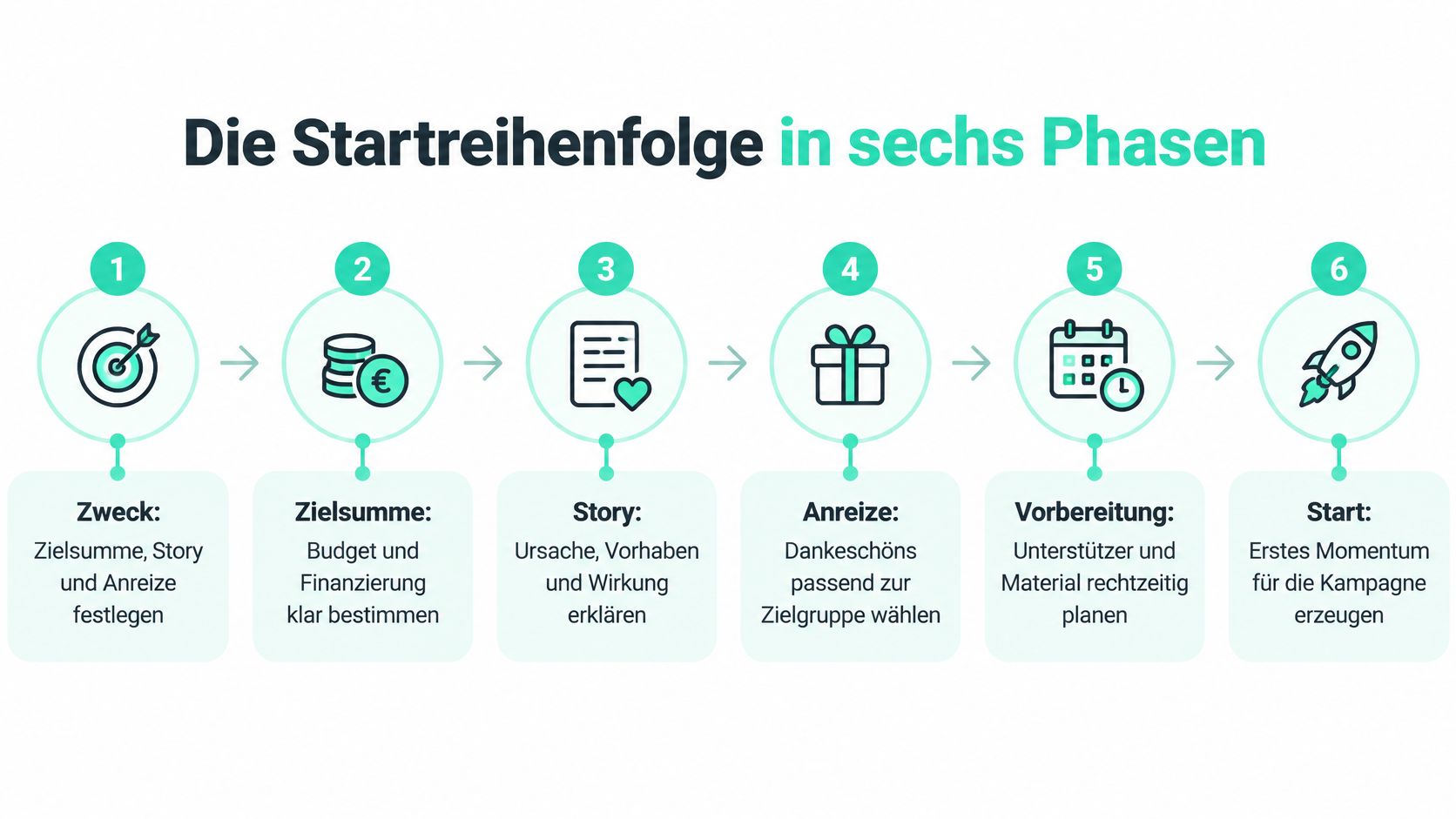
Work in parallel, don't scatter responsibility
Name one person who approves the launch. Budget, communication and documentation can have different people responsible, but open decisions need a shared place to be recorded, such as a task list in Trello or a shared spreadsheet.
Setting up the payment channels sensibly begins during the budget work. Missing association documents cannot be made up for by writing faster. The tips on preparing a crowdfunding campaign also help to compile the organisational tasks before the public call.
Whoever skips a phase loses time later, usually at the approval stage or with the target sum.
Deriving the target sum and budget from a cost model
A round target sum looks tidy. But it says nothing about whether the project can actually be carried out with it. The public target sum must arise from the actual costs, not from an amount the board considers easy to communicate.
To do this, set up a calculation with supporting documents, a responsible person and the current state of quotes. Separate expenses that directly serve the project from costs for payment processing and communication. Already-committed own funds should be listed separately, so you don't finance the same need twice.
Cost blocks of the target sum
| Cost block | What belongs to it | Check question |
|---|---|---|
| Project costs | Material, fees, food or ongoing operating costs | Would this amount arise even without the donation? |
| Payment and processing costs | Fees of the payment provider per payment method | What fee applies for SEPA, PayPal and credit card? |
| Communication budget | Photos, video, printing and paid reach | What share of the target sum goes into visibility? |
| Reserve | Buffer for price increases and additions | Is the reserve clearly accounted for within the public target sum? |
The first check question helps with classification: an expense that would occur anyway is not automatically unsuitable for a donation campaign. But it must be recognisable as an ongoing need and must not appear as a new, one-off project service.
From purchase price to a fundable project
Suppose a mosque association wants to finance food parcels for families in winter. The team first defines the contents of the parcel and obtains purchase prices. This results in the direct project costs, supplemented by any necessary packaging and transport.
The treasurer then checks the actually agreed processing costs. A separate item is set up for photos and flyers, even if part of it is done voluntarily. The reserve is given a justification, such as fluctuating purchase prices, instead of appearing as an unexplained markup.
Calculation method: Project costs plus processing costs plus communication budget plus reserve, minus bindingly available own funds, result in the open funding need. With percentage-based payment fees, the calculation must take into account that fees may also apply to the additionally raised amount.
Realistic rather than as big as possible
In a German study of 338 crowdfunding projects, 51.78 percent reached the funding goal; the average target sum was 13,364.53 euros, and the average amount raised was 7,999.16 euros. This is not a success forecast for your Sadaqa campaign, but a good reason to critically review your desired amount.
The study covers a different campaign basis than pure Sadaqa donations. Success rates from reward- or investment-based models therefore cannot be directly transferred.
Check before approval:
- Completeness: Are all cost blocks included and supported by quotes or comprehensible assumptions?
- Feasibility: Can a lower amount already complete an independent part?
- Minimum contribution: Is a technical lower limit necessary, and is it explained clearly?
- Underfunding and surplus: What happens if less or more money comes in than planned?
Planning the story and funding stages
A general appeal to support those in need leaves many questions unanswered. A concrete appeal, on the other hand, explains which supply gap the community wants to close next winter, who puts together the packages and when they are distributed. People need to be able to see what action their donation makes possible.
Let's stay with the food project. The story doesn't begin with the association's history, but with the need: families cannot fully cover their necessary shopping. The association then explains the criteria it uses to provide support and how it organises purchasing and distribution without publicly exposing individual households.
The story needs verifiable statements
A solid campaign text combines four building blocks: need, plan, use of funds and impact. The need explains the gap. The plan states the place and time frame, the use of funds makes the spending comprehensible, and the impact describes the benefit for people.
Avoid making promises that can't be substantiated. A food package can bridge a supply gap, but it cannot permanently eliminate poverty. Especially with religiously motivated donations, a precise description remains more convincing than a grand promise of impact.
The visual language should support this same clarity. An illustration like this can show the connection between the plan and its benefit, but it does not replace actual project evidence.
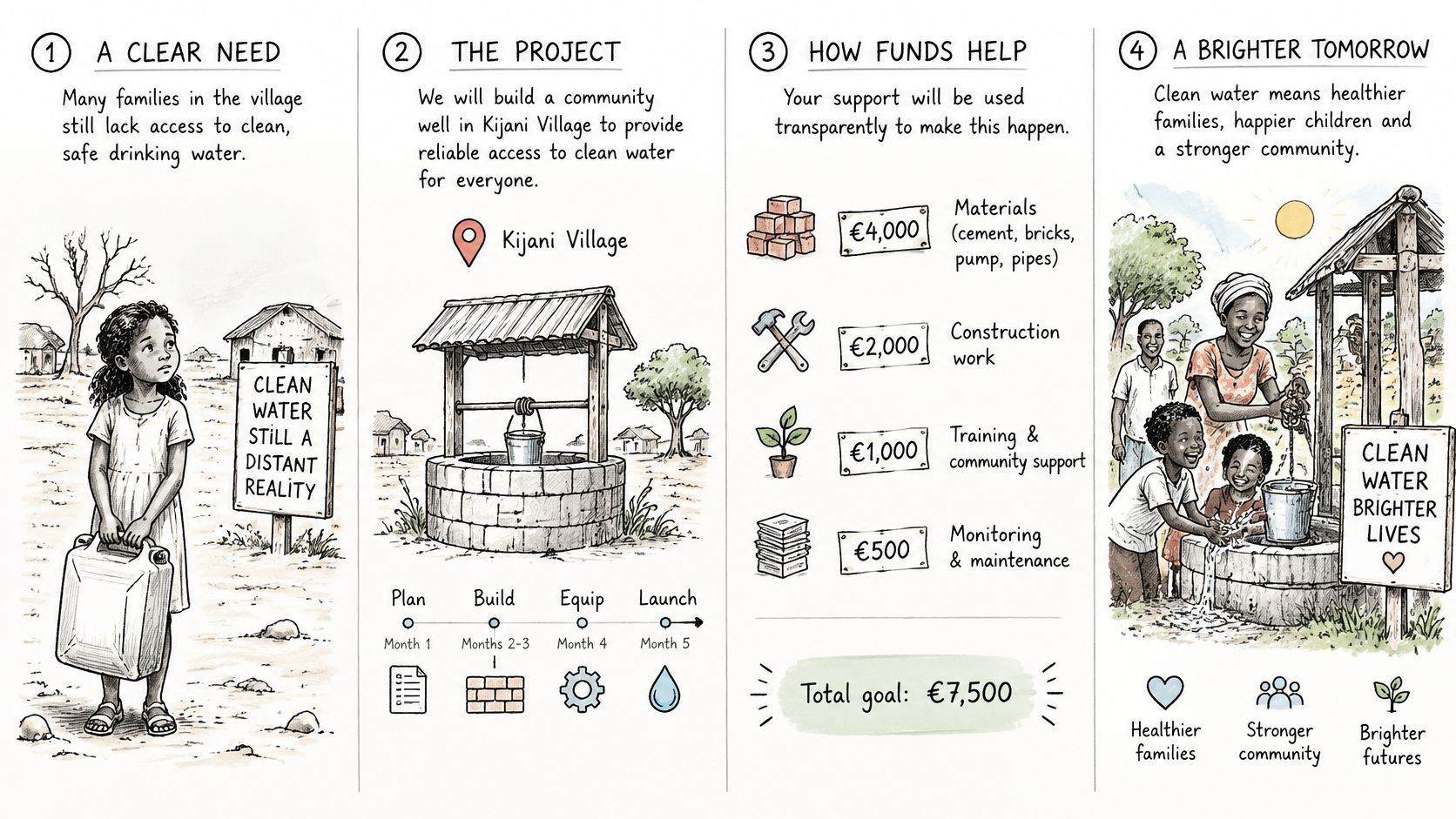
Deriving funding stages from the same project
For the food project, the first stage could enable an initial distribution. A further stage expands the circle of supported households, and the next one extends the period of support. Each stage needs its own independently verifiable result.
Don't mix in unrelated purposes after the fact within the same campaign. Someone who donates for food should not only learn in the final report that a surplus went into a building renovation. Name additional purposes in advance and clarify whether they are permissible.
Institutional projects should openly name the organisation, contact person and how it is carried out. For personal emergencies, on the other hand, it is enough to provide the information donors need to assess the need and its use. For the concrete structure of the page, our guide on creating a donation page can help.
Release checklist for the campaign text
- Gap named: Is it clear which specific need remains unmet so far?
- Plan defined: Are the place, time frame and implementation understandable?
- Use of funds quantified: Do the published amounts match the calculation?
- Impact described: Is the benefit explained without exaggerated promises?
- Stages verifiable: Can the team later provide evidence for every announced result?
- Image and name approvals clarified: Is the publication documented as approved?
Clarifying rewards and tax deductibility of donations
A good cause does not automatically make a payment tax-deductible. Even a non-profit association can design a campaign in such a way that, economically speaking, supporters are buying something. What matters is the recipient, the purpose and any consideration received, not the label on the donation button.
According to the encyclopedia entry on donation deductions from smartsteuer, the deduction generally requires a payment without consideration to a tax-privileged recipient; for non-profit associations, donations up to 300 euros generally only require simplified proof such as a bank statement or payment receipt, while above that amount a donation receipt is normally required.
Incentive models and donation deductions
| Model | Consideration | Donation deduction usually possible |
|---|---|---|
| Pure donation to a tax-privileged organisation | None | Yes, with proof |
| Donation with symbolic thanks without monetary value | Thanks in a video or mention of name | Usually yes, check in advance |
| Pre-order or product as thanks | Goods or item | No |
| Crowdinvesting with return | Share or interest | No |
| Private emergency campaign | Usually none, but regularly a private recipient | Generally no |
Making the decision before publication
Check the campaign in this order:
- Determine the legal recipient. On whose account is the collection being made, and who is the money allocated to?
- Check the tax-privileged purpose. Does the specific use match the recipient's tax-privileged purposes?
- Evaluate considerations in return. Do payers receive goods, admission, special benefits, or economic claims?
- Define the documentation process. Who is allowed to issue the certificate, and what information does the accounting department need?
Suppose an association offers supporters a cookbook from a set contribution amount onward. Then the book is not merely a friendly phrase in the thank-you text, but a possible consideration in return. Do not promise a donation deduction for this before it has been clarified for tax purposes how the payment is to be classified.
A general video of thanks or a voluntary mention of a name without an advertising service must be assessed differently than a product delivery. An invitation should also not be hastily classified as worthless if it includes catering, admission, or an exclusive benefit.
An emotionally convincing campaign is not automatically a donation for tax purposes.
Organisationally separate thanks and sales
If you also want to sell products, separate the ordering process, accounting, and communication from the donation campaign. Simply renaming it as a thank-you does not solve the problem. Record the classification and approval in writing.
In private emergencies, a tax-privileged recipient is often missing. A payment without consideration in return is then not automatically a tax-deductible donation and may, under certain circumstances, be classified as a gift.
For the practical organisation of documentation, the article on donation receipts for associations offers additional guidance. Unclear considerations in return or recipient structures should be clarified with a tax advisor or the tax office before you start.
Clarifying legal notice, data protection, and personal rights
Before starting, it must be established who is publicly responsible and who processes which data. A platform form does not replace reviewing your own texts, photos, and workflows. Keep the approved documents together with the campaign version.
Reviewing the documents in a sensible order
- Provide the provider identification. Check the legal form, a valid postal address, and the person authorised to represent the organisation. The result is a correct legal notice accessible from the campaign page.
- Describe the data processing. Record which donor data you receive, what you use it for, who gets access, and which retention periods apply. This results in a suitable privacy policy, not an unchanged copied template.
- Have publications approved. Document consents for recognisable persons and published names. The declaration should clearly state the purpose of use, publication channels, and information on revocation.
- Limit sensitive information. For health information or personal emergencies, you need a particularly careful review of the legal basis and, where applicable, explicit consent. Also deliberately decide which details will not be published despite consent.
- Assign documentation duties internally. Determine who collects invoices, delivery receipts, and project photos. The result is a binding responsibility for the final report.
Not pressuring vulnerable individuals to provide proof
A publicly visible name is not a necessary proof of need. You can explain the review process while personal documents remain protected with the responsible organisation.
Also separate the payment confirmation from a newsletter sign-up. Anyone who donates should not incidentally end up in an additional communication list. Have the privacy policy and consent texts reviewed by experts before you use them.
Approval rule: Only publish information whose purpose you can explain and whose publication you can take responsibility for.
Choosing payment methods by donor type and building trust
Choose payment methods based on how your supporters actually want to donate. A person planning a regular congregation contribution needs a different access point than someone opening an appeal on their phone while on the go. As many logos as possible in the form is no substitute for an understandable process.
The Deutscher Spendenmonitor by the Deutscher Fundraising Verband reports, based on a representative online survey of 5,049 people between the ages of 16 and 70 in Germany, that 9 percent of Generation Z, but only 1 percent of baby boomers, had already used Apple Pay, Google Pay, or Garmin Pay to donate. This suggests offering mobile payment methods without displacing traditional options.
Payment methods by donor type
| Payment method | Suitability | Strength |
|---|---|---|
| SEPA direct debit | Plannable and recurring donations | Repeated collection after mandate is granted |
| PayPal | Quick completion on mobile | Familiar process, little input needed with an existing account |
| Credit card | Spontaneous one-off donations | Direct payment authorisation |
| Apple Pay and Google Pay | Mobile donors, especially with an already set-up wallet | Payment details are already stored |
| Bank transfer | Large individual donations and donors without online payment | Direct banking route, proof via bank statement |
SEPA direct debit and a standing order are not the same thing. With direct debit collection, the recipient initiates the payment based on the mandate. A standing order is set up by the donor with their own bank; any bank fees depend on the respective account model.
Check first, then launch publicly
At SadakaNow, we check all campaigns for charitable purpose before activation. The contract only comes into effect once MoreDonate confirms the registration, activates the organisation, or actually enables use of the platform. A submitted registration alone is therefore not yet a completed approval.
To choose the right infrastructure, you can use the criteria in the article on the crowdfunding platform in Germany. What matters is not just payment methods, but also understandable proof, administrative processes, and the allocation of incoming payments.
Monitor the payment completion closely
Test the form on a smartphone with someone who was not involved in building it. They should understand the purpose, amount, and payment method without explanation. Also check whether a confirmation arrives and whether a failed payment is explained clearly.
For the evaluation, a few clearly defined metrics are enough to start with:
- Completion rate by payment method: Successful payments in relation to started payment processes.
- Form drop-offs: The step at which people leave the process.
- Recurring support: The share of actively set-up regular donations.
- Response to updates: Changes following publications, without hastily drawing a cause from them.
For ongoing needs, you should visibly offer regular donations and, alternatively, a standing order. Don't hide this option only in the thank-you message.
Promotion, updates, and closure in time windows
A campaign doesn't need its own presence on every channel. It needs responsible people and prepared communication occasions. So plan by time windows: What needs to be ready before publication, what should happen during the campaign, and what should be documented after it ends?
Obtain concrete commitments before publication
Approach the community, board, and multipliers personally. Don't just ask whether they like the idea, but whether they will donate at launch, forward the appeal, or use an event to introduce it. Record commitments and responsibilities without listing an amount that hasn't arrived yet as a received donation.
Prepare short texts for newsletters and WhatsApp, suitable images, and a clear campaign link for this. The person addressed should immediately recognise what action you expect from them. A general request to share without context shifts all the explanatory work onto your supporters.
The time windows can be used as a shared work list.
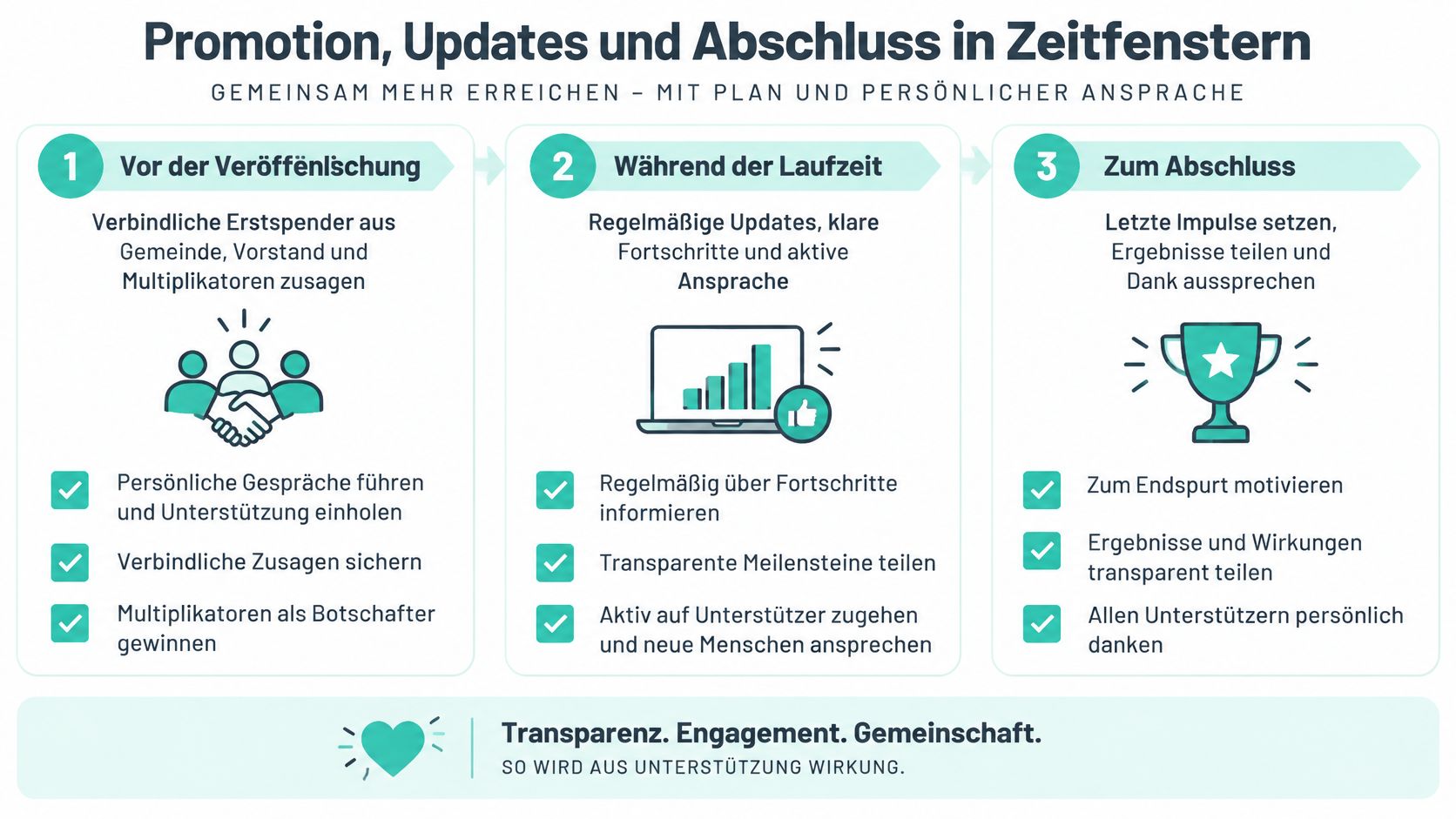
Work to a fixed rhythm during the campaign
Deliberately reserve time at the start for personal messages and follow-up questions. After that, a weekly update slot is a workable rule, provided the team can reliably keep to it. Don't publish only when a large amount has come in.
An update should link the current status with a verifiable development. A usable template is: So far, [amount] of [target amount] has come in. With this, we can implement [specific outcome]; for [next outcome], [remaining amount] is still needed.
A photo of the delivery, a dated project receipt, or an explanation of the next implementation step fits well here. Thanks alone doesn't answer whether the project is making progress.
For internal communication planning, the guide to measurable recruiting campaigns by osiro is also useful as a methodological comparison: target audience, message, channel, and metric are planned separately. Transfer this working method, not the metrics from recruitment.
Deliver a comprehensible conclusion at the end
Remind people of the campaign with the actual remaining need and the valid deadline. Artificial urgency or continually postponed end dates make credible communication harder.
- In case of underfunding: Explain what can be implemented and how you will handle the unmet need.
- In case of delays: State the cause, the consequence, and the next verifiable step.
- After implementation: Publish income, use of funds, and suitable evidence, without disclosing personal data.
The final report is part of the campaign work. It should have a person responsible and a publication date, not just a non-binding declaration of intent.
Frequently asked questions before starting on SadakaNow
Can we still start the campaign at short notice?
With us you can start your campaign in under 24 hours. To do so, submit the complete documents and a campaign draft ready for approval. The technical publication does not replace your internal budget approval or the clarification of open legal questions.
Does our association have to be non-profit?
Yes, we check every campaign for non-profit status before activation. So clarify early on which organisation legally stands behind the project. Whether a private emergency campaign can be offered is decided by our team before the start; don't simply assume its approval.
Is our registration immediately binding?
No. It becomes binding through confirmation of the registration, activation of the organisation, or the actual enabling of platform use by MoreDonate. So don't plan public launch announcements based solely on a submitted form.
Who do we contact with open questions?
For new campaigns and partnerships you can reach us at partner@sadakanow.de. Questions about donations and payment problems belong at hilfe@sadakanow.de. Describe the matter as specifically as possible so it can be assigned correctly right away.
What should we decide in the board now?
Create a joint approval folder. It should contain the target amount including the calculation, the funding tiers, the campaign text, and the written decision on rewards and donation deductibility.
Use the checklist for the story, the review steps for the incentives, and the document list for data protection and personal rights. Then name the person who will complete any missing documents and register the campaign. This turns the decision into an actionable launch order.
On SadakaNow you can submit a donation campaign for a Muslim project and publish it after the non-profit status has been reviewed. Now put together your calculation, project description, and evidence, and register the campaign so we can prepare the launch together with you.