
Zekat kimlere verilir? The eight recipient groups explained
Is a good intention really enough for a donation in Germany to count as Zakat? Many donors assume exactly that when they transfer money for a good cause or support a family they know. In practice, however, a blind spot quickly becomes apparent: good deeds and religious obligatory dues do not follow the same rules.
Anyone searching for the answer to „Zekat kimlere verilir?“ almost always comes across the classic list of eight recipient groups. This list sets the binding framework, but in everyday life in Germany it is far from answering everything. Here, religious criteria meet social benefits, high rental costs, energy debts and legal maintenance obligations.
To pass on Zakat safely and conscientiously, simply memorising the categories is not enough. You need to know how each group is defined, where scholars apply different standards, and how genuine need can be properly assessed in individual cases.
Table of contents
- The eight recipient groups of Zakat at a glance
- Checking need in three steps
- Differing scholarly opinions and the boundary with Sadaka
- Debts, rent and relatives in individual cases
- Properly checking organisations and donation channels
- Calculating the Zakat amount and recording your decision
The eight recipient groups of Zakat at a glance
According to Qur'an 9:60, Zakat may only be distributed to eight clearly named recipient groups, as summarised by the Muslim Charity Foundation's guide to Zakat eligibility. Because Zakat is a mandatory religious due, not every social, charitable or morally worthwhile expense automatically falls under it. Every payment must be clearly assignable to one of these eight categories.
The following overview sets out the eight groups together with their meaning and a concrete everyday example for Germany. Where Islamic scholars disagree on today's application, this is noted directly.
| Group | Who is meant | Modern example |
|---|---|---|
| Fuqara (the poor) | People without significant assets or income | Person with no earned income and no savings |
| Masakin (the needy) | Have income that is not enough to cover necessary needs | Low-wage workers whose pay does not cover rent and food |
| Amil (Zakat administrators) | Those tasked with collecting and distributing Zakat | Volunteer team of a Zakat fund with appropriate, transparent compensation |
| Muallafat (those whose hearts are to be won) | People whose faith is to be strengthened or who are to be won over to Islam | New converts in financial hardship (interpretation disputed) |
| Riqab (people in bondage) | Originally the freeing of slaves; today mostly of little relevance | Freedom from coercive relationships, according to individual interpretation |
| Gharimun (the heavily indebted) | Debtors whose debts arose from necessary needs | Rent arrears or energy debts with proven insolvency |
| Fi sabilillah (in the path of Allah) | Generally a matter of faith, in practice dependent on interpretation | Educational projects in the religious sphere (disputed, not a standard case) |
| Ibn as-Sabil (travellers) | Destitute traveller in acute hardship while on the way | Stranded traveller without money for the return journey |
At first glance, this list seems manageable. In Germany, three groups in particular are directly relevant: people with too little income, eligible debtors in acute hardship, and travellers who run out of funds along the way.
Transfer of ownership and disputed categories
Besides mere membership in a group, a classical legal principle plays a central role: the actual transfer of ownership (Tamlik). The majority of scholars require that the money or in-kind benefit passes directly into the ownership of an eligible person, so that this person can freely dispose of it. Anyone who simply renovates a building or finances general infrastructure usually does not fulfil this requirement according to classical doctrine.
Three rows of the table also require particular caution: Muallafat, Riqab and Fi sabilillah. While Riqab historically referred to freeing people from slavery and is today applied to modern forced relationships only by a few scholars, Muallafat and Fi sabilillah open up wide room for interpretation. Without expert review, donations in these categories quickly end up in grey areas.
Principle for practice: The eight groups from Quran 9:60 open up the assessment, they do not replace it. If you cannot clearly assign a case to any of these categories, you should not record the donation as Zakat.
Checking neediness in three steps
In everyday life, the greatest confusion arises with the first two groups, because both are often translated into German simply as "needy". Fuqara refers to people who have almost no assets and no sufficient income to cover their basic needs. Masakin, on the other hand, do earn their own money or receive regular funds, but still cannot make ends meet by the end of the month.
Think of the difference like an account: for the Faqir, the account is empty and nothing more comes in. For the Miskin, money does flow in regularly, but the bills for rent, energy and food take out more every month than comes in. Both are considered needy, but for different reasons, and it is precisely this difference that later determines the appropriate amount of the Zakat payment.
A donation campaign does not become eligible for Zakat simply because it has an Islamic background, supports a charitable association or has a socially valuable effect. As the recipient criteria of Zakat Deutschland emphasise, what ultimately counts is the concrete flow of money to an eligible person or a clearly defined group of beneficiaries. In the case of rent arrears, heating costs, food or medically necessary expenses, it must be verifiable that the necessary need exceeds the person's own available means.
The following infographic clearly summarises the difference between the two groups and the most important assessment steps.
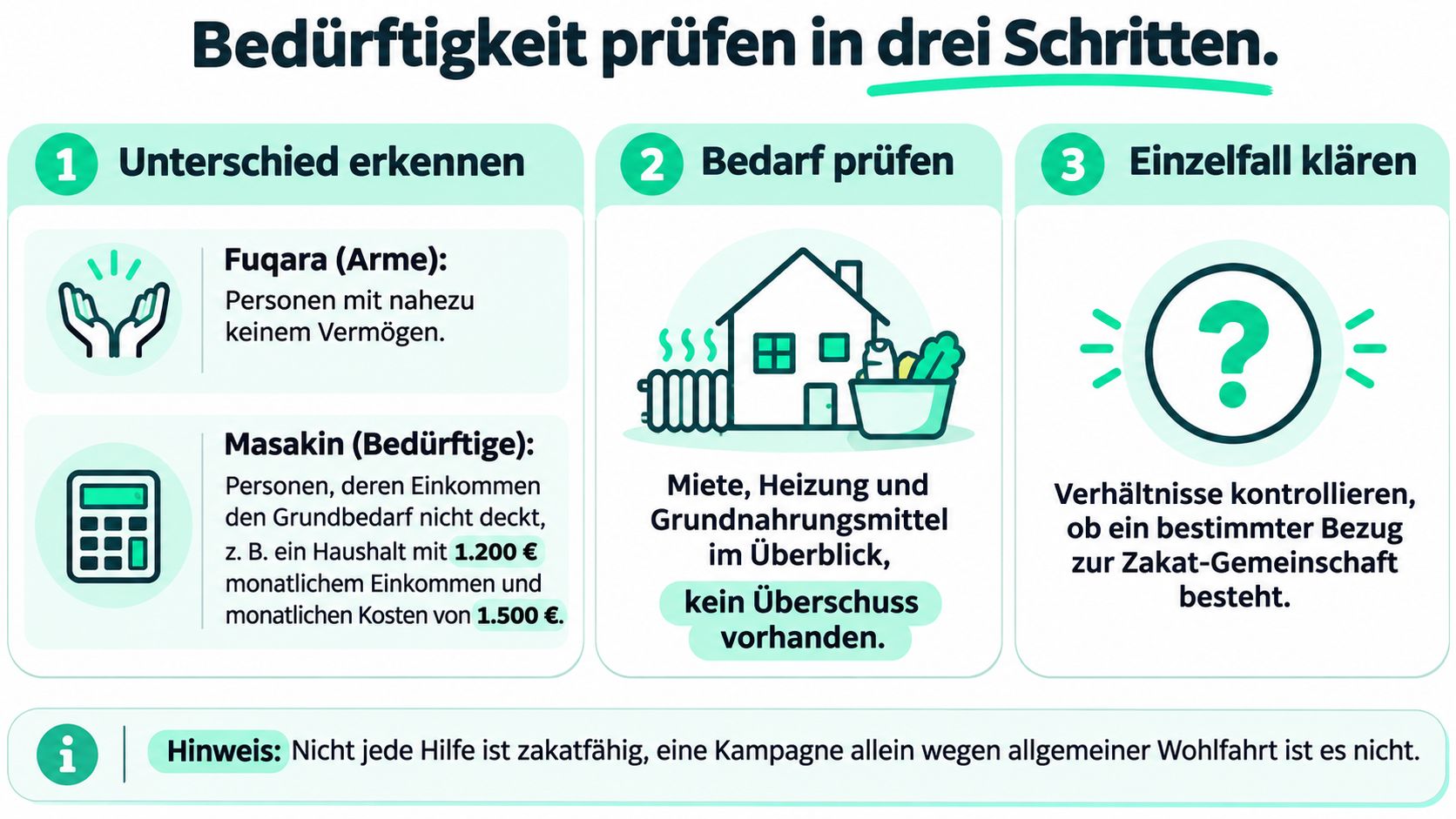
In order to act neither on gut feeling nor to unnecessarily expose people in need within the German context, a structured three-step process has proven effective.
- Record identity, place of residence and economic situation: First note down who is requesting help, where the person lives and what the current household situation looks like. This step clarifies whether a real person with a verifiable place of residence is behind the request, instead of paying out funds for anonymous collective purposes. A common mistake is relying on hearsay from acquaintances without actually knowing the real living situation.
- Compare concrete need against all means: Compare the necessary expenses for rent, energy, food or health against all available income, social benefits, liquid reserves and any priority state assistance. Only if a genuine gap remains afterwards does Zakat-eligible neediness exist. A concrete example: a single parent with two months of rent arrears and a power cut-off, whose Bürgergeld does not cover the outstanding payments, shows such a gap. Someone with the same rent but a five-figure bank balance does not.
- Document payout, purpose and conclusion: Record in writing or digitally when which amount flowed for which purpose and whether the hardship was thereby resolved. This documentation protects against double payments and makes the religious purpose verifiable even months later. The most common mistake lies in informal cash payouts without any receipt, after which no one can later say whether the original need was actually covered.
Why the at-risk-of-poverty threshold alone is not enough
Many guides look for a simple figure from German social statistics to shortcut the question of Zakat eligibility. German statistics do indeed have such a threshold: a person is considered at risk of poverty there if their income is below 60% of the median income. This figure is useful as an initial point of orientation during screening, but it does not replace religious verification.
The reason is simple. The statistical threshold measures only income, whereas the Zakat assessment looks at the whole picture.
A household below the 60-percent mark may well have bank balances, gold or other realisable reserves and would then not be eligible for Zakat. Conversely, a household above this mark can quickly fall into financial difficulty in a big city if high rents, care costs or family obligations completely consume the income. So anyone who looks at the statistics alone overlooks both eligible and ineligible cases in either direction.
A robust assessment model therefore always looks at several factors simultaneously: available income, necessary living expenses, liquid reserves, pressing liabilities and family obligations. When it comes to categories that depend on interpretation, such as Fi sabilillah or Muallafat, you should not decide the case on your own but consult qualified Islamic expert advice.
Differing scholarly opinions and the boundary with Sadaqa
Anyone who looks deeper into „Zekat kimlere verilir?“ quickly encounters apparent contradictions. While one mosque community says Zakat may only be paid out to Muslim private individuals, another initiative advertises financing education projects through Zakat. Behind such differences there is rarely arbitrariness, but usually a differing interpretation by individual schools of law.
The following overview illustrates the basic framework of Zakat distribution and shows how narrowly the religious categories are defined.
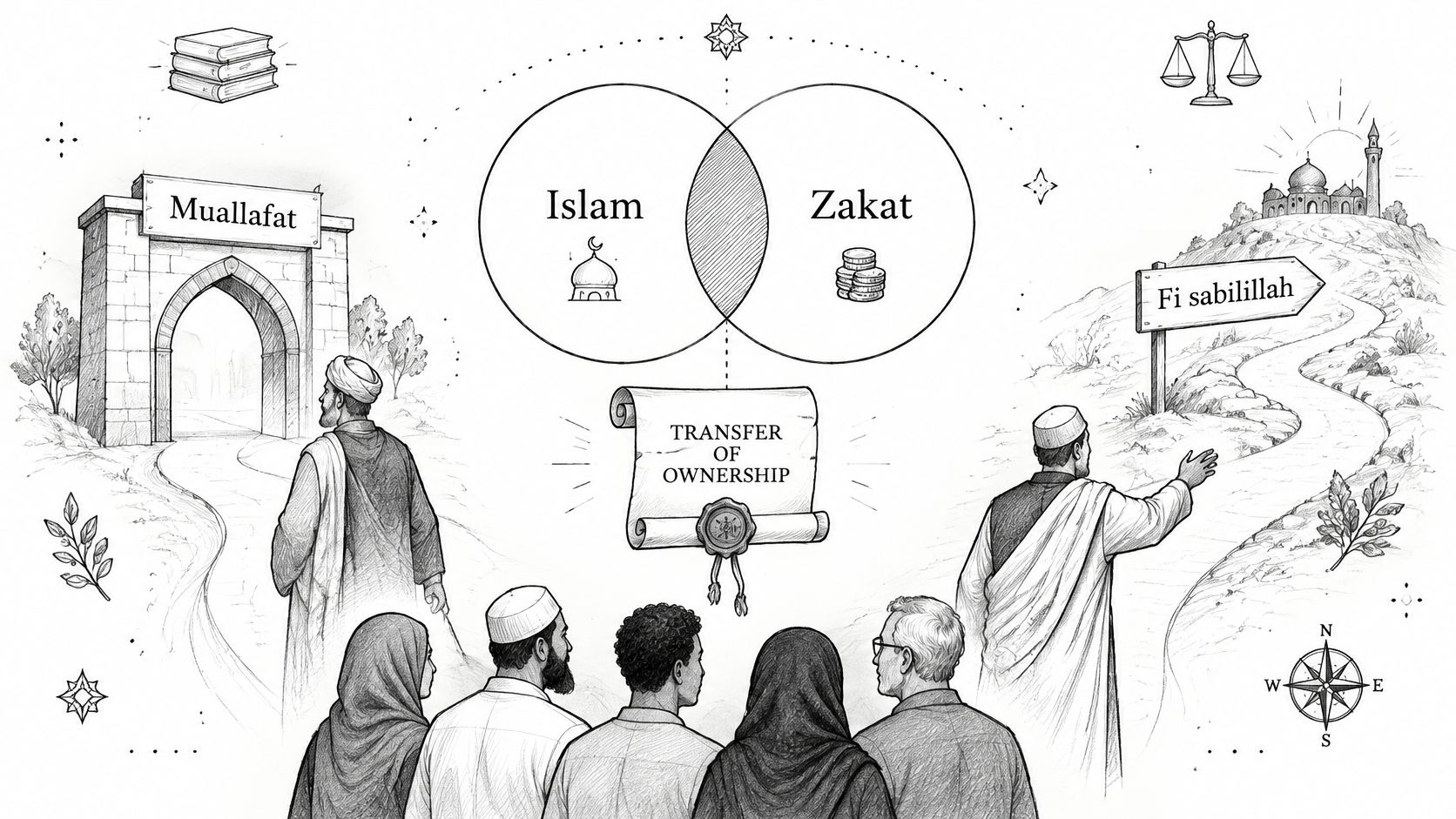
Scholars' opinions diverge noticeably on three points:
- Zakat only for Muslims: The classical majority opinion holds that Zakat, as a mandatory levy within the community, goes to Muslims in need. Some contemporary voices consider an exception conceivable under certain conditions, but the clear majority refers to voluntary Sadaqa when it comes to helping non-Muslim people in need.
- Obligation to transfer ownership: According to the prevailing legal view, the recipient must receive the Zakat directly and be able to dispose of it independently. A narrowly limited opposing position also allows in-kind benefits or indirect aid for certain projects, as long as only eligible people in need benefit from them.
- Interpretation of Muallafat and Fi sabilillah: Some scholars apply Fi sabilillah very narrowly and see hardly any everyday cases in it today. Others extend the term to Islamic education work, pastoral care or charitable community projects, which however remains disputed among experts.
Clearly separating Zakat and Sadaqa
Especially in Germany, a clear separation between mandatory levy and voluntary charity is crucial, as the classification of religious donation practice in the research report „Muslim Life in Germany 2020“ by the BAMF also shows. Zakat remains strictly bound to the eight categories from Quran 9:60 and follows a clear recipient focus. This also applies similarly to special mandatory levies at the end of Ramadan, which is why it is worth taking a look at the rules on Fitr-Zakat in order not to mix up the different types.
Sadaqa, on the other hand, offers the flexibility that many donors are actually looking for. With voluntary charity you can support mosque buildings, wells, neighbourhood assistance, scholarships or humanitarian projects for people of any faith, without getting into legal grey areas. Referring to a minority opinion among scholars never replaces your own due diligence, but merely makes visible where there is room for flexibility and where caution is advised.
The following video clearly revisits the most important questions about eligible groups and common misunderstandings.
Anyone who wants to reliably fulfil their Zakat should choose a donation with a clear Zakat label and a clearly documented recipient category. If any doubt remains regarding a project or individual case, voluntary Sadaqa or consultation with a qualified expert is always the safer path.
Debts, rent and relatives in individual cases
May people with debts in Germany receive Zakat? This question comes up in almost every consultation, and a blanket answer is almost certain to mislead. What matters is not the mere existence of a minus on the account, but what the debt arose from and whether the person affected can pay it off on their own.
Permissible under the category Gharimun are above all existential debts, i.e. outstanding rent arrears, energy debts or medically necessary bills that a household demonstrably can no longer pay. How widespread financial hardship around housing is becomes clear from a press release by the Federal Statistical Office (Destatis): in 2025, around 4.7 million people in Germany lived in households that could not adequately heat their homes for financial reasons, which corresponded to 5.7% of the population. This figure measures energy poverty and not debt directly, but it clearly shows how quickly tight household budgets can turn into unaffordable arrears.
The following overview classifies typical life situations in Germany and shows at a glance where Zakat applies and where other approaches are better suited.
| Case | Zakat permissible? | Reasoning |
|---|---|---|
| Rent arrears with proven need | Yes, as a rule | Essential need and lack of own means |
| Energy debt, home not adequately heated | Yes, after review | Existential hardship; payment directly to the supplier is possible |
| Consumer loan for holiday or car | No, generally not as Gharimun | No existential necessity for the debt |
| Spouse or minor children | No (majority opinion) | Maintenance is already a duty regardless |
| Siblings, uncles or aunts in need | Usually yes | No legal maintenance obligation on the donor |
| Mosque construction or general infrastructure | No, rather Sadaqa | No transfer to an eligible person |
| Traveller in acute hardship | Yes | What counts is the current hardship while travelling |
| Non-Muslim people in need | Disputed, usually only Sadaqa | Widespread majority opinion: Zakat goes to Muslims |
While rent arrears or an impending power cutoff can be assessed relatively clearly, two areas repeatedly cause uncertainty: consumer instalment loans and help within one's own family.
Clearly distinguishing between consumer loans and insolvency
With a loan for a holiday trip, an expensive smartphone or a vehicle, there is usually no existential necessity. Someone who voluntarily takes on debt beyond their means does not automatically fall under the Gharimun category from a scholarly standpoint. An exception may be considered in individual cases at most when a vehicle was absolutely necessary to get to work in order to support the family, or when, after a genuine life crisis, there is no ability to pay whatsoever.
With acute energy debt or rent arrears, a practical trick often helps: transferring the money directly to the landlord or energy provider with the consent of the person affected. This way the money goes without detours exactly where a termination or cutoff is threatening, and reliably resolves the hardship.
When relatives may receive Zakat
Many donors hesitate to help relatives because they believe family is completely excluded. In fact, the majority opinion draws the line precisely along the maintenance obligation. For one's own spouse, minor children, as well as parents or grandparents, there is generally a direct responsibility for their upkeep, which is why Zakat may not be used here to offload one's own duties.
The situation is quite different for siblings, uncles, aunts, nieces or nephews, for whom there is no legal maintenance obligation. If, for example, a brother falls into rent arrears after an illness despite having a full-time job and no longer has any savings, he may receive Zakat. In such cases, discreet support is even especially fitting, because you can realistically assess the actual living situation.
Carefully checking organisations and donation channels
Not everyone knows someone in their personal circle whose neediness can be checked tactfully and reliably. Many donors therefore pass on their Zakat through an aid organisation or a digital donation platform. However, such a donation only fulfils its religious purpose if the organisation actually passes the funds on to eligible persons for that specific purpose and does not pour them into a general project pool.
One example of a narrow, recipient-focused distribution model is the Zakat distribution by Islamic Relief Deutschland, in which Zakat funds are explicitly directed at the groups from Surah 9:60 and are mediated above all to the poor and needy. Anyone who processes donations for those in need through a platform should pay attention to a clear separation. Clearly separated campaign labels such as "Zakat for eligible persons", "Sadaqa/general project funding" and "Administrative costs" are sensible.
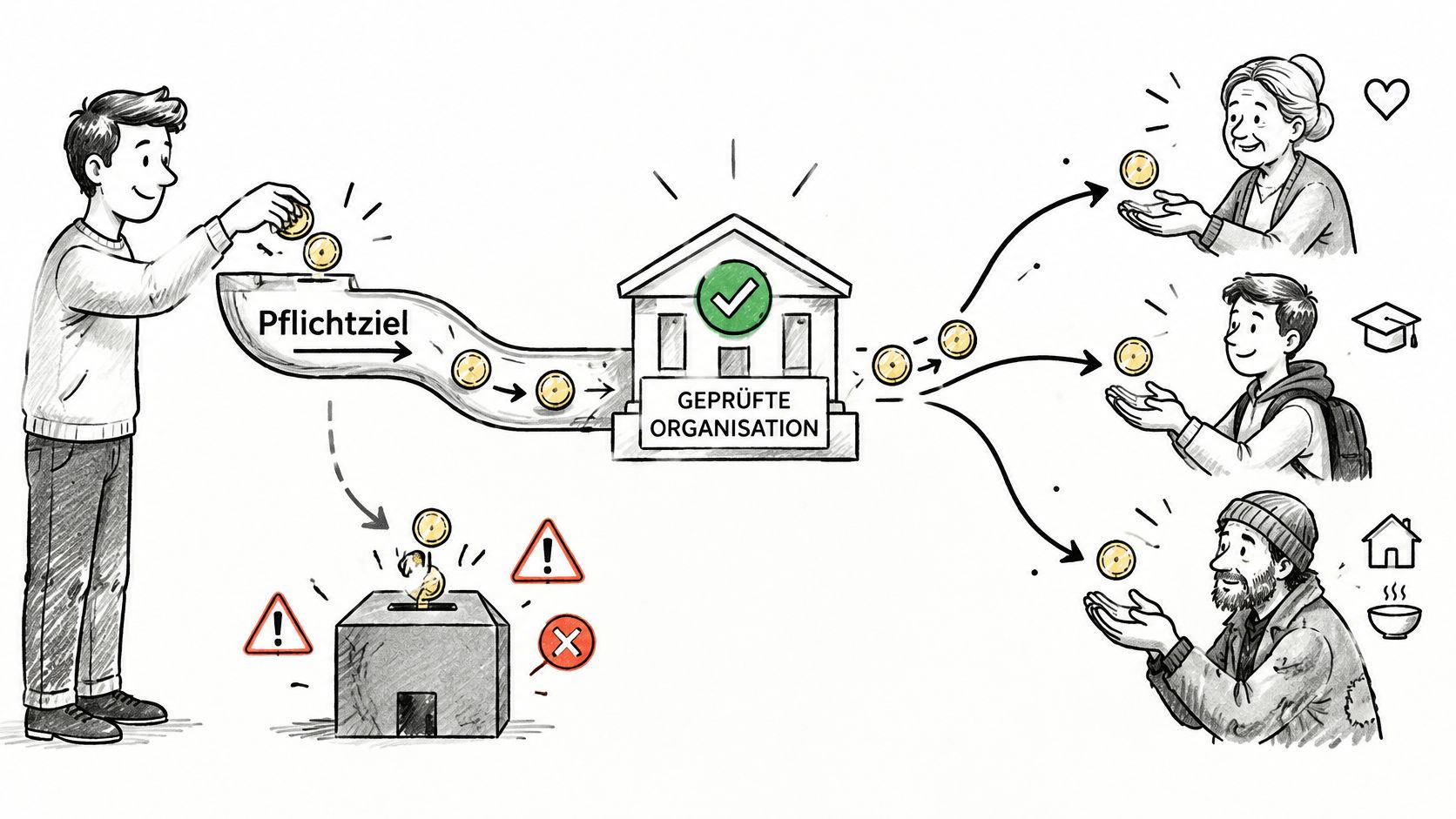
A closer look is especially worthwhile when it comes to administration. According to Quran 9:60, those who administer Zakat (Amil) may indeed be compensated for their specific work, but this compensation must remain transparent and be strictly limited to the actual administration of the Zakat. General project costs, advertising or ongoing association rent are not automatically considered a Zakat expense.
Checklist for reviewing an organisation
Before you transfer money, go through these four points one by one:
- Clear purpose allocation: Check whether the campaign explicitly states which of the eight recipient groups will receive the funds, rather than just speaking generally of “help”.
- Documentation and reporting obligations: With us at SadakaNow, organisations must use earmarked donations exclusively for the stated purpose and fulfil all legal information, documentation, and verification obligations for funds received.
- Handling of surplus funds and impact: Look for anonymised impact reports on the number and type of cases supported, as well as a clear policy on how surpluses within the same Zakat category are further used.
- Verification of partner organisations: Don't rely on attractive campaign images; at SadakaNow we work exclusively with partners that we have thoroughly reviewed and approved in advance.
Why the payment method determines trust
Even a good project description loses its value if it remains unclear through which accounts the money flows and who has access to it. A clean payment method ensures that amounts are not mixed together and remain fully traceable.
For exactly this reason, we at SadakaNow never touch donated funds ourselves: donations are managed in trust and paid out directly to the respective verified organisation. This way, the purpose allocation remains traceable and cleanly separated from the moment of your transfer until it reaches the project operator.
Calculating the Zakat amount and recording your decision
Once it's clear who may receive Zakat and how to recognise trustworthy channels, the practical part follows: calculating and carrying out your own obligatory payment. Anyone who structures this step cleanly once will save themselves uncertainty and lengthy recalculations in every following year.
According to the usual religious rule, Zakat amounts to one-fortieth, i.e. 2.5% of zakatable wealth, once this reaches the Nisab threshold and has been held for a full lunar year. For a quick and traceable calculation, our Zakat calculator is available to you. After three short questions, it delivers a result based on current gold and silver prices, works in any currency according to Diyanet standards, and all entries remain exclusively local in your browser.
From calculation to secure handover in four steps
It's best to carry out your annual Zakat payment in this fixed order:
- Determine the Zakat amount precisely: Record cash, account balances, gold, silver, and other zakatable assets, deduct outstanding liabilities, and note the calculated target amount. This ensures that you neither give too little nor accidentally estimate off the top of your head.
- Define exactly one recipient group per donation: Before making the transfer, consciously decide whether your amount should go to, for example, Masakin (needy people with insufficient income) or Gharimun (heavily indebted people in existential hardship). If you give directly to a person, assess the case based on concrete need and family criteria rather than purely out of sympathy.
- Verify the organisation or payment method: When donating through associations, check for clear Zakat labelling, separate cost disclosures, and evidence. For categories open to interpretation, such as Muallafat or Fi sabilillah, be sure to seek qualified Islamic expert advice before making the payment.
- Document your decision cleanly: Save the donation confirmation, date, amount, and the chosen recipient category in a dedicated folder. This brief overview not only helps you keep track for the next lunar year but also provides peace of mind should questions arise later.
Incidentally, a single Zakat amount does not necessarily have to go to just one person. You can split the total sum, for example using part of it for an urgent rent arrears within your extended family and giving the rest to a verified aid organisation with clear Zakat purpose allocation. What matters with every individual partial payment is the conscious intention and the clean allocation.
If, at the end of your assessment, some uncertainty remains, supporting demonstrably poor or needy people with clear basic needs is always the safest choice. All schools of law agree on these two groups, and your Zakat reaches directly where it is most urgently needed.
If you want to pass on your donations to verified mosques, aid organisations, and social initiatives transparently and without a platform fee, you'll find clearly structured campaigns at SadakaNow with clear purpose allocation and trust-based payouts directly to the respective organisations. Use the Zakat calculator in your browser, compare verified projects, and follow your donation with traceable updates until the goal is reached.