
Zakat eid ul fitr: Amount, Deadline and Recipients 2026
The German Fatwa Committee names 10 euros per person for Zakat al-Fitr 2026; 13 euros per person is another guideline figure cited in Germany. The range is not a calculation error but is based on different assumptions about the amount of food, its quality and its purchase price.
For your decision, therefore, the amount alone is not the only thing that matters. Just as important are the religious basis for calculation, the correct recipient group, and a distribution that arrives in time for the festival.
Table of Contents
- What Zakat al-Fitr means for Eid
- Amounts for Zakat al-Fitr 2026 in Germany
- Who pays and who may receive
- Differences by school of law and country
- Calculation examples for typical households
- Paying Zakat al-Fitr in good time before the Eid prayer
What Zakat al-Fitr means for Eid
A family prepares the festive meal, the children lay out their clothes, and Fitrana is still on the to-do list. This refers to Zakat al-Fitr, the per-person levy marking the end of Ramadan. Anyone searching for Zakat Eid ul Fitr usually means the same obligation, not an additional Zakat alongside Fitrana.
The difference from wealth Zakat is fundamental: here, it is not accumulated wealth that is calculated with a percentage. Instead, it concerns a levy for each registered person. This is why a child can appear on the household list even though they have neither income nor savings.
A levy with a specific purpose
Zakat al-Fitr links the end of fasting with support for people in need. Religiously, it is understood as a purification from shortcomings during the fast. Socially, it is meant to enable people to celebrate the festival with provision and dignity.
This means it is not just any festive donation. A contribution towards renovating a mosque may be worthwhile, but it serves a different purpose than food aid for a family in need.
Rule of thumb: Fitrana is calculated per person. Wealth Zakat is determined based on zakat-liable wealth.
Even an invitation to break the fast does not automatically replace the levy. What matters is the intention, the permissible form, and the actual transfer to entitled people.
Distinguishing voluntary help from obligation
Anyone who has already donated a lot during Ramadan should therefore check which payment was explicitly intended as Zakat al-Fitr. A general Sadaka and an earmarked Fitrana payment do not simply belong in the same pot.
The overview on donating during Ramadan helps to distinguish between different giving occasions. For your own household, it is advisable to keep a separate note with names, the chosen fatwa, and the responsible person. This turns a last-minute task before the festival into a deliberately prepared levy.
Amounts for Zakat al-Fitr 2026 in Germany
Guideline figures for Zakat al-Fitr 2026
| Basis | Value 2026 | What it means |
|---|---|---|
| One Sa of food | about 2.5 to 3 kg | Wheat, rice, dates or raisins |
| German Fatwa Committee | 10 euros per person | published via lak24 |
| Another source active in Germany | 13 euros per person | Quality, purchase price, scope of support |
| Household of five people | 50 to 65 euros | five times 10 to five times 13 euros |
The table brings together the reference values for Germany: the figures on the traditional amount of food of about 2.5 to 3 kilograms, on 10 to 13 euros per person for Ramadan 2026, and on the calculated household amount of 50 to 65 euros for five people are based on the information on Fitrana at Barakah.
Why the monetary values differ
A Sa is originally a measure of volume, not a kilogram figure that is identical everywhere. How much a filled measure weighs depends on the food. Rice, raisins and dates have different properties and cost different amounts to buy.
Even within the same type of food, quality, packaging and purchase price differ. An organisation that uses a different basket of goods or a different scope of support can therefore arrive at a different monetary value. A higher amount does not automatically prove that a lower one is wrong.
What matters is the distinction between the religious measure and the practical monetary valuation. The measure describes the obligatory gift. The monetary value is meant to enable the corresponding provision.
Anyone giving money through an aid organisation should therefore be able to recognise what is meant to happen with it. Does the organisation buy food at the place of distribution? Does it pass on the equivalent value permitted under the view it follows directly? This information is more meaningful than an amount given without explanation.
How to recognise a transparent campaign
A useful campaign page should not just contain a donate button. Look out for the following information:
- Reference year: The recommendation must relate to the current Ramadan and must not simply be carried over unchanged from an earlier campaign.
- Basis of calculation: The organisation should state the food, the measure, or the fatwa it relies on.
- Scope of the payment: It must be clear whether the amount is entirely intended for the obligatory gift and how additional costs are handled.
- Distribution: The page should explain who receives the support and by when it will be passed on.
A higher amount is not automatically the better religious decision. A transparent basis is more important than comparing two donate buttons.
For your household, choosing one consistent rate is a good organisational solution. If you follow a particular fatwa, apply its basis consistently rather than randomly switching between recommendations when filling out different forms.
You can list a voluntary addition separately. This keeps it clear which part is meant to fulfil the obligatory gift and which part is additional support. Anyone wishing to give food should also clarify before buying what goods the community actually accepts and how it distributes them.
Who pays and who may receive
Start with your own household, not with the transfer form. Write down for whom you want to take on the obligatory gift and who pays for themselves. Living in the same household does not automatically mean that the same person bears the same maintenance responsibility for everyone.
The following graphic offers a simplified orientation. However, its statement about the absence of a minimum threshold must not be read as a rule shared across all schools of law: this is precisely where the Hanafi view differs from the other Sunni schools of law.
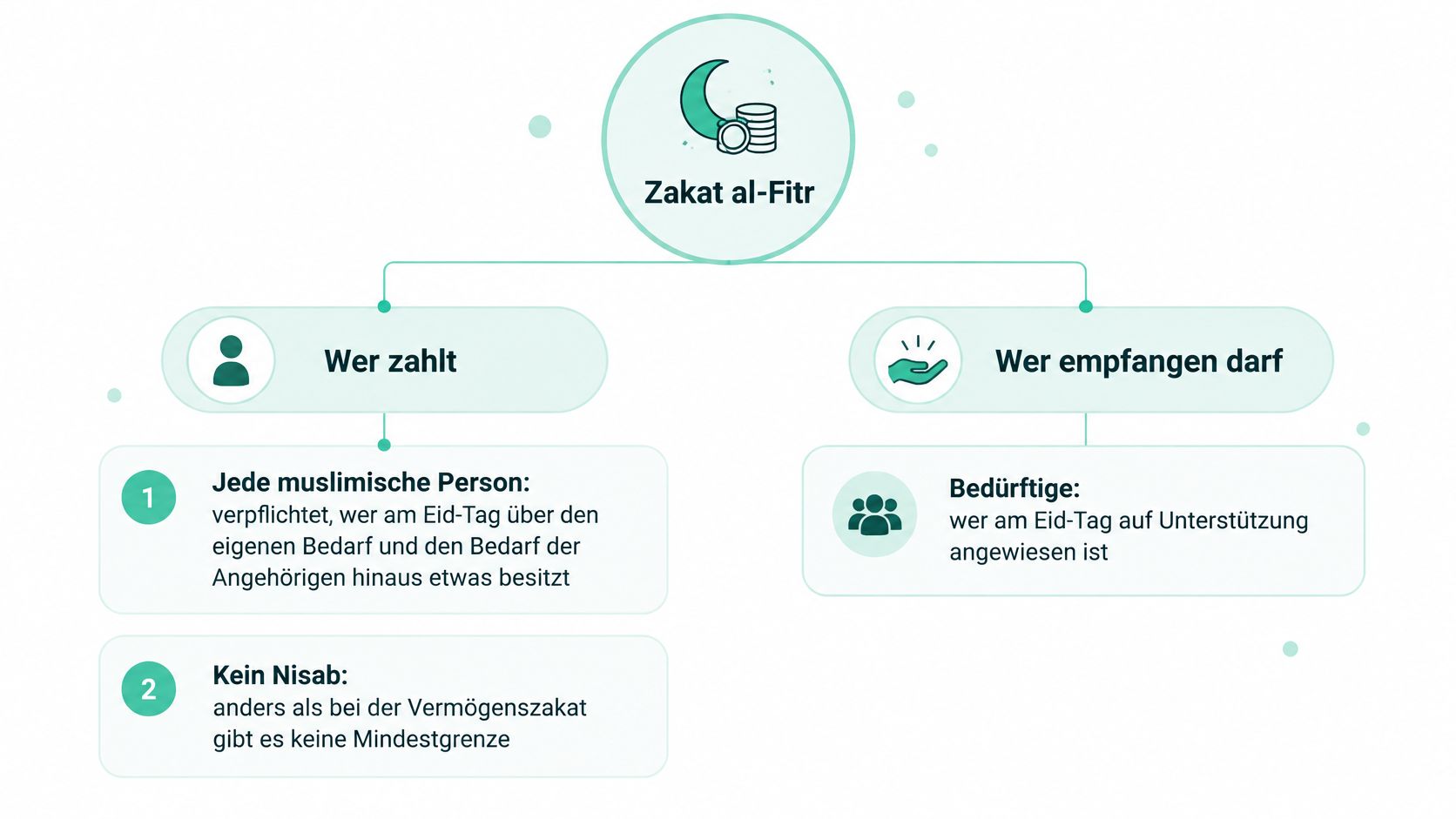
Correctly assessing your own payment obligation
Maliki, Shafi'i and Hanbali views generally tie the ability to pay to a surplus beyond the provision necessary for the festival. The Hanafi school, by contrast, takes into account a Nisab beyond basic needs. The blanket statement that there is never a wealth threshold for Fitrana would therefore be misleading.
The question of which relatives someone must pay for is also answered differently. The fact that one parent organises the entire family's payment is a practical solution, but it is not yet a complete description of the religious maintenance obligations.
These distinctions help with the decision:
- Children and dependants: Clarify who takes on the obligatory gift according to the view followed.
- Adults with their own income: Explicitly agree whether they pay themselves or assign someone to do so.
- Guests and housemates: An invitation to the festival or a shared address does not automatically create a payment obligation toward one another.
- Pregnancy and birth: For an unborn child, the gift is often given voluntarily. In the case of a birth close to the festival, the decisive point in time, which depends on the school of law, must be clarified.
Need instead of blanket assumptions
Zakat al-Fitr is intended especially for poor and needy people. A family whose means are not sufficient for necessary food may be eligible for it. A residence status, a certain origin, or receiving a social benefit alone does not answer this question.
Examine the actual living situation without exposing people. A trusted community or aid organisation can take over the selection and protect the privacy of the recipients.
For close relatives, the own duty of maintenance must also be taken into account. The payment must not simply serve to replace maintenance already owed to parents, children, or spouses; details belong in a personal religious consultation.
There are also differences between the schools of law regarding the circle of recipients. Therefore, do not transfer the rules of wealth Zakat to Fitrana without checking. The overview of Zakat helps with the conceptual classification, but does not replace an examination of special family situations.
Differences by school of law and country
Zakat al-Fitr by school of law
| School of law | Measure | Money instead of food | Usual early point in time |
|---|---|---|---|
| Hanafi | Classically different measure for wheat and other foods | Allowed | Also possible early; observe specific view |
| Shafi'i | Sa of the suitable staple food | Generally food | From the start of Ramadan |
| Maliki | Sa of the suitable staple food | Generally food | Shortly before the Eid |
| Hanbali | Sa of the suitable staple food | Generally food | Shortly before the Eid |
This overview describes basic outlines, not complete fatwas. Within a school of law, details about food, delegation, and timing can have additional significance. Contemporary scholars may also assess the practical implementation differently than a simplified table suggests.
Monetary payment is not an identical rule everywhere
The Hanafi school generally allows the value of the payment to be given in money. In the other schools mentioned, food distribution is the focus. That a German organisation accepts money therefore does not prove which religious view it applies.
It makes a difference whether the organisation passes on money as the final benefit to those in need, or is commissioned to procure suitable food with it. Anyone who follows a food-based view should explicitly clarify this distinction.
The graphic illustrates the different assessment of money and food measures.
Technically accepting a payment is not the same as a religiously effective transfer. An organisation can, for example, accept money early and carry out the actual food distribution later. Whether this arrangement suits you depends on the view followed and the agreed process.
Why a foreign reference value does not automatically fit
A sum of money from another country cannot sensibly be adopted solely on the basis of the exchange rate. The foods used as a basis there and their local purchase prices may differ. In addition, there may be a different legal basis for the calculation.
If you live in Germany and support relatives abroad, separate these decisions. For your own payment, you need a suitable fatwa and a clear distribution path. If you additionally organise the payment for relatives living there, clarify their local and religious basis separately.
The place of distribution is also not merely a question of price. Anyone who wants to give the payment abroad should consider how the school of law followed assesses passing it on outside one's own location.
Do not pick individual simplifications from different overviews without knowing their conditions. Have a coherent approach explained to you.
For communities, this means: name the view being used, instead of presenting a local practice as the only Islamic solution. A clear explanation spares donors unnecessary doubts and allows other recognised approaches to stand.
Calculation examples for typical households
The German Fatwa Committee set Zakat al-Fitr for 2026 at 10 euros per person, as lak24 reports on the decision. Anyone who follows this fatwa uses this rate for the people whose payment is being covered.
The calculation itself is simple. Mistakes arise more from relatives being missed, counted twice, or no one knowing who actually made the payment.
A student organises her payment herself
A student living alone first checks whether she is obligated to pay according to her religious view. The fact that she works alongside her studies does not answer this question alone, since necessary expenses and the school-of-law-dependent capacity also play a role.
If she pays herself, her family does not need to include her again in the joint payment without asking. If a parent is to take over the payment for her, both agree on this beforehand. A clear arrangement is more helpful than a silent assumption.
The illustration is a reminder of how different the life circumstances within a family can be.

Parents bundle the payment for their household
A married couple with children decides that one parent will organise the transfer. The list includes everyone for whom this payment is intended. The responsible person multiplies the recorded number of people by the chosen rate and checks the entry before submitting it.
Simple notes can help with this:
- Name recorded: The payment for this person is included in the joint payment.
- Separate payment agreed: This person organises their own payment and is not counted additionally.
- Special case open: A birth, a changed maintenance situation, or an unresolved arrangement still needs to be discussed.
An adult son with his own salary may, for example, live in his parents' house and still pay for himself. In that case, what matters is not just his address but the actual arrangement. If he pays separately, this should be clearly noted on the household list.
Different websites lead to a mixed calculation
One parent takes the guideline value of a community for the adults and a different website's value for the children. There is no factual reason for this if simply different donation pages happened to be open. Children should not automatically be assigned a lower rate.
However, a mix does not make a payment invalid on its own. There may be different arrangements or religious bases involved. For a jointly organised household payment, though, a deliberately chosen, uniform rate is still easier to follow.
Anyone who wants to give additionally for an unborn child should note this part separately as a voluntary contribution. For a newborn close to the festival, the family should not simply assume Eid morning as the cutoff, but should clarify the decisive point in time according to their school of law. This way, a simple multiplication does not turn into an unintentionally incorrect list of people.
Paying Zakat al-Fitr in good time before the Eid prayer
Plan backwards from the moment the aid reaches those in need, not forwards from clicking the donate button. A payment confirmation can prove that your order has been received. It does not yet prove that a family has already received food or the permissible equivalent value.
The graphic shows the organisational process from checking the date to confirmed distribution.
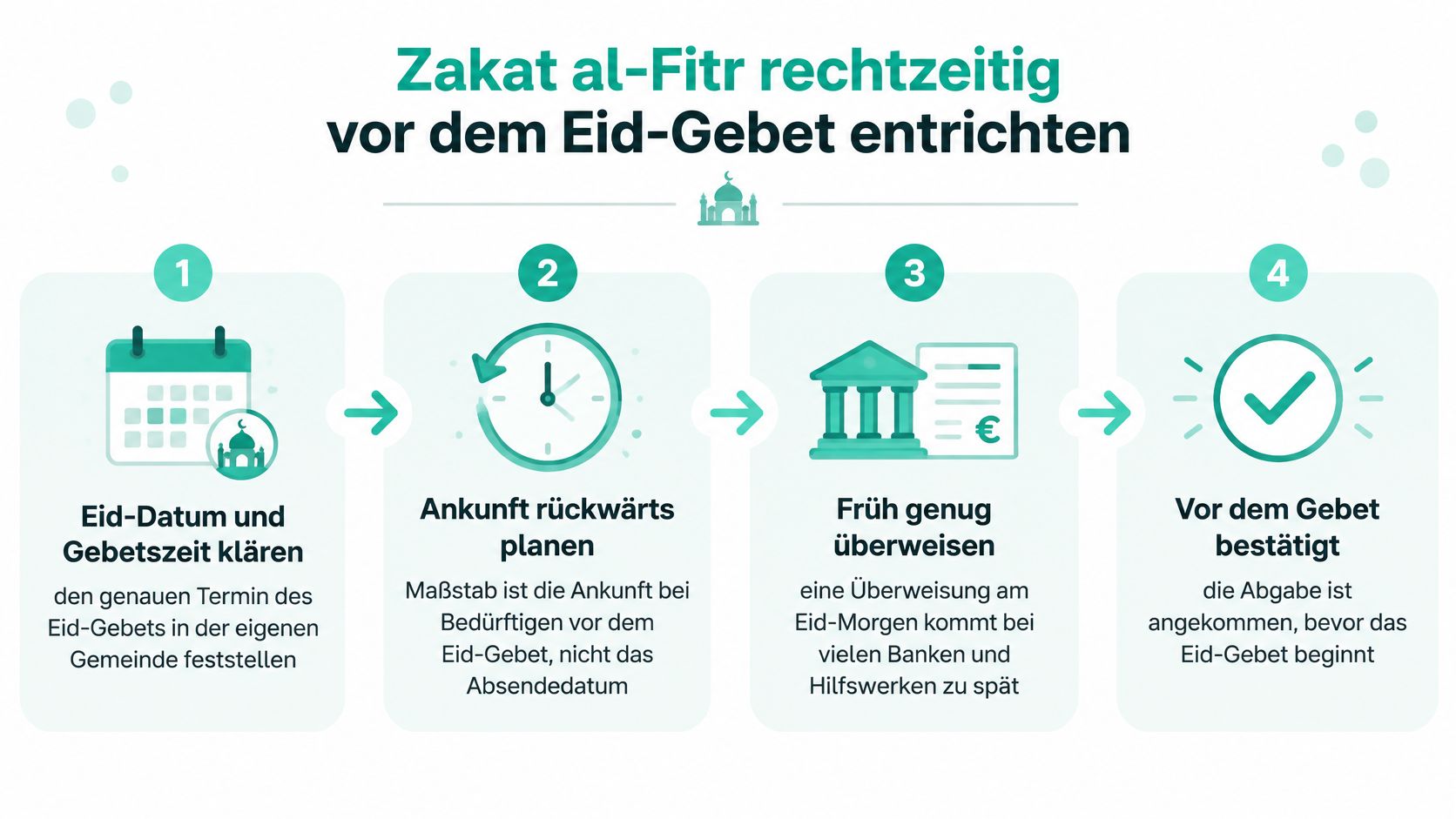
Checking the payment process thoroughly
Start with your community's prayer time and the announced deadline for acceptance by the distributing organisation. If the aid is passed on abroad, the local holiday schedule and the specific distribution process must also match up. A German transfer time alone is not enough as a guide.
Work through the preparation in this order:
- Note the date. Write down the announcement from the community you follow and the start of the Eid prayer. Do not rely blindly on a general calendar entry.
- Finalise the household list. Clarify any open arrangements and check the total amount based on the chosen fatwa. Keep voluntary extra contributions separate.
- Choose a purpose-bound distribution. The campaign must be explicitly suitable for Zakat al-Fitr. A general food campaign is not automatically suitable.
- Coordinate the religious time window and processing. If your school of law has stricter time requirements, ask when the organisation accepts the money and when it actually passes on the payment.
- Set the intended purpose clearly. Choose the designated Fitrana field or enter Zakat al-Fitr with the relevant reference year.
- Keep your documents. Keep the payment confirmation, the campaign description, and the distribution details together.
A particularly important question is: Does the organisation only confirm receipt of payment, or also the planned distribution? If this information is missing, asking is more sensible than simply hoping it will work out.
What earmarking means on a platform
At SadakaNow, we support Muslim projects in Germany, Austria, and Switzerland. We do not touch the donated funds ourselves; they are held in trust and paid out directly to the respective organisation. The organisation must use earmarked donations exclusively for the stated purpose.
However, this payment process does not automatically turn every listed campaign into a Fitrana campaign. A mosque-building or water campaign serves a different purpose. For your payment, you need a campaign that is explicitly suitable and a traceable commitment regarding distribution.
The guide on online donations helps you carefully check recipient details and payment processes. With Fitrana, the religious suitability of the distribution always comes on top of technical security.
The embedded video offers an additional way to engage with the topic.
If you have missed paying on time
Do not simply leave the payment aside just because the prayer has already taken place. According to common view, the obligation remains in place. Make the payment without delay and clarify the religious assessment of your situation with a qualified person.
For communities, a clear separation between accepting Fitrana that can be distributed in time and payments received later is recommended. Donors should be able to see before submitting what the organisation can still commit to. An honest deadline is more helpful than a donation button left open until the last moment without explanation.
At SadakaNow you will find fundraising campaigns from Muslim organisations and communities in Germany, Austria and Switzerland. For your Zakat al-Fitr, check specifically whether a campaign explicitly names this designated purpose and commits to passing it on to those in need before the Eid prayer. Only then choose the matching campaign, and keep your household list as well as the payment confirmation ready together.