How does crowdfunding work? The process in 2026
Many treat crowdfunding like a single button: enter a goal, share a link, wait for the money. The actual gap sits one question earlier. What do you get in return?
Without that answer, you don't know whether you're making a donation, receiving a thank-you gift or a product, taking a stake in a company, or handing over money with an expectation of repayment. That is exactly where a contribution differs from a purchase and from an investment with a risk of loss.
How crowdfunding works therefore doesn't depend first on sharing within the community, but on the model. Before you pay, you check the consideration, the purpose, and what happens to your contribution if the campaign is cancelled.
Table of contents
- How crowdfunding fundamentally works
- The four models compared directly
- Legal classification for charitable projects and mosque communities
- How a campaign runs from idea to payout
- What determines success or failure
- Preparing and launching the right campaign
How crowdfunding fundamentally works
Crowdfunding works by having many people each give smaller amounts via a digital platform until a previously set goal is reached. The platform bundles the project description, funding goal, duration, payment processing and feedback to supporters.
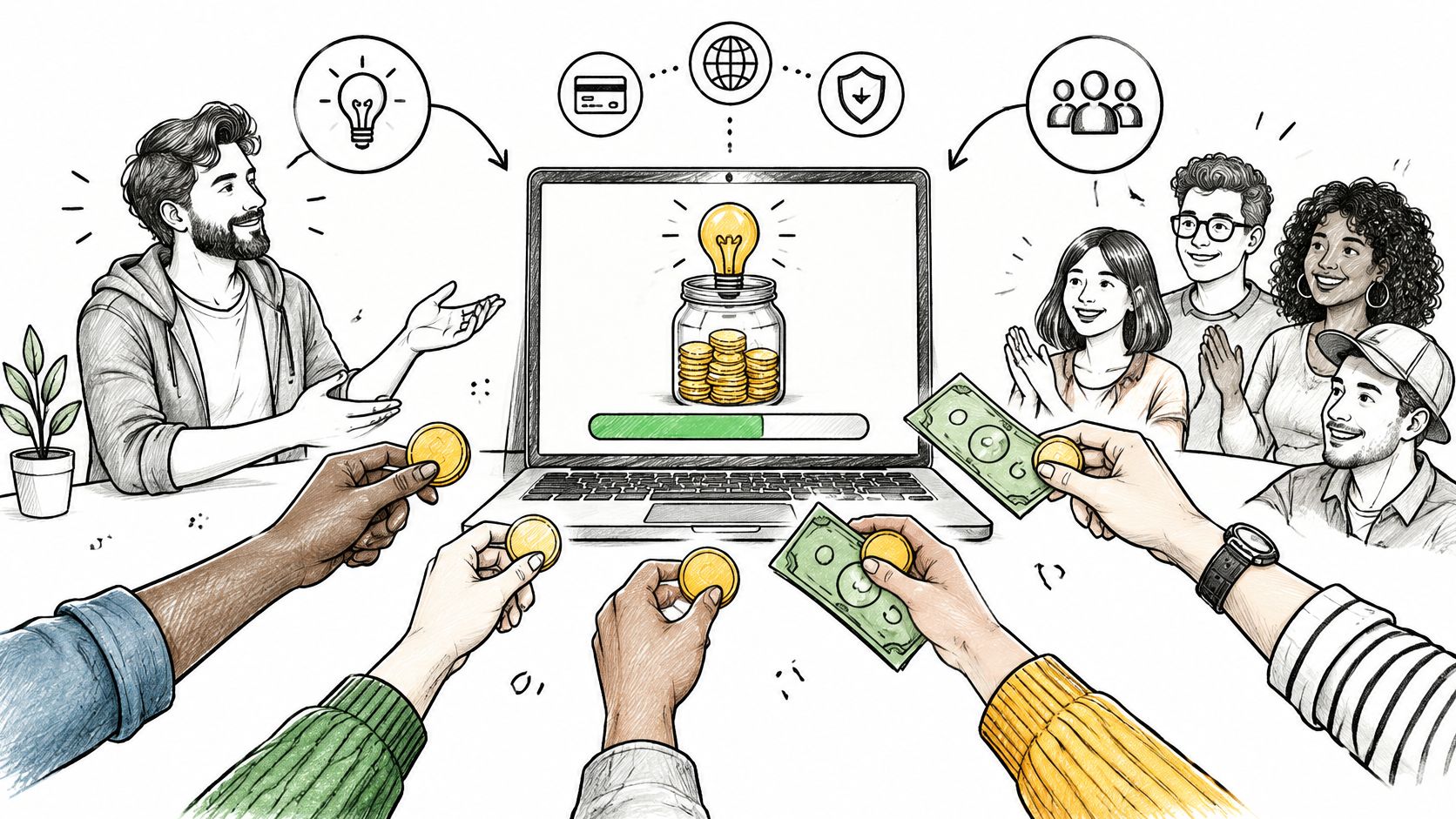
Three building blocks carry every campaign.
- Project page: Target amount, end date and a description that states the specific purpose.
- Payment: Individual contributions run through the platform and are forwarded according to the campaign rules.
- Feedback: Updates show the current status instead of leaving supporters alone after payment.
With the all-or-nothing model, the money is paid out once the goal is reached. If the total falls short, the contributions are refunded. In a flexible campaign, the organiser can also keep a partial amount. This rule is stated in the terms, not in the cover image.
The consideration differs depending on the model. Supporters receive a thank-you gift, a stake, or a financial repayment claim. With donation-based crowdfunding, the focus is on supporting a charitable or social purpose.
For a construction phase of a mosque or a well, you choose an amount. You get a receipt and a progress report, not a share in a company.
This principle became visible as its own financing market in Germany at the latest from 2010 onward. By 31 March 2015, on the German platforms examined at the time, 2,917 of 5,419 launched projects had raised capital, a success rate of 54%, with a cumulative volume of 18.7 million euros, according to the Crowdfinanzierung-Monitor by Für-Gründer.de and Dentons. In the first quarter of 2015, an additional 2.2 million euros was added, 83% more than in the first quarter of 2014.
A convincing public presentation and enough individual contributions have to come together. Nearly every second campaign in this period missed its goal. The question of the model comes before every payment.
The four models compared directly
Before every payment, one question decides the model: What do you get back? Depending on the answer, you donate, receive a product or thank-you gift, take a stake in a company, or give a loan.
| Model | What supporters receive | Return | Risk of loss | Typical example |
|---|---|---|---|---|
| Donation-based | No consideration | None | Not an investment; the donation is a contribution | Mosque construction, aid project |
| Reward-based | A thank-you gift or product | None | Not an investment | Music album, small production run |
| Equity (crowdinvesting) | A stake in the company | Possible | Total loss possible | Start-up, real estate project |
| Lending (crowdlending) | Repayment with interest | Contractually agreed | Total loss possible | Company financing |
With a donation, you support a cause, such as the expansion of a prayer room or a relief shipment. You receive no financial return. With reward-based crowdfunding, there is instead a thank-you gift or a product, such as a music album.
With equity, also called crowdinvesting, you receive a stake. A return is possible, as is a total loss. Lending, also called crowdlending, works like a loan: repayment plus interest is agreed, but in the event of default, the money invested can be lost.
The BaFin overview on crowdfunding describes different regulatory requirements, including rules for financial investment brokers and crowdfunding service providers. Which of these apply depends on the specific offer.
The German crowdinvestment market reached a placed volume of 297 million euros in 2018. From 2011 to 2018, 687.7 million euros flowed into German companies as well as real estate and energy projects. The average annual growth rate was 113.9%, according to the Crowdinvest Market Report 2018.
For charitable projects, promoting the cause is the main focus. The relevant question to ask is therefore: Do I receive a thank-you gift, a product, a stake, or a repayment with interest?
Legal classification for charitable projects and mosque communities
A donation to a charitable organisation is not an investment. Crowdinvesting and crowdlending, on the other hand, allow for a total loss. The BaFin overview on crowdfunding makes clear that donation-based and reward-based crowdfunding is not an investment, while a total loss is possible with crowdinvesting and crowdlending. The same source notes that, for many offers, BaFin does not itself review the projects and project sponsors.
A professional project page is therefore no substitute for proof. At SadakaNow, all campaigns are checked for charitable status before being activated. You should still want to see the statutes or the tax exemption notice yourself, since the platform's review and your own review are two separate steps.
Five questions before transferring money
- Who is the legal recipient? Is the registered association named on the page, or only a campaign name? For a mosque construction project, the e.V. should be named, not just the construction site.
- Will a donation receipt be issued? Without a charitable recipient, there is usually no donation receipt. How an association issues one is explained in the article on the donation receipt of a charitable association.
- How is the earmarking documented? "For the community" is too vague. "For the shell construction of the prayer room" can be verified later.
- What happens in case of overfunding? A clear follow-up purpose, such as the interior fitting of the same building, prevents money from sitting idle without a designated use.
- What happens if the project is not carried out? Is there a provision for a refund, a reallocation to a related purpose, or only a note in the fine print?
Sadaqa, Zakat and earmarked donations
These three forms of giving do not belong in the same pot. Sadaqa is a voluntary gift and can be used broadly. Zakat follows its own eligible recipient groups and should be recorded separately so that the community does not mix it with general construction expenses. An earmarked donation may only be used for the stated purpose. Three separate account records or cost centres make this clearly traceable later for bookkeeping and auditors.
You should clarify the tax implications of a donation with a tax advisor or an advisory office for association law. A platform profile alone is not proof of verified impact or financial security.
How a campaign runs from idea to payout
The process is a chain of decisions. Each step has a typical mistake that is hardly fixable later on.
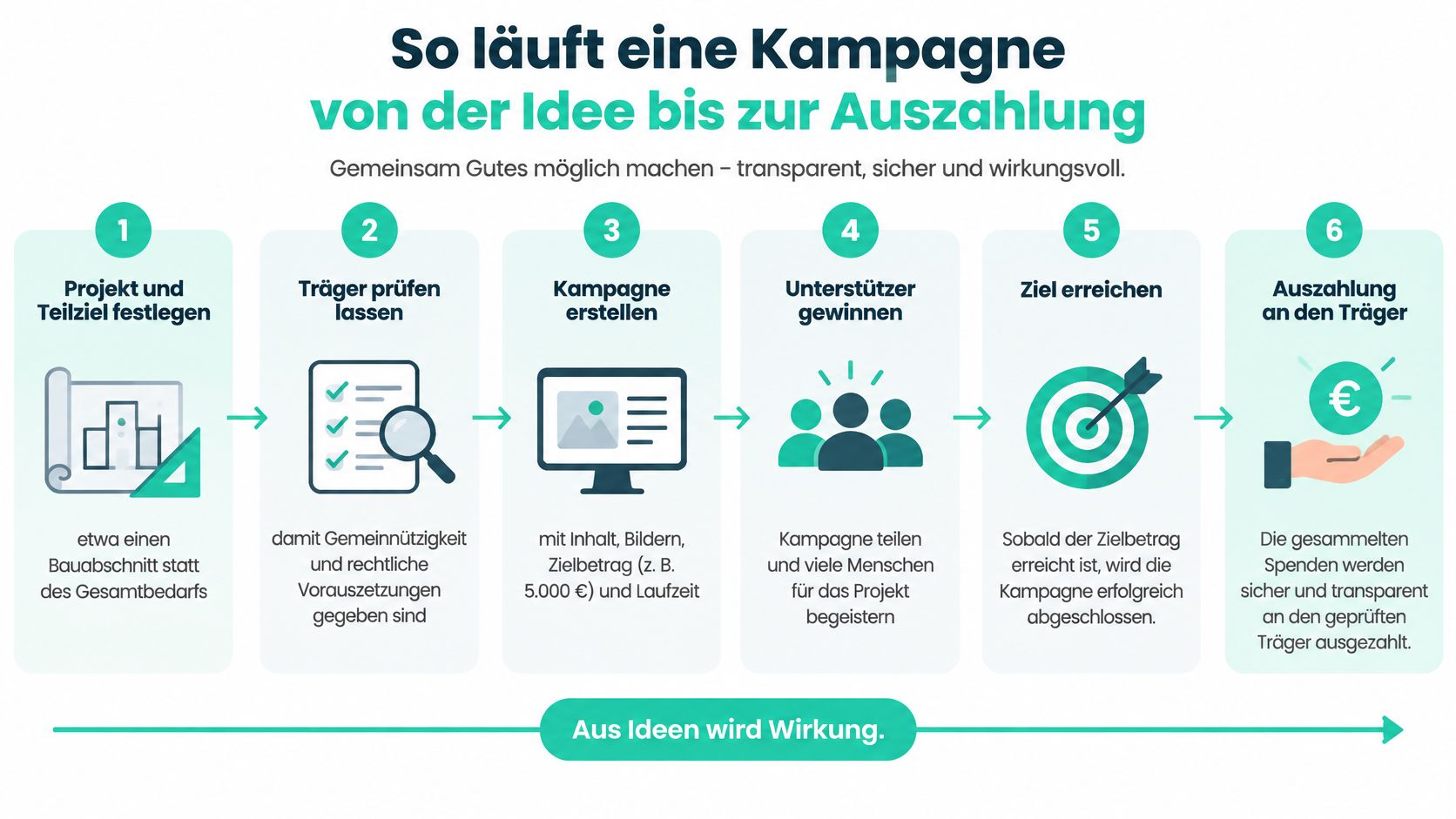
- Define the project and a sub-goal. You fund a construction phase or a specific aid delivery, not the entire need at once. The most common mistake is an overall goal that doesn't cover a single community within the runtime.
- Have the organisation checked. Non-profit status and the responsible people must be established before the page goes online. Without the tax-exemption notice, you start with a name no one can place.
- Build the project page. Text, images and a short video show the location, the need and the next step. Stock photos with no connection to the community make the appeal feel interchangeable. What a German donation page should pay attention to is shown in the overview on the crowdfunding platform in Germany.
- Set the runtime and amounts. You offer amounts with a clear purpose, for example 25 euros for building material or 100 euros for a share of a window. At this step you also decide whether unreached money is returned or a partial amount is paid out. This choice belongs before the start, not in the final week. Platform and payment fees differ depending on the provider and belong in the contract before you publish.
- Go public and share personally. A link alone is not enough. You approach people after Friday prayer, put the appeal in the community newsletter and ask the first supporters to share it in their own chats. Anyone who only waits for the algorithm will see hardly any movement in the first week.
- Write updates during the runtime. An interim update with a photo or a short figure keeps the page alive. The most common drop-off after the start is silence. Supporters then can't see whether anything is still missing.
- Payout according to the rules of the model. If the goal is reached, the platform forwards the sum to the project. If it is missed, what you set in step 4 applies, such as a refund. Every donation remains traceable, and projects are updated regularly so the status isn't only kept internally in the books.
- Close with proof of use. After the end, you publish what the money was spent on, including what is still open. Thanks without proof feels like a closed gate.
Anyone who notes the sub-goal, the payout rule and the first update date before the start avoids the three most common gaps at once.
What decides success or failure
The figures up to March 2015 are a historical order of magnitude, not a picture of today's market. They still show that a start is not funding.
| Metric | Value | Interpretation |
|---|---|---|
| Projects started by 31 March 2015 | 5,419 | basis for the success rate |
| Successfully funded projects by 31 March 2015 | 2,917 | roughly every second project |
| Success rate by 31 March 2015 | 54 % | nearly every second campaign fails |
| Cumulative funding volume by 31 March 2015 | 18.7 million euros | total across all platforms |
| Average funding goal (Startnext sample) | 13,364.53 euros | deriving a goal from individual contributions |
| Success rate (Startnext sample) | 51.78 % | comparable to the overall rate |
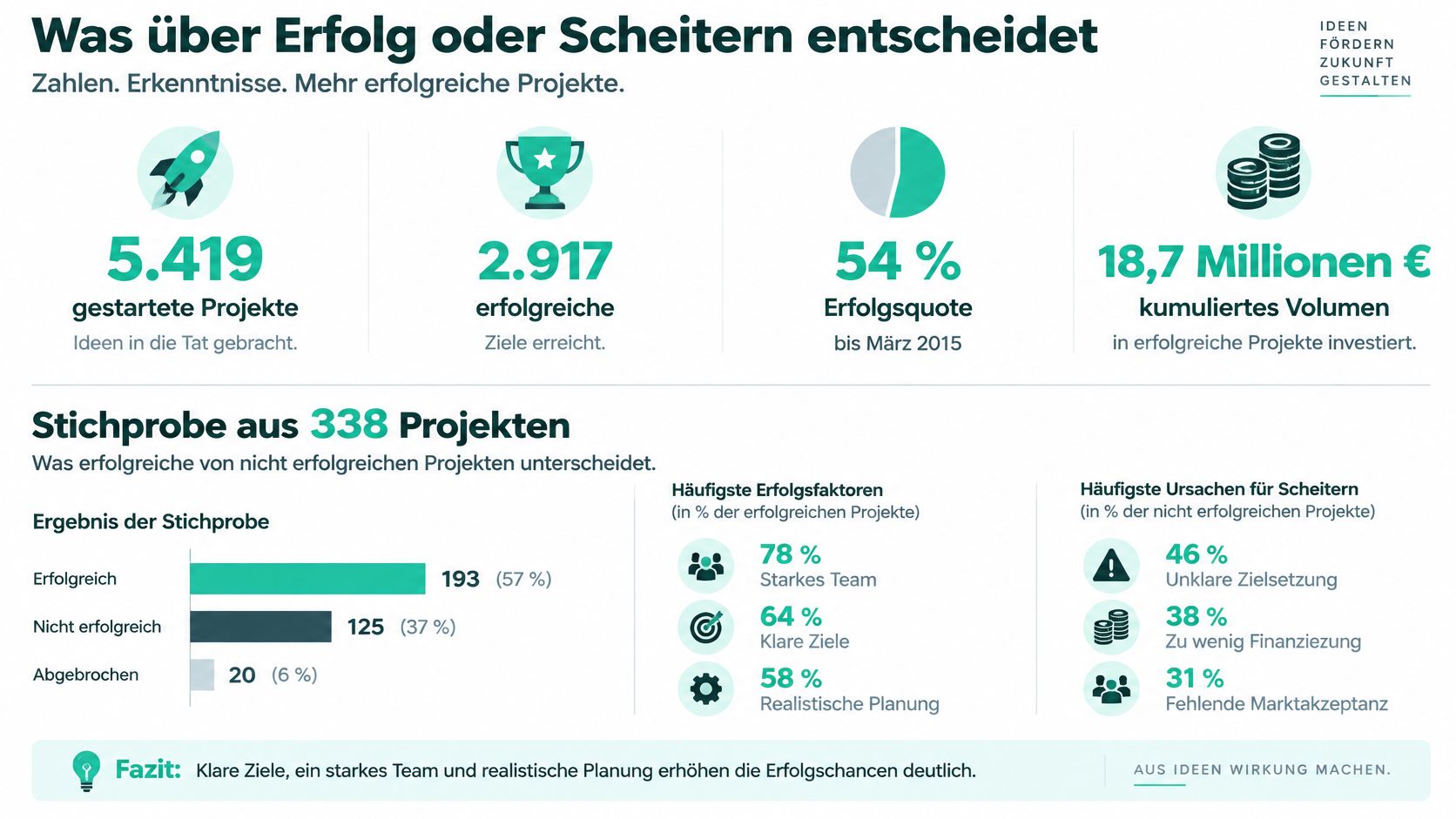
A study of 338 German Startnext projects, documented in the study held at the Deutsche Nationalbibliothek, cites an average funding goal of 13,364.53 euros and a success rate of 51.78 percent. The target amount is not just an administrative figure here. The effect of updates, comments and social signals changes with its size.
Why updates and comments carry different weight
Updates were significant especially for goals under 4,000 euros as well as over 7,000 euros. Comments gained importance as the target amount increased. For a small well project, a clear progress photo is often enough. For a larger build, people want to be able to ask questions and see a visible interim status.
You derive the goal from realistic individual contributions and the reachable community, not just from the total need. A clearly defined sub-goal, such as a construction phase or an aid delivery, plus regular progress updates, reduces uncertainty. For larger goals you need project pages that allow comments and traceable use of funds.
A tidy page alone does not prove impact. You assess verification, evidence and ongoing updates separately.
- Clear sub-goal: a section you can explain within the runtime.
- Credible organisation: name, non-profit status and a contact person are visible.
- Regular updates: even when only one detail has changed.
- Visible use of funds: which sum is intended for what.
Nearly every second campaign at the sizes mentioned did not reach its goal. Preparation, not the share button, makes the difference.
Preparing and launching the right campaign
Three decisions are enough to start a non-profit campaign. You choose the model, cut the sub-goal to size, and plan the updates before the page goes live.
For mosque construction, water projects and aid projects, the donation-based model fits well because nobody expects a return. Donors choose a project, enter an amount and pay by SEPA direct debit, credit card or PayPal. Anyone who wants to give monthly uses the same route via a recurring option, instead of having to search anew each time.
You can launch a campaign in under 24 hours, as soon as the beneficiary and sub-goal are fixed. Inquiries about a new campaign or about partnerships go to partner@sadakanow.de. Questions about donations or payment issues go to hilfe@sadakanow.de.
The project page itself should be as clear as a good donation appeal. Concrete tips on this are in the guide Creating a donation appeal. For structuring the page, meaning the headline, first image and the sentence that states the purpose in one breath, the landing page tips from Stay Digital help.
Checklist before launch
- Proof of charitable status: the articles of association or exemption notice is available, and the legal recipient is named.
- Concrete sub-goal: a construction phase or a delivery, not an undivided overall need.
- Update plan: the first interim report has a date, even before the campaign goes online.
Once these three points are in place, you know which model you're using and what to do first. You write the purpose in one sentence, set the first amount, and fix the date for the first update.
SadakaNow is a donation platform from Germany on which vetted mosques, aid organisations and social initiatives publish Sadaqa campaigns with a goal, progress and updates. You choose a project and support it directly, without the contribution counting as equity or a loan. If you want to prepare the next appeal or donate yourself, you'll find the projects on SadakaNow.