
Orphan sponsorship: how to start in 2026
60,900 young people newly entered a home or foster family in Germany in 2023, as classified by the Scientific Services of the German Bundestag based on child and youth welfare statistics. This is not an orphan statistic. Rather, the figure shows why you should look closely at an orphan sponsorship: which children does the program support, what professional help do they receive, and what does your donation achieve?
A responsible decision therefore does not begin with a photo of a child. It begins with a clear funding goal, verifiable child protection, and a payment plan you can sustain in the long term.
Table of Contents
- What an orphan sponsorship provides
- Criteria for a reputable sponsorship
- Handling regular payments securely
- How to start the sponsorship via SadakaNow
- Reading reports and impact correctly
- Common mistakes with sponsorships
What an orphan sponsorship provides
An orphan sponsorship is voluntary support for education, health, material aid, or social participation, cancellable according to the agreed terms. It does not establish custody or any claim to contact or family placement. You finance supplementary help, while responsibility for care and protection remains with the responsible people and professional bodies.
The term sponsorship can trigger different expectations. Some think of personal letter contact, others of a fixed contribution toward school supplies or medical care. What matters, therefore, is not the label but the program's specific description of services.
Sponsorship and other forms of help
| Form | Legal consequence | Duration | Donor's expectation |
|---|---|---|---|
| Sponsorship | No custody, voluntary help | Ongoing and cancellable by agreement | Program report, no family placement |
| Foster family | Educational assistance | According to the care plan | No donor status |
| Emergency protective custody | Temporary protection | Short-term, until further help is clarified | Not a sponsorship model |
| Residential youth welfare | Care in a home or supervised living | According to the care plan | No individual marketing |
| Guardianship | Legal representation | Until adulthood or revocation | No claim to contact through a donation |
| Adoption | New legal parenthood | Permanent | Not a donation product |
The table helps you classify offers correctly. If you give money regularly, you do not automatically take on the tasks of a foster carer or a guardian. Likewise, an organisation must not derive private care responsibility from your willingness to donate.
What German statistics actually describe
In Germany, orphan sponsorship is not a separate official statistical category. The child and youth welfare system is relevant for context, but its groups are not equivalent to orphans. A child can live outside their family of origin and still have living parents.
The various forms of help also describe different situations. A temporary protective measure is something different from longer-term placement. The size of these groups therefore does not allow you to deduce either the number of orphans or the number of possible sponsorships.
For your assessment, this means: have it explained to you who is admitted according to which criteria. Is it about children whose parents have died, foster children, children in residential care, or families in economic hardship? A program may support several groups, but must name them clearly.
Terminology rule for donation decisions: Orphans, foster children and disadvantaged children in general are not interchangeable terms.
One example: if a project funds learning materials and psychosocial support for children in a residential group, you are supporting a professionally supervised service. You are not buying a place in a child's life story, nor a personal relationship. The sponsorship complements professional care, it does not replace it.
Criteria for a reputable sponsorship
First check the organisation and its safeguarding concept. You decide on the amount afterwards. An emotionally convincing presentation is not yet proof that an organisation looks after children responsibly.
Particularly critical is the selection of individual children based on public photos and life stories. SPIEGEL reported on the criticism of a sponsorship practice analysed at the University of Erlangen-Nürnberg, in which such depictions can encourage catalogue-like marketing. What matters for your decision, therefore, is whether a project explains its aid without publicly putting children on display.
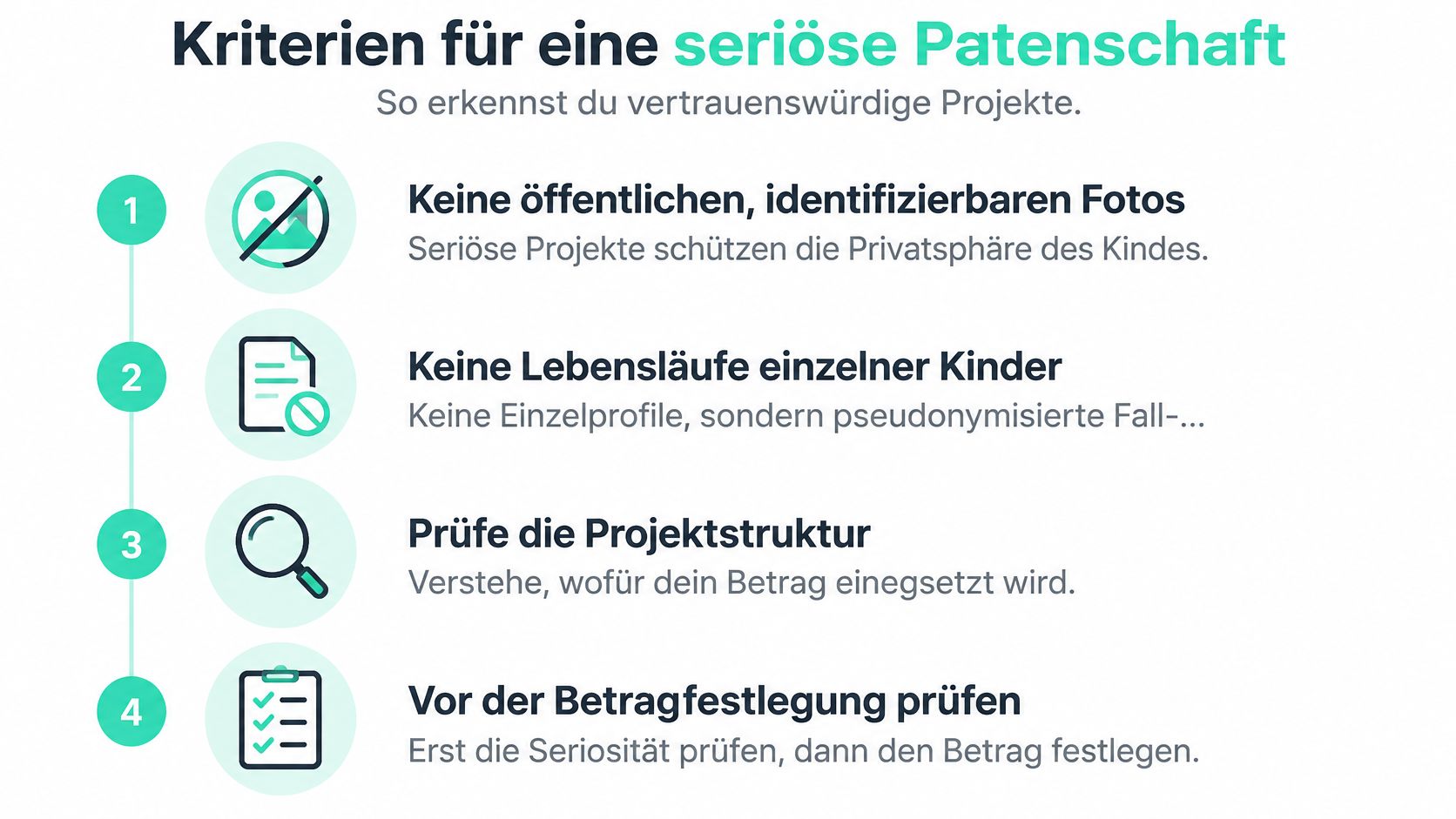
Checklist before taking on a sponsorship
| Criterion | Good evidence | Warning sign |
|---|---|---|
| Child protection | Pseudonymised case or group description | Photo and life story as in a catalogue |
| Consent | Documented procedure involving the guardian and age-appropriate participation of the child | No information on consent |
| Data protection | Minimal data and restricted access | Publicly identifiable profile |
| Contact | Supervision by trained local staff | Private direct contact with the child |
| Reporting point | Independent body and anonymised incident report | No complaints office |
| Success rate | Definition, time period and reference group | Blanket "rescued" figure |
| Funds | Traceable allocation to the programme | Unclear use |
| Organisation | Proof and verification of non-profit status | Missing proof |
Mark for each criterion whether verifiable evidence exists. A friendly reply such as "We take data protection seriously" is not enough. More meaningful is a description of what data is collected, who may access it, and when it is deleted.
You don't need a child's private consent documents for this. Ask for the documented procedure, not sensitive individual case data. Transparency towards donors must not come at the expense of privacy.
Protection must work in everyday practice
A usable safeguarding concept names those responsible, training measures and an accessible complaints procedure. It also explains how staff report a suspicion and who oversees the handling of it. An independent reporting point should remain reachable even when a complaint is directed against the project management.
Look out for verifiable process details: Are safeguarding checks completed before a payout? Are the staff involved trained? Does the organisation record how long it takes to process safeguarding reports, and does it publish anonymised information on how these are handled?
Specific questions can help you with the financial review:
- Purpose: Which services are funded, for example tutoring, treatment or care?
- Responsibility: Who decides locally on admission and the need for help?
- Allocation: How does the organisation separate programme expenses, administration and communication?
- Selection: Do children receive help according to need or according to how appealing they are to donors?
Our guidance on finding suitable donation projects helps you compare such documents systematically. Non-profit status is an important review criterion here, but it is no substitute for a professional assessment of the specific programme.
Stop the selection process if children are presented to you as if in a catalogue. If information is missing, you can ask further questions. In the case of clearly degrading marketing, you should not become part of this model through a donation in the first place.
Handling recurring payments safely
| Frequency | Planning | Proof | Ending |
|---|---|---|---|
| Monthly | Recurring direct debit, if offered | Payment confirmation and account reconciliation | Revoke the mandate before the next collection, check the agreement separately |
| Quarterly | Combined transfer or agreed collection | Quarterly receipt or payment overview | Stop further transfers, observe agreed deadlines |
| Annually | Set aside a fixed sum in the household budget | Annual confirmation | Cancel before an agreed renewal |
| One-off | Project donation with no fixed term | Individual receipt | No renewal unless a repetition was agreed |
Choose the frequency based on your available budget, not on an emotional donation appeal. An ongoing commitment should remain affordable even when other expenses rise. A one-off project donation is a sensible alternative if you do not yet want to commit permanently.
There is no flat matching amount in euros. What matters are the described benefits and the programme's local needs calculation. Your contribution is not pocket money for a single child, but serves the agreed funding purpose.
Tracing the flow of money
With us, the donated money does not come under the control of SadakaNow. It is held in trust and paid out directly to the respective organisation. Before giving your approval, still check which body is the recipient and what payout rule the project description states.
Set up a small payment file for yourself. A digital folder with the project description, confirmation, proof of payment and the terms of the recurring payment is enough. Also keep a record of the designation under which the debit appears on your account.
Distinguish between an automatic donation confirmation and an official tax donation receipt. A confirmation email documents the transaction, but is not automatically the appropriate tax document just because of its name. Check which document you actually have, especially if you are liable to tax outside Germany.
For your budget planning, you can find further guidance on monthly donations. Also keep a record of how you can change the amount and frequency or end further payments.
Resolving revocation and payment issues in an orderly way
You can revoke a SEPA mandate. Plan the notification before the next collection and note that revoking the mandate and ending an underlying agreement can be separate steps. Keep the confirmation of your change.
If a direct debit fails, first check the account details, account balance and mandate. Then compare your bank statement and payment status instead of donating again immediately. If you have questions about your donation or payment problems, you can reach us at hilfe@sadakanow.de.
For your records: Note down the recipient, purpose, frequency and method of ending the payment together. This way you can trace a payment later without having to search for it.
Before the first collection, one question should be answered clearly: Is the donation amount you approved fully allocated to the verified organisation and the selected programme? Clarify any unclear additional items or differing recipient names before the payment.
How to start the sponsorship via SadakaNow
The start should enable you to make a comprehensible funding decision. The goal is not the greatest possible emotional closeness, but a clear commitment to a suitable programme. For this, you need a project page, an affordable amount and an idea of when you want to review the results.
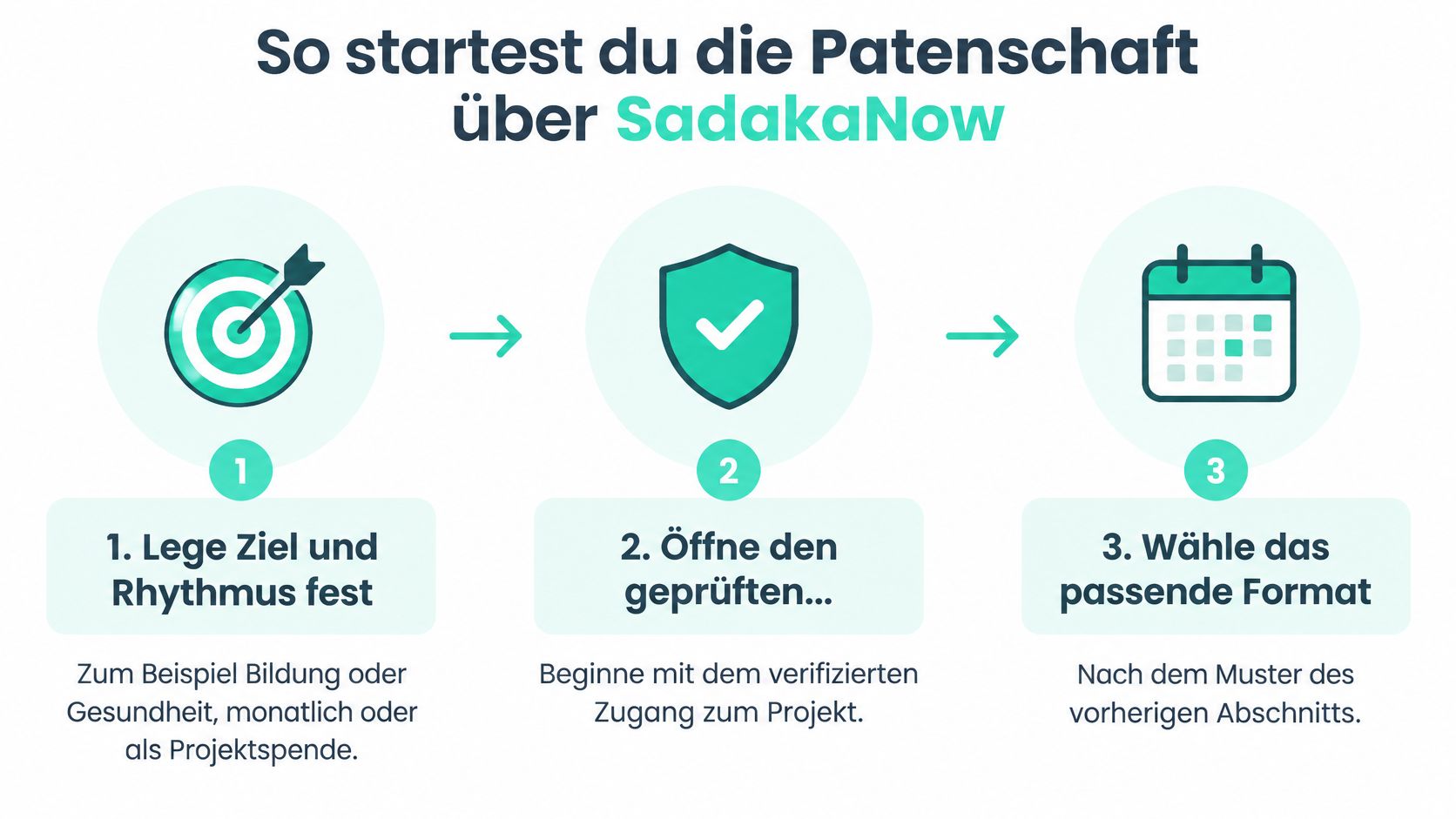
From funding goal to approval
Set your goal and rhythm.
Decide which need you want to support, such as education, health, or basic provisions. Then consider whether you can contribute regularly or would prefer to make a one-time project donation first. Your result is a short sentence, for example: I want to help fund an education programme long-term.Open the project catalogue and search for the aid purpose.
Orient yourself by aid projects with the desired education or health focus, not by individual child profiles. If the selection doesn't offer a suitable filter function, check the project descriptions for these terms. At the end, you'll have a narrower selection of programmes whose purpose matches your intention.Read the goal, progress, duration, and organisation.
Check whether a campaign is funding a limited acquisition or enabling ongoing services. A completed construction or equipment campaign is not automatically the right goal for an ongoing commitment. Note who is implementing the programme and which specific service your donation is meant to support.Place the non-profit review in proper context.
With us, all campaigns are reviewed for non-profit status before being activated. This review is an important starting point, but on its own it says nothing about whether the funding goal matches your expectations. Your result is a decision for a vetted organisation with a task you understand clearly.Enter the amount and choose the payment method.
With us, you select a project, enter the amount, and pay via SEPA, card, or PayPal. Before confirming, check the project name, the amount, and any selected recurrence. You shouldn't mentally treat a one-time payment as an ongoing sponsorship.Let the automatic review finish.
We automatically check every transaction for fraud risks and as part of anti-money-laundering prevention; for SEPA, this includes the mandate review. This usually happens within seconds and without any further action on your part. Your result is a confirmed payment status or a specific need for clarification, not the assumption that you should pay again just to be safe.Save the confirmation and your payment note.
Keep the automatic confirmation email and compare it with your account. Note the chosen rhythm as well as the process for changes and cancellation. This way you can manage the commitment yourself later, without having to rely on your memory.Enter the first reporting date.
Use the update or reporting period announced on the project page. If no such information is given, set your own date to check back and ask questions. Your result is an active funding decision with a review point, rather than an unmonitored standing payment.
An example without a child profile
A donor from North Rhine-Westphalia wants to regularly support an aid project. She doesn't choose a specific child, but instead decides on a programme with a clear education goal. Before making the payment, she checks whether the organisation describes ongoing learning support or merely a one-time purchase of materials.
She saves the project description and notes what development should become visible later. A rising donation total alone is not enough for her. She wants to know whether the planned service actually took place and what difficulties arose.
On the project page, updates with images and videos can explain the work. Assess this content as an insight into processes, not as a substitute for an outcome report. A picture of a classroom, for example, does not yet answer whether children were able to attend classes regularly.
A completed payment is the beginning of your support, not proof of its success.
If a confirmation is missing after the release or a status remains unclear, write to hilfe@sadakanow.de before making another payment. Name the project and the existing payment reference, but do not send complete card details or unnecessary personal documents.
Check a suitable project today, set the amount and rhythm, and save your receipt. Then enter the first reporting date. This way, your commitment has a clear financial and substantive foundation from the start.
Reading reports and impact correctly
A good report separates need, service, and outcome. Buying school materials is a service. Whether children can learn more reliably as a result is a different question and requires appropriate observations.
The academic debate on child sponsorships assesses the evidence for sustainable, structural poverty reduction ambivalently: educational and health successes often cannot be methodologically and clearly attributed to the personal sponsorship rather than to the accompanying project structures. Therefore, don't expect a simple rescue story, but a comprehensible account of the entire programme.
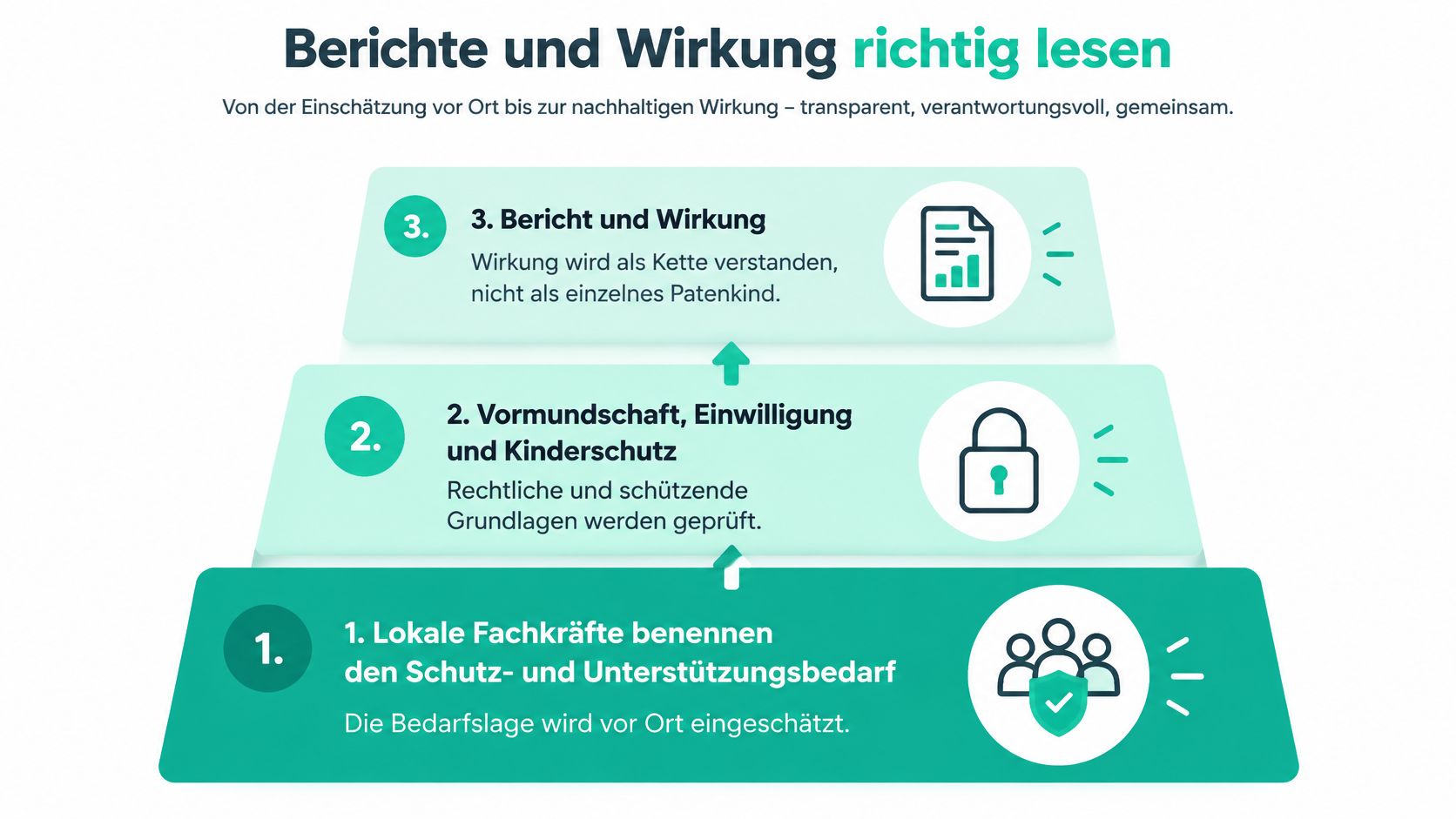
Checking the chain of impact
Local specialists should first determine the need for protection and support. This is followed by a review of the care situation, consent, and child protection. Only then does the selection of suitable services build on this.
These services can combine individual support with offerings for the surrounding environment, such as lessons, healthcare, and psychosocial support. For evaluation, the organisation needs a baseline value, a well-founded target value, and regular measurements. Suitable observations concern, for example, school attendance, learning progress, health development, or the transition into vocational training.
The following table shows a hypothetical reporting model for a school programme. It deliberately contains no invented result values.
| Criterion | Weak report | Complete report |
|---|---|---|
| Baseline value | None stated | School attendance at the start documented |
| Target value | General wish for better opportunities | Goal and review date named before the start |
| Result | A success story | Actual proportion with documented school attendance, reference group, and measurement time stated |
| Dropouts | Not mentioned | Number and reasons disclosed anonymously |
| Use of funds | Only total sum | Expenses for school and health traceably allocated |
| Comparison group | Missing | Named, or its absence methodologically justified |
Complete does not automatically mean causally proven
A careful report makes results verifiable. However, it does not automatically prove that the donation alone caused the observed change. Better school participation can also be related to changed transport routes, family stabilisation, or other forms of help.
So pay attention to the limits of the evaluation. A missing comparison group should be named, not hidden behind moving individual stories. Equally important is that the organisation accounts for programme dropouts and does not retroactively narrow the reference group to successful participants.
Before continuing your support, these questions can help:
- Starting situation: Is it clear what problem existed at the beginning?
- Measurement: Does the organisation record the same characteristic at traceable points in time?
- Completeness: Are interruptions, missing information, and unmet goals explained?
- Consequence: Does the organisation describe when it changes or ends services?
With us, all organisations are vetted, non-profit, and trustworthy. For the substantive evaluation of a programme, concrete results nonetheless remain decisive. Use our transparency information for context and additionally check the statements of the respective project.
Expenses are not proof of impact. If a report only states the number of recipients and the amounts spent, specifically ask about the observed changes. If the organisation discloses uncertainties and explains adjustments, that is more meaningful than a seamless success narrative.
Common mistakes with sponsorships
3,601 children were adopted in Germany in 2023, around 73 percent of them as part of a stepchild adoption, reports the Federal Statistical Office. Adoption is therefore not only legally but also practically a different matter from a donation pledge. Your support does not create a path to bringing a child into your family.
The personal significance of a donation may be great without giving rise to a claim to a child.
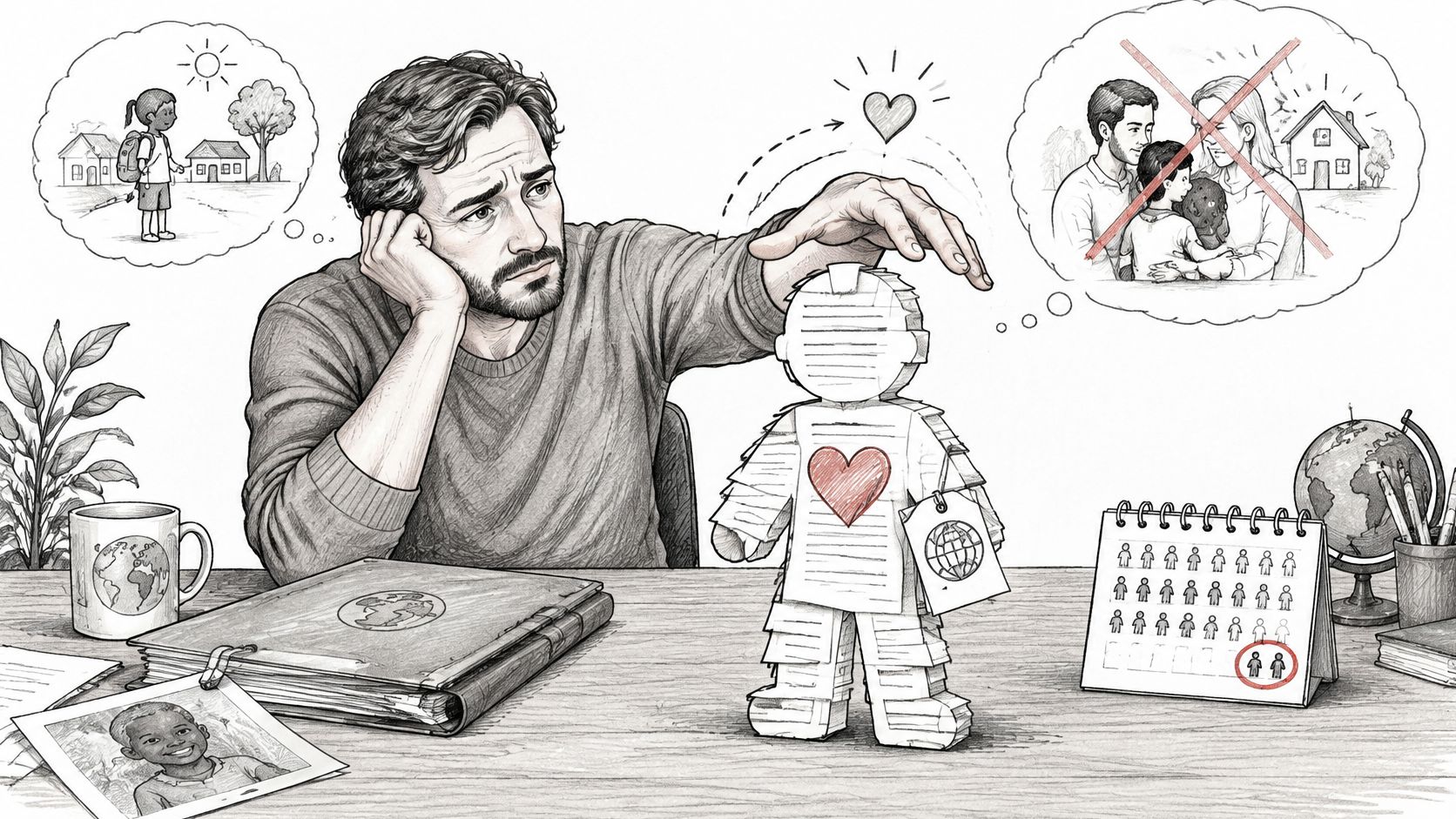
Correcting expectations after the pledge
After the start, mistakes often arise not from bad intent but from a misunderstood sense of closeness. A gift or visit may be well-meant and still bypass protective procedures. So clarify any additional contact through the organisation.
- Letters and gifts: Do not send anything privately, bypassing staff or protective procedures. Use only the designated channel.
- Demanding a specific child: Do not request exclusive assignment if the programme funds communal services.
- Treating anonymisation as a sign of fraud: Missing individual stories are not, by themselves, evidence of suspicion. Traceable programme information is what matters.
- Assuming visits: Safety, consent, and professional oversight must be clarified beforehand. Private access is not a quality feature.
- Letting payments lapse without comment: If your budget becomes tight, communicate the change and consider a different schedule or a pause.
To explore the topic further, you can watch this video. For your specific decision, the documents of the chosen programme remain authoritative.
Above all, drop the expectation that a child owes you personal gratitude. Your pledge should remain meaningful even if you receive no name, no face, and no private messages. Reliable support comes from sustainable payments and verifiable programme goals, not from a sense of ownership over a child's profile.
At SadakaNow you can choose vetted aid projects and compare their goals before you donate. Look for a programme with a clear funding purpose, check child protection and reporting standards, and only then decide on your amount. After paying, keep the confirmation and note down when you want to check the next results.