
Finding Donation Projects: How to Vet Sadaqa Projects
You want to use your monthly Sadaqa purposefully. A project page looks professional, a mosque is asking for support for a building project, an aid organisation is advertising urgent overseas relief, and a platform shows several campaigns with emotional images. Yet the decisive questions remain unanswered: Who is behind the project, where does the money actually go, and what proof will you receive afterwards?
When finding donation projects, a good feeling is not enough. You need to check two things separately: Is the organisation legally and organisationally trustworthy? And is the use of funds documented concretely enough that you can trace its impact? These two questions determine whether your Sadaqa is traceable support or just a payment with an unclear outcome.
A good first point of orientation is the guide to donating for social projects. After that, you shouldn't simply pick the most emotional campaign, but apply a fixed vetting routine.
Table of contents
- Why finding the right project is harder than it looks
- How to vet organisations, finances, and project goals
- Where to actually find trustworthy projects
- Which payment method suits your donation
- Claiming tax deductions via the Zuwendungsempfängerregister
- Which metrics actually carry meaning
- Your two-minute routine before every donation
Why finding the right project is harder than it looks
In Germany, willingness to donate is high, yet many projects compete for attention. According to the Bilanz des Helfens 2024, private individuals donated 5.1 billion euros to charitable organisations, aid and charity organisations, and churches. The number of donors fell by 300,000 to 16.7 million people, while the average individual donation rose from 40 to 43 euros. For you, this means an emotional campaign alone is not a reliable selection criterion.
For Muslim donors, alongside the social purpose, compatibility with one's own Sadaqa principles also matters. With a mosque association or aid organisation, you should therefore clarify whether the purpose is clearly described, whether the organisation works transparently, and whether it reports regularly on how funds are used. The tax side also belongs to the decision: whether a donation is tax-deductible can later be checked via the Zuwendungsempfängerregister. This way, you combine religious criteria, organisational oversight, and practical proof.
A first point of orientation is the guide to finding social donation projects. Even so, replace your gut feeling with a fixed vetting routine.
The first trust question concerns the organisation
A professional landing page is no proof of charitable status. Many followers, well-known supporters, or moving videos also say little about the actual work being done. Check who is legally responsible. This list should include a complete imprint, a traceable address, registration details, and a reachable point of contact.
Small initiatives may lack some information. That alone is not proof of fraud, but it does increase your duty to check further. Associations, foundations, aid organisations, and private campaigns must each provide different kinds of proof. If the organisation cannot clearly answer simple questions about legal form, use of funds, or reporting intervals, you should not donate.
The second trust question concerns the use of funds
A donation goal alone does not describe a verifiable use. A reliable project page states the goal, target group, timeframe, budget and progress. It also explains how much has been received, which expenses have already been incurred and what remaining need exists.
Practical rule: The more specifically a project asks for money, the more specifically it must explain the planned use.
So check the organisation, financial logic and progress in this order. This doesn't take days of research, but it protects you from payments to projects with unclear responsibility or missing documentation.
How to check the organisation, finances and project goals
A serious donation process begins with the formal existence of the organisation. Read the legal notice (Impressum) in full and compare the name, address and legal form with the information in the association register or, for a foundation, with the official foundation data. For a registered association (eingetragener Verein), a current tax exemption notice (Freistellungsbescheid) is also among the important documents. It shows that the tax-privileged treatment is not merely claimed.
Next comes financial plausibility. A financial report should not just contain a positive summary, but should present income, expenses, reserves and control mechanisms in a verifiable way. In the impact report, look for results, not big promises. Statements like "we help many people" remain worthless if the organisation does not explain which measures have been completed and how it verifies its claims.
For its donation seal, the DZI assesses, among other things, internal management and control mechanisms, the informative value of financial reports, public transparency, and advertising and information material. As a plausibility check, advertising and administrative expenses should amount to no more than 30 percent of total annual expenses. At DZI seal organisations, on average 88 out of 100 euros go into programme work and 12 out of 100 euros into advertising and administration, as explained by the DZI seal standards.
Putting administrative costs into perspective
Low administrative costs alone are no proof of quality. Bookkeeping, internal control, data protection, personnel management and accountability cost money. If these structures are missing, an organisation may look particularly economical on paper but still be poorly controlled.
So pay attention to the combination of cost ratio, independent oversight, concrete results and disclosed assumptions. An organisation that explains its costs and states its limits is often more credible than one that advertises solely with minimal administration.
Every project page should contain at least the following information:
- Funds received: How much money has come in so far?
- Expenses so far: Which amounts were used for what?
- Remaining need: What is still missing and how was this amount calculated?
- Beneficiaries: Which target group is being reached?
- Implementation period: When does the measure begin and end?
- Reporting rhythm: When will the next update or report appear?
| Organisation type | Required evidence | First plausibility question |
|---|---|---|
| Registered association | Legal notice, association register details, tax exemption notice, financial and project report | Do the association's name, account holder and project purpose match? |
| Mosque association | Legal entity, proof of non-profit status, responsible persons, budget and earmarking | Who decides on the funds and how is the community informed? |
| Foundation | Foundation details, statutory purpose, financial report, project description | Does the specific project match the defined foundation purpose? |
| Foreign organisation | Legal identity, German tax documentation, project budget, progress reports | Can the organisation be verified by German donors in terms of tax and organisation? |
For Sadaka, it also matters whether the purpose is clearly and islamically comprehensible. This does not replace a legal check. A religiously fitting purpose still needs to be checked even when the campaign comes from one's own community.
Where to actually find trustworthy projects
Not every search channel is suitable for every donation. A direct collection at the mosque offers personal closeness and quick follow-up questions. You can speak to those responsible, ask to see documents, and find out how the community is informed about expenses. The weakness lies in inconsistent documentation. Closeness builds trust, but it does not replace a financial report.
Established aid organisations usually work with fixed reporting formats and controlled processes. This is especially useful if you want to support larger emergency relief or a long-term development project. In return, decision-making paths can be longer, and the connection between your individual donation and a concrete result sometimes remains less direct.
Four channels with different strengths
Directories and databases help with initial filtering. A DZI entry or a comparable proof is a sensible starting point, but no reason to stop reading the project description. Keep checking earmarking, current figures and progress reports.
Donation platforms bundle multiple campaigns and make comparison easier. You can pre-sort projects by topic, region and goal, track progress and compare payment methods directly. However, platforms are only as good as their verification processes. Pay attention to clear information on the organisation, fees, forwarding, refunds and updates.
Uncomfortable truth: A visible donation bar shows participation, not automatically impact.
At SadakaNow you can browse available donation projects. The platform bundles campaigns from mosques, aid organisations and social initiatives and provides project information such as description, goal, progress and updates. According to the available information, verified projects are offered with 0 percent platform fee, while voluntary tips support the financing. Nevertheless, you should also read the project details yourself and ask if anything is unclear.
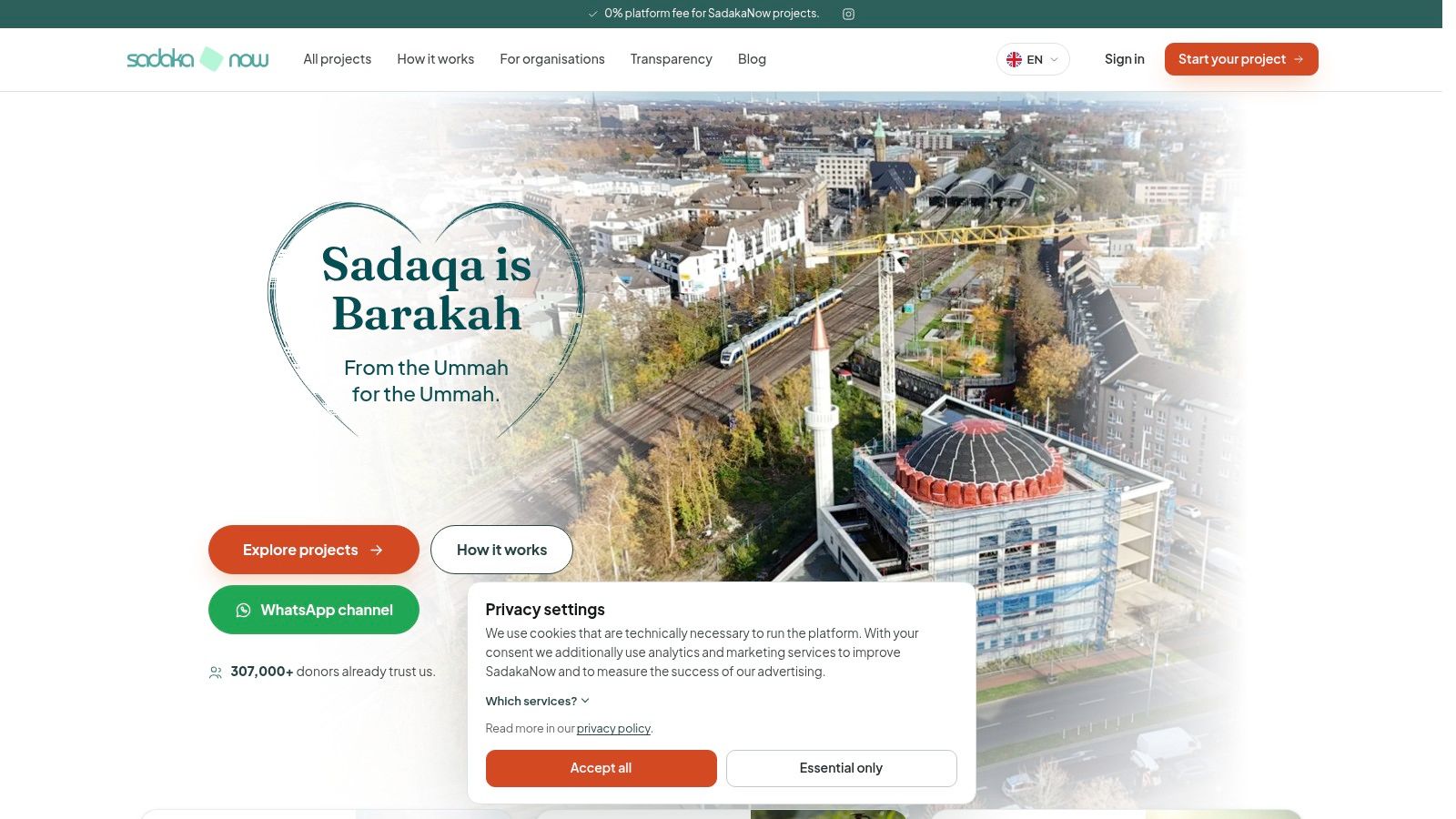
For the initial selection, a simple question is enough: Can you tell within a short time, from the project page, who is responsible, what is being financed and when the next proof will come? If the answer is no, the project doesn't belong on your shortlist.
Direct inquiries are especially worthwhile with smaller associations and mosques. Ask in writing about the statutes, tax exemption notice, budget and reporting plan. A reputable organisation doesn't have to provide every answer immediately, but should openly explain which documents are available and where the limits lie.
Which payment method suits your donation
Online doesn't automatically mean credit card. The Deutsche Spendenmonitor 2025 is based on 5,008 respondents aged 16 to 75 in Germany. The classic bank transfer was the most used donation channel at 47 percent, while PayPal reached 26 percent, slightly above the previous year's figure of 25 percent.
These figures match the reality of many German donors. Those who regularly set aside Sadaka don't necessarily need the fastest payment method. What matters is predictability, a clean receipt and whether the payment fits one's own habits.
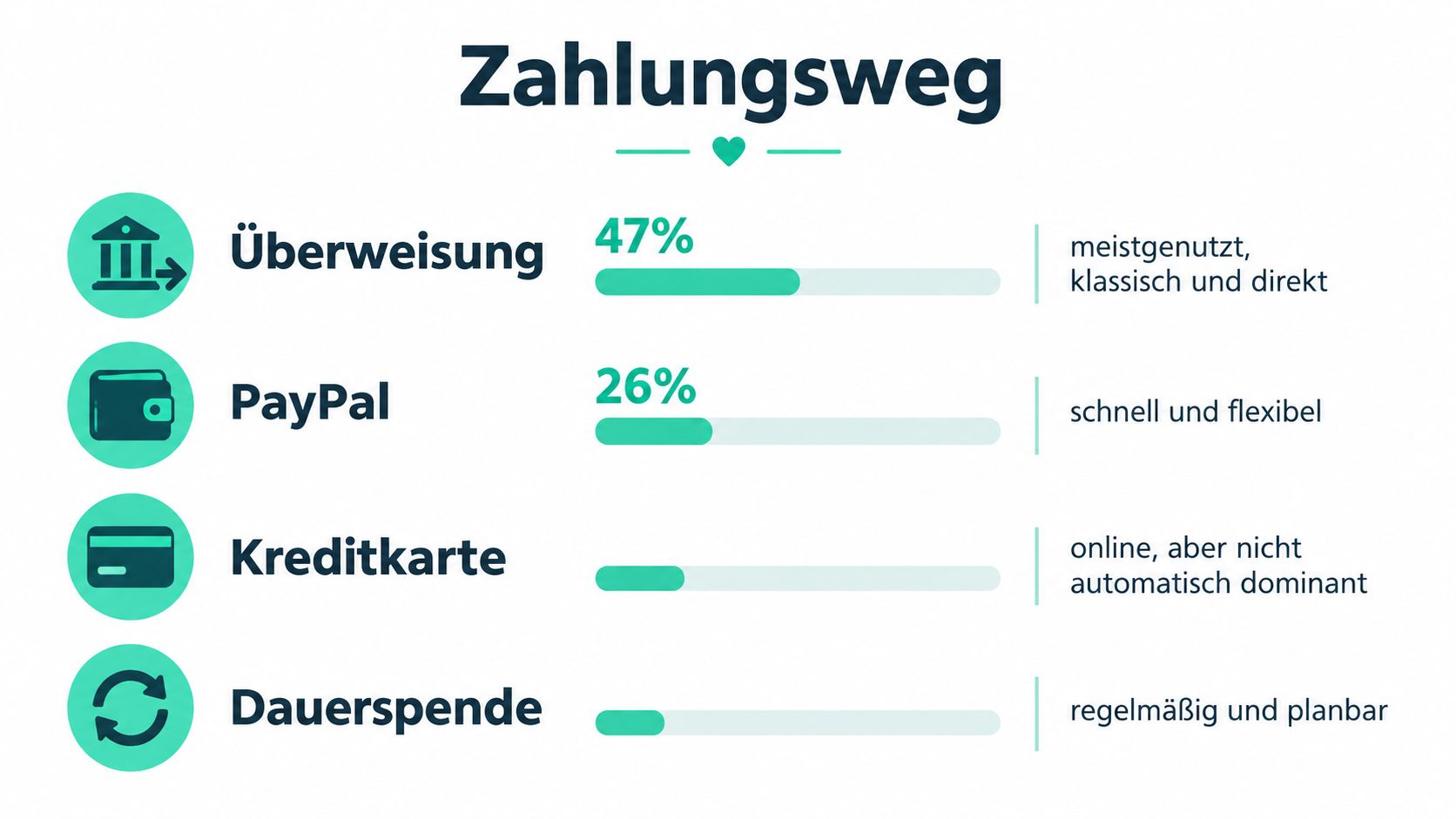
Bank transfer remains the sober standard solution
The bank transfer suits people who want to consciously trigger their payment from their own online banking. It is familiar, direct and easy to trace via the bank statement. For spontaneous emergency aid, however, it can feel slower if you first have to copy bank details and authorise the payment.
SEPA direct debit suits a regular Sadaka better. You don't have to remember it every month, but you should only grant the mandate if the recipient, amount, frequency and cancellation terms are clearly described. A standing donation is predictable, but remains a commitment that you should regularly review.
PayPal and credit card lower spontaneous barriers
PayPal is suitable for quick mobile payments and for donors who don't want to re-enter their bank details for every project. Still, the payment receipt must be clearly attributable to the recipient and the purpose. Keep the confirmation and check whether the organisation issues a formal donation receipt.
Credit cards are convenient if you want to complete a one-time online donation immediately. However, they are not automatically the preferred solution. Check the security features of the payment page, the privacy information and how any fees are presented. SSL, PCI-DSS Level 1 and GDPR compliance are important security indicators of a platform, but they don't replace checking the actual payment recipient.
| Payment method | Suitable for | Check before completing |
|---|---|---|
| Bank transfer | Deliberate single donation, familiar bank payment | Recipient name, purpose of payment, account details |
| SEPA direct debit | Regular Sadaka and predictable support | Mandate, frequency, cancellation and receipt |
| PayPal | Quick mobile or spontaneous donation | Payment confirmation, fees and proof |
| Credit card | One-time payment in the online process | Security page, data protection and refund |
For tax purposes, what counts is not your preferred payment method, but the recipient's status and the appropriate proof. An account or payment confirmation may be sufficient in certain cases, while other donations require a formal donation receipt. Clarify this question before making the payment, not only when preparing your tax documents.
Tax deductibility via the Zuwendungsempfängerregister
A donation receipt alone doesn't guarantee a tax deduction. What matters is whether the recipient is tax-privileged and meets the official requirements. The Zuwendungsempfängerregister of the Bundeszentralamt für Steuern offers a central way to check online which organisations serve charitable, benevolent or religious purposes and are authorised to issue donation receipts.
Start with the registered seat of the organisation. A German association, a mosque with its own legal personality, a foundation and a foreign aid organisation can be treated differently for tax purposes. Don't simply take the name from the campaign, but compare it with the official register information and the payment recipient.
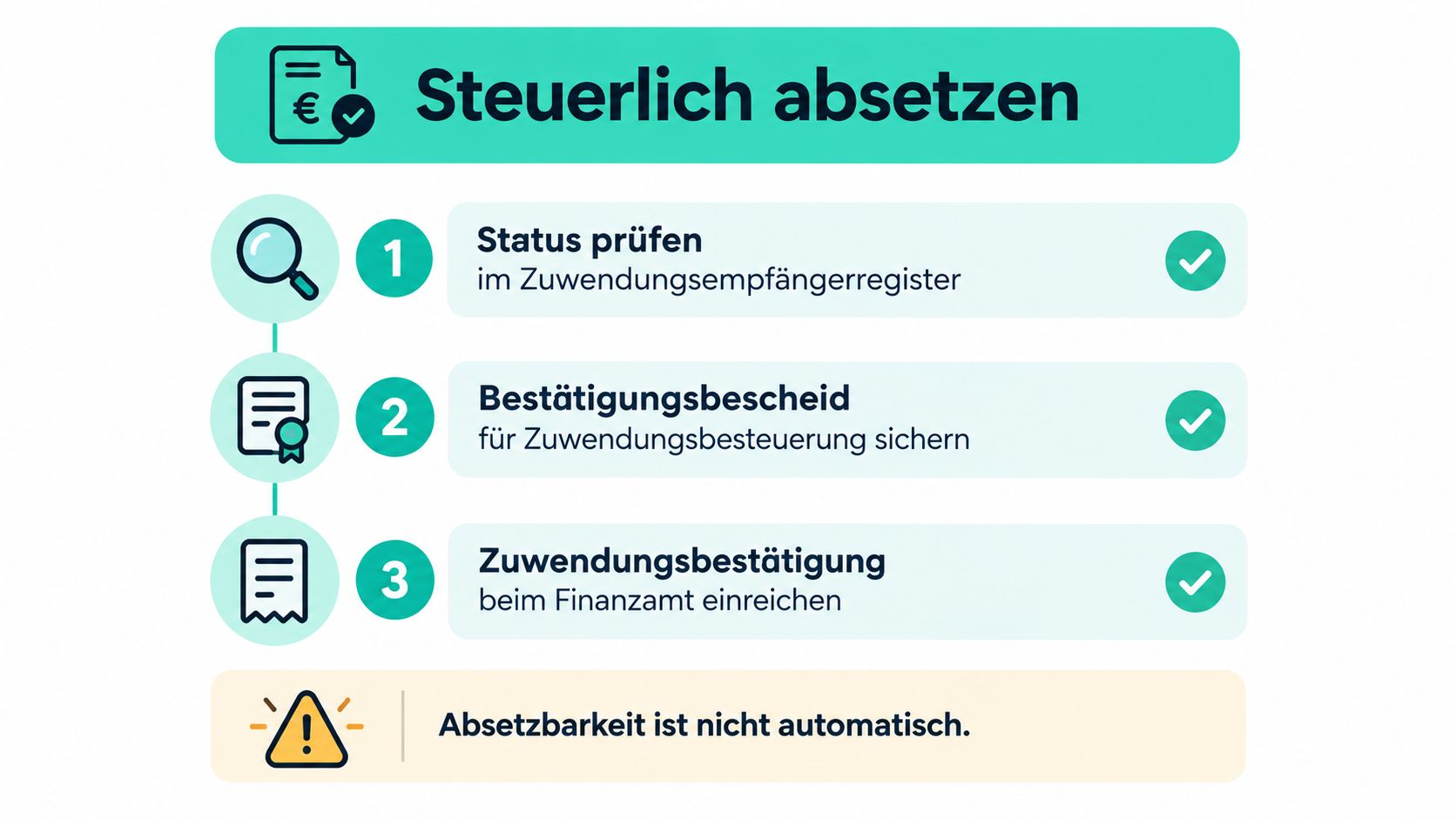
You should document this information
Note down the nonprofit status, the register entry and the type of proof. Also ask whether your payment is earmarked for a specific purpose or may be used freely. An earmarked Sadaka needs a clear description, so that it remains recognisable later whether the organisation used the money accordingly.
For foreign organisations, from the 2025 assessment period, they must be entered in the Zuwendungsempfängerregister for donations to be tax-recognised in Germany, as the Bundeszentralamt für Steuern explains. This is especially important for international aid projects. A foreign project partner can work seriously and still not automatically meet the requirements for German tax deduction.
Important: Tax deductibility and religious suitability are two different checks. You don't need to mix them up.
Keep the payment receipt, donation confirmation and project description together. If an organisation advertises tax deductibility but cannot explain its register status or issuing practice, you should not accept the claim without checking it.
Which metrics are actually meaningful
High donor numbers show reach, not impact. Emotional stories, well-known logos and low administrative costs also do not replace proof of results. What matters is: What was concretely achieved with the money?
The donation volume mentioned in Section 1 and its distribution across regional, national and international projects help classify the market. They say nothing about the success of an individual project. Therefore, check completed measures, people reached, cost per result and verifiable evidence.
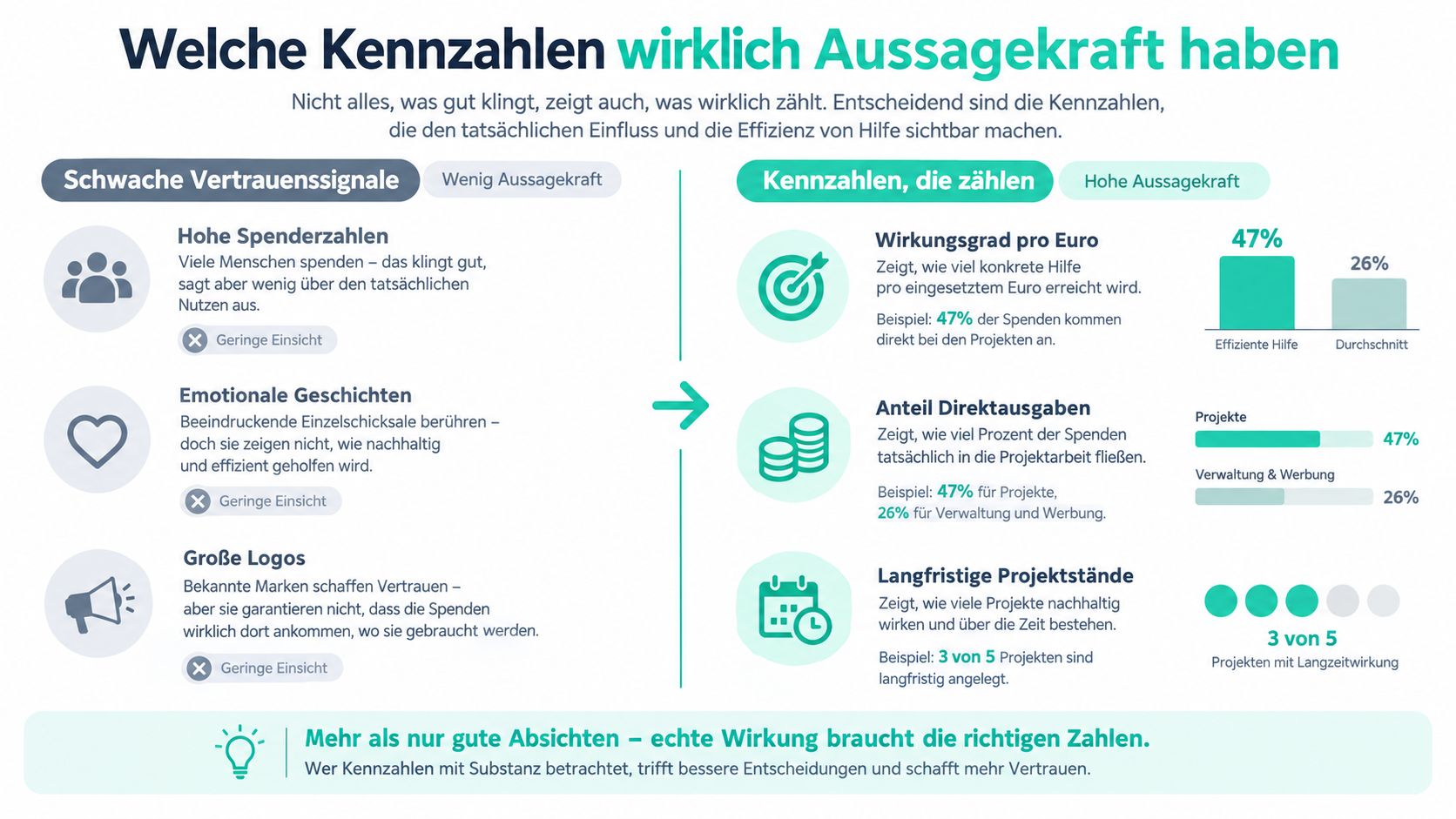
Look for results, not applause
With a well campaign, concrete answers count: Is construction complete, how many households have access, who takes over maintenance, and when does the next report follow? For emergency aid, distributions, target groups and the implementation period should be documented. If this information is missing, the progress bar remains a promotional claim.
A high share of program expenses also does not prove impact. Serious organisations explain their goals, disclose assumptions and show how they monitor results. This aligns with the DZI review system and complements Islamic Sadaqa criteria such as clear earmarking and verifiable benefit. On the transparency page of SadakaNow you should check exactly this information, rather than letting yourself be convinced solely by images or donor numbers.
Your two-minute routine before every donation
You don't need lengthy research if you always ask the same questions. Check the organisation in the Zuwendungsempfängerregister, if a German tax deduction is relevant. Then read the information on program expenses, administration, goal, progress and the next report.
- Match the organisation: Do the name, legal form, imprint and payment recipient match?
- Understand the project: Are the purpose, target group, period and remaining need concretely described?
- Check progress: Are there current expenses, results and an announced reporting rhythm?
- Choose a payment method: Use a plannable method for regular Sadaka and, for spontaneous help, the payment method you can reliably track.
- Keep proof: Save the payment confirmation, project description and, if applicable, the donation confirmation.
Residual risks remain. A report can be incomplete, a project can be delayed, and even a formally clean organisation can miss its goals. A short, repeated check is still better than a single major research effort before an emotional spontaneous donation. If you support regularly, set yourself reminders for project updates and check whether actual progress matches the original promise.
Finding donation projects is not a matter of luck. It is a learnable routine that turns a good intention into a verifiable decision.
SadakaNow bundles verified Sadaka projects from mosques, aid organisations and social initiatives with project goals, progress information, updates and several payment methods. Compare the available projects using this review routine and visit SadakaNow now to choose a suitable campaign.