
Donation Organisations Comparison 2026: The Best Test Winners
You want to donate money, but not blindly. Perhaps the question right now is whether the local mosque, a large relief organisation, or a digital platform is the better choice. This is exactly where most comparisons fail, because a logo, reach, and a seal alone say nothing about whether the organisation really fits your purpose.
| Criterion | What you should check | Why it matters |
|---|---|---|
| Transparency | Statutes, board, use of funds, annual reports | Without open information, there is no reliable assessment |
| Verification | Non-profit status, registry entry, certification seal | Only verified organisations are cleanly comparable |
| Fee model | Platform fee, transaction costs, hidden deductions | A cheap-looking impression can be deceptive |
| Payment methods | SEPA, PayPal, credit card, direct debit | Good access options lower barriers and increase everyday usability |
| Data protection | Server location, data sharing, security standards | Donating is a matter of trust, technically as well |
| Impact monitoring | Project reports, progress data, updates | Without evidence, impact remains a claim |
| Target group fit | Local, national, international, Islamic projects | The best organisation is the one that fits your purpose |
Table of Contents
- Why a comparison of donation organisations is essential in 2026
- The seven decisive comparison criteria
- Established relief organisations, local mosque associations, and digital platforms at a glance
- Fees, payment methods, and data protection in detail
- Which providers fit which donation goal
- Checking providers yourself in 15 minutes
- SadakaNow as an option for Sadaqa donors in the DACH region
Why a comparison of donation organisations is essential in 2026
A female donor sits on her phone in the evening, comparing three options. A large relief organisation seems reputable, she knows the mosque in her neighbourhood personally, and an online platform promises simple processing. In exactly this kind of situation, gut feeling is no longer enough, because a good outward impression and good donation practice don't automatically coincide.
The German donation market is large, but the figures depend heavily on the measurement method. According to the Deutscher Spendenrat, in 2024 16.7 million people donated a total of 5.1 billion euros, which was 2 percent more than in 2023, while the average donation rose from 40 to 43 euros and the number of donors fell by around 300,000. At the same time, another calculation for 2024 puts private cash donations for charitable purposes at 12.5 billion euros, which shows how much the definition changes the impression. The classification of the donation figures from the Deutscher Spendenrat
What this means for your decision
The point is simple: anyone comparing donation organisations must first clarify the metric. Is it about individual donations, all private cash donations, or additionally large and corporate donations? Without this distinction, you're comparing apples to oranges and end up mistaking the loudest organisation for the biggest one.
Practical rule: Never rely on first impressions. Only once you know exactly what was measured can you compare organisations fairly.
This is especially important for Muslim donors, because very different goals often stand side by side. One search is directed toward the local mosque, the next toward international emergency relief, the third toward a digital Sadaka solution. Sorting this out clearly saves time and makes donations more targeted.
The seven decisive comparison criteria
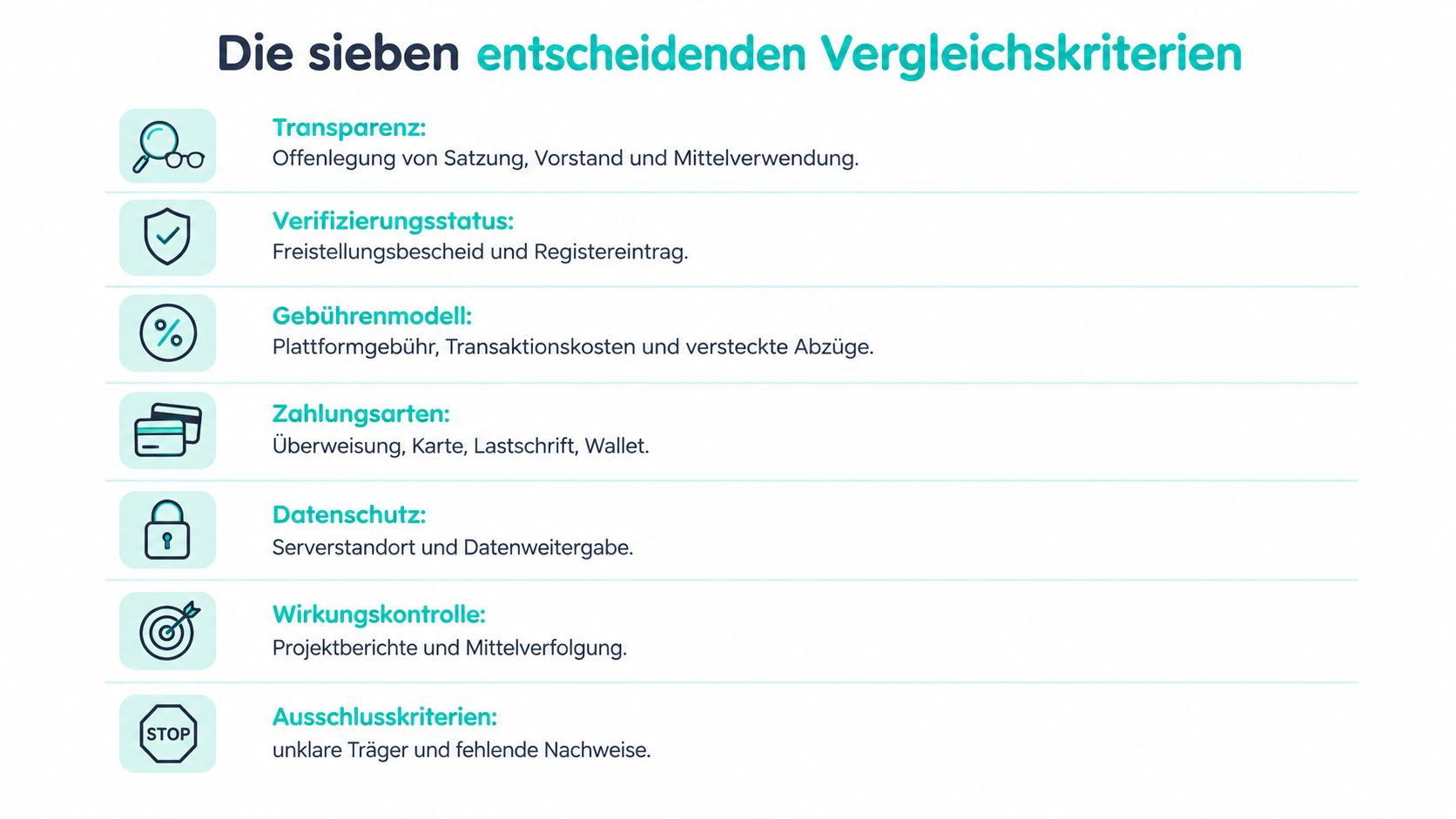
Transparency and verification status
An organisation is only as good as its documentation. Statutes, board, register entry and charitable status belong on the table, not in a footnote. Anyone who doesn't disclose these basics makes a simple comparison unnecessarily difficult.
When it comes to verification status, what matters most in Germany is whether a provider has been vetted and operates transparently. The DZI reviews these questions annually and sets an upper limit of 30 percent for advertising and administrative expenses, relative to total expenditure, for organisations with the Spenden-Siegel (donation seal). DZI seal organisations use on average 88 out of 100 euros for program work and 12 euros for advertising and administration. The seven seal standards of the DZI
Fee model, payment methods and target group fit
A good fee model is not an end in itself. What matters is how much ultimately reaches the project and whether the payment methods fit everyday life. For many donors, a provider is only practical if SEPA, PayPal and credit card are available, because friction costs willingness to donate.
Target group fit involves even more. A platform can be technically clean and still unsuitable if it fails to meaningfully represent local mosque associations, Islamic initiatives or small community projects. This is exactly where a general donation marketplace separates from a solution that is genuinely useful for Muslim donors.
Data protection and impact monitoring
Data protection is not a side issue. Anyone who donates shares payment data and expects it not to be processed more broadly than necessary. On top of that, clear updates on the use of funds are needed, otherwise any impact remains an empty promise.
A low price is only good if everything else is right too, namely security, evidence and clean use of funds.
For the evaluation, this means you don't just look at costs, but always at the overall package. Annual reports, project progress and traceable financial channels belong together. Anyone who only shows part of the picture does not provide a solid comparison.
Established aid organisations, local mosque associations and digital platforms at a glance
The first instinct of many people is to choose only big names. That's convenient, but not automatically smart. According to the ZiviZ Survey 2023, Germany has 656,888 civil society organisations, of which 615,759 are registered associations, so around 93.7 percent. Local providers are therefore not a fringe phenomenon, but the norm. ZiviZ Survey 2023 and donation practices
Three categories, three logics
Established aid organisations score points with professional structures, well-known reports and often broad project coverage. Local mosque associations are stronger in direct community ties, closer to people on the ground, and often easier to follow when it comes to a specific project in your area. Digital platforms are strongest where overview, comparability and quick selection are needed.
Structural features of the three provider categories compared
| Criterion | Established aid organisations | Local mosque associations | Digital platforms |
|---|---|---|---|
| Reach | national or international | local or regional | depending on the platform, local to international |
| Closeness to everyday life | rather indirect | very high | depends on project logic |
| Transparency | often well developed | varies greatly | mostly governed by platform standards |
| Comparability | good for big names | often harder, because small and diverse | high, if key figures are clearly displayed |
| Typical strength | established processes | community ties and personal closeness | quick selection and easy donation |
Where the limits lie
Large aid organisations can feel distant if you want to support a small, specific project. Local associations are personally close, but their documentation isn't always standardised enough to make external comparison easy. Platforms solve comparability, but they don't replace checking the provider.
Clear recommendation: If you want to help locally, look locally. If you're seeking broad impact, check large aid organisations. If you want to compare quickly, you need a platform with clean data.
The right choice therefore doesn't depend on size alone, but on purpose, closeness and verifiability. A good donation organisation comparison separates these levels cleanly instead of cramming everything into one list.
Fees, payment methods and data protection in detail
With donations, people like to pretend that "0 percent fee" is automatically free. That's not true. Zero platform fee only means the costs end up somewhere else, for example through voluntary tips or other financing methods.
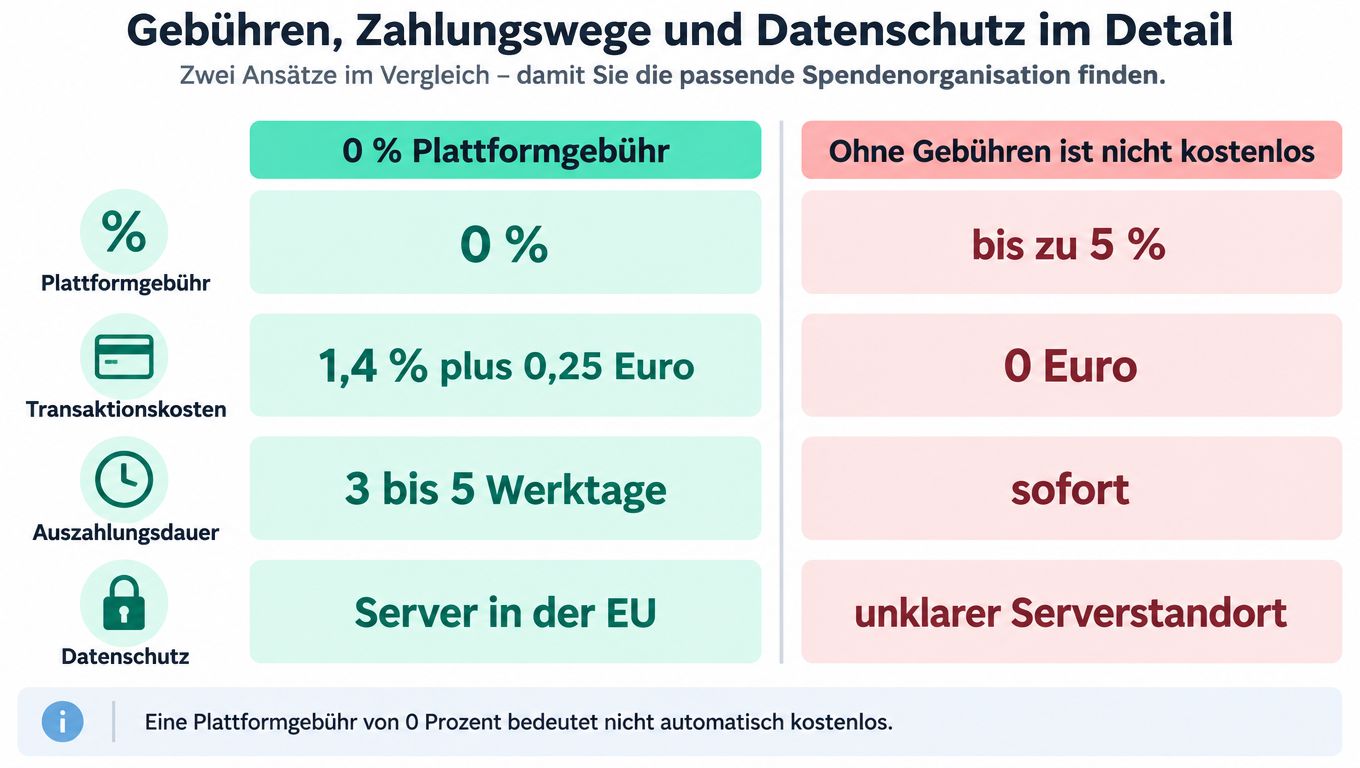
Read fees carefully instead of trusting buzzwords
More important than the headline is the cost basis. A platform fee, transaction costs and any deductions must be looked at separately, otherwise an offer looks cheaper than it actually is. Those who work transparently show these points openly and understandably.
The payout duration also belongs in the assessment. Fast donation processing is good, but only sensible if it doesn't come at the expense of traceability or data security. That's exactly why you should look at the real final amount and not just the first click.
Payment methods and protection
Reputable providers offer clear, well-known payment methods. SEPA, PayPal and credit card are relevant for many users because they are familiar and make completion easier. In addition, there are technical minimum standards such as SSL and PCI-DSS, which show that payment data is not handled carelessly.
Data protection is just as important as the fee question. If it remains unclear where data is processed or who gets access to it, caution is advisable. A clean provider explains this clearly and doesn't hide behind generic phrases.
You can also find the practical view of fees and administration in the internal overview on Prices and Administration at SadakaNow.
Rule of thumb: 0 percent platform fee sounds good, but only the sum of fees, payment method and data protection shows whether the model is really strong.
Which providers fit which donation purpose
Decide on the goal first, then on the provider. For the same donation, the standards are completely different depending on the purpose. Those who separate this cleanly compare better.
Local projects need direct contacts
A mosque, youth work or local renovation works best through a local organisation. There, the paths are short, questions can be asked directly, and the people responsible know the need from everyday life. This fits particularly well for Sadaka with a clear community connection, as long as the statutes, charitable status and use of funds are traceable.
Acute emergency aid needs robust processes
After a disaster, it's not only speed that counts, but also clean evidence. In such cases, a provider should deliver timely mission reports, clearly state the donation amount, and disclose the period of fund usage. If this information is missing, it remains unclear whether the help really arrives where it is needed.
Education and long-term projects need a track record
With a Ramadan donation for an education project, a Zakat calculation, or a long-term orphan sponsorship, continuity is what matters. In that case, an organisation only convinces if it makes progress visible and reports regularly on the status of the project. One-off buzzwords are not enough for this.
| Donation purpose | What you should pay attention to | Practical standard |
|---|---|---|
| Ramadan deadline and time-critical single donation | Clear responsibility and fast confirmation | The organisation must respond quickly and document the deployment |
| Zakat with precise calculation | Clean allocation of purpose and traceable processing | The usage must match the religious obligation |
| Long-term orphan sponsorship | Regular updates and stable care | Continuity counts more than individual campaigns |
Check providers yourself in 15 minutes
Those who save five minutes before clicking the donate button can save themselves a lot of trouble later. The check isn't complicated, it just needs to be consistent. A clean check separates reputable organisations from pretty websites.
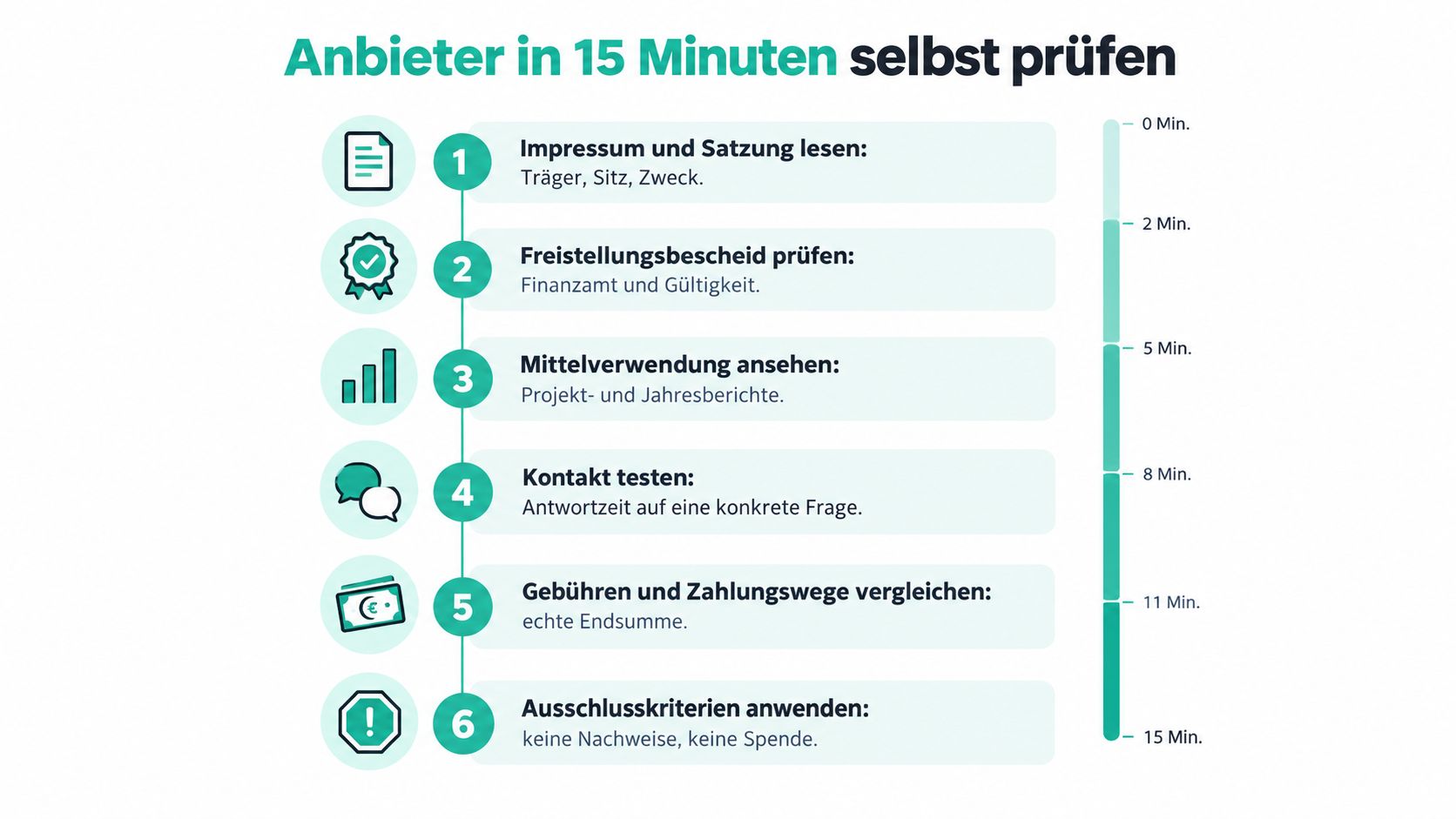
The quick check process
- Read the legal notice and statutes. Those who don't clearly state the organisation, location and purpose fail right away.
- Check the tax exemption notice. Charitable status is not just a nice word, it's proof.
- Look at the use of funds. Annual reports and project reports must be understandable and up to date.
- Test contact. Those who don't respond to a specific question are weakly positioned as a donation recipient.
- Compare fees and payment methods. The real final amount counts, not just a marketing phrase.
- Apply exclusion criteria. No proof, no donation.
What should make you suspicious immediately
Aggressive door-to-door advertising is a warning sign, especially when pressure is applied. The same applies to unclear legal forms or cost structures that only appear upon inquiry. Those who work reputably don't need to hide anything.
This also applies to social media appeals without solid information. A nice post doesn't replace a legal notice or a verifiable organisation. If you have doubts, better not donate right away.
You can also find the complete practical view on suitable projects in the internal guidance on Finding donation projects at SadakaNow.
Quick rule: If you can't find basic data in 15 minutes, that's not a buying signal. It's a stop sign.
SadakaNow as an option for Sadaka donors in the DACH region
Anyone who wants to give Sadaqa digitally and in a targeted way will find a clear specialised solution in SadakaNow. The focus is on 0 percent platform fee, vetted projects and transparent project selection. For people who regularly give small amounts or want to manage Ramadan donations in a bundled way, this is practical.
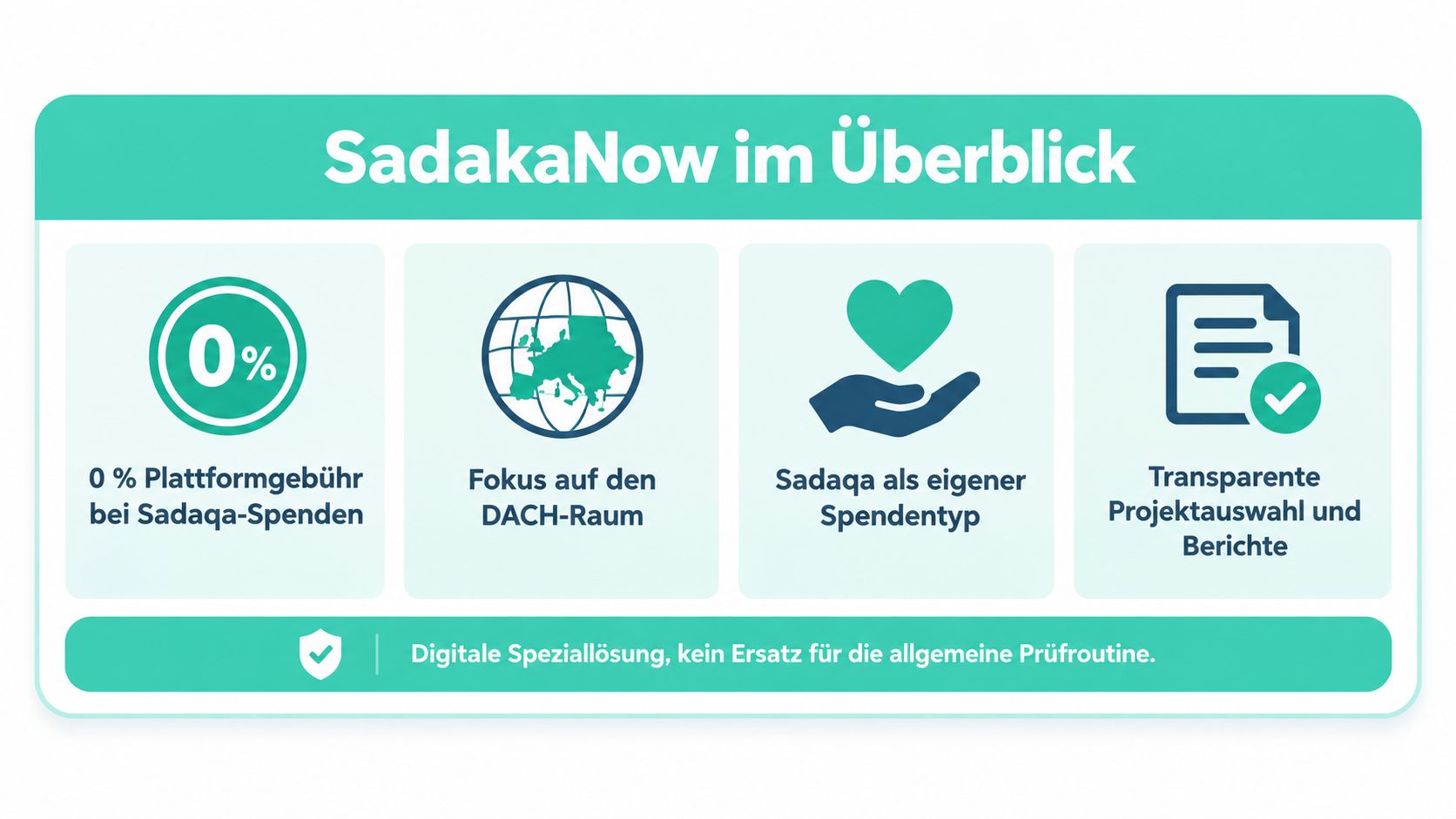
When the platform fits particularly well
SadakaNow plays to its strengths when Muslim communities and donors need a digital structure that can measure up to German transparency expectations. The platform is no substitute for local closeness, but it complements mosque associations where overview and simple processing matter more than a personal handover.
A typical use looks like this: A donor sets up a recurring Sadaqa of 25 euros per month, checks the project profile beforehand and sees there who is responsible for the project, what the verification status looks like and which progress data has already been published. This exact view of verification and development is missing from many small collection campaigns.
For processing, SEPA direct debit, PayPal and credit card are the relevant payment methods. Anyone concerned with clean traceability should look closely there.
My clear assessment
SadakaNow is worthwhile for everyone who wants to consciously steer their Sadaqa and not donate blindly. The platform gives a structured answer to a real everyday problem, but it does not replace one's own due diligence.
More details can be found directly at SadakaNow. Anyone who wants to check the administration page and the pricing framework will find the next sensible step there: Pricing and administration at SadakaNow.