
Donating During Ramadan 2026 in Germany
You want to donate during Ramadan, but perhaps you're caught between several open questions right now: How much is appropriate? Does the payment count as Zakat or as Sadaqa? Which project is trustworthy, and which digital payment method works securely? Especially in Germany, Austria and Switzerland, good preparation determines whether a spontaneous call for donations turns into deliberately planned support.
Ramadan brings together fasting, prayer, community and responsibility. Those who themselves abstain from food and drink often become more aware of need. At the same time, an effective donation requires more than good intentions. It should be correctly classified from a religious perspective, financially manageable, securely transferred and later traceable through documentation.
Table of Contents
- Why Ramadan is so important for donations in Germany
- Zakat and Sadaqa compared
- How a digital Ramadan donation works
- Which projects can be meaningfully supported during Ramadan
- Tax information for Germany, Austria and Switzerland
- Secure payment methods and trust when donating online
- Concretely supporting SadakaNow and Ramadan campaigns
- A simple Ramadan donation routine for everyday life
Why Ramadan is so important for donations in Germany
Ramadan is the most important annual donation window for many Muslim women and men. The evenings bring families, circles of friends and communities together for Iftar. Tarawih prayers take place in mosques, aid projects are presented, and the question of one's own responsibility gets a firm place in everyday life.
For donors in Germany, four practical questions usually arise:
- How much do I give? Is it about the obligatory Zakat, a voluntary Sadaqa, or both?
- Who am I helping? Should the support go to people in one's own city, to a community, or to an international project?
- When do I transfer it? Is a one-time payment more sensible, or does a regular gift fit better with one's own budget?
- Through which channel do I donate? How can trust, data protection and a valid receipt be combined?
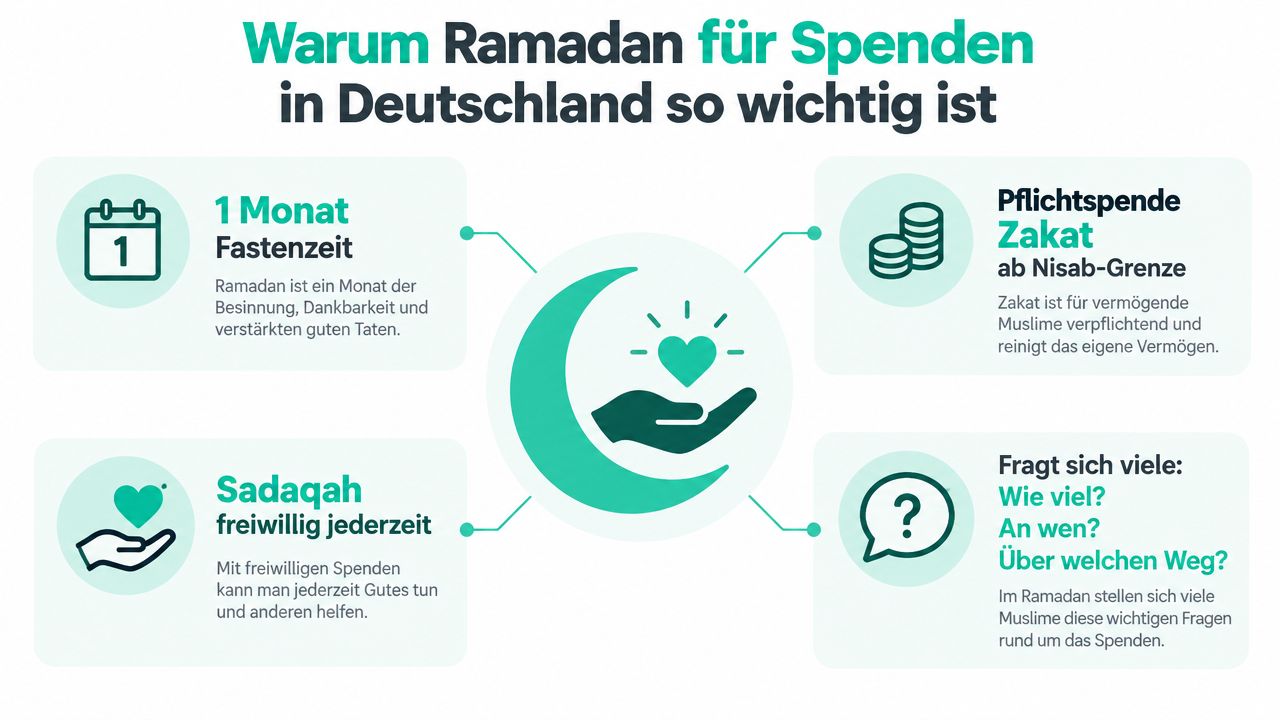
Ramadan as a shared donation window
Religious communities and Islamic organisations in Germany often rely heavily on donations. With them, they finance, for example, community work, social counselling, educational programmes, Iftar meals, or the operation of mosque premises. In Austria and Switzerland too, donations support many projects that are not always visible in everyday life.
Ramadan concentrates attention and motivation. A call made during a shared Iftar reaches people at a moment when they are already reflecting on gratitude, need and community. This makes the month a fitting time to connect Zakat and Sadaqa not just spontaneously, but with a plan of one's own.
The digital significance of this period can be clearly seen for Germany. In March 2025, 17.99% of the total annual digital volume of religious organisations fell within this month. December accounted for 11.96%, as shown by the analysis from Neues Stiften on digital fundraising. The analysis explicitly attributes the March peak to Ramadan.
Practical rule: If you want to donate digitally during Ramadan, check the project page, payment method, and confirmation before the month begins. Technology should not determine the decision during the most important donation period.
Religious motivation and German donation logic
A study on Muslim donation behaviour in Germany cites an average annual donation of 452 euros. The Deutsche Spendenmonitor 2019 cites, by comparison, an average donation amount of 143 euros for Germany. Muslim donors thus give on average roughly three times the overall German average amount.
This does not mean that every person should give this amount. Rather, it shows that religiously motivated giving has considerable financial significance in the German market. A good Ramadan strategy therefore relies not only on the widest possible reach, but also on trust, clear allocation of purpose, and appropriate amounts.
Zakat and Sadaqa compared
Zakat and Sadaqa both belong to Islamic giving practice, but they fulfil different functions. Zakat is an obligatory levy when the religious requirements are met. Sadaqa is voluntary giving that is possible at any time and is not tied to a fixed wealth threshold.
For Zakat, you first check whether your zakat-liable wealth reaches the Nisab. The personal calculation can include, among other things, cash, bank balances, gold, silver, and business assets. Debts, liabilities, and the specific valuation of individual assets are treated differently depending on the school of law. Anyone who is unsure should consult a trustworthy Islamic advisory body or a knowledgeable person from the community.
Zakat is usually calculated as 2.5% of zakat-liable wealth, provided the religious requirements are met. It is directed at specific groups of recipients, described in Islamic tradition as the eight Asnaf categories. Sadaqa, by contrast, has no fixed minimum amount and can support people, projects, or social causes, as long as the gift is religiously and ethically justifiable.
| Criterion | Zakat | Sadaqa |
|---|---|---|
| Character | Obligatory levy when requirements are met | Voluntary gift |
| Calculation | Usually 2.5% of zakat-liable wealth | No fixed calculation formula |
| Basis | Assessment of Nisab, type of wealth, and where applicable the annual period | Personal intention and financial capacity |
| Recipients | Fixed groups of recipients defined by Islamic tradition | Broader range of permissible social and charitable purposes |
| Timing | Due after individual calculation, Ramadan is often deliberately chosen | Any time, often increased during Ramadan |
| Purpose | Fulfilling a religious obligation and supporting eligible recipients | Voluntary help, charity, and social responsibility |
Why both forms complement each other
Many people plan their Zakat during Ramadan because the month holds special religious significance. This is practical, but it must not replace the individual due date. If the Zakat has already become due earlier, it should not be postponed without good reason.
Sadaqa complements Zakat. A person can, for example, give their calculated Zakat to eligible recipients and additionally donate small amounts regularly for Iftar, educational work, or an emergency relief campaign. What matters is that the category is clearly specified when donating. This keeps one's own records understandable, and allows the organisation to allocate the payment as accurately as possible.
With platforms or organisations, you should therefore make sure whether you can explicitly choose between Zakat and Sadaqa. A voluntary project donation does not automatically become Zakat just because it is made during Ramadan.
How a digital Ramadan donation works
A digital donation can be prepared through a few clear decisions. First, take the time to check things properly instead of reacting directly to the first appeal you see on social media.
Six steps from selection to proof of donation
Choose a trustworthy platform: Look for a complete legal notice (Impressum), transparent information about the organisation, an encrypted connection and traceable contact details.
Research the project: Read what the money will be used for. A good project page describes the goal, the recipients, the planned measures and the type of reporting.
Set the amount: Decide separately whether you want to give Zakat, Sadaqa or both. The amount should match your financial situation and should not arise from social pressure.
Choose a payment method: Depending on the provider, options such as SEPA direct debit, credit card, PayPal, Apple Pay or instant bank transfer are available. Choose the method you can use safely and trace later.
Enter your details and confirm payment: Check your name, email address, purpose of use and, if applicable, the choice between a one-time and a recurring donation.
Save the confirmation: Save the email, the digital receipt and the transaction data. These documents help with your personal overview and may be relevant for tax purposes.
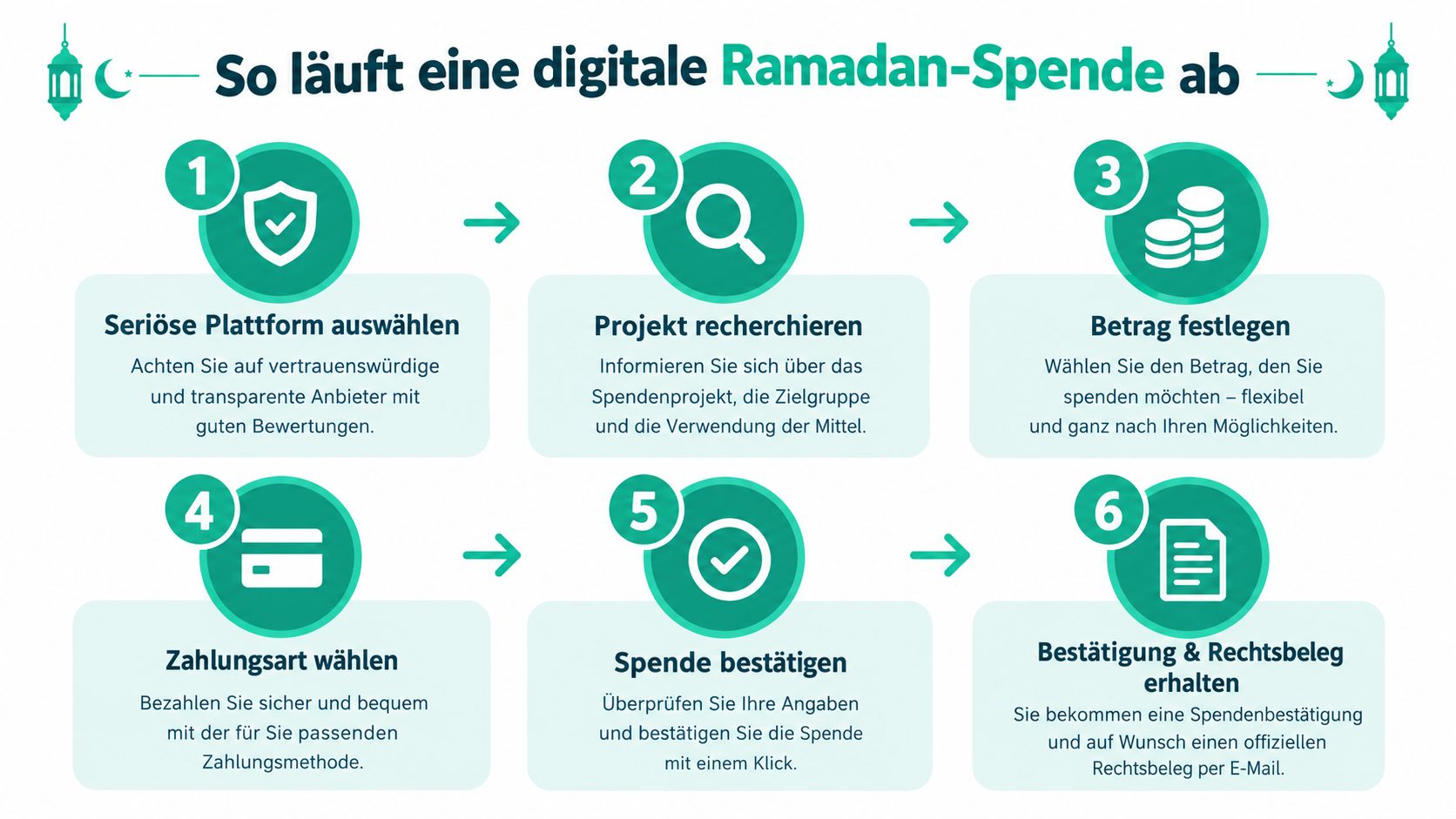
Verification before you click
The DZI Spendensiegel can be an additional verification signal for suitable organisations. In addition, you should look for a current transparency report, non-profit status and visible project updates. A seal alone does not replace reading the specific campaign description.
The email confirmation should arrive promptly and clearly state at least the amount, date, recipient and purpose of the payment. If it doesn't arrive, first check your spam folder and then contact the provider. A donation is only properly documented once you can later trace when, to whom and for what purpose you gave.
Which projects can be usefully supported during Ramadan
The right donation doesn't depend only on emotional impression. First ask yourself what impact you are looking for. Do you want to directly reach people in your local area, support a larger international relief effort, or fund a religious project with social benefit?
Mosques and local associations
Mosque associations often know their community's needs directly. A Ramadan donation can, for example, enable Iftar meals, social counselling, youth and children's work or educational programmes. Ongoing costs and necessary repairs also remain important tasks, even if they appear less visible in a donation appeal.
Local projects often offer a close personal connection. You can ask contact persons how the funds are used, and observe at events yourself what work is taking place. At the same time, you should also ask well-known associations for a budget plan, a tax exemption certificate (Freistellungsbescheid) or an understandable project statement.
International relief projects
International organisations can reach several regions through existing structures. Ramadan packages, water projects, medical aid and education programmes are often implemented in countries where local partners are already active.
Greater reach does not automatically mean greater impact. Check whether the organisation discloses project goals, selection criteria, partners and use of funds. An annual report is especially helpful when it clearly describes income, expenses and specific activities.
Social initiatives in Germany
Refugee cafés, food banks (Tafeln), orphan sponsorships and educational scholarships create a direct connection to one's own environment. Such projects can suit people who want to use their Sadaqa deliberately within Germany. With orphan sponsorships, it is important to distinguish between a personal sponsorship and general project funding.
Four questions can help with the decision:
- Impact: Is there a comprehensible report on what the donation enables?
- Transparency: Are the organisation, goals, funding and contact persons named?
- Non-profit status: Can the organisation prove its legal status?
- Religious suitability: Is it clearly explained whether Zakat is accepted and how it may be used?
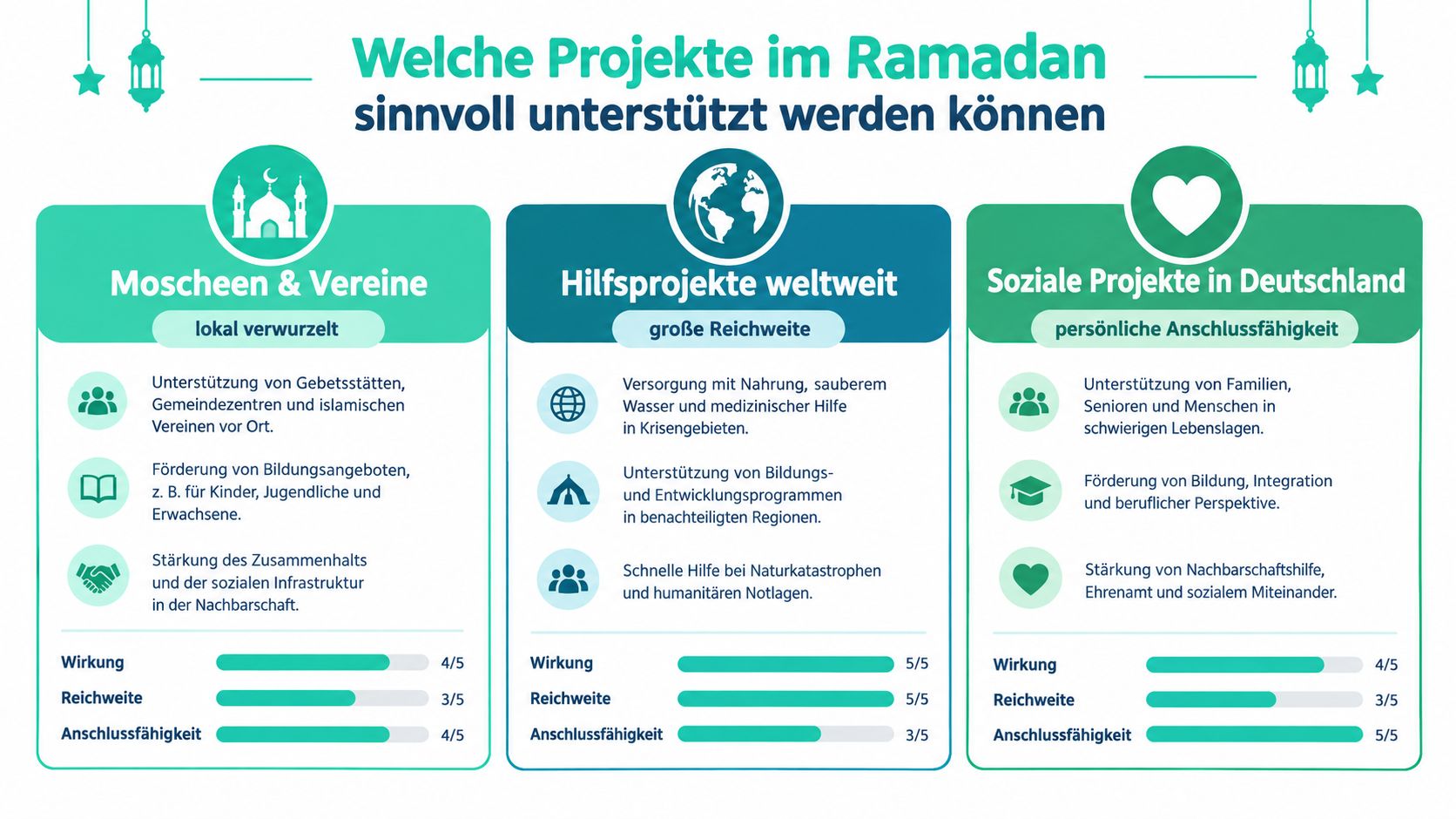
Those seeking personal closeness often find it with local associations. Those who want to reach many people through existing structures look at international programmes. A combination can make sense, as long as the amounts are planned separately and the respective purposes are clearly documented.
Tax information for Germany, Austria and Switzerland
Tax rules differ across the DACH region. What matters is not simply that an organisation works religiously or socially. It must meet the requirements of the respective country, and the donation receipt must be issued correctly.
Germany
In Germany, donations to tax-privileged organisations can generally be considered as special expenses (Sonderausgaben). The central legal basis is § 10b EStG. The deduction is limited to 20% of the total amount of income or, alternatively, to 0.4% of total turnover plus the total payroll. You should check these figures and the requirements against the information provided by the Federal Ministry of Finance on donations and contributions, and, if needed, with a tax advisor.
To provide proof, you generally need a donation receipt. Check whether the recipient holds a valid exemption notice or comparable proof of tax-exempt status. A religious intention alone does not make a payment tax-deductible.
Austria
In Austria, contributions to eligible donation recipients can be taken into account as special expenses. For this, the organisation must be registered accordingly with the tax office. The tax treatment depends, among other things, on whether the recipient is listed in the official register of eligible institutions.
Switzerland
In Switzerland, voluntary contributions to tax-exempt non-profit organisations can generally be deducted from income. The specific limits vary by canton. You should therefore check the cantonal requirements for your canton of residence.
| Country | Legal basis | Max. deductible | Required documents |
|---|---|---|---|
| Germany | § 10b EStG | 20 % of total income or alternative calculation | Donation receipt and proof of tax-exempt status |
| Austria | Rules for eligible donation recipients | Limitation under Austrian tax law | Registration of the recipient and documented donation |
| Switzerland | Cantonal tax regulations | Varies by canton | Proof of payment and proof of tax exemption |
Keep receipts, payment confirmations and emails organised. For Zakat and Sadaka, you should also note which category the payment was assigned to. This does not replace tax advice, but it prevents later uncertainty.
Secure payment methods and trust when donating online
A secure Ramadan donation begins with the organisation, not with the payment form. First check the legal notice, the legal entity, the project description and the information on how funds are used. A reputable provider will also explain how data protection, questions and donation receipts work.
Choosing the right payment method
SEPA direct debit is suitable for people who prefer a payment directly from their bank account. Credit card and PayPal can be convenient if you already use their security features. Apple Pay and Google Pay reduce the amount of sensitive payment data entered on the donation page, provided the provider supports these options.
Don't just assess speed. Also ask:
- Receipt: Is the donation confirmation sent automatically by email?
- Fees: Are payment or platform costs clearly explained?
- Purpose: Can you clearly select Zakat, Sadaka and project donation?
- Data protection: Is there clear information on how your data is stored and processed?
- Security: Does the address start with HTTPS, and is the payment provider clearly identifiable?
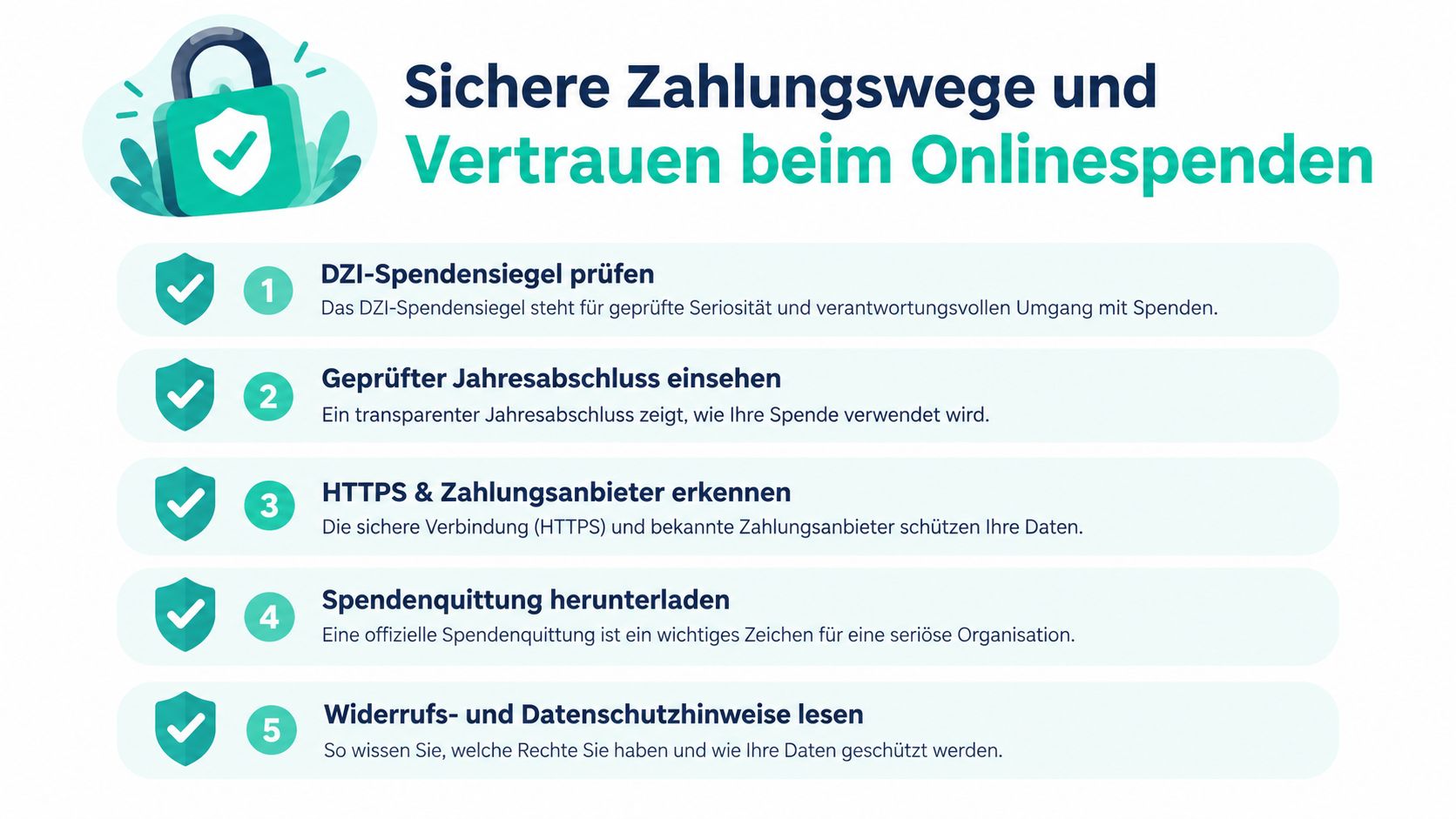
Recognising warning signs
Unknown domains, missing contact details and dramatic time pressure are reasons against a hasty payment. Even a countdown or an emotional call on social media doesn't prove that a project has been vetted. Open the official website yourself instead of using payment links from private messages without checking them.
For guidance on digital donation platforms, the guide on the best crowdfunding platform in Germany can provide additional orientation. The most important decision remains your own review of the organisation and the specific project.
A secure payment is not the opposite of a spontaneous good deed. Two minutes of checking protect your intention and the people you want to help.
Supporting SadakaNow and Ramadan campaigns in concrete terms
On SadakaNow, donors can browse active campaigns from mosques, aid organisations and social initiatives. The selection can be narrowed down by country, project type and urgency. This makes it easier to distinguish between a local Iftar campaign, a food project and a longer-term sponsorship.
From campaign overview to payment
First open the project page and don't just read the title. Pay attention to the description of the problem, the donation goal, the planned use of funds and any available updates. Progress indicators and documentation can help you better assess the status of a campaign, but they do not replace checking the responsible organisation.
Then you determine the donation category. If the platform distinguishes between Zakat and Sadaka, deliberately select the appropriate option. Next, decide whether you want to give once or recurringly, enter the amount and choose an available payment method such as SEPA, PayPal or credit card.
After confirmation, an email with the payment information should arrive. Save it right away. In your personal account area, you can review your previous contributions, provided the relevant platform feature is available for your account.
Community without social pressure
Sharing links can draw the attention of family members and friends to a campaign. When sharing, include the project's purpose and information about the organisation, not just an urgent call for donations. Every person should be able to decide for themselves whether the amount, recipient and purpose fit their own religious and financial planning.
For organisations, a Ramadan campaign is especially easy to understand when the goal, duration, use of funds and updates are defined from the outset. Questions about minimum amounts, processing times or a missing confirmation should go directly to the platform support or the responsible organisation.
A simple Ramadan donation routine for everyday life
A good routine takes the pressure of decision-making out of the last days of Ramadan. Start with the Zakat calculation and keep it clearly separate from voluntary Sadaqa gifts. If the calculation is complicated, seek religious and, if necessary, tax advice early on.
Then divide your voluntary support according to personal priorities. One week can go to your own community, another to a social project in Germany, and another to an international aid programme. This keeps the selection deliberate, without every daily donation requiring a new fundamental decision.
A practical monthly plan
- Before Ramadan: Check your assets, clarify the Nisab question, set a budget and compare suitable organisations.
- At the start: Make a clear Zakat decision and save the payment receipt.
- During the month: Give Sadaqa in an amount that fits your everyday life. Either as a one-off or recurring, both can make sense.
- In the last days: Check projects, reports and any outstanding payment confirmations. Special nights of prayer can be a personal occasion for additional voluntary gifts.
- After Ramadan: Note which projects were supported, what information was missing, and which routine will work better in future.
Calendar reminders, a personal donation folder and a platform's dashboard make documentation easier. Check afterwards whether project updates have arrived and whether the organisation presents the use of funds clearly. A brief review combines religious reflection with responsible donation practice.
SadakaNow brings together vetted campaigns from mosques, aid organisations and social initiatives and enables digital Sadaqa donations via common payment methods. For your Ramadan, choose a specific project, check its purpose and organiser, and visit SadakaNow to make your donation deliberately and transparently.