
Donating for Orphans – Donate Safely and Effectively
You want to donate for orphans, so you open several websites and almost everywhere you end up with the same emotional images, unclear promises, or international sponsorship offers. Yet what you may actually be looking for is concrete help in Germany, a traceable organisation and a payment method that doesn't require lengthy research first.
My clear recommendation: don't donate spontaneously based on a single image. Check the organisation, the purpose, the use of funds and the reports. Only then decide whether a one-off donation, regular support or a local project suits you.
Table of Contents
- Why orphan aid in Germany is a data-based decision
- How big the problem of orphaned children really is
- Review criteria for reputable orphan aid projects
- The path to a safe donation, step by step
- Payment methods and security for online donations
- After donating: checking impact and doing good long-term
Why orphan aid in Germany is a data-based decision
A family stands in front of the supermarket. The child needs new shoes, the rent isn't paid, and there's no money for tutoring. If a parent dies or reliable care is missing, this situation becomes even more severe. Then it's not individual donations in kind that matter, but stable support structures for housing, nutrition, clothing, education and social support.
The data on child poverty show why donating for orphans in Germany is more than a niche topic. According to Kinderhilfe.de, in 2024 15.2% of minors were at risk of poverty. That corresponded to around 2,247,000 children and young people. In 2023 the figure was 14%, in 2022 15%, and in 2021 16.4%.
Material hardship also remains widespread. In 2024, around 7.4% of minors were considered significantly materially and socially deprived, meaning about 1,088,000 young people. These figures do not state the number of full or half orphans. However, they do show the social context in which children without sufficient family security need support especially quickly.
Help must achieve more than acute relief
Orphan aid should therefore not end with food parcels or clothing. A reputable project can fund care, education, psychological support, accommodation, or support for foster families. The organisation must clearly explain which children are reached and what support they receive.
The Deutsche Kinderhilfswerk speaks of around 2.8 million children growing up in poverty in Germany, classifying that as roughly every fifth child. UNICEF Deutschland also cited around 1.9 million children under 18 for 2024 who lived on their families' basic welfare support. According to UNICEF, relative child poverty has remained constant at around 15% for years.
Before donating, check four points: Who is helping? Who does the project help? What is being funded? How is progress documented? These answers turn a good impulse into a responsible donation decision.
How big the problem of orphaned children really is
The most important figure is usually missing: how many full and half orphans live in Germany? A reliable official total figure cannot simply be stated. Official statistics primarily record educational assistance and forms of placement, but do not record every child according to whether one or both parents have died. The expert overview on the orphan project explicitly points this out as well.
This is not a minor statistical issue. Anyone advertising with a seemingly exact orphan figure quickly creates a precision that the data simply doesn't support. Reputable organisations should therefore disclose whether they support full orphans, half orphans, children in foster care, children from low-income households, or another target group.
How to correctly assess project claims
Pay attention to the description of the aid system, not just the label “orphan aid.” Ask the organization these questions:
- Target group: Is this about full orphans, half orphans, children without stable care, or minors affected by poverty in general?
- Location: Does the project operate in Germany, in a specific region, or internationally?
- Service: Does it fund care, education, housing, medical aid, or direct cash payments?
- Selection: What criteria determine which children receive support?
- Proof: Are there project reports, progress updates, and a traceable use of funds?
This allows you to sensibly compare local and international aid without using an unverifiable total figure as your basis for decision-making. 50 euros can fulfill different tasks in different projects. The right comparison is therefore not “Where is the number of orphans higher?” but “Which clearly defined problem does this project solve, and can the organization prove the solution?”
Review criteria for reputable orphan aid projects
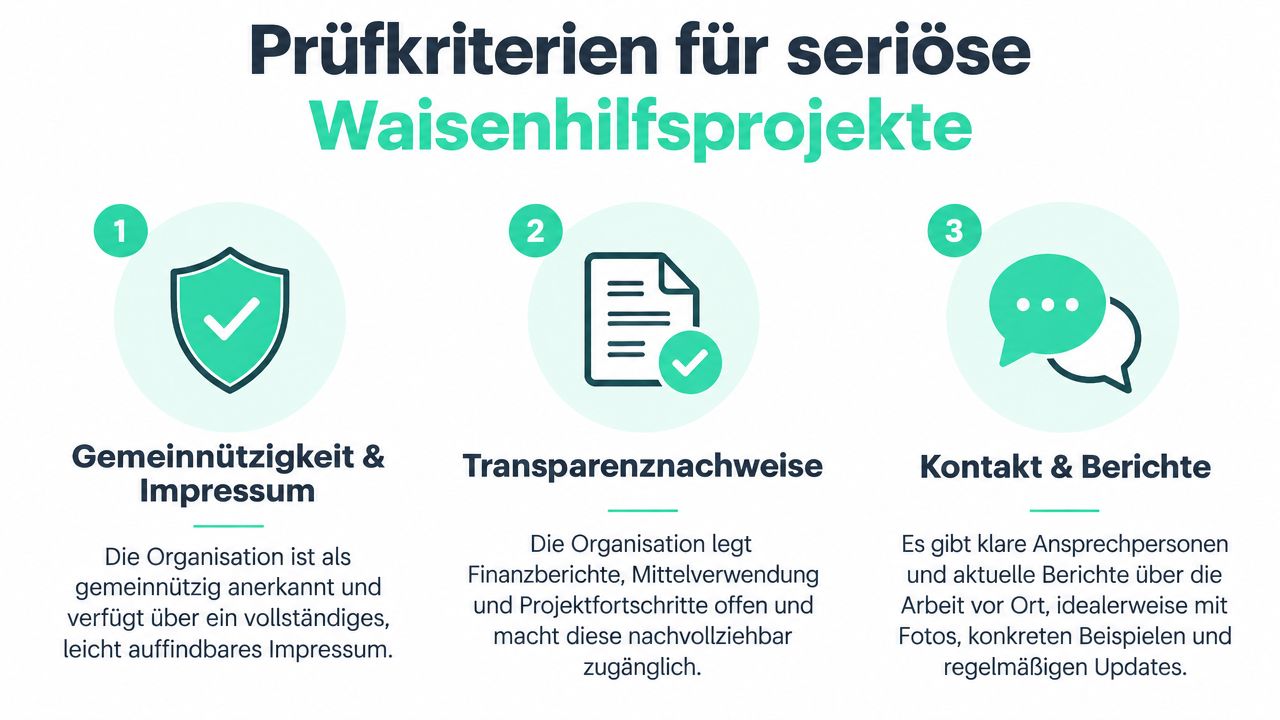
A reputable organization discloses who is responsible and how the aid works. Therefore, check the legal notice (Impressum), legal form, charitable status, address, and reachable contact persons. A donation page without a clearly identifiable organization behind it is not enough proof of trustworthiness.
The rigorous audit report
Read the current annual or impact report, not just the campaign page. There, the organization should present income, expenses, goals, achieved results, and administrative costs in an understandable way. The DZI donation seal helps with an initial assessment. However, it does not replace checking the specific orphan aid project.
Check the annual report for the share spent on program work relative to administration and advertising. UNICEF Deutschland, for example, reported 79.5% of income for worldwide program work in 2024. Compare such figures with the concrete services provided per child and the evidence in the project report. Percentage figures from different organizations are only comparable if they use the same cost categories.
Pay attention to impact rather than emotional imagery. The overview of the German donation market and children's aid work shows the significance of humanitarian aid and child and youth welfare work within the donation market. For your decision, however, what counts is not the size of the organization but the quality of its information about the project.
Ask concrete questions:
- Target group: Does the project support full orphans, half orphans, children without stable care, or minors affected by poverty in general?
- Service: Is it about care, education, housing, medical treatment, or direct cash payments?
- Selection: What criteria determine which children receive support?
- Impact: How many children are being cared for, what progress is documented, and over what period?
- Costs: Are expenses broken down transparently per child, per service, or per project location?
Rule of thumb: A clear project goal counts more than an emotional donation appeal. If the purpose, target group, or report is missing, you are not donating with full information.
Review criterion or warning sign at a glance
| Review criterion | Good sign | Warning sign |
|---|---|---|
| Organization | Complete legal notice, responsible persons, and reachable contacts | Unclear operator, no legal notice, or anonymous form |
| Goal and purpose | Concrete description of the target group and planned services | “Help for orphaned children” without a clear definition |
| Financial transparency | Annual report, use of funds, and understandable cost structure | No information on administration, advertising, or project expenses |
| Impact | Regular updates, measurable services, and documented progress | Emotional images without results |
| Payment process | Encrypted connection, secure payment providers, and receipt | Time pressure, private accounts, or unusual payment requests |
Pay particular attention to high marketing costs, unclear allocation of funds, and lack of impact measurement. Also check whether the project actually supports children in the described life situation or merely uses the term “orphans” as an emotional label.
The path to a safe donation, step by step
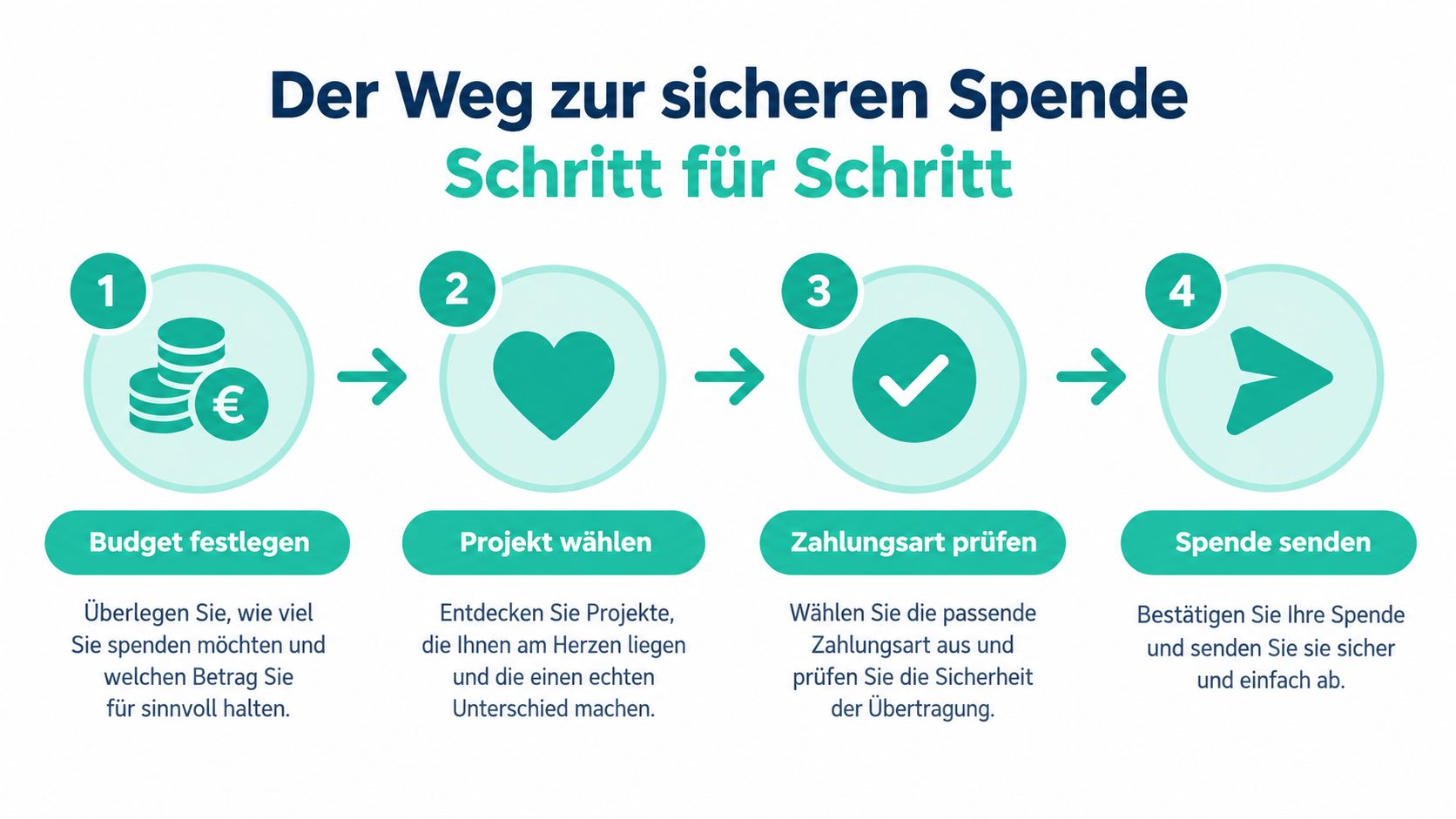
First, set your personal donation budget. A one-time donation is appropriate if you want to support a specific project or take advantage of an occasion. A recurring donation makes sense if you want to support an organization long term and the regular commitment fits your budget. It should never be so high that you later have to cancel it due to financial hardship.
Before the payment process
Don't choose the payment method first, choose the project first. Check whether the target group matches your intention. If you want to support children in Germany, you need an organization with a clear connection to Germany. If your focus is on international orphan aid, the organization should name the project location, the local partners, and the type of care provided.
Also read the page about earmarking. An unrestricted donation gives the organisation more flexibility, while an earmarked donation can be tied to a specific project. Both can make sense. But you need to be able to recognise what your choice is actually linked to.
Never donate under time pressure. First check the organisation, then the project, then the payment method.
For regular Sadaka and seasonal donation campaigns, it's also worth taking a look at the guide to donating during Ramadan. Then decide whether you want to send a one-time payment or set up a recurring order. Save the confirmation, the purpose of use, and the organisation's contact details.
A simple decision filter
- Does the target group fit? The term orphans must be explained concretely in the project.
- Does the location fit? Germany, a specific region, or an international program should be clearly identifiable.
- Does the service fit? Education, shelter, nutrition, and care are different areas of support.
- Does the evidence fit? Updates must contain more than general words of thanks.
- Does the commitment fit? A recurring donation must be transparently cancellable.
Regularity can make projects more predictable, but it is not proof of quality. A poor organisation does not become more trustworthy through monthly payments. Verification remains mandatory for every form of donation.
Payment methods and security for online donations
SEPA direct debit is practical for recurring donations because the amount is collected automatically. Before confirming, check the recipient, the amount, and the cancellation terms. PayPal is suitable for people who do not want to provide their bank details directly to the project. Credit card payment is fast and widely used, but requires special attention regarding the card statement and the authenticity of the donation page.
| Payment method | Practical strength | What you should watch out for |
|---|---|---|
| SEPA direct debit | Suitable for regular donations | Check mandate, amount, and cancellation |
| PayPal | Fast payment process and separate payment account | Verify recipient and transaction confirmation |
| Credit card | Direct online payment | Only pay via encrypted, trustworthy pages |
Technically, a platform should demonstrate SSL encryption, PCI-DSS Level 1, and GDPR compliance. These details do not replace checking the project's content, but they do reduce risks when transmitting and processing your payment data. If a clear privacy policy is missing or the payment page seems unusual, cancel the process.
Fees deserve their own look. Platform fees can reduce the amount that reaches the project. A model with 0% platform fee and voluntary tips, on the other hand, can allow the donation amount to be passed on in full. Still, check whether the tip selection is understandable and whether you can review the amount before submitting.

SadakaNow as a concrete payment method
SadakaNow lists projects for orphans in a project catalog and offers payments via SEPA, PayPal, and credit card. The platform describes vetted projects, public transparency pages, regular updates, and the live feed "Sadaka Pulse" with anonymised real-time donations. Partner organisations are checked for charitable status before being approved. These features do not replace your own look at the specific project, but they do make selection and documentation clearer.
You can find further criteria for assessing digital donation offers in the article on the crowdfunding platform in Germany. What matters most: check the project page, the recipient, and the payment confirmation before completing the process.
Checking impact after donating and doing good permanently
After the payment, the organisation's responsibility begins, but so does your opportunity to verify. Save the confirmation and keep the donation receipt for your records. Later, check the project updates and compare them with the original goal. A good update names specific activities, progress, and open tasks.
A recurring donation should not simply keep running just because you forgot about it. Set yourself a fixed reminder date, review the reports, and cancel if the purpose, transparency, or reachability no longer convince you. If you are satisfied, you can turn a one-time donation into regular support without committing to a rigid sponsorship.
Three questions after donating
Are donations tax-deductible? This depends on the organisation, its charitable status, and the applicable tax requirements. Don't rely on a general statement — ask the organisation for the specific donation receipt.
How do I cancel a recurring donation? Use the specified cancellation option and keep the confirmation. In the case of a SEPA mandate, you should also check your bank statements.
Is local help better than international help? Not automatically. Local support makes sense if you want to support needs within Germany. International aid can be just as suitable if the target group, partners, and use of funds are clearly documented.
The best decision consists of three parts: check the organisation, understand the project, verify the payment. Then a spontaneous donation becomes reliable support that you can also stand behind in the long term.
SadakaNow brings together verified projects for orphans and other social causes, offers SEPA, PayPal and credit card payment, and presents project progress transparently. If you want to donate purposefully right now without a platform fee, visit SadakaNow, check a suitable project and send your support deliberately rather than under time pressure.