
Donating for Social Projects: Find Reputable Causes and Give Safely
When you want to donate to a social project today, the search often begins with a good impulse and quickly ends in uncertainty. One campaign asks for help for children, another supports a local mosque, a third promises quick support in an emergency. At the same time, you ask yourself: Who is behind it, how much actually arrives, and how can I tell that my donation is being used meaningfully?
Donating for social projects should require neither complicated effort nor blind trust. What matters is verifiable information, vetted organisations, secure payment methods and regular insight into project progress. The following steps will help you assess offers and make a decision that matches your personal values and your budget.
Table of Contents
- The journey to a trustworthy donation project
- Understanding the donation market in Germany
- How to find a reputable social project
- Comparing donation platforms and methods
- Legal and tax aspects of donating
- Secure payment methods and practical tips
The journey to a trustworthy donation project
Imagine you want to support a local initiative. Perhaps it involves food for families, education programmes for children or equipping a community centre. You find several projects, but the descriptions differ greatly. Some name a specific goal and publish updates, others work with emotional images and few verifiable details.
In this situation, a brief shift in perspective helps. The most important question is not: "Which project touches me the most?" Instead, ask first: Can I understand who is organising the project, what the money is used for, and how those responsible report on progress?

From the wish to donate to a verifiable decision
A trustworthy project does not need to be large or well known. Local, religiously oriented or specialised initiatives in particular often reach people very directly, but they do not always have the same public visibility as large aid organisations. This does not automatically make them less reputable. It simply means you should pay closer attention to the information available.
Look for a clear description of the problem, a named purpose and a reachable point of contact. Good project pages explain which measure is to be funded, who is responsible for it and what information will be provided after the donation. A progress report can be more important than an especially moving headline.
Practical rule: The more concretely a project describes how its funds are used, the more easily you can assess the decision both before and after donating.
Trust continues to grow after payment
A donation does not end with a click on "Pay". Trust grows when organisations show what happens with the funds, which steps have already been carried out and where difficulties lie. Regular updates, public transparency pages and traceable contact options give donors the ability to put their support into context.
This also applies to Sadaka and other faith-based donations. The religious or personal connection can strengthen motivation, but it does not replace organisational scrutiny. A project can be emotionally appealing and still explain clearly how it works. It is precisely this combination of closeness, values and traceability that makes a donation more solid.
Understanding the donation market in Germany
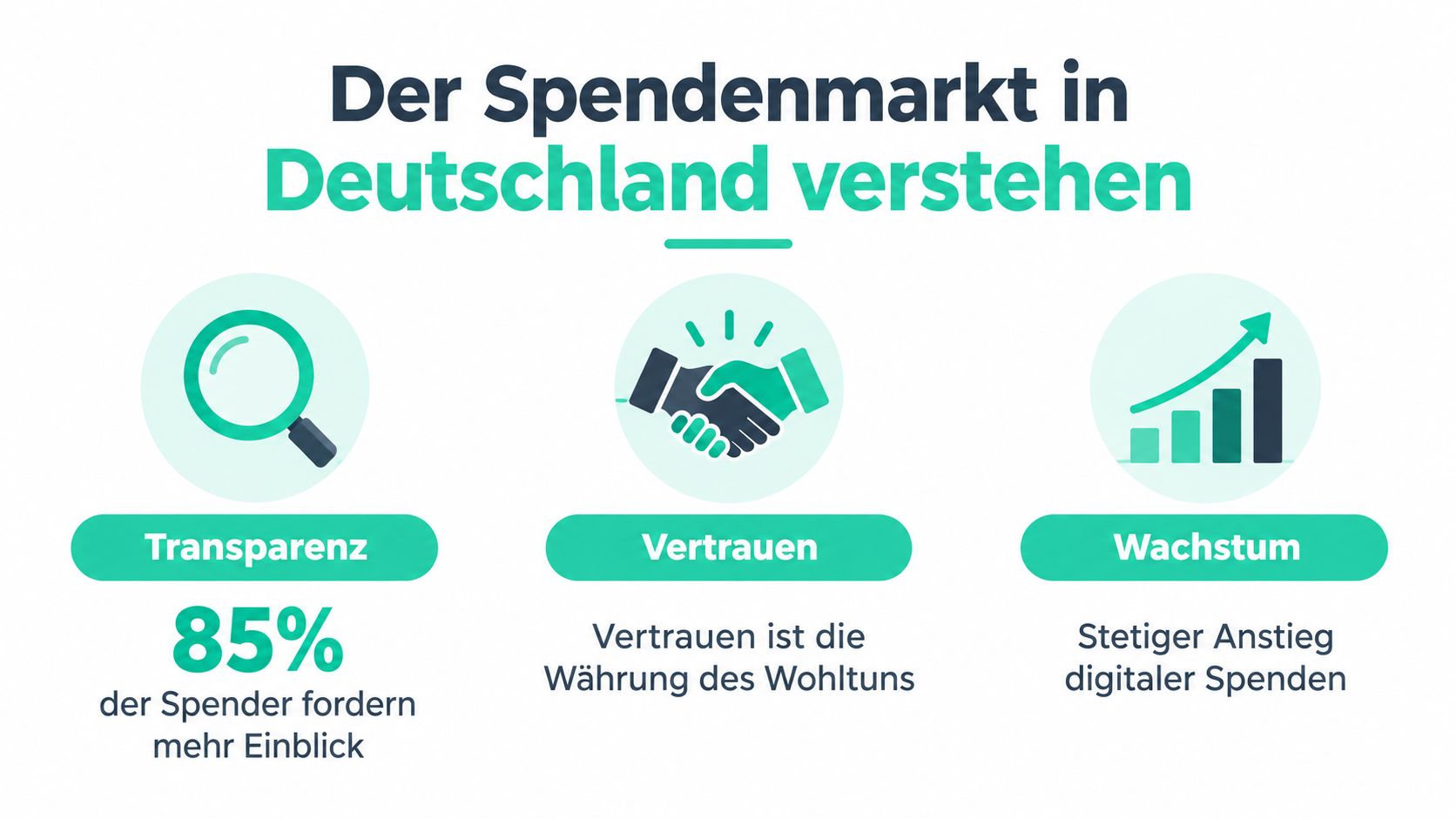
The German donation market is large, but not static. According to the Deutsches Zentralinstitut für soziale Fragen donation statistics, people in Germany donated a total of 12.5 billion euros for charitable purposes in 2024. In 2023 it was 12.8 billion euros; the decline amounted to 2.1 percent in nominal terms and 4.3 percent adjusted for inflation. The DZI uses this to describe the total volume of monetary donations in Germany.
The comparison shows two things. On one hand, the overall donation volume remains at a very high level. On the other hand, donors respond to economic and social changes. The willingness to donate was particularly visible in 2022 after the start of the war in Ukraine. At that time, 13.1 billion euros were donated, of which a good 1 billion euros went to emergency aid for Ukraine, as the DZI documents in the same overview.
Many purposes, different decisions
Among earmarked donations, child and youth welfare ranked first in 2024 with 974 million euros. Church and religion followed with 901 million euros, as summarised by the analysis of donation purposes in Germany. These figures show that donations do not only flow into acute emergencies. People also support long-term social structures, education, care and community services.
The donation monitor reports that 49 percent of the population were donors in 2025. On average, each donor gave 187 euros. Historical data from the bpb and social reporting cite a donation share of 43 percent for 2019, with an average donation amount of 347 euros, compared to 205 euros in 2009 and 257 euros in 2014. These figures are not directly comparable without qualification, but they make clear that the donor base remains broad while also changing over time.
Why transparency is a selection criterion
In a market with many causes, organisations and campaigns, an emotional appeal alone cannot prove the quality of a project. Public information about the organisation, purpose, expenses and progress reduces information gaps. The German donation monitor with an overview of the donation market emphasises the importance of traceability in expenses, administrative costs and impact.
For donors, this has a simple consequence: transparency is not an add-on on a project page, but a tool for verification. It helps you distinguish between a clearly documented initiative and a campaign with incomplete information. This is especially important when a project is local, religious or topically specialised and therefore cannot rely on a widely known name.
How to find a trustworthy social project
A good review can be broken down into a few straightforward steps. You don't need to be an expert in association law or financial auditing to do this. What matters is that you look not only at the donation goal, but also at the structure behind it.
Step one: identify the organisation
Start by asking who is running the campaign. Look for the full name of the association, foundation, charitable organisation or community. An imprint, a postal address and a reachable contact person are important positive signs.
If the name, address or contact details are missing entirely, you should be cautious. A very short deadline, strong pressure, or a request to pay exclusively via private accounts also calls for additional scrutiny. An urgent cause can be genuine, but urgency should never rule out every question.
Step two: read the intended use
A trustworthy project states as specifically as possible what the donation will be used for. "Help for people in need" can be a starting point, but remains imprecise without further explanation. It is better to have a description that connects the target group, the measure and the accountability.
Also check whether the campaign is earmarked or whether the organisation is allowed to use the funds more flexibly. Both can make sense. An earmarked donation suits a clearly defined project, while a general donation can allow an organisation to help wherever the need is currently greatest.
Step three: look for evidence and updates
Look for public financial information, project progress and previous reports. The information does not need to list every single expense. But you should be able to see what has already happened and how those responsible inform people about the use of the funds.
Those who want to donate specifically for children without parents or for corresponding aid programs can additionally refer to a guide to donating for orphans. There too, it remains important to check purpose, organisation, and reporting separately.
Step four check the payment page
Before entering payment details, check the website address and the presentation of the payment process. A secure connection alone does not prove that a project is legitimate. It protects the transmission, not the accuracy of every statement on the campaign page.
Warning sign: If a campaign does not name a verifiable organisation, gives contradictory information, or avoids questions, you should not pay immediately out of a bad conscience.
Comparison of donation platforms and methods
The right donation method depends on what you want to support and how much control you need during and after the payment. A direct bank transfer to a well-known association can be straightforward. A platform, on the other hand, can bundle projects, offer payment methods, and present progress information in one place.
Fees also deserve attention. Check whether a platform uses a fixed fee, a transaction fee, a voluntary tip, or some other form of financing. What matters is not just the advertised fee but the amount that actually reaches the project. With a fee-free platform model, the platform is not financed from the donation itself. With other models, payment or service costs can affect the amount paid out.
| Platform type | Fees | Transparency | Payment methods |
|---|---|---|---|
| Direct donation to an association | Depends on bank and organisation | Depends on the organisation | Usually bank transfer, sometimes online payment |
| General donation platform | Varies by provider and campaign | Check project page, updates, and provider rules | Often several online methods |
| Specialised community platform | Check fee model and financing explicitly | Often focused on specific topics or communities | Depends on platform, often SEPA, PayPal, or credit card |
| Personal donation campaign | Read rules for private initiatives carefully | Check organiser, purpose, and evidence especially carefully | Depends on the platform provider |
Direct channel or curated selection
A direct donation is suitable if you already know an organisation and can find its reports yourself. You then have a short payment path, but may need to gather information on project progress, certification, and use of funds from several pages.
A platform offers more guidance if you want to choose between different projects. Project goals, duration, progress, and updates can be placed side by side. This makes comparison easier, but does not replace checking each individual campaign.
When looking for a suitable technical solution, a comparison of crowdfunding platforms in Germany can help, especially if you not only want to donate but also want to start a campaign yourself for an association or initiative.
Distinguishing between fees and impact
A low fee does not guarantee a good impact. A fee-free platform is only useful if it also works transparently, explains the payment process clearly, and checks the project organiser. Conversely, a platform with costs can offer a useful service, such as payment processing, support, or campaign management.
For specialised projects, another factor comes into play. A platform that bundles mosques, aid projects, and social initiatives from a particular community can make it easier to find suitable topics. What matters is that the religious or cultural focus is combined with verifiable organisational information.
Legal and tax aspects of donations
A donation for a social or faith-based project legally begins with a simple clarification: Who receives the money, what purpose does it serve, and what proof do you receive? Check this information before making the payment. This way you avoid discovering missing information only when filing your tax return.
For donations to tax-privileged organisations, a donation receipt may be relevant. Whether one can be issued depends, among other things, on the recipient, the payment method, and the documentation. A platform may provide a payment receipt. However, this receipt does not automatically replace a formal donation confirmation.
For religious occasions, additional questions about the purpose and the organisation may arise. The guide to donating during Ramadan explains the background and practical tips.
Earmarked and unrestricted donations
With an earmarked donation, you determine which project or area the money should be used for. Examples include a food distribution, an education initiative, or a specific construction project. An unrestricted donation gives the organisation more flexibility to use the funds where there is currently a need. This is similar to choosing between a voucher for a specific purchase and a freely usable budget.
Read the campaign's terms carefully. If the project goal is reached, it should be clearly described whether further amounts go to a similar purpose or whether you can choose a different use. If this information is missing, ask before making the payment.
Keeping documents properly
Save the payment confirmation, the project description and, if applicable, the donation receipt. For recurring donations, an organised filing system helps so that each amount can later be matched to the right proof.
A clear overview of platforms, donation receipts and tax requirements is provided by the guide to donation platforms and tax documentation. For your specific tax return, you should check the current guidance from the tax authorities or consult tax advice, as treatment can depend on the individual case.
Checking before you send
Answer three questions before making the payment:
- Who is the legal recipient? Is the organisation clearly named and reachable?
- What does the purpose mean? Does your donation go to a specific project or to the general work?
- What proof will I receive? Will a payment confirmation or a donation receipt be provided?
If an answer is missing, ask a follow-up question. A reputable organisation should be able to explain how it accepts donations, documents them and reports on their use.
Secure payment methods and practical tips
When donating online, security and convenience meet directly. A process should be easy to understand, display the amount correctly and give you a confirmation. At the same time, you must be able to recognise who you are paying and whether the payment page actually belongs to the organisation you selected.
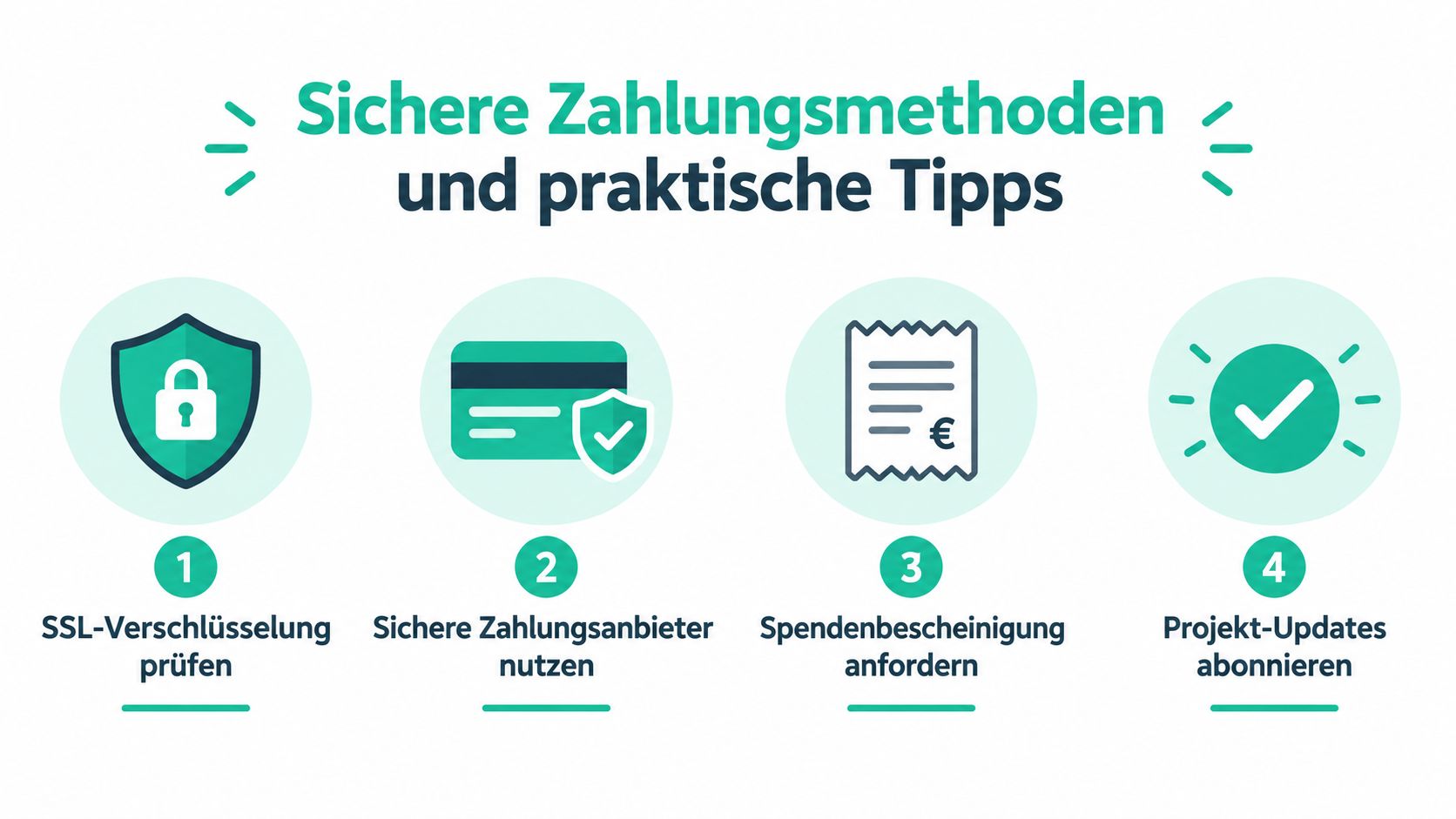
In Germany, online donations are strongly concentrated on a few payment methods. According to Fundraising Box data on relevant payment methods for non-profits, 93 percent of online donations are processed via PayPal, direct debit and credit card. The three methods differ in authorisation, reversal and processing. For donors, this means: choose not only based on habit, but also based on traceability and your own security requirements.
Classifying the payment methods correctly
SEPA direct debit is suitable for people who prefer to pay via their bank account or want to set up regular support. Check the displayed mandate and payment details before confirming.
PayPal offers a familiar payment process and can be especially convenient if you already have an account there. Still, check the recipient and amount in the redirect.
Credit card allows direct online payment. Only use the card on the official payment page and make sure there is a secure connection as well as a clear confirmation after completion.
Security standards such as SSL encryption, PCI-DSS Level 1 and GDPR compliance can technically secure the payment process. They are important signals, but they do not replace checking the project. Technical security and organisational transparency address different risks.
Staying active after payment
Keep the payment confirmation and check whether the amount was correctly recorded. If you donate regularly, occasionally check whether the deductions still match the intended purpose. For a one-time donation, you can revisit the project page later and look for an update.
Progress reports should not only mention successes. Good updates also explain delays, changed priorities or the next step of work. This creates a more realistic picture of impact than individual success stories alone.
Impact begins with traceability: A donation does not become meaningful because it is presented in a particularly emotional way, but because people can check its path and its outcome.
Small or regular donations
Many people wonder whether a single larger payment or regular smaller amounts are better. There is no universally valid answer. What matters is your financial situation, the project's planning, and whether the organisation can actually handle ongoing support.
Regular donations can be helpful for recurring tasks, such as care, meals or educational programmes. A one-time donation, on the other hand, can fit a time-limited campaign. Choose an amount you can sustain over time, and check the conditions for changing or ending a standing order.
A safe routine for every donation
Use this short sequence before completing your donation:
- Open the project: Read the purpose, operator, goal and duration in full.
- Check the organisation: Look for an imprint, contact details and information on charitable status.
- Understand the fees: Check whether the donation amount is passed on in full or what costs apply.
- Review the payment page: Pay attention to the official web address and a secure connection.
- Save the confirmation: Keep the proof of payment and any possible donation receipt.
- Follow updates: Check whether the project provides information on progress and use of funds.
This is how you combine personal conviction with a sober review. A platform like SadakaNow brings together vetted social projects, mosques and relief initiatives, offers public project information as well as updates, and enables payments via SEPA, PayPal and credit card without a platform fee. Visit SadakaNow, choose a clearly described project and make your donation through a secure payment method.