Donating for Gaza: 10 Aid Organisations Compared 2026
How can you tell whether your donation for Gaza actually goes towards water, food, or medical aid rather than disappearing into a general donation pool? A donation seal, a well-known name, or a sample amount do not answer this question alone. What matters is earmarking, local partners, the transfer route, cost disclosures, and how funds are handled when access restrictions temporarily prevent their planned use.
The willingness to donate for Gaza is high in Germany. The ten offers below nevertheless differ considerably. Some work medically, others focus on children, nutrition, water, or religious forms of donation such as Zakat and Sadaqa. When choosing, it therefore helps to organise by focus, payment method, and typical restrictions: access restrictions in the Gaza Strip, earmarking in the case of Zakat, or the question of whether an organisation is allowed to reallocate funds flexibly.
Strict earmarking is not automatically more effective. In a rapidly changing emergency, flexible funds can help faster, provided the organisation discloses any reallocation afterwards.
Table of Contents
- 1. View All Projects
- 2. Islamic Relief Deutschland
- 3. HASENE International e. V.
- 4. Ärzte ohne Grenzen
- 5. UNICEF Deutschland
- 6. Oxfam Deutschland
- 7. Deutsche Welthungerhilfe
- 8. CARE Deutschland
- 9. Johanniter-Auslandshilfe
- 10. Deutsches Rotes Kreuz (DRK)
- Focus Areas and Suitability of the Gaza Donation Offers at a Glance
- Donating Safely: How Your Gaza Aid Becomes Effective
1. View All Projects
The page View All Projects is not a single aid organisation but a project directory on SadakaNow. There, campaigns from mosques, aid organisations, and social initiatives appear side by side. Depending on the campaign, donors can see, among other things, the donation goal, progress, and detailed information, and then donate directly.
This structure is particularly suited to people who are not looking for a specific organisation right away but want to compare several ongoing projects. To put things into perspective, it helps to look at the difference between state and private aid. The German state provided around €82 million in 2022, €175 million in 2023, €148 million in 2024, and €77 million in 2025 for humanitarian aid in the Palestinian territories including Gaza, as shown by the Federal Foreign Office's overview of humanitarian aid from 2022 to 2025. Such sums are no benchmark for the success of a single private campaign. A campaign only becomes comparable through its target amount, recipient organisation, location of use, disbursement status, and dated updates.
Payment and Transparency in Detail
SadakaNow states that it lists vetted organisations, charges no platform fee, and supports payments via SEPA, PayPal, and credit card. The fact that PayPal should be prominent at checkout fits payment behaviour in Germany. According to the Bundesbank, slightly more than three-quarters of those surveyed used PayPal as a mobile or electronic payment method, as documented by the Bundesbank report on payment behaviour in 2025. This figure describes usage among those surveyed, not the share of donation volume.
- Strength in comparison: Multiple campaigns can be assessed by goal and progress without having to check many websites separately.
- Strength in updates: Project updates and public impact insights support later traceability.
- Limit of the directory: Need and quality differ per campaign. For conditions, partners, and use, you must always open the individual campaign page.
2. Islamic Relief Deutschland
Islamic Relief Deutschland combines Gaza aid with Islamic forms of giving. According to the organisation's own description, the offer includes food, water, medical help as well as areas such as education and health. Anyone wishing to give Zakat or Sadaqa will find these purposes on the same platform as general emergency aid.
Example amounts help with orientation, but they do not guarantee a specific service for a chosen person. Especially with religious donations, it is worth looking at the terms and conditions. According to the FAQ, such donations cannot always be assigned to a single project. For Zakat, the collection point decides on the distribution, which is why any desired narrow earmarking should be clarified beforehand. A good overview of other Islamic organisations is provided by the overview of Muslim relief organisations.
Clarify the tax question before paying
For deductibility, it is not only the humanitarian purpose that matters, but the legal donation recipient. According to German classification, direct donations to organisations in third countries are generally not deductible as special expenses, as described by the explanation by Flick Gocke Schaumburg on direct donations to foreign NPOs. Therefore, check the name and registered office of the German organisation, its charitable status, and the donation receipt directly on the form.
- Strength for religious donations: Zakat, Sadaqa, and Gaza emergency aid are offered together, also on a recurring basis and through dedicated fundraising campaigns.
- Limit in allocation: An amount for “Gaza” or “emergency aid” is no guarantee for a single family or a specific type of aid.
3. HASENE International e. V.
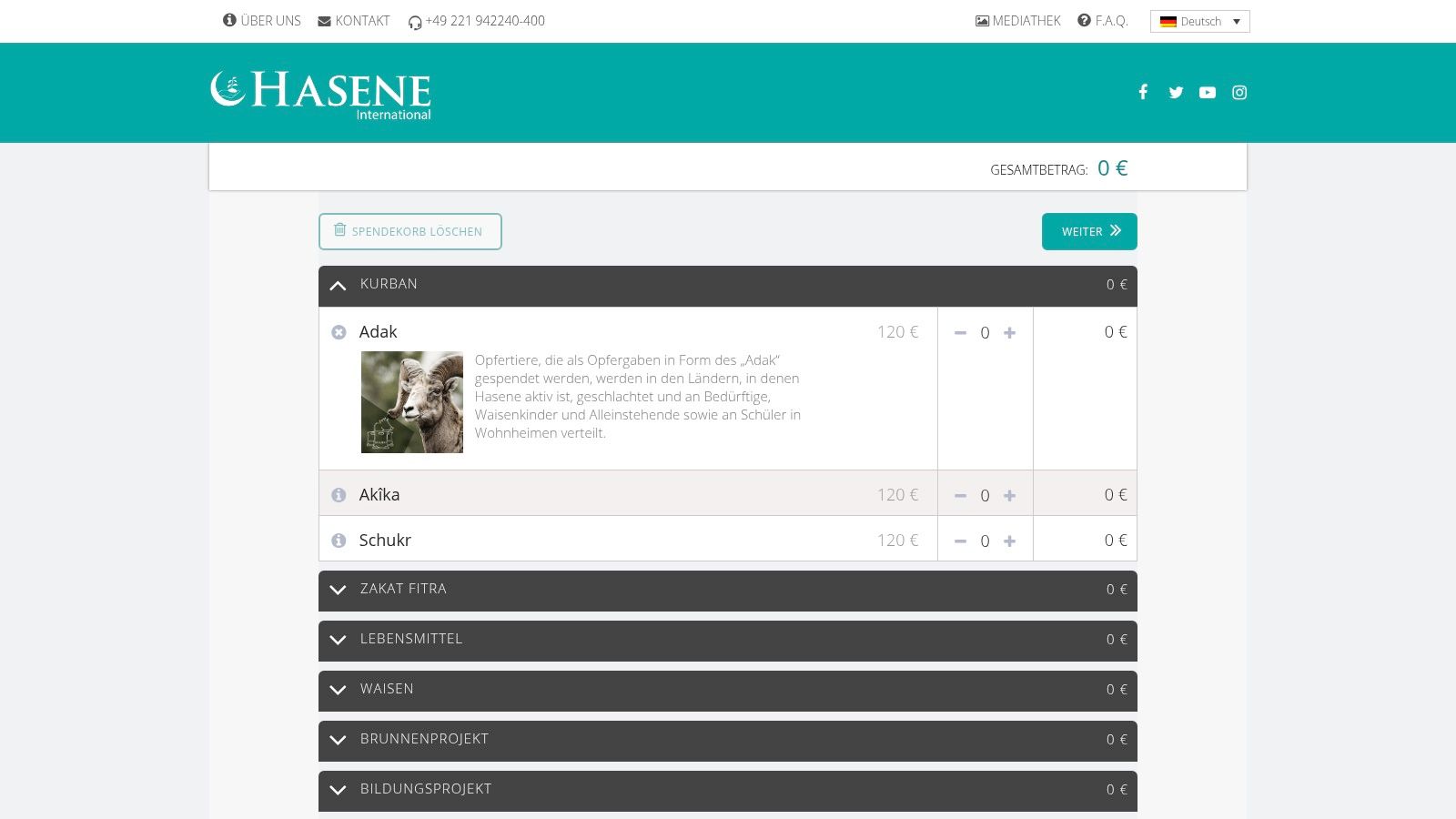
HASENE International e. V. offers a dedicated option called Soforthilfe Gaza (Immediate Aid Gaza) on its donation form. Alongside this are Gaza-related food aid and support for orphaned children. For Muslim donors, the combination is particularly relevant, as the same form also allows selecting Zakat, Fitra, and Sadaqa.
This allows religiously motivated giving to be combined with a regional purpose without having to use several organisations in parallel. Payment methods such as PayPal, credit card, and SEPA direct debit lower the technical barrier. The German association's address and contact options in Cologne make it easier to ask questions about certificates and use of funds.
Where the information becomes thinner
Not every donation purpose always comes with a detailed cost breakdown published. Anyone wanting to know what share goes into transport, local distribution, or administration should request this breakdown before making a larger donation. With Zakat, it should also be noted that the distribution conditions must not be confused with a freely chosen earmarking.
- Strength in the form: The Gaza purpose is clearly displayed rather than only accessible through a general emergency fund.
- Strength for orphans and food: Donors can narrow down their focus more specifically than with a purely regional donation.
- Limit in cost information: Without a project-specific breakdown, comparison with other organisations remains only partially reliable.
4. Ärzte ohne Grenzen
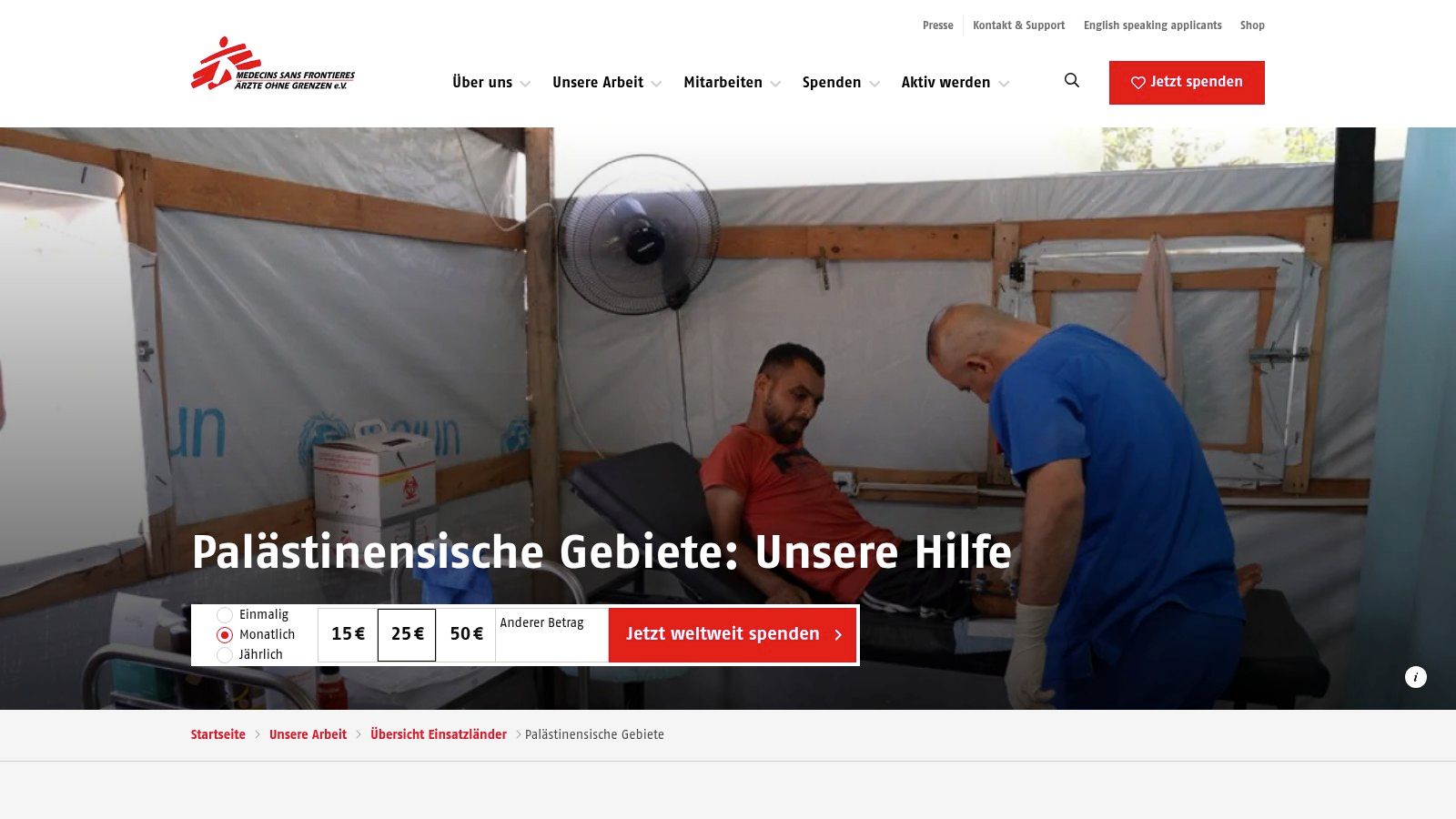
For a Gaza donation with a medical focus, Ärzte ohne Grenzen is the most specialised entry in this list. The organisation reports providing care through Palestinian staff in Gaza and the West Bank. The focus is on its own medical teams and local structures.
The decisive difference lies in the risk profile. Access restrictions, disrupted import routes, and changing security situations can prevent an amount from being converted into treatment capacity in a timely manner. Anyone specifically looking for a clinic, a hospital project, or a single treatment should read the earmarking of the chosen appeal beforehand; the checklist for verified donation organisations helps to systematically check how overfunded purposes and reporting obligations are handled.
Who this profile suits
- Strength in specialisation: The contribution targets a medical field of work with its own teams and local presence.
- Strength in risk communication: Access, import, and planning problems are openly named.
- Limit in purpose accuracy: A donation is not necessarily tied to a single clinic, operation, or treatment.
5. UNICEF Deutschland
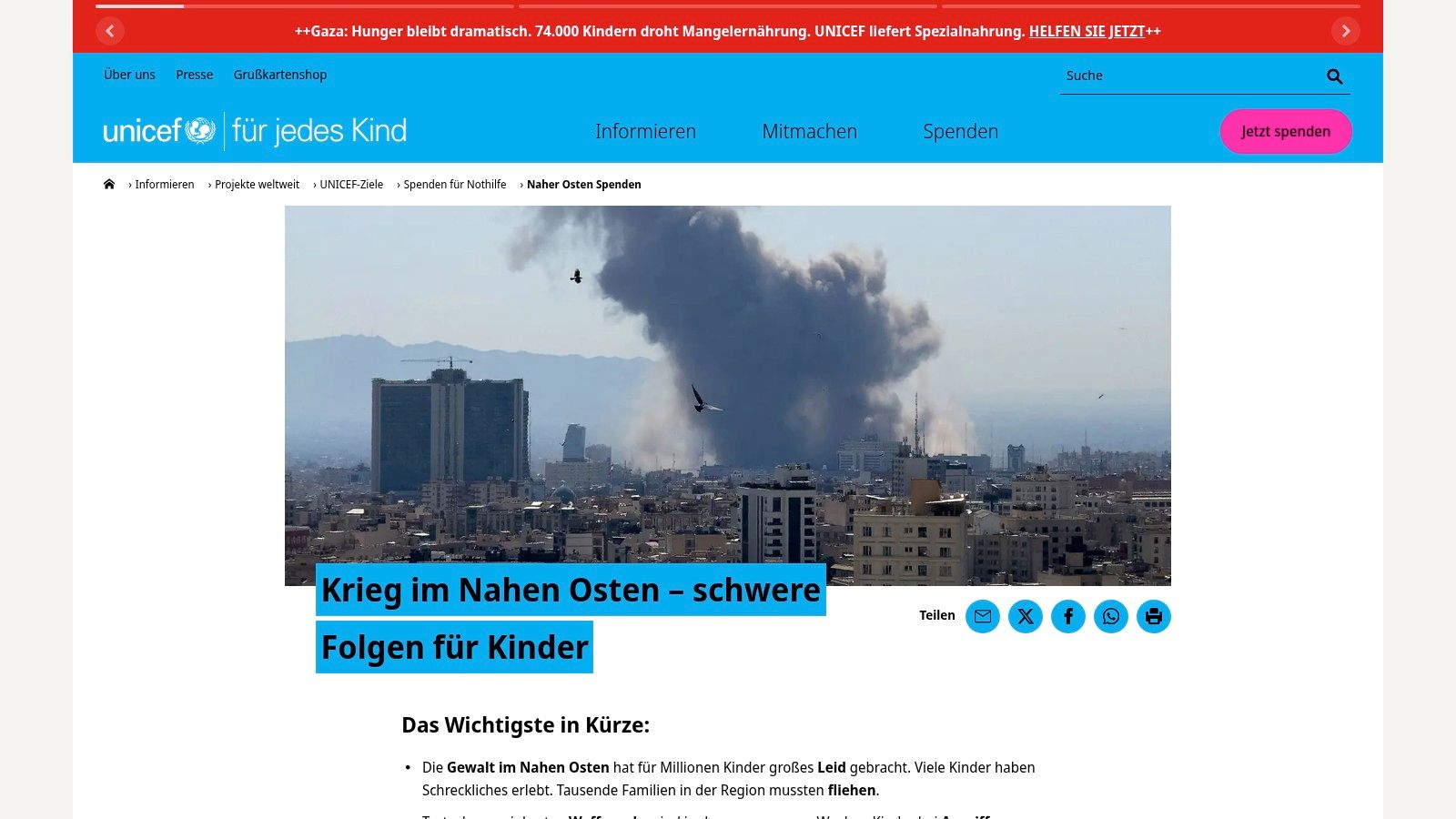
UNICEF Deutschland addresses donors who want to support children and families. For Gaza, the organisation names, among other things, water, special food against malnutrition, medicines and first-aid material. This means the focus covers basic supplies that are immediately vital for children's survival.
Donations go through the German UNICEF organisation, which simplifies receipts and queries for donors in the DACH region. However, anyone who specifically wants to support orphaned or particularly vulnerable children should read carefully whether the chosen form lists Gaza, the Middle East conflict as a whole, or a children's purpose. Background on choosing the right purpose is provided in the guide to donations for orphans.
Check the regional scope
A Middle East donation appeal can cover several affected areas. This makes sense in terms of regional supply routes, but it doesn't match every expectation of a donation purely for Gaza. Therefore, check the current selection in the form and the rules in case of over-funding.
- Strength with children: Nutrition, health and clean water are bundled from a child-focused perspective.
- Strength in reach: UNICEF works through large partner and supply structures that can also cushion difficult deployment situations.
- Limitation in implementation: Access and security conditions determine the timing and location of distribution.
6. Oxfam Deutschland
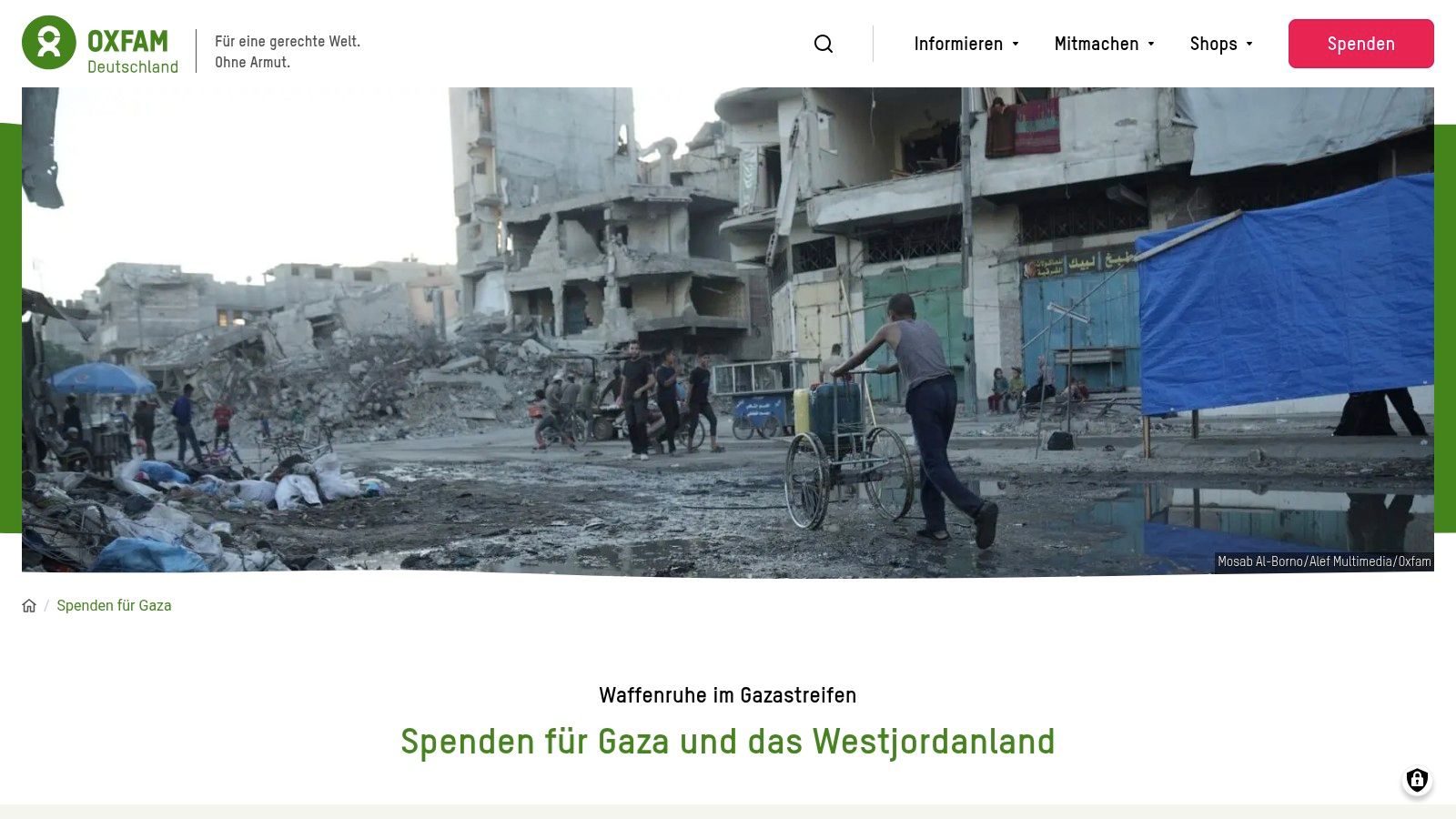
Oxfam Deutschland runs its own campaign for Gaza and the West Bank. In terms of content, this covers clean water, hygiene items, psychosocial support as well as work on water and wastewater infrastructure. This sets Oxfam apart from organisations whose focus lies almost exclusively on food or medicine.
This combination makes sense because contaminated water can intensify disease, and hygiene quickly becomes a bottleneck in overcrowded shelters. Example amounts on the campaign page show possible uses, but they do not guarantee that your individual donation will fund exactly this service. As with almost all organisations, money is pooled across programmes and deployed according to need.
Decision rule: Anyone who wants to prevent disease through water and hygiene should consider infrastructure and acute care together, not just count the goods delivered.
Distinction from pure emergency aid
- Strength in water and hygiene: The focus is clearly recognisable and not just a secondary purpose of a general campaign.
- Strength in infrastructure: Described work on pipelines and wastewater can have an effect beyond a one-time distribution.
- Limitation with deliveries: Access for aid supplies, spare parts and personnel can significantly restrict implementation and pace.
7. Deutsche Welthungerhilfe
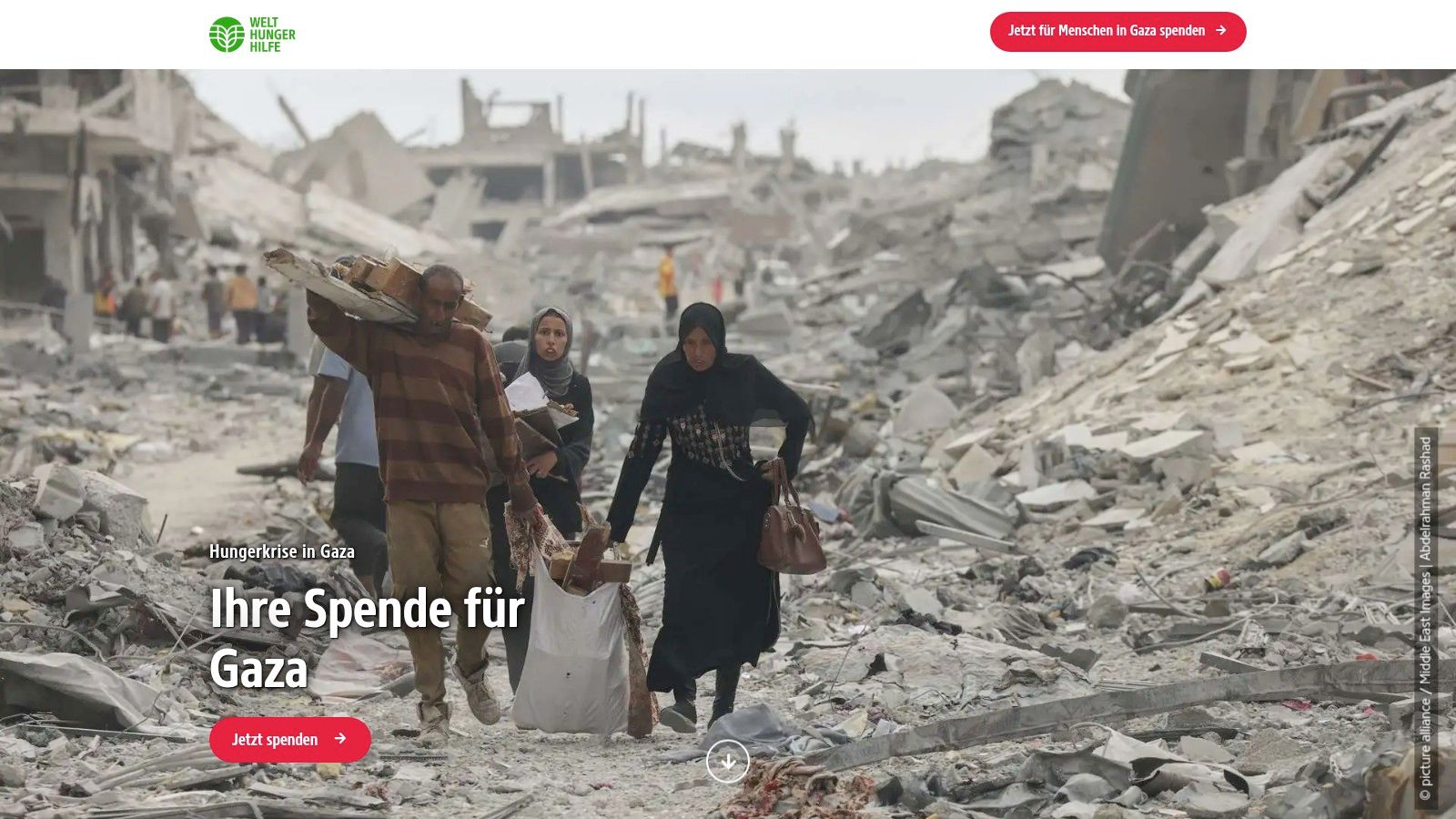
Where does Deutsche Welthungerhilfe start, and where does its controllability end? Deutsche Welthungerhilfe focuses on food security and treating malnutrition. Children as well as pregnant and breastfeeding women are specifically mentioned. According to its own statements, it works with international and local partners, including CESVI and Juzoor.
Local partnerships can enable aid when the organisation's own supply routes are restricted. This makes the transfer path the decisive point: who distributes on the ground, how needs are assessed, and what happens when transports wait for approvals can mainly be traced through the partners. The organisation reports on such access barriers and, according to its website, carries the DZI seal of approval. For assessing aid to Gaza, however, the concrete partner pathway counts, not the seal alone.
Government food aid is also part of the context. The German Bundestag reported that in the 2024 budget year, 58 million euros went to UNRWA and the World Food Programme to fund food aid for, among others, pregnant women, breastfeeding women and children under five, as explained in the short report of the German Bundestag. A private donation to Welthungerhilfe should be viewed separately from this.
- Strength with vulnerable groups: The nutrition focus is tailored to people with particularly high risk.
- Limitation with supply chains: Direct deliveries remain less predictable due to approvals; the partner pathway requires additional coordination.
8. CARE Deutschland
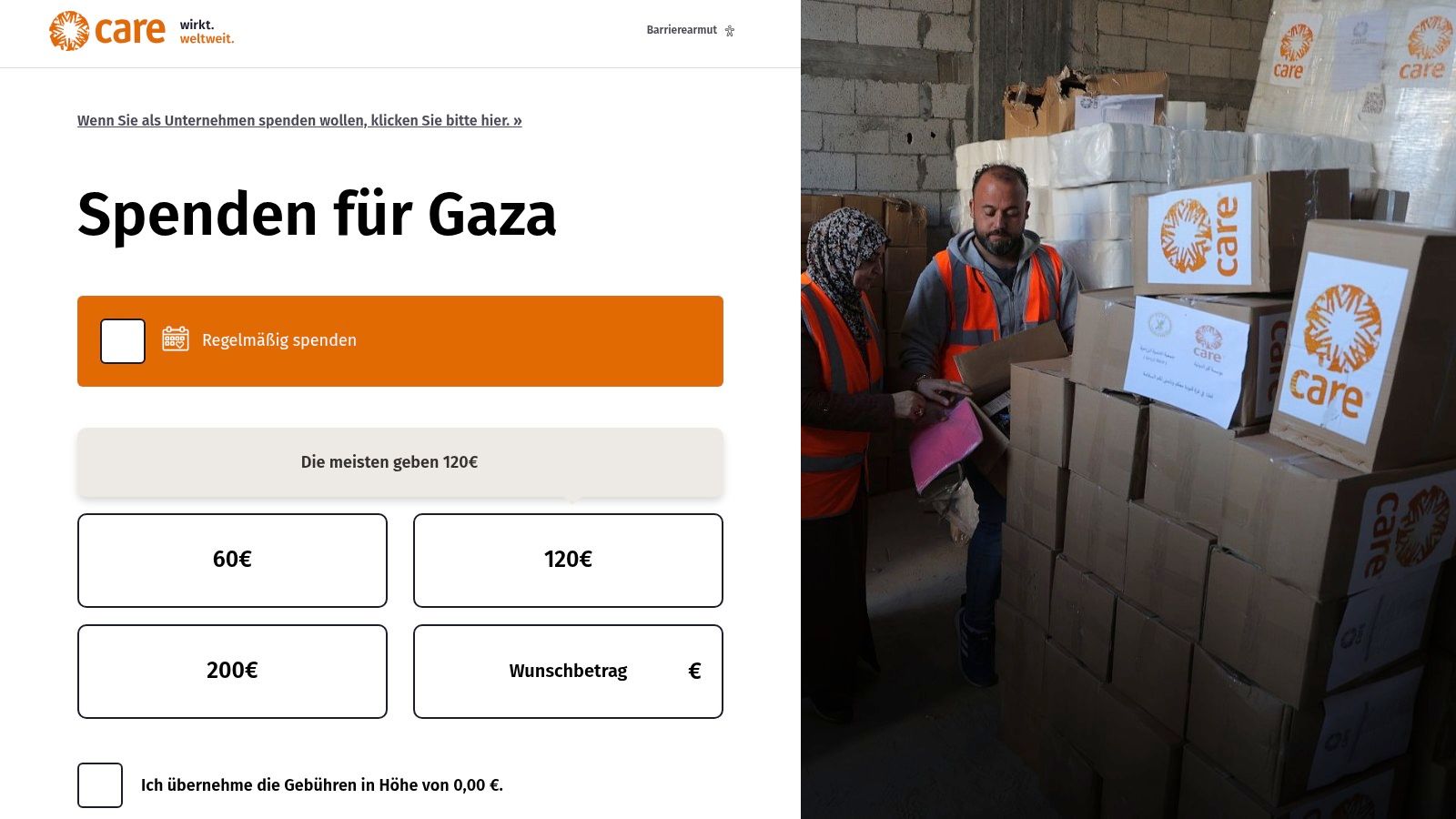
CARE Deutschland offers its own Gaza donation appeal with a broad emergency aid profile. It describes help with drinking water, hygiene, medical care and emergency shelters. According to its own account, the organisation works with local partners and its own teams.
For donors, the broad profile is a double-edged sword. It allows flexible responses when needs shift, but makes it harder to attribute the impact of a single amount to a specific item. It stands out positively that CARE describes procedures for monitoring distributions as well as for feedback from those affected. Such mechanisms are more reliable than pure delivery figures, because they make misallocations and unreached groups more visible.
Payment and surplus rule
One-off and recurring donations are possible via PayPal and SEPA direct debit, among others. Before making an earmarked donation, you should read the surplus rule. Earmarked donations can, in the event of a surplus, be used for another aid project. This can make operational sense, but it should match your expectations.
- Strength in oversight: Distribution monitoring and feedback channels are explicitly described.
- Limit in earmarking: Access, security situation, and surplus rules influence the concrete use.
9. Johanniter-Auslandshilfe
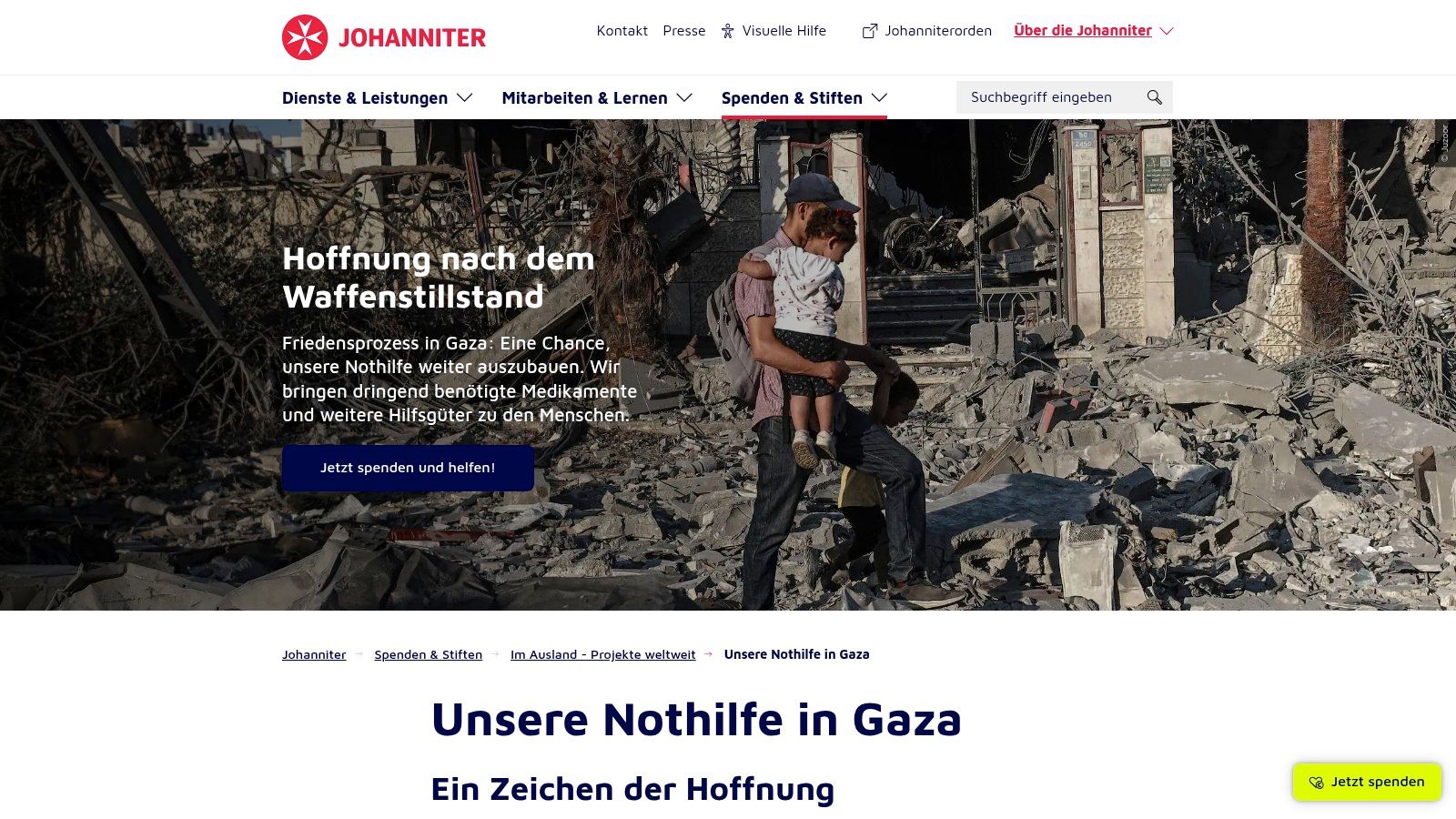
The Johanniter-Auslandshilfe focuses on medical aid in Gaza. They report mobile clinics for initial medical care, cooperation with local and international partners, and support for health facilities. This includes medical care at a reopened hospital.
Mobile services can reach people who have no functioning clinic nearby or who can only travel with difficulty. However, their impact depends heavily on personnel, materials, and secure access. A mobile deployment therefore cannot be guaranteed months in advance like a fixed clinic operation. According to the linked donation page, Johanniter states that it has carried the DZI donation seal since 2004. Still, a seal does not replace checking what the current Gaza donation may be used for.
In-kind donations are not a substitute here
Johanniter advises against unsolicited in-kind donations. Monetary donations are usually more practical, because needed materials can be procured and transported more specifically. Anyone wishing to send medication, clothing, or bandages should explicitly ask beforehand whether there is a concrete need for them.
- Strength in forms of deployment: Mobile clinics and hospital support are described concretely.
- Limit in predictability: Security, staff availability, and material supply determine the actual scope.
10. German Red Cross (DRK)
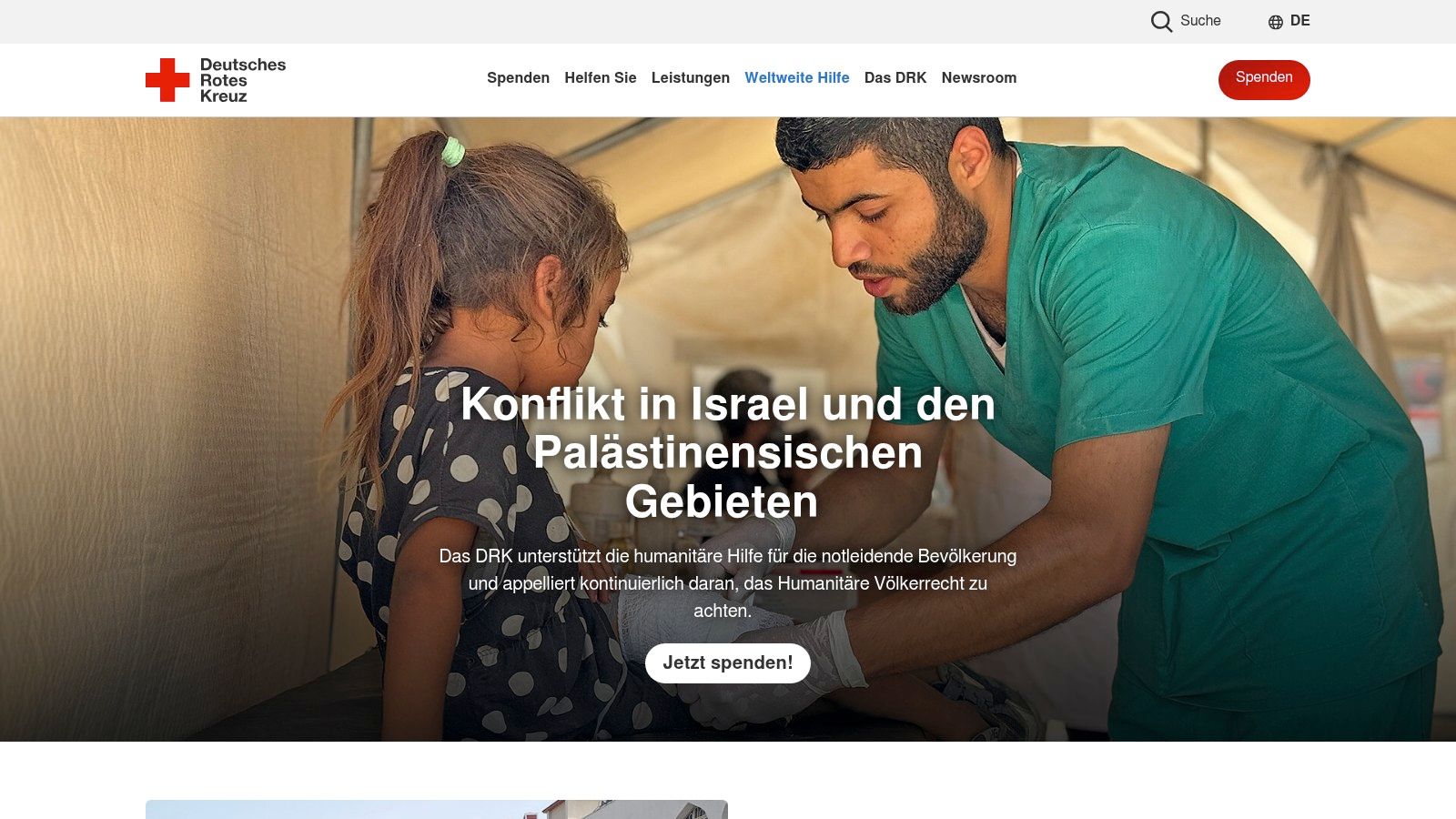
The Deutsche Rote Kreuz works together with the Palestinian Red Crescent in the Palestinian territories. The measures described include medical care, drinking water, relief supplies, mobile health services, as well as support for rescue and ambulance services and displaced families.
This network model can draw on local knowledge and established handover routes. DRK explains transport and handover routes for relief supplies on its website, which increases traceability. At the same time, transports are subject to strict regulations and additional approvals. Timelines can therefore shift even when money and goods are already in place.
As an indication of the scale of private alliance aid, Aktion Deutschland Hilft reported in 2025 that around 7.5 million euros in donations for Middle East emergency aid had been received in total since October 2023, as reported by Aktion Deutschland Hilft on Middle East emergency aid. This sum belongs to an alliance and is not an impact figure for an individual DRK donation.
- Strength in partner network: Cooperation with the Red Crescent creates local operational structures.
- Limit in selection: Individual goods or recipients usually cannot be directly selected.
Focus areas and suitability of the Gaza donation offers at a glance
The overview arranges the ten offers according to two criteria: the focus of fund usage and the donor group for which the offer is typically suitable. The classification follows the organisations' publicly described focuses, not an assessment of their impact on the ground.
| Organisation | Focus | Particularly suitable for |
|---|---|---|
| SadakaNow – View all projects | Overview of current donation campaigns | People who want to compare different projects |
| Islamic Relief Deutschland | Gaza emergency relief, education and health | People who want to combine humanitarian aid with Zakat or Sadaqa |
| HASENE International e. V. | Gaza emergency aid, food and orphan support | Muslim donors who want to combine Gaza aid with religious forms of giving |
| Ärzte ohne Grenzen | Medical emergency aid and healthcare | People who prioritise medical aid |
| UNICEF Deutschland | Help for children and families, including water, nutrition and health | People who want to support children and their basic care |
| Oxfam Deutschland | Water, hygiene, psychosocial support and infrastructure | People focused on water and hygiene |
| Deutsche Welthungerhilfe | Food security and treatment of malnutrition | People who want to support particularly vulnerable groups and nutrition aid |
| CARE Deutschland | Water, hygiene, medical aid and emergency shelter | People who want to support broadly based emergency aid |
| Johanniter-Auslandshilfe | Medical aid, mobile clinics and hospitals | People who prioritise healthcare and medical aid |
| Deutsches Rotes Kreuz (DRK) | Medical emergency aid, drinking water and relief supplies | People who want to support broadly based humanitarian aid |
Two patterns stand out. The broader an organisation's mandate, the less a single donation can be directed: UNICEF, CARE and the DRK cover several areas at once, which makes funds flexible but hard for the donor to predict. Conversely, the narrower the stated focus, the clearer the expectation of how funds will be used, as with Ärzte ohne Grenzen for medicine or Oxfam for water and hygiene.
SadakaNow falls outside this pattern, because the platform does not provide aid itself but bundles campaigns for Muslim projects in Germany, Austria and Switzerland. Whether a donation has an effect in Gaza is decided there by the individual campaign, not by the name of the platform. Those who want to compare will find several providers side by side here; those looking for a fixed point of responsibility are better served by relief organisations with their own country programme.
With offerings that explicitly take Zakat and Sadaqa into account, earmarking becomes an additional selection criterion. Amounts declared as Zakat are tied to the stated purpose, which narrows the selection to projects that explicitly state this purpose. For donors who are mainly focused on the breadth of emergency aid, this tie is a disadvantage.
Donating safely: How your Gaza aid becomes effective
Whether an organisation is large or small says little about the effect of your donation. What matters is which problem it aims to solve. For initial medical care, Ärzte ohne Grenzen or the Johanniter are a good fit. For children, UNICEF is more relevant, for nutrition the Welthungerhilfe, for water and hygiene Oxfam or CARE. Those who want to specifically connect Zakat or Sadaqa with Gaza can compare Islamic Relief, HASENE and suitable campaigns on SadakaNow.
State aid and private donations must not be mixed up. As the Bundestag document on German Gaza aid shows, a government statement documented in the German Bundestag later raised the funds provided since 7 October 2023 to up to 420 million euros, and Germany additionally contributes 123.5 million euros to the EU's Team Europe initiative for Gaza. These amounts say nothing about whether a private campaign has achieved its narrower goal. For that, project-specific figures count.
Impact figures from different organisations are only comparable to a limited extent. Save the Children Deutschland reports 72.6 million euros for 66 projects for 2025 and states 75 cents per euro for direct projects, as shown on the Gaza page of Save the Children Deutschland. “Direct project costs”, “people reached” and in-kind donations are defined differently depending on the organisation. A percentage alone is therefore no proof of impact.
The quick check before every payment
- Clarify the recipient: Name, registered office, non-profit status and German donation receipt must be identifiable on the form.
- Read the purpose exactly: Check whether Gaza, a region, a target group or an aid sector is meant, and what applies in case of overfunding or access restrictions.
- Trace the transfer route: Local partner, time period, target group, cost ratio and handling of delivery obstacles should be stated.
- Request updates: Target amount, amount already disbursed, project status and update date make progress verifiable.
- Secure the payment: Use the official website, check the amount and recipient, and save the confirmation as well as the certificate.
Those who wish to give regularly should choose an organisation that publishes project reports and explains any changes in purpose. Monthly donations improve predictability but should be adjustable or cancellable at any time. Questions about donations and payment issues at SadakaNow are answered by support at hilfe@sadakanow.de. Publicly viewable project progress also shows how a donation is being used and whether a project is still active.
Take a few minutes before transferring money to carry out this check. You will then donate faster and with a realistic expectation of the reach, duration and limits of your help.
On SadakaNow you can compare vetted aid projects, see goals and progress publicly, and donate without a platform fee via SEPA, PayPal or credit card. Choose a suitable Gaza campaign, check its purpose and updates, and give your Sadaqa where the use of funds and the organisation are transparent to you.