
Financing Social Projects: The 2026 Practical Guide
A community wants to start a family counselling service that helps young people with educational questions, supports older people in everyday life, or accompanies families in financial hardship. The concept is in place, the volunteers are ready, but the financing hinges on one decisive question: How do you reach people who don't yet support you regularly, without risking the trust of your existing donors?
The answer does not lie in a single source of money. Anyone who wants to finance social projects needs a combination of grants, community donations, Sadaka, digital campaigns and reliable partnerships. What matters is that every source of income is tied to a clear purpose, a traceable impact and professional communication.
Table of Contents
- Why the classic donation logic no longer works in 2026
- The four building blocks for financing social projects
- Writing grant applications that actually get approved
- Crowdfunding and donation campaigns built on real trust
- Comparing platforms, payment methods and fee models
- The 30-day plan for your first campaign
Why the classic donation logic no longer works in 2026
A mosque plans a family counselling service, but the appeal for donations after Friday prayer brings in hardly any new supporters. The cash box is used less often, and younger community members expect digital payment methods and traceable results. Anyone who wants to finance social projects can therefore no longer rely on appeal letters and one-off actions.
The donor base in Germany is shrinking, even though individual donors are giving more. From January to December 2025, private households donated 4.649 billion euros, 9 percent or 463 million euros less than the previous year. At the same time, the average donation per donation act rose to 46 euros. The Deutscher Spendenrat documents this development in its Bilanz des Helfens 2025.
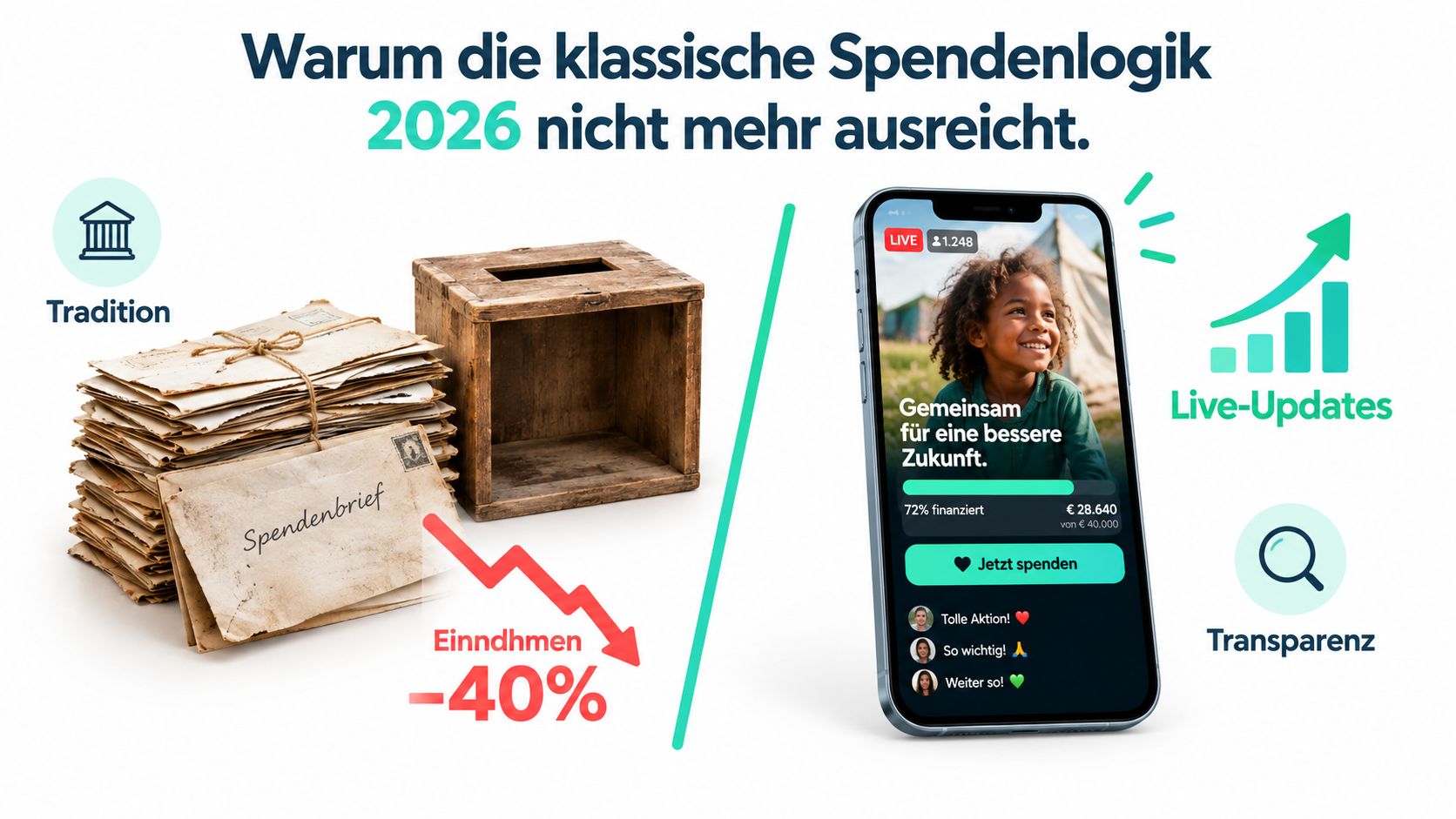
For mosques, this means that Sadaka today must be organised with the same clarity as a good grant application. The purpose belongs on the front page, progress remains publicly visible, and every payment leads directly to the project without detours. A digital platform with 0% fees can support this logic if it transparently shows impact, use of funds and updates. This is how trust is built with people who are not on site every week.
Reach is not the same as donation amount
In 2025, around 15.8 million people donated in Germany, about 848,000 fewer than the previous year. Donor reach stood at 24 percent, while the average donation rose to 46 euros. These figures are shown in the detailed analysis by the Deutscher Spendenrat.
The risk of classical methods therefore lies in the loss of occasional and first-time donors. A letter mainly reaches existing contacts. A digital campaign makes the concrete benefit visible, can be shared, and connects Sadaqa with a verifiable project outcome.
Practical rule: Every donation appeal needs a clear purpose, a simple payment method, and visible proof of what happens after the donation.
In December 2025, 1.124 billion euros were donated, which corresponded to 24 percent of the entire annual total. The year-end campaign remains important, but it must not be the only supporting pillar, as the donation council's balance sheet shows.
Those who rely solely on events, door-to-door collections, and long letters are only managing their existing reach. Instead, plan regular updates, digital Sadaqa appeals, and publicly documented impact. This way, you finance social projects more reliably and build new relationships with the community.
The four building blocks for financing social projects
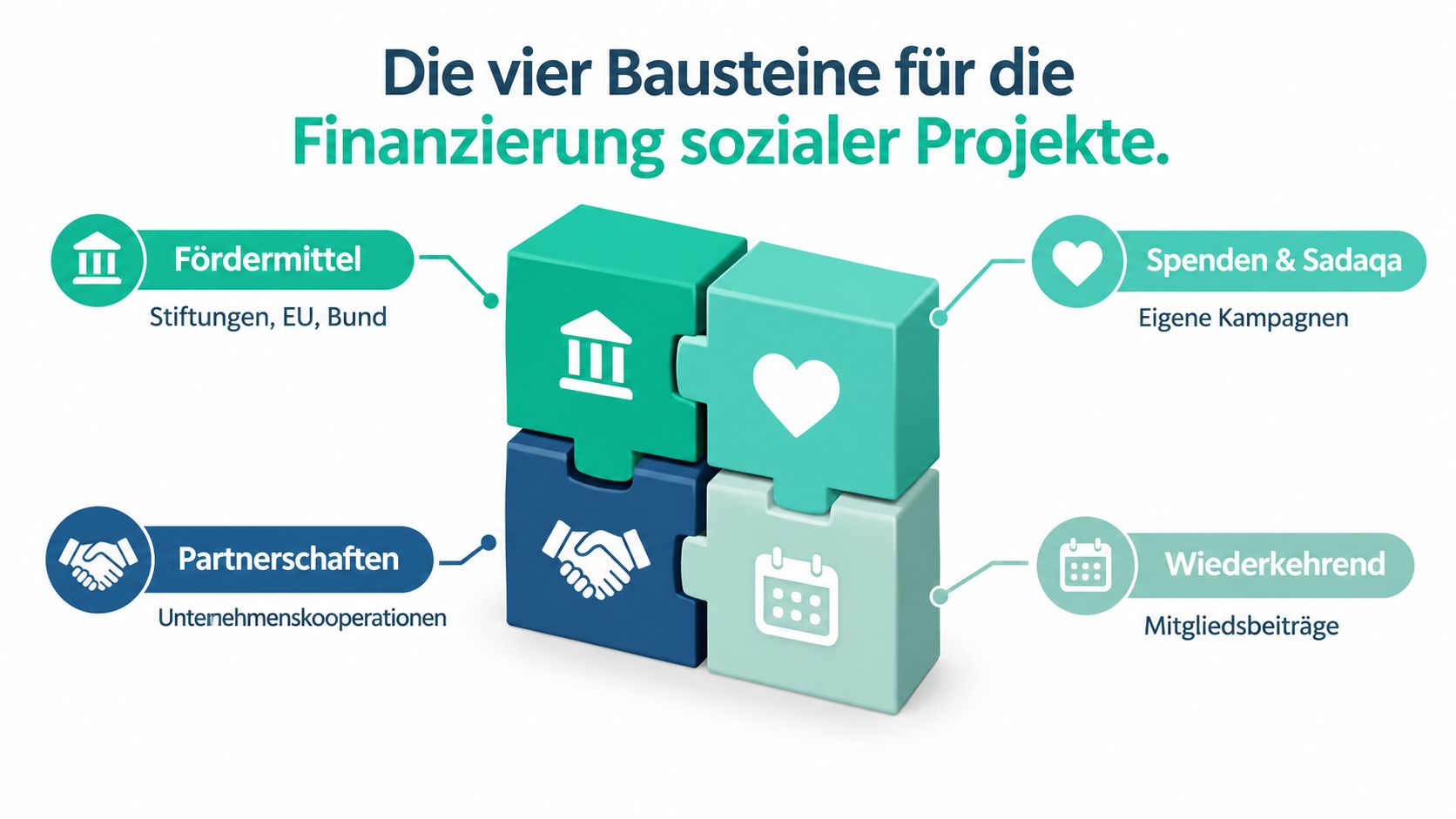
Stable financing does not come from a long list of possible sources of income. It comes from building blocks that secure one another. Grants give a project planning security, donations create closeness to the community, digital campaigns expand reach, and partnerships bring in knowledge, spaces, or in-kind contributions.
Grants give the project a solid foundation
Foundations, municipalities, federal programmes, and European programmes usually fund clearly defined projects. For this you need a suitable legal form or an eligible partner, a comprehensible cost plan, and a project that fits the funder's guidelines. Grants are rarely available spontaneously. They require research, deadline tracking, and clean documentation.
Your own donations and Sadaqa create responsibility within the community
Community donations are not just income. They show that the community itself stands behind the project. A Sadaqa campaign should therefore not stop at an emotional appeal. Describe who is being helped, what the next step is, and how supporters can follow the impact. For seasonal campaigns, clear preparation can help, as shown in the guide on donating during Ramadan.
Digital campaigns make the project visible
Crowdfunding is particularly suitable for a clearly defined goal, such as equipping a counselling room, financing a course cycle, or purchasing necessary learning materials. The campaign page should include a concrete target group, a comprehensible amount, images from the project environment, and regular updates. A general call for "more support" is too vague.
Partnerships lower costs and expand impact
Companies, other NGOs, schools, and educational institutions can contribute spaces, expertise, in-kind resources, or reach. Do not write to potential partners with a general request. Explain which problem you are solving together, which task the partner will take on, and how you will document the collaboration.
For a family counselling service, the model could look like this: a funder supports the setup, the community contributes a share through Sadaqa and its own donations, a school refers families, and a local business provides equipment or communication support. The exact mix depends on the project. What matters is that no single source determines success or failure.
Writing grant applications that actually get approved
A good grant application does not describe a dream project. It shows that a concrete problem has been identified, that the planned measures fit it, and that the organisation is capable of carrying it out. Funding bodies do not want to read as many pages as possible. They want to quickly understand who receives help, what you do, what it costs, and how you recognise impact.
Start with the funding logic, not the form
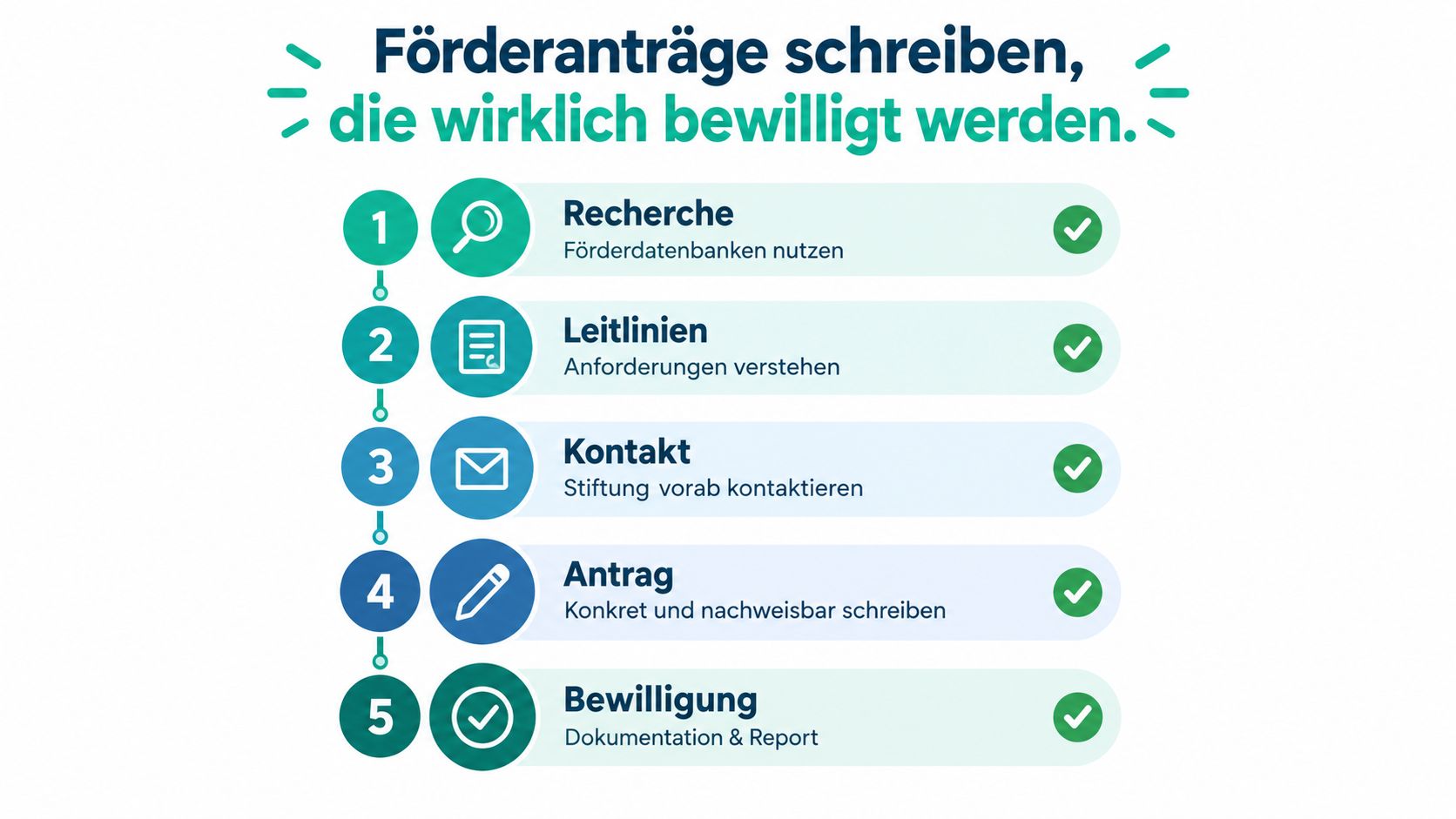
First research funding databases and the websites of suitable foundations, municipalities, and programmes. Read the guidelines in full, especially exclusions, deadlines, requirements for own funds, and specifications regarding the target group. Do not send a standard application to every organisation.
Before submitting, you should call the funding body. Ask specifically whether the project fundamentally fits, whether the legal form is sufficient, and which documents are expected. The claim that a phone call statistically doubles the chance of approval is not supported by the verified data provided. Nevertheless, a preliminary conversation remains a sensible recommendation, because it helps you avoid unsuitable applications.
Build the application like a chain of impact
A clear structure prevents the cost plan from appearing disconnected from the project goal:
- Starting situation: What specific social problem exists, and who is affected by it?
- Goal: What change should the project achieve for the target group?
- Measures: Which activities lead step by step to the goal?
- Timeline: When does the project start, what stages are there, and who is responsible?
- Cost plan: Which expense belongs to which measure?
- Impact indicators: How do you recognise progress and benefit?
- Sustainability: How should the service continue after the funding phase?
An application is not convincing because it promises a lot. It convinces when every expense pays into a measure and every measure pays into a goal.
These Mistakes Cost Trust
First-time applicants often fail due to avoidable gaps. The target group remains unclear, the own contribution is not explained, deadlines are overlooked, or the application names activities but no verifiable results. An overloaded cost plan also appears problematic if it is not clear why every item is necessary for the impact.
Therefore, set up an internal review before submission:
- Target group: Is it clear who specifically is to be reached?
- Responsibility: Is there a named person for implementation and accounting?
- Proof: Can you document participation, counselling, placement, or other results?
- Financing: Are own funds, requested funds, and other sources presented separately?
- Deadline: Are signatures, statutes, proofs, and attachments complete?
Funding bodies such as Aktion Mensch, the GlücksSpirale, or local foundations can be suitable contact points depending on the project area. What matters is not the well-known name, but the match between the guidelines, the target group, and the project.
Crowdfunding and Donation Campaigns With Real Trust
A crowdfunding campaign without publicly traceable use of funds is a trust risk in 2026. The sentence "We are collecting for a social project" is not enough. Donors need an answer to three questions: What is being funded, who bears responsibility, and what has already happened?
Trust Is Created Through Verifiable Details
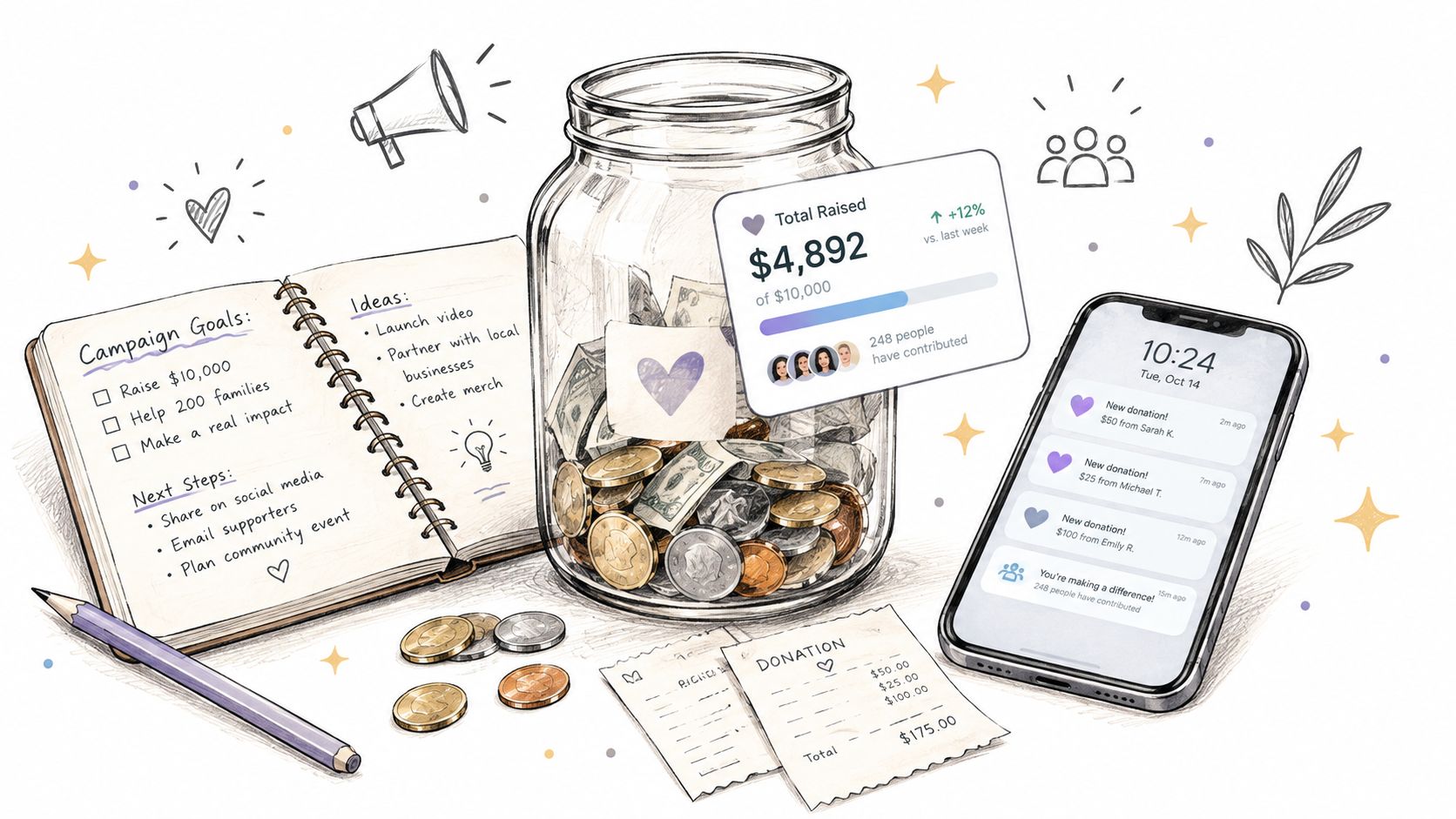
Introduce the responsible person with name and photo. Divide the budget into understandable items, such as materials, room use, counselling, or transport. Publish interim reports and explain deviations instead of only posting success stories.
A good campaign page contains at least:
- Concrete goal: A clearly defined task instead of a vague promise of help.
- Project responsibility: A reachable person or organisation with a traceable role.
- Budget breakdown: The most important expenses explained clearly.
- Progress display: Visible development from the start to implementation.
- Updates: Short reports with images, evidence, or results, as long as the privacy and dignity of those affected are preserved.
Data protection is not a side issue here. For families, children, and people in need, photos or personal stories may only be published with appropriate consent. Impact transparency does not mean disclosing private information.
Sadaka Requires More Than a One-Time Click
The Sadaka tradition draws attention to voluntary help and lasting benefit. This has a clear consequence for campaign management: do not communicate only the moment of donating, but the development of the project. Show what help became possible, what the next stage is, and how the community can contribute on an ongoing basis.
This strengthens the relationship between the organisation and its supporters. A campaign thereby becomes not a pure transaction, but an ongoing process of accountability. Further practical criteria for the design are described in the guide to crowdfunding for associations.
Trust cannot be replaced by a nice cover image. It arises when donors see that responsibilities are clarified, money is used for its intended purpose, and questions are answered.
Platforms, Payment Methods, and Fee Models Compared
Do not compare platforms first by design or reach. For a mosque, three questions matter: What fees apply, how is the organisation verified, and when is the money available? Only after that come features like campaign templates, social media integration, or progress displays.
The following table is deliberately formulated as a decision aid. Where providers can change their terms, reviews, or payout deadlines, you must check the current service description before starting.
Platforms for Social Crowdfunding Compared
| Platform | Platform fee | Payout | Verification | Suitability for mosques |
|---|---|---|---|---|
| Community's own solution | Depends on payment service and administration | Depends on payment provider and internal review | Must be organised and documented independently | Suitable with own administration, legal clarity and sufficient resources |
| General crowdfunding platform | Provider-dependent fees | Provider-dependent | Depends on provider and campaign type | Suitable when reach is more important than religious specialisation |
| Association-oriented platform | Provider-dependent fees and payment charges | According to platform rules | Proof of the association or organisation is often required | Suitable for registered associations with complete documentation |
| Specialised Sadaka platform | 0 percent platform fee under the model described in the briefing, voluntary tips possible | According to the platform's terms | Review of charitable status before activation | Suitable when Sadaka, community connection and public impact are to be brought together |
Payment methods without unnecessary hurdles
According to the provided fundraising analysis, PayPal remains a dominant online payment method in German practice. SEPA direct debit and other methods are also relevant, but should not be assumed. Offer at least two familiar payment methods and explain transparently whether additional payment charges apply.
Organisations too should look at their digital payment processes holistically. Anyone dealing with card payments can find, for example, in the article Paying rent and taxes by card practical tips on recurring payments and payment processes. For donation campaigns, however, the following still applies: the payment method must fit the purpose, the target group and the legal structure.
Fees are not automatically bad. They become problematic when donors cannot recognise them or when the organisation does not know what amount actually reaches the project. A platform with a 0 percent platform fee can be interesting for communities, provided that verification, data protection, payout and support also fit. A further decision-making aid is offered by the comparison of crowdfunding platforms in Germany.
The 30-day plan for your first campaign
A campaign should not go live as soon as someone spontaneously creates a donation button. In four weeks you can lay the most important foundations, provided responsibilities and deadlines are firmly set.
Week 1 defines the project
Formulate a single goal. Create the cost plan, name the target group and designate a responsible person. Also clarify who writes texts, selects images, answers queries and publishes updates.
Milestone: At the end of the first week, the project description, budget, distribution of roles and approval by the board or the responsible community leadership are in place.
Week 2 creates the technical foundation
Compare platforms by fees, verification, payment methods and payout. Open the required organisation account and submit documentation early. Create the campaign page with a real project photo, a clear story, the location of impact and a comprehensible budget breakdown.
Avoid generic wording. Describe what offer is being created, who it helps and which first stage is to be financed.
Week 3 activates the community
Don't start with just a single social media post. Announce the campaign at the mosque, inform existing supporters and ask several trusted individuals to share the campaign personally. Every ambassador needs a short, consistent explanation of the goal.
Milestone: Everyone involved can say in a few sentences what the funds are being raised for, how they will be used and where updates will appear.
Week 4 shows accountability
Publish an initial interim report, share suitable receipt photos and answer questions promptly. If costs or the timeline change, explain the reason openly. Announce the next project stage instead of stopping communication after the first call for donations.
After these 30 days, the work is not finished. Now begins the transition to a lasting funding structure with regular updates, recurring donations, funding applications and reliable partnerships.
SadakaNow offers verified mosques, aid organisations and social initiatives campaign pages with public progress information, multiple payment methods and a 0 percent platform fee. If you want to finance your social project transparently and launch your Sadaka campaign professionally, visit SadakaNow.