
Sadaqah jariyah meaning: sustainable giving explained
A donation can help today and be forgotten tomorrow. When does a good deed become a charitable act whose benefit continues permanently? This is exactly the question at the heart of the meaning of Sadaqah Jariyah. What matters is not just how much someone gives, but whether the gift creates a reliable benefit for others.
For donors in Germany, this religious principle connects two levels: sincere intention and verifiable project planning. A well, an educational facility or a long-term social project can have a lasting effect. But only clear responsibility, secured maintenance and traceable information show whether this effect is actually sustained.
Table of Contents
- What does Sadaqah Jariyah mean?
- The difference from one-time Sadaqa and Zakat
- Religious foundations and sources
- Examples of ongoing charitable acts
- Spiritual and practical benefits
- Modern forms of implementation and platforms
- Conclusion - Sustainable giving with meaningful impact
What does Sadaqah Jariyah mean?
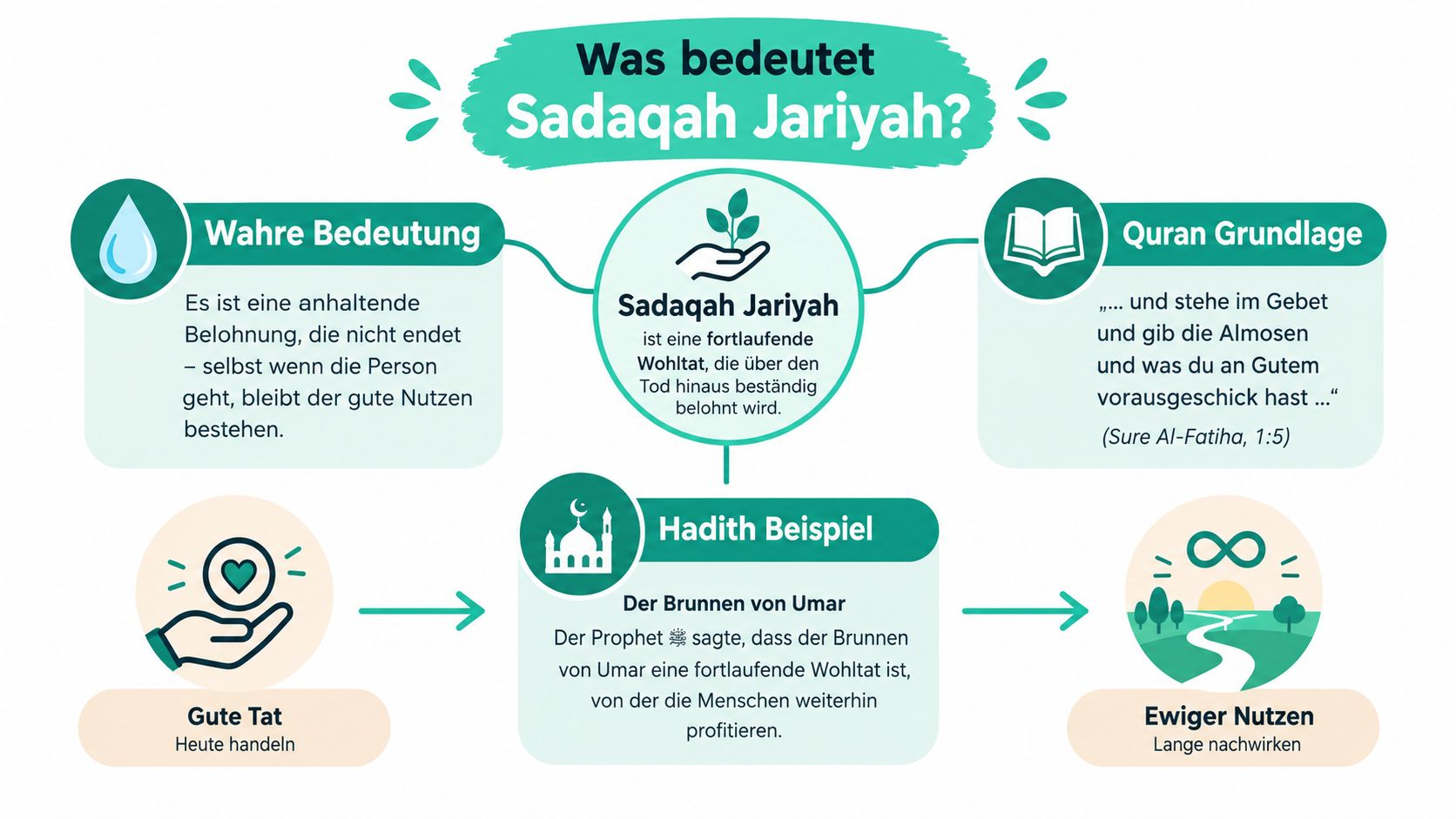
Sadaqah Jariyah refers, in the Islamic understanding, to an ongoing voluntary donation. Its benefit does not end with the handing over of money, but remains for a longer period and repeatedly benefits other people. The historical core lies in the idea that a good deed can continue to have an effect even after death, as long as it continuously helps people. The Deutsche Islam Konferenz describes Sadaqah Jariyah among other things using mosques, wells, schools, educational initiatives and long-term social projects as examples.
This is how Sadaqah Jariyah differs from a gift whose effect is intended only for a brief moment. A food donation can relieve acute need and is therefore a valuable Sadaqa. With Sadaqah Jariyah, an additional permanently usable value is created, such as a water source, a place of learning, or infrastructure that people use repeatedly.
The meaning of lasting impact
Intention remains central. A donation does not become Sadaqah Jariyah simply because it is intended for a large project. What matters is whether the project creates a benefit that extends beyond the moment of payment. The size of the gift also does not determine its permanence. A smaller contribution to a well-planned project can have a more sustainable effect than a larger payment without secured follow-up costs.
In practice, a simple check helps:
- Lasting value: Does it create an asset, a learning opportunity, or usable infrastructure?
- Responsibility: Is it clear who operates the project and makes decisions?
- Operation: Are maintenance, staff, spare parts or ongoing costs accounted for?
- Proof: Do supporters receive traceable information about progress and use?
Practical rule: Permanence is not a marketing claim. It must be evident in the benefit, in the responsible body, and in the financing of ongoing operations.
According to an estimate by the Deutsche Islam Konferenz, around 5.5 million Muslims lived in Germany in 2024, including around 3 million German citizens. The total population was approximately 83 million, making the Muslim share of the population around 6.6%. However, religious affiliation is not centrally recorded by official authorities, which is why this is an estimate. This societal base makes long-term projects in mosque communities, associations and civil society organisations especially relevant. Anyone who wants to understand the meaning of giving during Ramadan should therefore pay attention not only to the timing of the gift, but also to its long-term purpose.
The difference from one-time Sadaqa and Zakat
The terms are often mixed up in everyday use, even though they have different functions. Sadaqa is the general term for a voluntary good deed. It can be material, but it can also consist of a helpful act. Immediate support for people in need generally falls into this category.
Sadaqah Jariyah is a special form of voluntary Sadaqa. The difference lies in the logic of its effect: the gift enables a benefit that continues to exist repeatedly or over a longer period of time. A well, an educational facility or a permanently usable religious offering are typical examples. The tax classification of foundations in Nordrhein-Westfalen illustrates, from an organisational perspective, how a long-term preserved asset can be linked to ongoing returns for a defined purpose.
Three forms with different functions
| Form of support | Basic idea | Typical question to ask |
|---|---|---|
| Sadaqa | Voluntary help with no fixed duration | What need can I ease right now? |
| Sadaqah Jariyah | Voluntary help with a continuing benefit | What remains usable after my payment? |
| Zakat | Religious obligation with its own rules on calculation and eligible recipients | Am I fulfilling my Zakat obligation correctly? |
Zakat must therefore not simply be replaced by a Sadaqah Jariyah donation. It follows its own rules regarding calculation and eligible recipient groups. Anyone who is unsure should seek qualified religious advice for Zakat and plan voluntary Sadaqa separately from it.
Which donation fits the situation?
In an acute emergency, fast help counts. Food, medical support or short-term shelter can cover immediate needs. This impact is no less valuable just because it is not designed to last.
For a long-term need, a different kind of assessment is worthwhile. An educational space needs not just an opening, but also teachers, learning materials, electricity, maintenance and a responsible organisation. A water facility may need spare parts and regular checks. Without these conditions, a project may be planned to last, but it cannot actually function in the long run.
This distinction also guards against a common misunderstanding: Sadaqah Jariyah does not mean that a payment automatically has an endless effect. It describes an intention that must become concrete through a sustainable, recurring benefit.
Religious foundations and sources
The religious significance of Sadaqah Jariyah is based on the idea that good deeds can extend beyond a single moment. Whoever enables a facility from which people repeatedly benefit creates a benefit that is not limited to the original act of giving. At the centre of this are sincerity, the common good, and the hope that the effect of a good deed will endure beyond one's own life.
This spiritual perspective must not be played off against practical responsibility. A good intention does not automatically make a project lasting. It gives the action its religious direction, while planning and oversight ensure that the benefit actually continues.

From intention to verifiable impact
Several questions are helpful for religious classification:
- Niyyah, the intention: Is the gift given voluntarily and with the wish to benefit others?
- Benefit: Does the project reach people repeatedly or over a longer period of time?
- Responsibility: Is there a named body overseeing the purpose?
- Continuation: Is it regulated how operation and upkeep are financed?
- Transparency: Can supporters see what has been implemented?
These criteria are not a substitute for religious scholarship. However, they help donors avoid reducing a spiritual concern to a project sign or an emotional description. Especially with digital campaigns, the presentation should show how a payment turns into an ongoing benefit.
Intention opens the path. Reliable oversight keeps the benefit on that path.
The boundary with Zakat also remains important. Sadaqah Jariyah is a voluntary form of charity and does not automatically take on the calculation or recipient rules of Zakat. Anyone who consciously keeps the two separate can fulfil their religious obligations while also supporting a long-term project for the common good.
Examples of lasting good deeds
A well makes the principle easy to understand. The donation ends with the financing or installation of the facility, but access to water can afterwards repeatedly help people and families. Whether this actually becomes a lasting good deed depends on whether the source remains accessible, can be repaired, and is accompanied in its use by a responsible organisation.
A mosque can likewise serve as Sadaqah Jariyah. This is not just about constructing a building. The lasting benefit arises from a reliably operated place of prayer and gathering. Cleaning, maintenance, electricity, administration and a responsible community are therefore part of the impact planning.
Education as a passed-on benefit
A school or educational initiative has an effect that continues in a special way. People acquire knowledge, apply it, and possibly pass it on to others. The original donation then finances not only rooms or materials, but supports a process in which learning is passed on over a longer period of time.
This also applies to modern educational offerings. A digital learning platform, permanently accessible teaching materials, or a supervised online course can in principle fit into this logic. What matters is not the digital format or the modern name, but accessibility, content quality, technical maintenance, and clear responsibility for continuation.
Social infrastructure with a long-term purpose
A social project, too, can be set up to last. This includes, for example, rooms for counselling, a sustainably run care facility, or an initiative that gives people regular access to important services. A one-time provision of equipment is not enough if no one later takes over the operation.
Before making a donation, it is worth looking at concrete project data. A transparent project catalogue for Sadaka and long-term help should, as far as possible, make clear who is responsible, how long the benefit is expected to last, and what ongoing tasks are involved.
This small matrix can help with the personal decision:
- High benefit, clear maintenance: The project is a strong candidate.
- High benefit, unclear operator: Ask beforehand.
- Low lasting benefit, acute help: Valuable Sadaka, but not necessarily Sadaka Jariyah.
- Large scope of promises, few proofs: Caution and further review.
Spiritual and practical benefits
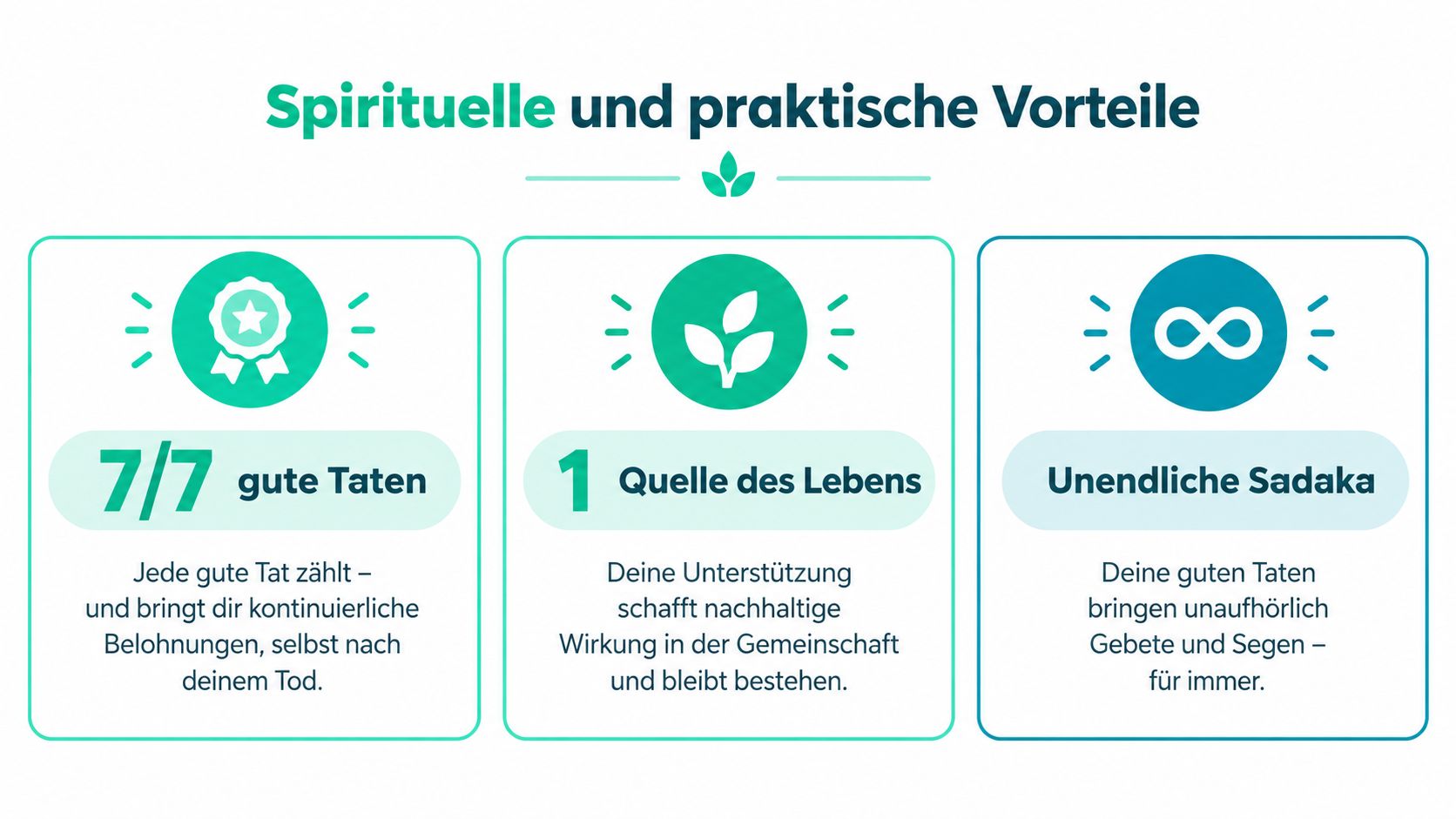
Sadaka Jariyah combines a religious wish with a social task. Spiritually, the gift is directed toward a good deed whose benefit continues. Practically, it can strengthen structures that support people not just once, but repeatedly. This connection makes the concept particularly tangible for communities in Germany.
A mosque, a place of learning, or a care project can enable encounters and foster trust within a community. Such places do not automatically create social cohesion, but reliably organised use can bring people together and promote shared responsibility.
Why permanence also matters in everyday life
One-time help often answers an immediate question: who receives support today? An ongoing project additionally raises a structural question: what condition will also help people later on? Both forms have their place. The decision should depend on the need and the quality of the project, not on the wish to present every donation as especially lasting.
For donors, this creates a further advantage: they can plan their support more deliberately. Instead of merely reacting to emotional urgency, they examine the goal, the operation, and the evidence. This strengthens their own informed judgement and can encourage communities to document projects better.
Impact does not only begin after the donation. It begins with the question of who receives the benefit — and who receives it once the initial funding has been used up.
Responsibility also changes for organisations as a result. They should not only state the construction or acquisition costs, but describe the entire lifespan of a project. This includes responsibilities, maintenance needs, funding sources, and regular updates. This allows supporters to combine spiritual hope with factual scrutiny.
Modern forms of implementation and platforms
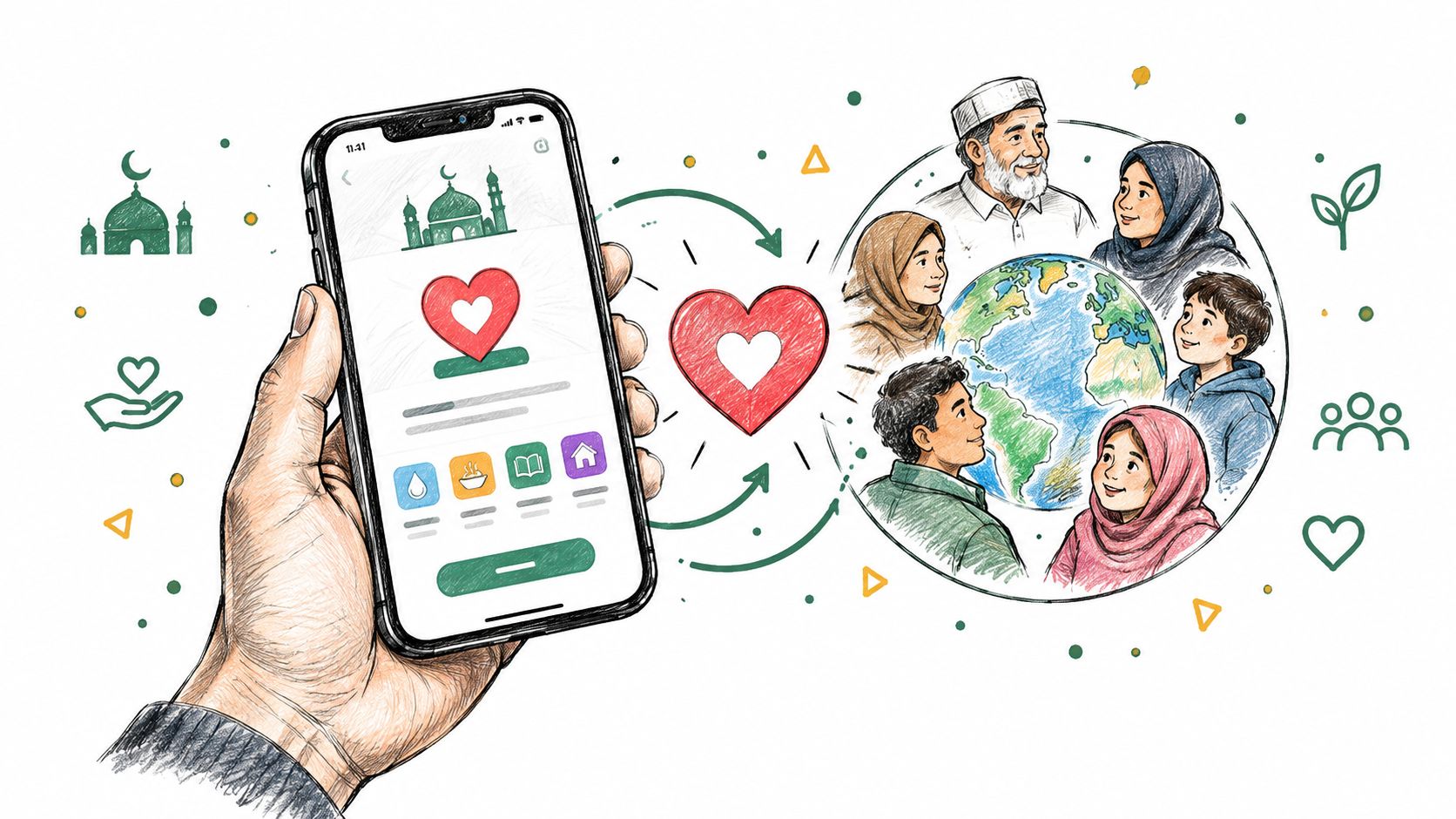
Digital donations make long-term projects easier to access, but they do not replace scrutiny. An appealing campaign page can spark interest. Whether a project is suitable as Sadaka Jariyah only becomes clear through its goal, operator, operational planning, and progress evidence.
The German donation market offers an important context for this. For 2024, private donations in Germany were reported at around 5.1 billion euros. Of this, 901 million euros went to church and religion, as shown by the analysis of donation purposes in Germany. For religious or church-related purposes, it also reports an increase of 138 million euros, or 3.5%, compared to the previous year. These figures do not prove that every religious donation is a Sadaka Jariyah. However, they do show that religious donations in Germany meet a relevant culture of giving.
How to properly check a digital campaign
Follow this order when looking at a long-term project:
- Read the purpose: Is it clear what concrete benefit is meant to be created?
- Check the operator: Is a responsible organisation named and verifiable?
- Understand the operation: Who takes care of maintenance, staff, and follow-up costs?
- Observe progress: Are there regular updates rather than just a final image?
- Compare payment information: Are fees, payment method, and use of funds presented clearly?
- Ask questions: What happens in case of overfunding, delays, or technical problems?
The question of trust is particularly important because long-term donations don't end with a one-time handover. The Deutsche Spendenmonitor reports for 2025 that respondents assumed on average that 60 % of their donation would reach the intended project, while they considered 75 % to be appropriate. In the same context, an average donation amount of 187 Euro is mentioned, compared to 174 Euro in the previous year. The donation rate fell from 50.2 % to 49.2 %. These figures show that a higher average gift does not automatically mean more trust.
A good platform should therefore provide information not only about the donation process, but also about its impact. For donors, a sober project page is often more valuable than a particularly emotional presentation. For communities and organisations, it also creates an incentive to openly document their planning, progress and accountability.
Conclusion - Donating Sustainably with Meaningful Impact
The meaning of Sadaqah Jariyah lies in the connection between voluntary charity and ongoing benefit. A well, an educational offering, a mosque or social infrastructure can help beyond the single payment. But permanence only comes about when ownership, operation, maintenance and documentation are secured.
Anyone who wants to donate sustainably should therefore bring two questions together: Is the intention sincere? And can the project continue its benefit in a traceable way? This turns a good feeling into a responsible decision that combines spiritual hope with practical transparency.
SadakaNow brings together verified Sadaqa projects and provides information on goals, progress and updates, so you can evaluate long-term projects more consciously. Discover suitable projects and support a donation with lasting impact on SadakaNow.