
7 Muslim Charitable Organisations at a Glance
Which muslim charitable organisation fits your donation goal? The name alone doesn't answer this question. Even a religious purpose, visible project photos, or a professional-looking website don't yet show whether an organisation matches your desired kind of help, region, and type of donation.
A meaningful comparison therefore looks at several signals at once: charitable status or verification status, fields of activity, local or international focus, suitability for Zakat and Sadaqa, donation receipts, payment methods, and how transparency is handled. It is especially important whether an organisation describes its donation purpose in a comprehensible way and reports regularly on how funds are used.
The following selection ranks seven muslim charitable organisations and one vetted project option according to these criteria. The ranking describes publicly recognisable features and does not replace a check of the current legal or financial circumstances. For SadakaNow, the platform can be especially relevant when vetted projects, public progress updates, and a platform fee of 0 % are the priority. You should verify current information on the respective project or organisation page before every donation.
Table of Contents
- 1. HDD Charity on SadakaNow
- 2. Islamic Relief Deutschland
- 3. muslimehelfen e. V.
- 4. WEFA Humanitäre Organisation e. V.
- 5. Hasene International e. V.
- 6. Zakat Deutschland e. V.
- 7. Help Dunya e. V.
- Comparison of the 7 muslim charitable organisations
- Which verification step should donors start with?
1. HDD Charity on SadakaNow
HDD Charity is listed on SadakaNow as a vetted humanitarian project option. The project page combines a description of the aid, visible verification features, donation options, and a direct forwarding to the organisation. For donors, this is a different approach than searching in a broad directory of organisations. Not only the operating body counts, but also the specifically chosen project.
The description refers to humanitarian aid, including in Somalia, and makes the donation purpose comprehensible on the project page. SadakaNow describes public progress and impact information for its projects. This allows supporters to check before payment which campaign they are choosing and what information will be available after the donation.
What speaks in favour of this option
- Unreduced forwarding: SadakaNow states a fee model with a 0 % platform fee. According to the platform's information, the donated amount is forwarded to the organisation without any platform deduction.
- Verification signals: Verification badges and public transparency pages make an initial assessment easier, but they do not replace a check of the specific recipient organisation.
- Direct project choice: The donation is assigned to a selected campaign instead of flowing only generally toward a large organisation's purpose.
- Payment methods: The platform supports SEPA, PayPal, and credit card, so different preferences for donation processing are accommodated.
- Public updates: Progress information and an impact report help track the development of a campaign.
The limitation lies in the selection. A specialised, vetted project directory may exclude local groups that have not yet gone through a verification process. Tax deductibility and receiving a donation receipt may also depend on the donor's country and the partner's legal status. Anyone who wants to better understand the platform approach can find additional information in the article about a fundraising platform in Germany.
Practical rule: Before submitting, check whether the project purpose, recipient, payment confirmation, and possible donation receipt fit your personal situation.
More on the specific campaign can be found on the HDD Charity project page on SadakaNow.
2. Islamic Relief Deutschland
Islamic Relief Deutschland is one of the established Muslim-affiliated aid organisations in Germany. The organisation was founded in 1996 and has been active as a donation organisation in Germany ever since. In 2008, it was the first Islamic organisation to be admitted to the Association of German Development NGOs (VENRO). This development is more than a historical footnote. It shows how Muslim aid organisations have built institutional recognition and professional structures within the German NGO sector. The historical details are documented in the retrospective by Islamic Relief Deutschland.
The offering includes international humanitarian aid, development cooperation and campaigns with a religious focus, such as Ramadan and Kurban. At the same time, the organisation refers to its efforts during flood disasters in Germany. In this way, Islamic Relief combines international work with a local presence, which can be of interest to donors who don't want to help only abroad.
In its annual report for 2024, Islamic Relief Deutschland lists 47 projects and assistance for 3,338,728 people. These figures come from the overview of projects and aid provided, or the organisational context linked there. This scale makes the organisation a relevant reference point among Muslim aid organisations in Germany. Anyone looking for a wide range of projects, regular reports and a formally developed donor service will find a suitable structure here.
What this means for donors
The advantages lie in the thematic breadth, international experience and available reporting structure. At the same time, donors should factor public debates about partnerships and institutional relationships into their own due diligence. What matters most is whether the specific donation purpose, use of funds and current reporting are traceable.
The Islamic Relief Deutschland website is a good first point of reference for annual reports, project information and current donation options.
3. muslimehelfen e. V.
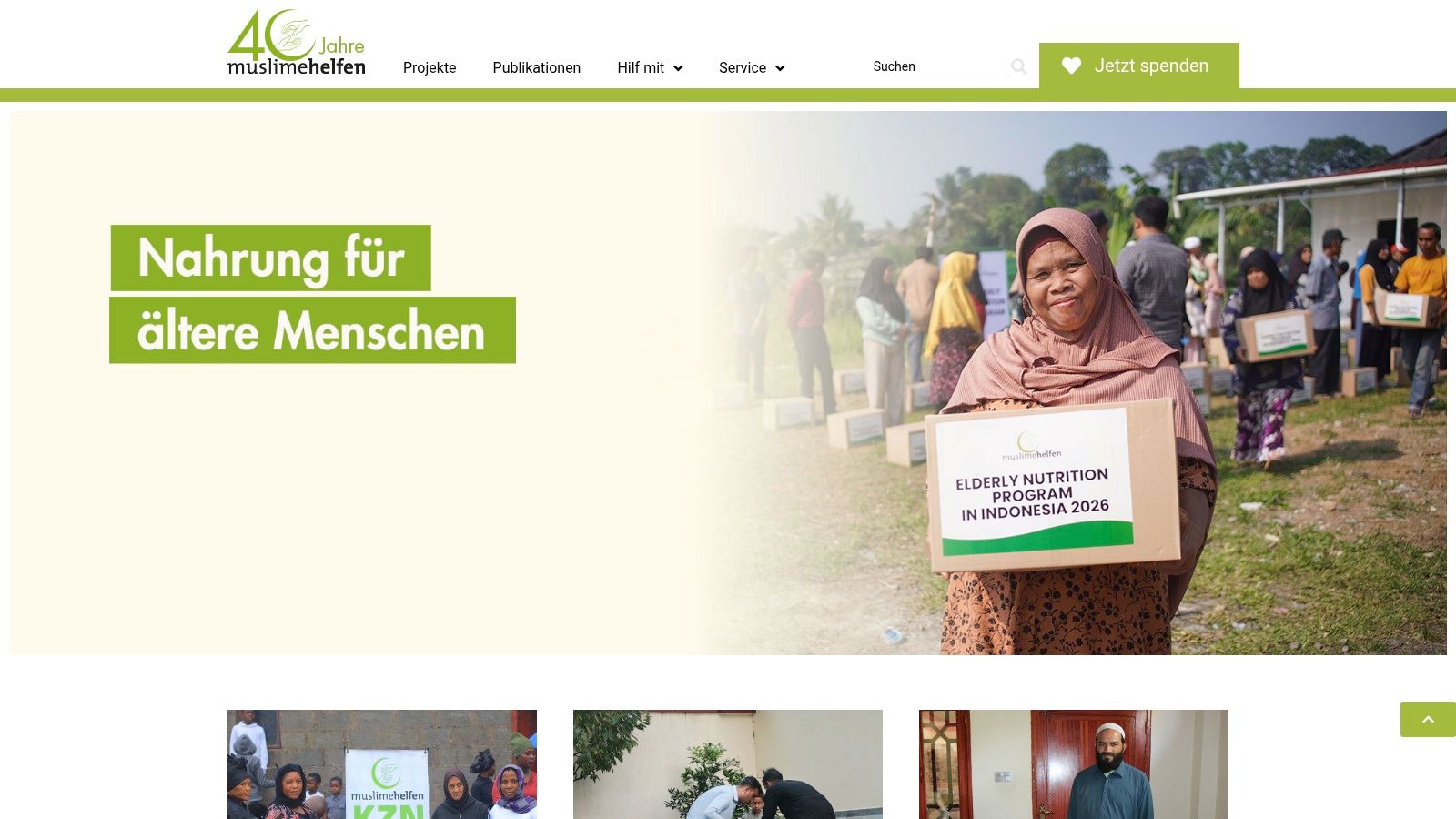
muslimehelfen e. V. particularly appeals to people who want to explicitly categorise their donation as Zakat or Sadaqa. The organisation has been established in Germany since 1985 and, according to its public presentation, works with local partners in various countries. Its focus is on classic areas of aid such as food assistance, emergency relief, health and education.
The key difference from a broadly positioned platform lies in the religiously shaped donation logic. Anyone specifically looking for an organisation that clearly separates or communicates Zakat and Sadaqa projects can more easily match the offerings to their own intention. This reduces a common source of confusion: a donation for general emergency relief is not automatically the same as a Zakat payment with its own conditions.
Transparency and tax questions
muslimehelfen regularly communicates about its projects and offers a donation magazine. According to the organisational information provided, donation receipts are possible. For practical purposes, you should still check whether the receipt for your specific donation is issued automatically or must be requested separately.
An important point to check is the status with the German Central Institute for Social Issues (DZI). muslimehelfen does not hold a DZI donation seal. This alone proves neither good nor bad work. However, it does mean that donors should give more weight to other documents, such as annual reports, information on partners, earmarking of funds and details on the use of funds.
Anyone wanting to direct their Zakat deliberately should not only read the project's stated purpose but also check the definition of recipients and the intended use.
The muslimehelfen website presents its own projects and donation channels. Additional guidance is offered in the article on donating to social projects, especially if you want to compare organisational donations with project-related online donations.
4. WEFA Humanitarian Organisation e. V.
WEFA is aimed at donors who want to bundle several religious and humanitarian donation purposes on a single organisation's page. According to its public presentation, the offering includes Zakat, Sadaqa, Kurban, orphan support, water projects, education, health and emergency relief. This thematic breadth can be practical when a family or community regularly supports different campaigns.
The organisation is present in Germany with contact points and donation information. Online, seasonal campaigns such as Kurban are addressed alongside longer-running areas of aid. For your choice, the sheer number of categories therefore matters less. What's more important is whether the page clearly distinguishes the conditions of each purpose, the recipient and the planned use.
Strengths and open points to check
One advantage is the combination of German accessibility and international project work. Bank details, addresses and digital donation channels can simplify contact. For communities that want to communicate seasonal campaigns, a broad campaign structure also offers a comprehensible starting point.
As a limitation, the missing DZI verification should be taken into account. The research provided notes that information for a DZI assessment was still outstanding. This is not a final judgement on the organisation. However, it is a signal to request further transparency documents directly before making a larger or recurring donation.
- Check the purpose: Read whether Zakat, Sadaqa and Kurban are shown separately.
- Check the recipients: Pay attention to whether the organisation describes target groups or specific project regions.
- Check contact details: Use the German contact details provided if information on certification or use of funds remains unclear.
The WEFA website provides direct access to donation options, campaigns and contact information. Especially with seasonal donations, you should check the conditions currently displayed once more before making a payment.
5. Hasene International e. V.
Hasene International e. V. is particularly interesting for donors who want to handle religious seasonal campaigns easily online. The offering focuses on Kurban or sacrifice campaigns and also includes Zakat, Fitra and Adak. In addition, emergency aid as well as social and educational projects are presented internationally.
The strength lies in the clear campaign logic. Anyone looking for a specific religious form of donation during Ramadan or at the Feast of Sacrifice can go directly to the appropriate category. The notes on proxy (Vollmacht) and Niyya are particularly relevant here, as they explain the religious procedure of commissioning. Before making a payment, however, it should be clear whether the donation is allocated to a general campaign or to a specific region.
Payment processing in comparison
Hasene lists several payment methods, including SEPA direct debit, PayPal, SOFORT and credit card. A wider selection lowers practical barriers, but it does not yet say anything about allocation of purpose or proof of impact. Donors must assess these two questions separately from payment convenience.
A DZI donation seal is not shown in the information provided. Transparency communication therefore takes place mainly through the organisation's own channels. This can include sufficiently informative documents, but should lead to a direct review of annual information, project reports and donation receipts.
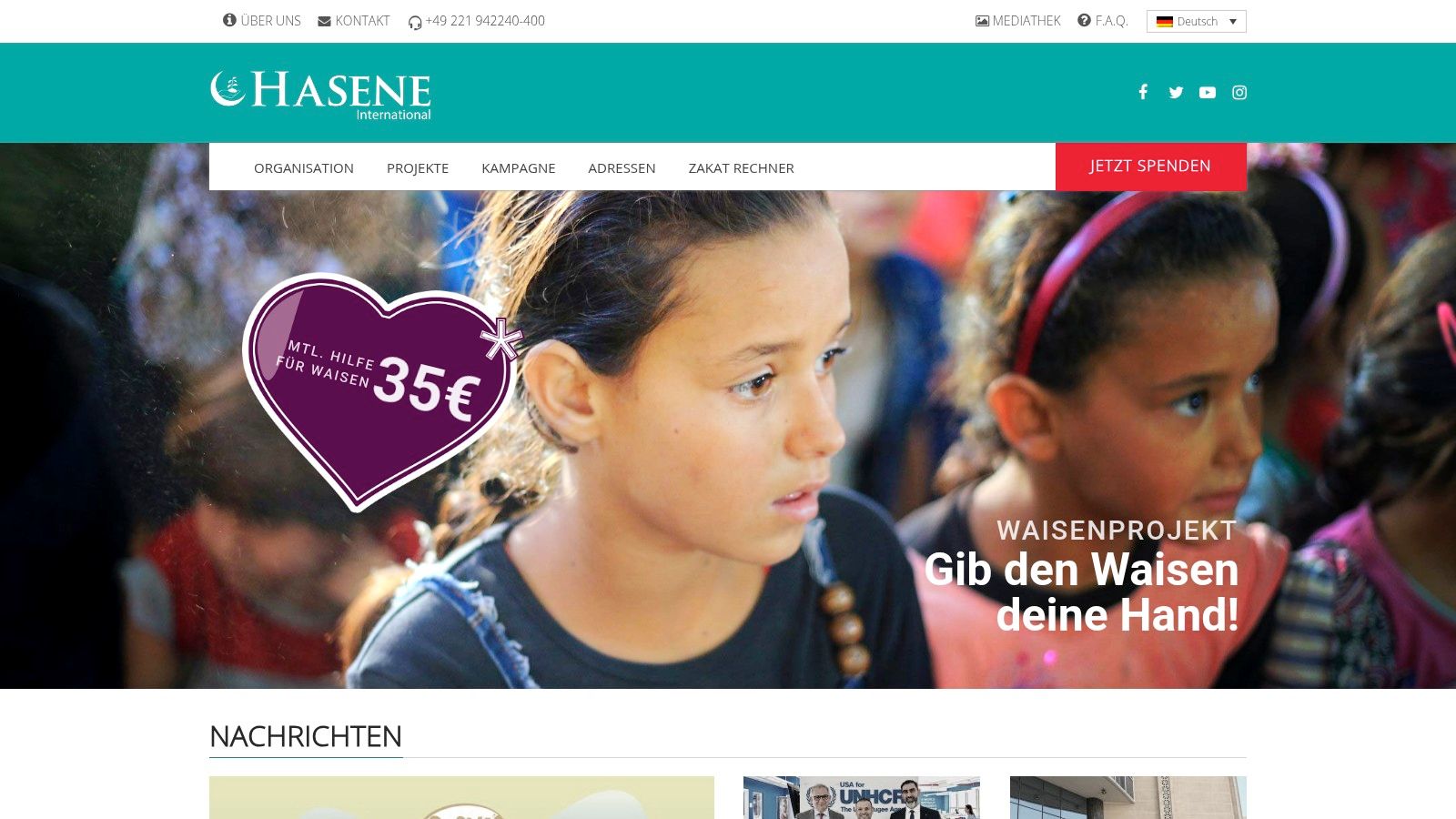
Simple payment is an advantage of the process, but it is not proof that the allocation of purpose and use of funds are adequately explained.
For people with a clear Kurban, Zakat or Ramadan goal, Hasene can be an obvious option. Anyone looking for ongoing, locally traceable aid, on the other hand, should check whether the campaign offered actually enables this regional precision. The German website of Hasene shows the available donation categories and current payment methods.
6. Zakat Deutschland e. V.
Zakat Deutschland e. V. sets a different focus than international aid organisations. The association concentrates on the practical implementation of Zakat in Germany, placing the verification of recipients at the forefront. For donors who want to help locally in a deliberate way and do not want to mix the religious allocation of purpose with general foreign aid, this approach is particularly relevant.
The donation categories are presented separately. These include Zakat, Sadaqa, Riba levy and Kaffara. Such a division creates orientation, because the donor does not have to work out themselves from a general project list which purpose matches their own intention. The published allocation guideline is a further signal of structured distribution of funds.
Local purpose instead of a broad project portfolio
The focus on Germany changes the decision. Anyone wanting to support a well campaign or emergency aid abroad will not necessarily find the same selection at Zakat Deutschland as with internationally active organisations. Anyone wanting to support eligible recipients in Germany, on the other hand, can regard the regional focus as a key advantage.
A digital Zakat tool in the payment area is intended to support calculation and classification. Such tools can simplify use, but they do not replace personal religious advice when the type of assets, obligation or recipient eligibility is complicated.
The organisation is comparatively young and, in the information provided, has no discernible DZI listing. This does not imply any assessment of its aid impact. It means that the published guidelines, recipient definitions and contact options should be read particularly carefully.
- Local intent: Suitable for people who want to use Zakat specifically in Germany.
- Clear categories: The separate purposes make it easier to allocate the payment.
- Need for review: For individual religious questions, expert advice should additionally be sought.
The website of Zakat Deutschland explains the approach and the digital donation channels. For seasonal donation decisions, the overview on donating in Ramadan can also be helpful.
7. Help Dunya e. V.
Help Dunya e. V. combines international project work with local aid in Germany. The public presentation mentions, among other things, water projects, orphan support and emergency aid. Countries such as Bangladesh, Ghana, Somalia, Kenya and Yemen, as well as Gaza and Germany, are listed as project regions. This makes the organisation suitable for donors who base their decision strongly on countries or visible project types.
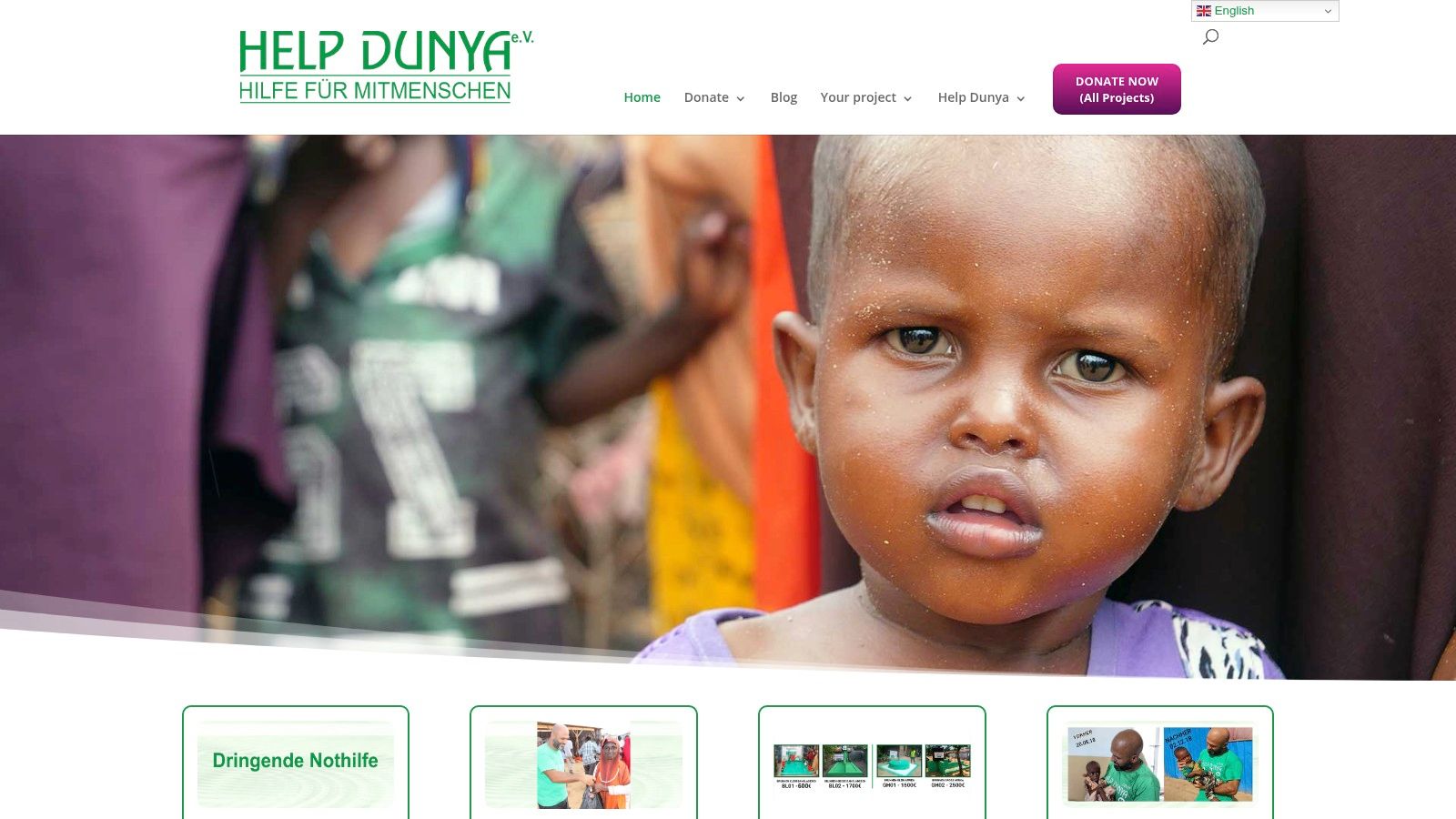
The communication works with photos, videos and before-and-after presentations. For water projects, project categories and price details are also shown. This form of presentation makes results quickly understandable, but should not be confused with a complete financial review. Images show what has been implemented on site. Annual reports and financial statements additionally show how an organisation uses funds overall.
Reading project allocation correctly
Help Dunya is suitable for people who value concrete results and media documentation. At the same time, a donation can be tied to a project category without the donor being able to select a specific location or a particular family. This distinction should be clearly recognisable on the project page.
Donation receipts can be issued based on the information provided. Nevertheless, check whether the receipt is sent automatically, what data is required for it, and whether the organisation clearly indicates the purpose of the donation on the confirmation.
Photos and videos increase vividness. For a reliable decision, you additionally need information on the recipient, the earmarking, and reporting.
Anyone who prefers concrete international projects can put Help Dunya on their shortlist. Anyone looking for a formally reviewed campaign comparison with consistent platform information, on the other hand, should compare the organisation's page with a directory such as SadakaNow. The website of Help Dunya offers access to projects, donation options and information about the organisation.
Comparison of the 7 Muslim relief organisations
| Organisation | 🔄 Implementation effort | ⚡ Resource requirement | ⭐ Expected results | 💡 Ideal use cases | 📊 Main advantages |
|---|---|---|---|---|---|
| HDD Charity | Low: platform listing, verified processes | Low: SadakaNow handles payment processing (SEPA, PayPal, card) | ⭐ High: direct disbursement, fast emergency aid, public updates | Sadaqa/quick aid; acute deployments (e.g. Somalia) | 100% forwarding; verification; transparent reports |
| Islamic Relief Deutschland (IRD) | Medium–high: large, structured organisation | High: extensive programmes and administrative resources | ⭐ Very high: broad programme range, proven internationally | Large-scale projects, emergency aid, Ramadan/campaigns | Broad portfolio; annual reports; formal compliance (Spendenrat) |
| muslimehelfen e. V. | Medium: established processes since 1985 | Medium: local partners and ongoing projects | ⭐ Good: reliable Zakat/Sadaqa projects and communication | Zakat/Sadaqa earmarked donations, orphan and emergency aid | Clear outreach to religious donors; donation receipts |
| WEFA – Humanitäre Organisation e. V. | Medium: campaign and logistics effort (Kurban etc.) | Medium–high: campaign logistics, local presence | ⭐ Good: broad thematic coverage, seasonal reach | Large seasonal campaigns (Kurban, Ramadan), emergency aid | Broad range; German contact points; online payment options |
| Hasene International e. V. | Low: mass-market online processing | Low–medium: many payment methods, simple processes | ⭐ Solid: efficient handling of large campaigns | Kurban/sacrifice, Ramadan, simple online donations | Very simple donation process; numerous payment options |
| Zakat Deutschland e. V. | Medium: structured review and allocation guidelines | Low–medium: locally focused distribution, digital tools | ⭐ Targeted impact: transparent, locally verified Zakat distribution | Local Zakat distribution; donors who want precise, verifiable aid | Clear categories; allocation guideline; digital Zakat assistant |
| Help Dunya e. V. | Medium: project-oriented implementation with documentation | Medium: project funding + media/documentation effort | ⭐ High: visible before-and-after results, concrete outcomes | Well construction, orphanages, project-based donations with proof | High result visibility; transparent cost details; donation receipts |
Which review step should donors start with?
Don't start with the payment method, and not with the most emotionally striking photo either. First decide which donation purpose should be fulfilled and whether you want to help locally in Germany, internationally, or in a specific region. Then check whether your payment is intended as Zakat, Sadaqa, Kurban, Fitra, Kaffara, or general emergency aid.
In the next step, you read the recipient definition and the purpose restriction. An organisation may offer many categories, but the specific campaign may still only be used for a particular type of project or region. If you are making a religiously bound donation, the page should explain who the intended recipients are and how the organisation makes this selection.
Only after that should you compare verification and transparency information. Look for a traceable charitable status, annual reports, information on audits, details on the use of funds, and reachable contact persons. A missing DZI seal is not automatically a reason for exclusion. However, it increases the value of other verifiable documents.
The quick check before you donate
- Project page: Is the purpose clearly described, and is the region named?
- Recipients: Can you find out who receives the help and by which criteria?
- Report: Are there current progress updates, project updates, or annual information?
- Fees: Is it explained whether part of the donation is used for platform or processing costs?
- Receipt: Is it clear whether you will receive a donation receipt and what conditions apply?
- Contact: Can you ask a specific question about the use of funds before making the payment?
SadakaNow can be interesting for donors who want to combine verified campaigns, public project information, and a platform fee of 0%. The platform supports SEPA, PayPal, and credit card, and describes public progress as well as verification features for listed projects. Here too, you should check the current details on the respective project page, especially regarding recipient status, purpose restriction, and donation receipt.
The data on donation willingness shows why this check is practically important. The Maecenata Foundation cites an average annual donation of 452 euros for Muslim donors in Germany and compares this figure to the reference value of 143 euros per donation in Germany from the Deutscher Spendenmonitor 2019. The figures can be found in the classification of Muslim philanthropy in Germany. The larger or more regular the support, the more important a clear purpose restriction, reliable reports, and dependable processing become.
The best organisation is therefore not automatically the most well-known one. It is the one whose purpose, recipients, transparency, and payment process match your specific donation intention.
SadakaNow brings together verified projects from Muslim organisations, communities, and social initiatives and forwards donations without a platform fee. If you want to compare Muslim aid organisations by project purpose, transparency signals, and secure payment methods, visit SadakaNow.