
Islamic Community Germany: 7 Associations at a Glance
Which islamic community suits your concern? At first, the question sounds like a search for the nearest mosque. In fact, people often mean very different things by "islamic community Germany": a local congregation, an umbrella association, educational offerings, youth work, pastoral care, political representation of interests, or a reliable way to give Sadaqa and other donations.
An umbrella association is not the same as a local association. The association bundles interests, offerings or organisational structures, while the local community operates actual premises, organises events and provides points of contact for everyday matters. Legal form, regional accessibility, linguistic orientation, transparency and the relationship between the local association and the national level also differ.
The following overview compares seven well-known structures. It does not make blanket judgements, but shows which concerns make a particular association or community especially relevant, and where follow-up questions are worthwhile. For context on political and social communication, the guide to political communication offers additional background.
Anyone wanting to support a specific local project will find vetted campaigns on SadakaNow with public project information, several payment methods and no platform fee for donors. Communities can launch their own donation appeals there and keep supporters informed about progress.
Table of contents
- 1. DITIB Solingen mosque construction project
- 2. DITIB Türkisch-Islamische Union der Anstalt für Religion e. V.
- 3. Zentralrat der Muslime in Deutschland e. V.
- 4. Islamrat für die Bundesrepublik Deutschland e. V.
- 5. Ahmadiyya Muslim Jamaat Deutschland
- 6. VIKZ Verband der Islamischen Kulturzentren e. V.
- 7. IGMG Islamische Gemeinschaft Millî Görüş e. V.
- Quick comparison: 7 islamic communities in Germany
- From comparing associations to finding the right community
1. DITIB Solingen mosque construction project
The DITIB-Türkische Islamische Gemeinde zu Solingen e. V. mosque construction project is an example of a clearly defined local campaign. The focus is not general association work, but a specific undertaking in Solingen: building a permanent place of prayer and community for the local Muslim population.
The project page for the DITIB mosque construction project in Solingen brings together background information, the current project status and public progress figures. Supporters can follow the development through regular updates and the visible donation progress. This makes a difference compared to a general donation appeal, where the purpose, organiser and use of funds are often only described on social media.
SadakaNow verifies partner status before activation and forwards donations without a platform fee. SEPA, PayPal and credit card are available as payment methods. The platform also states SSL encryption and PCI-DSS Level 1 as security standards. These details do not replace one's own due diligence on the organiser, but they do provide a traceable basis for the digital processing.
Who the project is suitable for
The project appeals mainly to people who want to support a tangible local construction project. The funds are tied to a location and a purpose that can be followed through project updates, goals and progress indicators. Besides its religious function, the planned place of prayer and community can also enable social encounters and community work.
Practical questions remain important for donors nonetheless. Construction projects can change due to permits, planning or building phases. Anyone donating should therefore pay attention to updated information on the timeline, milestones reached and the further use of funds. For larger contributions, the relationship between the local association and the DITIB structure should also be clarified directly with the organiser.
Practical rule: A transparent campaign not only answers what money is being raised for, but also shows who is responsible, what progress has been made, and when new information will appear.
An additional point of comparison is offered by the DITIB project of the Türkisch-Islamische Gemeinde zu Solingen. Those who want to specifically fund social projects can also use the guide to financing social projects.
Advantages
- High traceability: The campaign combines organiser information, progress display and regular project updates.
- Simple payment methods: SEPA, PayPal and credit card lower the barrier for different groups of supporters.
- Local purpose: The donation goes towards a concrete project in Solingen.
- Public development: The Sadaka Pulse feed and project information make the progress visible.
Possible disadvantages
- Planning risks: In a construction project, individual phases or deadlines may change.
- Need for review regarding the association structure: Donors who want to assess governance and institutional ties in more detail should request additional documents from the association.
- German project language: Those who need additional information in another language may need to ask the organiser directly.
2. DITIB Turkish-Islamic Union of the Institution for Religion e. V.
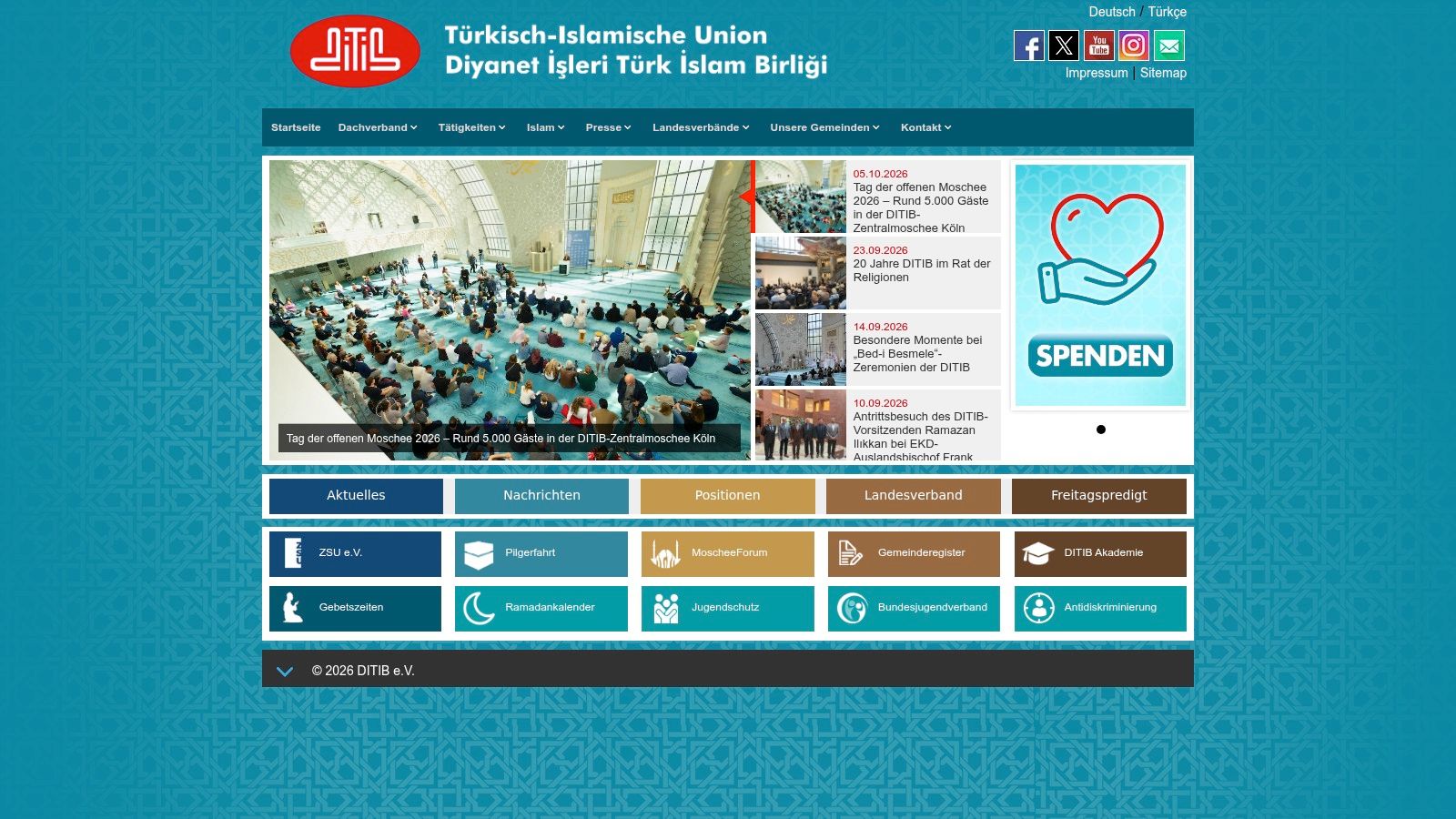
DITIB is one of the nationally known Islamic associations and is present through numerous local mosque associations and community centres. The structure combines religious services, educational work, social offerings and youth work with an overarching organisation. For people looking for a community with established infrastructure and a recognisable link to an association, DITIB is therefore often an obvious starting point.
The official DITIB website provides information on religious, social and organisational topics. However, the local association remains decisive for a concrete assessment. Local congregations are legally independent associations, even though they may be organisationally linked to the national federation. Interested individuals should therefore ask the respective congregation directly about opening hours, prayer language, lessons, offerings for women, youth groups and counselling.
Between local proximity and overarching structure
Depending on the location, families will find prayer offerings, educational formats, youth groups or events. A local DITIB congregation can also be a well-recognisable point of contact for municipalities and initiatives, provided it communicates regularly and is present in the neighbourhood. The nationwide network of congregations makes it easier to find an accessible association, but on its own says nothing about its actual work.
The role of imams sent or financed from Turkey is also publicly discussed. At the centre of this are questions about state influence, religious leadership and organisational independence. These debates describe the association structure, but do not automatically assess the community life at a particular location. Those choosing a congregation should therefore consider both levels separately.
For donations, what matters is the local organiser, the legal form and the purpose of the appeal. For digital campaigns, clearly stated goals, regular updates and traceable information on the use of funds provide guidance. SadakaNow can present such information in a bundled way, but it does not replace a conversation with the association. Those who want to specifically fund social projects will find further verifiable criteria in the guide to financing social projects.
Suitable for
- Prayer and community life: The nearest DITIB congregation can be an established local meeting point.
- Families and young people: Depending on the association, educational, youth and social offerings exist.
- Organised cooperation: Municipalities and initiatives often find clearly recognisable association structures.
Before making a decision, interested individuals should clarify the scope of the local offerings, the channels of communication and the connection to the national federation. For donations, it should also be distinguished whether it concerns a general membership contribution or a purpose-bound construction or social campaign.
3. Central Council of Muslims in Germany e. V.
What role should an Islamic umbrella organisation take on, and how can its practical benefit on the ground be measured? The Zentralrat der Muslime in Deutschland, or ZMD for short, operates as an advocacy group and association of Muslim organisations. The focus is on representation, dialogue, press work and political communication. Its profile is therefore oriented more towards nationwide public presence than towards the daily operation of individual prayer rooms.
On the website of the Zentralrat der Muslime there are statements, news and information on social topics. The content is relevant for media, politics, institutions and interested individuals who want to understand Islamic association work at the national level. The ZMD bundles positions and contacts, while concrete offerings generally lie with member organisations or local associations.
Public voice and practical selection criteria
Nationwide visibility is one of the clear strengths of the ZMD. The association can bring topics into public debates, accompany dialogue formats, and communicate the perspectives of affiliated organisations to media, politics, and other institutions. For political education, press inquiries, or the search for a nationwide point of contact, this function can be helpful.
Alongside position-building work come its networking function and contacts between member organisations. The ZMD's offerings can also include digital or international formats. Anyone interested in these should check whether an offering is organised by the national association itself or by an affiliated association.
For prayer times, rooms, lessons, pastoral care, and local events, the respective local association remains the right point of contact. The practical support, regional proximity, and accessibility differ depending on the member organisation. The public question of which organisations an umbrella association organisationally represents should also be taken into account when assessing it. Statements by the ZMD are therefore to be read as positions of the association and its affiliated structures, not automatically as the voice of all Muslims in Germany.
An umbrella association helps with classification at the federal level. In everyday life, what usually matters most is the quality of the local community.
Anyone wishing to donate or start their own SadakaNow campaign should clearly state the organisation, the purpose, and the responsible point of contact. For an initiative by a member association, different standards of scrutiny apply than for a statement by the national association. Transparent information about the goal, regular updates, and traceable information on the use of funds make the decision easier. Organisations should also clarify, before any cooperation, whether they are working with the ZMD or with a member association.
4. Islamic Council for the Federal Republic of Germany e. V.
Parents looking for religious education for their children often first ask about teaching qualifications, language of instruction, age groups, and the responsible contacts. For schools and educational initiatives, such questions can be more important than an association's public visibility. The Islamic Council sets priorities in religious education, Islamic religious instruction, theological qualification, and pastoral care.
The website of the Islamic Council provides information about the association's work and current topics. The association brings together positions of Islamic religious communities and associations. Courses, counselling, instruction, and pastoral care, however, are often organised by member organisations or local communities. For this reason, it should be clarified before making contact which level is actually responsible and how well it can be reached regionally.
Anyone viewing an Islamic community in Germany as a space for education and counselling can assess the offering using concrete questions: Is there instruction for children, training courses, theological discussion formats, or pastoral care? Which languages are used? What qualifications do the teachers have? Are there fixed contact persons and current dates? Membership in the umbrella association does not automatically answer these questions.
For schools and municipalities, it also matters whether the planned cooperation is agreed with the Islamic Council, a member association, or a local association. Through a personal conversation, families usually get a reliable picture of instruction, counselling, and accessibility more quickly.
In favour of such a classification speak the focus on education, the network of religious communities, and possible offerings in pastoral care and participation. What still needs to be checked are the local offering, the responsible level, and the currency of contact details, project descriptions, and dates. For donations or an own SadakaNow campaign, the organisation, purpose, and responsible point of contact should be clearly stated.
Public debates about individual sub-organisations are part of assessing the association, but they do not replace examining the specific local community. What matters, therefore, is both accessible association information and traceable information from the local organisation.
5. Ahmadiyya Muslim Jamaat Germany
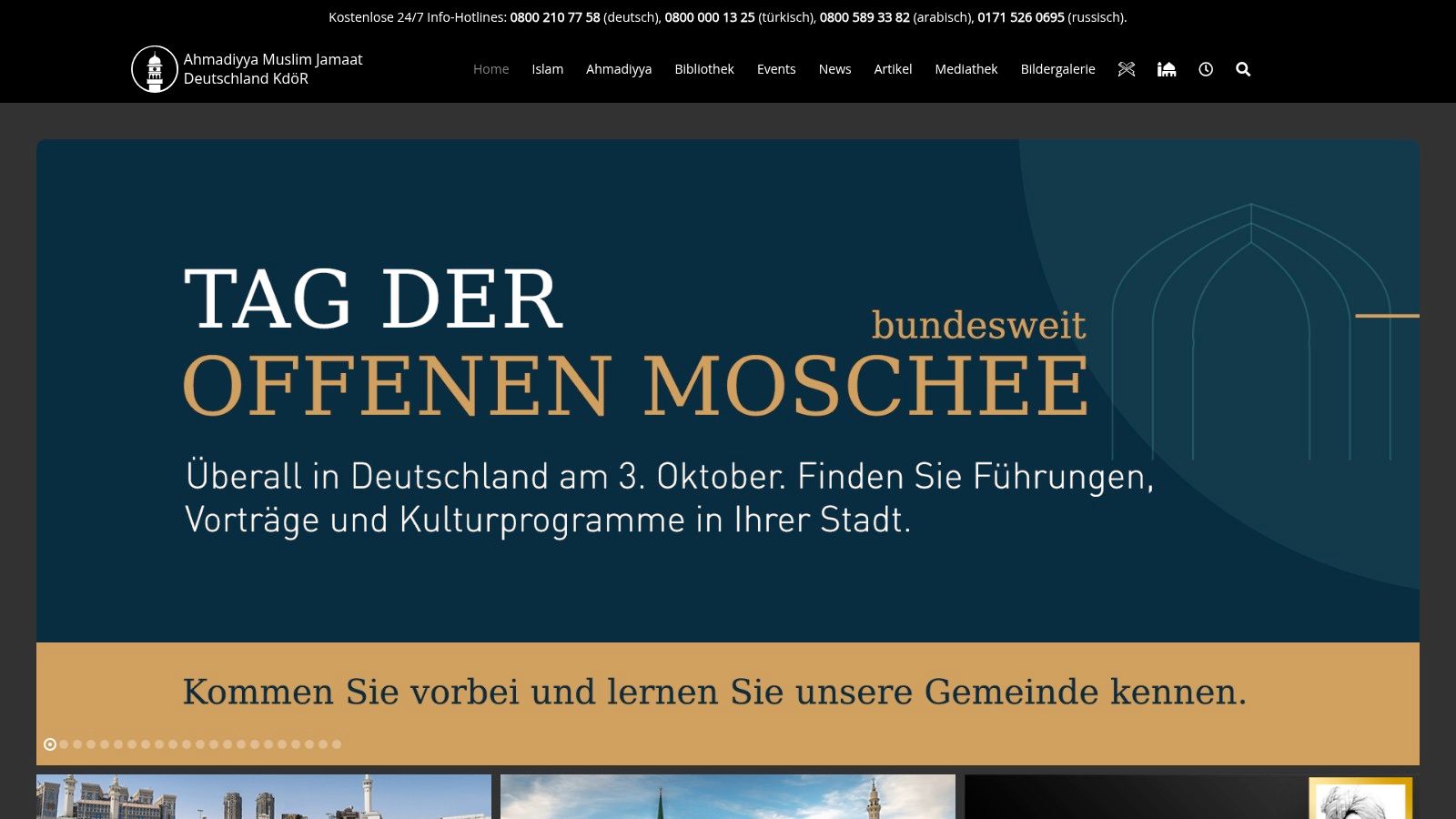
Which criteria matter when an Islamic community in Germany is assessed for a visit, educational work, donations, or an institutional cooperation? The Ahmadiyya Muslim Jamaat Germany presents itself as an independent Islamic religious community with communities, mosques, educational offerings, and centralised public relations work. According to its own account, structures in parts of Germany are recognised as a public-law corporation, including in Hesse. For schools, municipalities, or social organisations, this legal framework can play a role in choosing formal points of contact.
The website of the Ahmadiyya Muslim Jamaat Germany publishes German-language information, events, sermons, and publications. This makes central contacts and current content comparatively easy to find. At the same time, the community has its own distinct theological profile. Other Muslim associations and communities evaluate or shape cooperation with the Ahmadiyya to varying degrees of closeness.
Independence and cooperation on the ground
Ahmadiyya is organised as its own religious community. This includes its own theological training structures, congregations and publications. Anyone considering a visit, an educational cooperation or a donation should therefore examine both the religious profile and the specific organisational form at the respective location.
The central structure can offer clear lines of communication, regular German-language content and a clearly recognisable public profile. For other interested people, a congregation that is more strongly rooted in a regional association network or a different theological spectrum may be more suitable. The federal level does not automatically describe the services available at a local congregation.
An example from Hesse: before a school cooperates with an Ahmadiyya congregation, it can clarify which local body is responsible, who formally agrees to the cooperation and which services actually take place. Topics, scheduling arrangements, liability and lines of communication should likewise be recorded in writing. The community's KdöR status does not replace this review, but it can help to classify the institutional framework.
For donations and launching a SadakaNow campaign, the community, local congregation and specific project should be clearly named. The purpose of the funds, the responsible contact person and the form of progress documentation should also be identifiable. This makes it possible to distinguish Centrally organised communication, German-language educational work and Formal cooperations from the conditions at the respective location. The Theological profile and regional differences remain equally relevant to the decision.
6. VIKZ Association of Islamic Cultural Centers e. V.
The Verband der Islamischen Kulturzentren, VIKZ, combines long-standing congregational work with religious education, support for young people and its own institutions. According to the association, these include youth and student dormitories as well as the training of imams in Germany. This means the profile goes beyond regular mosque attendance and also covers care and qualification.
The VIKZ website provides information on congregations, educational offerings and the association's development. The publicly described profile also includes the expansion of infrastructure, including a new association headquarters in Cologne. For interested people, the VIKZ is therefore particularly relevant when Long-term educational work, housing offers and a recognisable nationwide organisation need to come together.
How this structure works in practice can be seen at different locations. In a congregation with an active youth dormitory, families and students may find fixed care and educational offerings. Conversations about house rules, responsibilities and daily life show there how closely housing, religious guidance and congregational work are connected. Another location, by contrast, may have a lower public profile and communicate events, contact persons or educational hours only to a limited extent to the outside. Regional visibility alone therefore says little about the actual work being done.
With VIKZ, it is worth asking about imam training on site, because the association carries out this qualification in Germany itself.
When reviewing this, parents, students and cooperation partners should clarify which offerings take place regularly, in which languages they are offered and who is formally responsible. For a donation or the launch of a SadakaNow campaign, the exact association, the specific project, the purpose of the funds and the donation channel should be clearly named. It should also be established how progress is documented and to whom questions or complaints should be directed.
Public debates about historical or religious influences affect the perception of VIKZ. An objective assessment keeps these discussions separate from the specific review of a location. Infrastructural offerings and Clear association identity can be advantages, while Varying regional visibility makes direct contact necessary. What remains decisive is whether the local congregation fits one's own educational, care or cooperation goals.
7. IGMG Islamic Community Millî Görüş e. V.
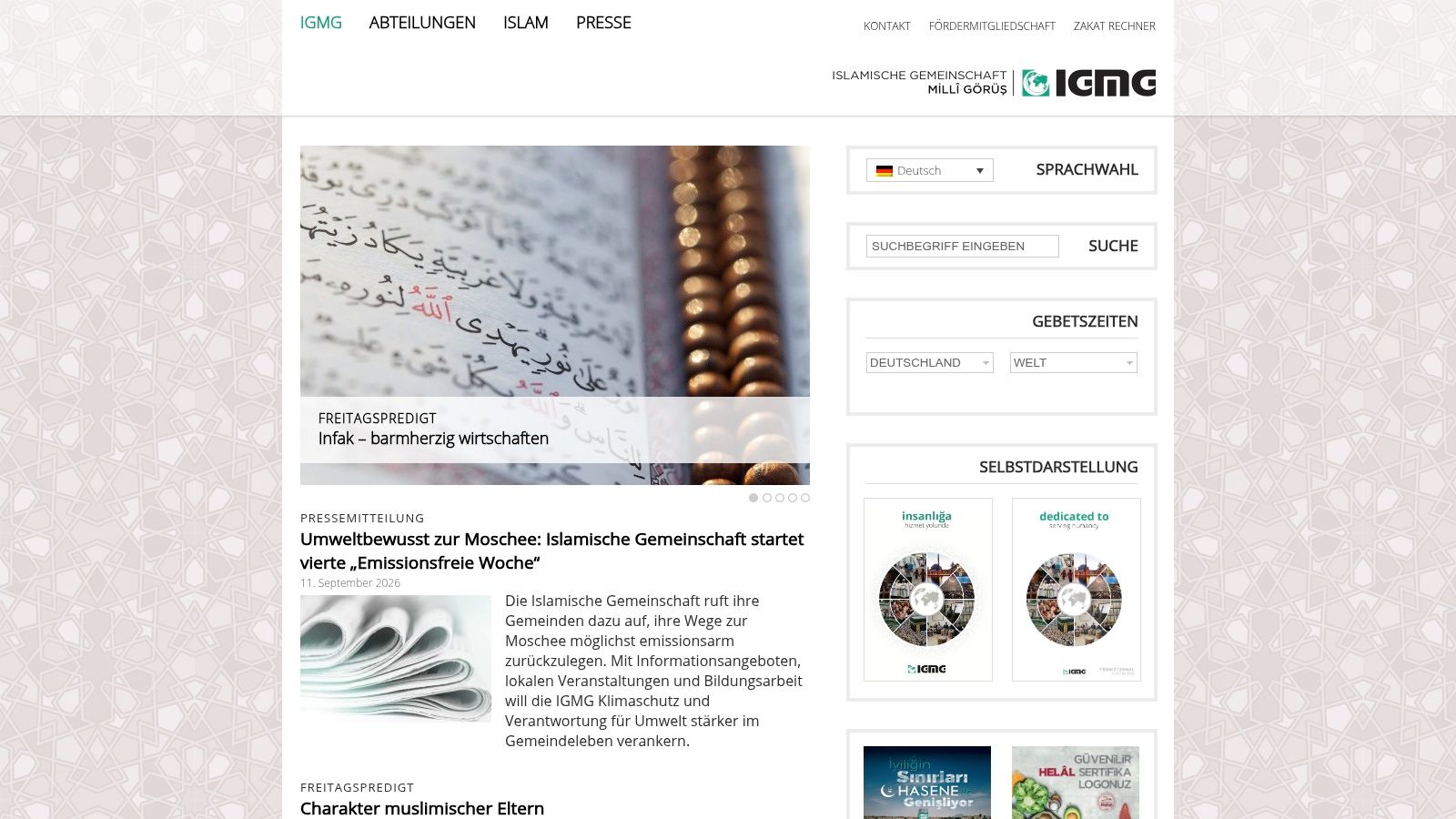
The Islamische Gemeinschaft Millî Görüş, IGMG, combines an extensive network of congregations with departments for education, social affairs, women and youth. Events, public campaigns and its own media offerings make the organisation visible even beyond its membership. For people seeking established structures and nationwide contact persons, this organisational form may be of interest.
The IGMG website provides information on topics, events and publications. Among the publicly known formats is the "Day of the Open Mosque". Such occasions can make it easier for neighbours to make first contact, even if they do not yet belong to a congregation.
Wide range of offerings, different local implementation
At the association level, IGMG provides guidance on educational and social topics. Whether this results in regularly usable offerings on site depends on the respective congregation. Interested people should therefore ask specifically about youth and women's work, social counselling, event languages, as well as cooperations with schools, municipalities and initiatives. Responsibilities and reachable contact persons should also be clear before any cooperation begins.
The IGMG is also the subject of public debates about ideological ties and monitoring by the domestic intelligence service (Verfassungsschutz). For the official classification, the relevant Verfassungsschutz reports should be consulted. The website of the IGMG also offers the organisation's own perspective and publishes its own topics and statements. Both levels should be viewed separately: public debates concern the federation, while the work of a local association can be assessed based on its communication, projects, and contacts with the neighbourhood.
For donations, what matters is the specific legal entity behind a project. The name of the association, its purpose, the planned use of funds, and the form of progress documentation should be traceable. A local example is the donation campaign of IGMG Pasing Ensar Moschee e. V. in Munich. Assigning a donation to a specific project makes it clear whether support is directed toward the general work of the federation or a particular initiative.
Structured departments can make educational and social work transparent. Public campaigns create points of contact, while media presence keeps information accessible. At the same time, local differences in offerings and implementation, as well as public debates, should be considered in one's own assessment. What matters is whether the local community matches one's personal goals.
Quick Comparison: 7 Islamic Communities in Germany
| Project / Organisation | 🔄 Implementation Complexity | ⚡ Resource Requirements | 📊 Expected Results | 💡 Ideal Use Cases | ⭐ Key Benefits |
|---|---|---|---|---|---|
| DITIB Solingen Mosque Construction Project | Medium–high (construction, permits, timeline) | High financial resources; platform facilitates payment processing | Concrete mosque/community centre; traceable milestones | Local construction/infrastructure projects with donor tracking | Maximum donation forwarding, SSL/PCI-DSS, visible progress |
| DITIB – Federal Association | Low–medium (established federation processes) | Large network, established association structures | Nationwide accessibility of religious services | Those seeking access to many locations and standard offerings | Broad community network, established public relations |
| Zentralrat der Muslime (ZMD) | Low–medium (coordination, advocacy) | Communication and networking resources | Visibility in politics/media; position and dialogue work | Political representation, media inquiries, dialogue formats | Recognised contact point for politics and the public |
| Islamrat für die BRD | Medium (specialist work, education coordination) | Experts for religious education; coordination of member associations | Standardised educational offerings, theological guidance | School education, religious instruction, theological questions | Professional expertise in education and pastoral care |
| Ahmadiyya Muslim Jamaat (KdöR) | Low–medium (centrally organised) | Centralised structures; partial KdöR recognition | Formal cooperations; consistent German-language offerings | Cooperation with authorities/institutions, public work | Transparent organisation, formal recognition (partial) |
| VIKZ – Verband der Islamischen Kulturzentren | Medium (long-standing structures, large-scale projects) | Extensive communities, educational and infrastructure projects | Imam training, youth dormitories, federation headquarters | Long-term training and infrastructure projects | Traditional education and youth development work |
| IGMG – Millî Görüş | Medium (structured departments, campaigns) | Broad national/European network | Standardised offerings, public campaigns, media presence | Large-scale public relations and campaign work | Broad community network, strong campaign and media work |
From Federation Comparison to the Right Community
The right Islamic community in Germany cannot be found simply by looking at the most well-known federation name. What matters is which concern is the priority. Those who want to pray daily, attend classes, or make use of social counselling need an accessible local association. Those seeking political positions, educational partnerships, or nationwide contacts may be better served by an umbrella organisation.
A first step is therefore a regional check. Look up the community with its full name, address, legal form, and current contact details. Ask about prayer times, languages, offerings for women, children, and young people, as well as a responsible person for pastoral care or social counselling. A phone call or visit often reveals more about practical accessibility than a general description of the federation.
The organisational form also deserves attention. An umbrella organisation, a regional association, and a local registered association have different roles. Check who is the contractual partner of a cooperation, who receives donations, and who is responsible for project updates. The name of a national federation on a website is not enough to determine the legal or financial responsibility of a local association.
The following questions can also help with an objective assessment:
- Services: Which activities actually take place on a regular basis?
- Target group: Is the community aimed at families, young people, students, specific language groups, or the entire neighbourhood?
- Transparency: Are the organisation, non-profit status, project goal, and use of funds clearly explained?
- Contact: Is there a reachable contact person, up-to-date dates, and a traceable complaints process?
- Cooperation: Does the community work together with schools, municipalities, social organisations, or other associations?
The state-commissioned study „Islamisches Gemeindeleben in Deutschland“ estimates the number of Islamic communities at around 2,350. At the same time, only about 20% of Muslims state that they are members of a mosque association, as the fact check by Tagesschau summarises. For the search, this means that a directory should not only take formal association members into account. Loosely connected visitors, neighbourhood projects, and public events also belong to a community's actual reach.
A study on the infrastructures of Muslim communities reports that 77% of the communities examined have a digital presence, for example through a website or Facebook page. The study report on the services and infrastructures of Muslim communities thus shows a good basis for digital information, but no evidence of professional donation or administration systems. A website should therefore not only show dates, but also make responsibilities, projects, and progress understandable.
For donors, financial transparency is a selection criterion in its own right. Mosque communities are financed mainly through donations, voluntary work, and membership fees. Only just under one in ten communities receives public funding, as an overview of mosque financing describes. This makes a community-specific review more important than blanket assumptions about associations or origin.
A good campaign page should state the organisation, the specific purpose, the target amount, the current progress, the duration, and regular impact updates. For construction projects, information on construction phases and delays should be included. For social projects, target groups, activities, and results achieved are more meaningful than a general appeal.
SadakaNow may be of interest to communities, mosques, and social initiatives that want to publish such information centrally and process donations digitally. The platform supports SEPA, PayPal, and credit card, provides public project pages, and enables regular updates. According to the platform, organisations can receive support within 24 hours of launching a campaign. For internal administration and the traceability of association processes, a GoBD-compliant accounting system for associations can also be useful.
Anyone starting a campaign should fully document the non-profit status, the responsible association, and the donation purpose before publication. After that, a realistic communication plan is needed for the website, community groups, prayer rooms, and social networks. QR codes, shareable project pages, and recurring progress updates can help reach even people who are not formal members of a mosque association.
SadakaNow offers verified Islamic communities and social initiatives transparent campaign pages, secure payments via SEPA, PayPal, and credit card, as well as regular public updates with no platform fee for donors. If you want to support a local mosque or finance your own project in a transparent way, visit SadakaNow and check out suitable campaigns or start your own appeal.