Hasene Zakat: Calculation, Payment Method and Transparency
Most people ask how much Zakat they have to pay. The question that actually helps is a different one: Which of my assets even count, which debts am I allowed to deduct, who may receive the money, and how do I later recognise that it has arrived?
Between these two questions lies the difference between a formula and a decision. The amount is calculated within a few minutes. The basis on which it rests is not: a checking account, an ETF portfolio, a building society savings contract, and jointly managed marital assets all behave differently, and none of these questions can be answered by a calculator alone.
Hasene Zakat stands here for a concrete case, an aid organisation based in Germany with Zakat projects. Anyone paying to it should keep two things apart: the religious obligation and the practical payment process, including the verification of the organisation. Treated separately, they lead to a figure that can be justified.
Table of Contents
- What Zakat is and why it works differently from Sadaqa
- Debts and schools of law, where opinions differ
- Calculating Zakat in four steps and classifying types of assets
- Checking the use of funds and transparency at Hasene
- Payment methods and the path of the money to the project
- Determining the Zakat amount and taking the first step today
What Zakat is and why it works differently from Sadaqa
Is a transfer to the mosque automatically Zakat? The payment method alone does not decide that. Anyone giving money to a mosque or a water project during Ramadan may be pursuing different religious purposes with it. Zakat and Sadaqa differ in their binding nature, their timing, and the rules about who may receive the money.
Zakat is a mandatory levy on wealth that falls due once a year. For this, the zakat-liable wealth must reach the Nisab, the religiously defined minimum value, and one Islamic year must have passed. The Nisab is based on gold and silver values. It first determines whether a Zakat obligation exists at all.
Sadaqa is voluntary and possible at any time, in any amount, without a minimum wealth requirement and without a fixed due date.

The Nisab works like an access threshold, not like a tax-free allowance: if the relevant wealth falls below it, no Zakat is due. If the conditions are met after the Islamic year has elapsed, the entire zakat-liable remaining amount is used as the basis. Considering only the portion above the threshold would make the calculation basis too small. The usual rate is 2.5% of the annual zakat-liable capital assets. This refers to the relevant remaining wealth, not simply any income across the board.
How respondents distinguish between obligatory and voluntary giving is shown by the study „Spenden zwischen Gutes tun und Pflicht“ by the Maecenata Institute from the year 2020: 90% of respondents described Zakat as a religious obligation, 8% classified it predominantly as a voluntary donation, and 40% of respondents stated that they most often donate as part of voluntary Sadaqa.
However, frequency says nothing about what proportion of the total donation money was given voluntarily. The survey also describes the responses of the participants, not a representative distribution across all Muslim households in Germany. For a personal calculation, such results do not replace an examination of one's own wealth.
Key takeaway: With Zakat, calculating the obligatory amount and checking suitable recipients go hand in hand. With Sadaqa, you can freely choose the amount and timing.
For a donation to Hasene, this means: first, it must be religiously classified what kind of payment is involved. Then come the practical questions about project, payment method, and traceable use of funds. A suitable project alone does not yet clarify whether a payment is suitable as Zakat.
Debts and schools of law, where opinions differ
Before a figure can be reached, a decision must be made: which debts may be deducted from the wealth? The answer depends on which school of law one follows, and it shifts the basis of assessment, not just the result.
The Hasene FAQ on calculating Zakat names the remaining zakat-liable wealth as the basis and allows the deduction of necessary living costs as well as certain debts. Behind this lies an intra-Islamic difference that no calculator page can resolve: the schools of law differ on whether debts reduce zakat-liable wealth at all, to what extent, and from what point of maturity. Some views only deduct liabilities that are already due, others also take future installments into account, and still others limit the deduction to certain types of debt. There is no uniform line that could simply be cast into a formula.
That sounds technical, but it is tangible. Picture the assessment basis like a scale: on one side lies the wealth, on the other the question of how much weight the debts are allowed to carry. Depending on the view, the same debt tips the scale to a different degree.
Which cases need to be clarified in German households
- Installment loans: The outstanding remaining debt counts as a liability, while the amount of the monthly installment is not a deductible item.
- Student loans: Here an additional question arises as to whether repayment is already due or only begins after completing studies.
- Building society savings (Bausparguthaben): The credit balance is wealth, the contract as a whole is not a debt. Looking at the two separately avoids mistakes.
- Jointly managed marital assets: Who holds which share is often undocumented, and the calculation depends precisely on this.
Let's work through it. Suppose someone holds 30,000 euros in zakat-liable wealth and has 10,000 euros in debts that are due. Whoever deducts the debts in full calculates on a basis of 20,000 euros and pays 500 euros in Zakat. Whoever does not deduct them arrives at 750 euros. Same household, same formula, two different amounts. The difference does not arise in the calculation step but in the question that comes before it.
Limit of the calculator: A calculator provides a basis for calculation, not legal guidance.
For a checking account and a call money account, one's own diligence is usually enough. For securities accounts, building society savings, loans, and jointly held marital assets, a qualified religious or tax professional should confirm the classification before any money is transferred. This is not excessive caution but the point at which most incorrect amounts arise. Anyone who wants to apply the view of a particular school of law bindingly should clarify, before the first payment, how that school treats debts in their own case, and should record this decision in writing. In the following year, you then continue calculating by the same standard instead of starting over each time.
Calculating Zakat in four steps and classifying types of wealth
Four steps are enough once the basis has been clarified and it is established how you handle debts. There is one question you should answer beforehand: to which amount does the 2.5 percent apply? Zakat does not apply only to the portion above the Nisab. Once your remaining wealth reaches the threshold, you calculate the 2.5 percent on the entire zakat-liable wealth, starting from the first euro. A household with 24,000 euros in remaining wealth therefore does not pay 2.5 percent on the difference to the Nisab, but 600 euros on the full 24,000 euros.
- Set a reference date and record your wealth. Choose a date and gather everything that belongs to you on that day: cash, checking account, call money, securities account, gold, silver. Note down the date, because next year you will continue calculating from the same reference date.
- Deduct living costs and debts that are due. Necessary costs of everyday living and liabilities that are due reduce the basis. Which liabilities are actually deductible is decided by the school of law you choose.
- Check whether the remainder reaches the Nisab. The threshold value is derived from gold and silver prices, so check it against current quotations. A figure from the previous year is not valid for this year.
- Calculate the amount. Hasene International e. V. states on its German-language page that Zakat amounts to 2.5% of the total remaining wealth after deducting necessary living costs (Hasene on Zakat and Fitra). "Total wealth" here means the complete remainder after step 2, not just the surplus above the Nisab. For a remainder of 24,000 euros, this comes to 600 euros.
The last step is the simplest and the least meaningful. Whether the 24,000 euros have been correctly determined decides the accuracy of the entire figure. That is precisely where the attention pays off.
| Asset type | Zakat liable | Note on calculation |
|---|---|---|
| Cash and checking account | yes | Balance on the reference date, minus due debts depending on the school of law |
| Call money and savings accounts | yes | Balance on the reference date, same calculation basis as checking account |
| Gold and silver | yes | Value the weight at the current market price; Nisab comparison required |
| Stock and ETF portfolio | yes, at market value | Valuation at market value on the reference date; the classification is disputed and should be clarified in advance |
| Building society savings | yes | Balance counts as assets; check accessibility and purpose restriction |
| Occupational pension provision | no, as long as there is no access | Accessibility before retirement begins determines the classification |
| Owner-occupied residential property | no | A home or house for personal use generally does not count as zakat-liable assets |
| Installment loan or student loan | deduction possible | Effect on the calculation basis depends on the school of law |
Cash, checking account, call money, gold and silver are uncontested. Three positions remain open: portfolios, building society savings, and occupational pension provision. For all three, two things decide: access and valuation — whether you can actually dispose of the amount on the reference date, and whether the market value or the amount paid in is applied. Anyone who answers these two questions for each position has a clean list.
Let's take the portfolio as an example. You hold fund units worth 8,000 euros, having paid in 6,500 euros. The value on the reference date is applied, so the 8,000 euros, because you could sell the units at this price on this day. The same logic applies to building society savings: what matters is what is in the account on the reference date, not the later purpose restriction. It's different for occupational pension provision. As long as there is no access, the accumulated capital does not count as assets, because you cannot dispose of it on the reference date.
Anyone who doesn't want to do the calculation by hand can use the Zakat calculator from SadakaNow: three short questions, calculation with daily gold and silver prices in any currency according to Diyanet standards, and the entries remain in the browser. However, a tool does not replace a decision on disputed positions.
Checking fund usage and transparency at Hasene
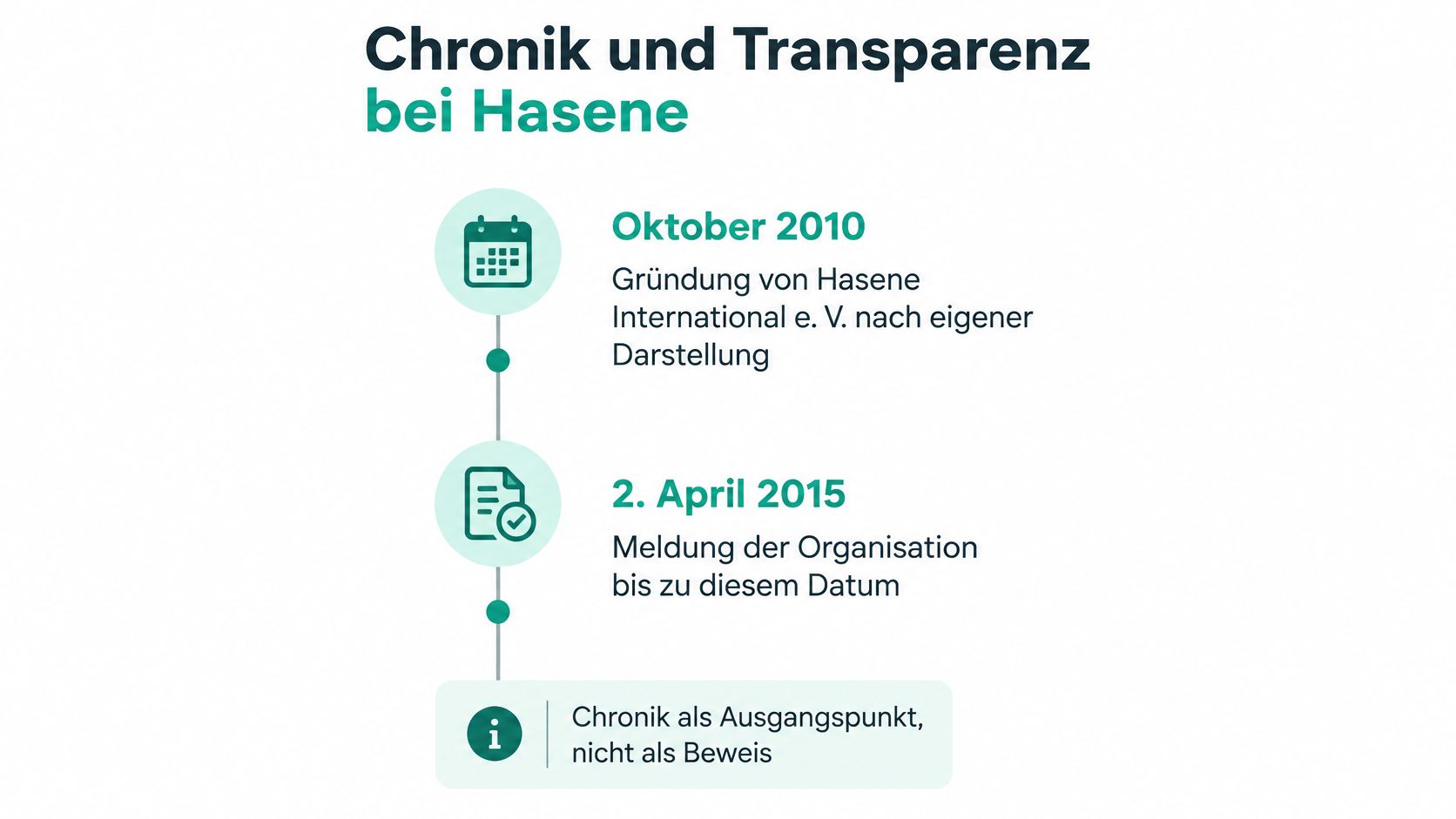
A chronicle is a good start and poor proof. Hasene International e. V. is documented as an internationally active aid organisation with ties to Germany. According to Hasene's own historical account, the association was founded in October 2010. By 2 April 2015, the organisation reported the construction of 1,728 water wells in 14 countries, with an average of 300 beneficiaries per well. Extrapolating this average across all wells gives a reach of approximately 518,400 beneficiaries.
This figure is a calculation, not an audit report. It arises because an average value is applied to a total number. It does not say whether every single well was actually built, works, or is still in operation.
The chronicle can be read as a timeline, and that is exactly how it is meant here:
Regarding funding, the account mentions donations from about 2,700 supporters. Calculated this way, that comes to around 0.64 wells per named donor. This figure, too, does not prove any individual donation amount or a clear allocation; it only describes the ratio of two figures from the same source.
From well construction to a broad Zakat programme
Later, Hasene describes the Zakat projects as being implemented annually in approximately 100 countries and regions, with refugees and people in war situations explicitly named as target groups. The development thus leads from concrete, measurable infrastructure projects in 2015 to geographically widely spread Zakat aid. For donors, this means: the historical figures serve as a starting point, not as proof. What supports a statement about fund usage are project-related annual reports, financial information, and proof of impact.
Who may receive Zakat
According to classical teaching, the Quran names eight categories of people who may receive Zakat in Surah 9:60, including the poor, the needy, and the indebted. This raises a question that every donor can ask: Does the organisation report Zakat funds separately from Sadaqa funds? If both end up in one pot, it is no longer possible to verify whether Zakat went to eligible recipients. An organisation that discloses this separation thereby answers the most important question before paying.
Five points for checking a provider
- Operator with legal notice, full address and legal form. Without this information, you don't know who you are dealing with.
- Proof of non-profit status. It also determines whether your donation is later recognised.
- Annual report with financial details and use of funds. If it's missing, the basis for any assessment is missing.
- Project progress with goals and updates. A photo at the start is not a track record; what matters is what is reported after six months.
- Reachable contact for questions. Write a short question before donating and see if and how it is answered.
Rule of thumb: An organisation that does not report its Zakat funds separately cannot be judged on whether Zakat actually reaches where it belongs.
If one of these points is missing, the basis for an assessment is missing. This is not an accusation, but the standard that applies to every donation organisation. Information from a platform about vetted partners does not replace this check, it is an addition. At SadakaNow, we only work with partners we have thoroughly reviewed and approved, and we operate the platform via MoreDonate GmbH, Carl-Zeiss-Straße 2, 33758 Schloß Holte-Stukenbrock. What this means in individual cases can be found on the SadakaNow transparency pages.
Payment methods and the path of the money to the project
Anyone wanting to pay 600 euros as Zakat for a water project must distinguish between two questions: Is the use suitable for Zakat, and how does the money reach the organisation? The payment method only answers the second question. A successful payment alone does not confirm Zakat-compliant use.
The donation passes through several stages: you pay, the payment service processes the payment, the recipient organisation implements the project. At SadakaNow, we do not touch the donation funds. The money is held in trust and paid out directly to the respective organisation. The platform thus facilitates the payment path to the organisation, which is responsible for implementation.
Which path suits which situation
| Payment method | Typical use | Check before payment |
|---|---|---|
| SEPA direct debit | Payment via bank account debit | Mandate, amount and designation as Zakat |
| PayPal | One-time donation via PayPal | Amount and selected recipient organisation |
| Credit card | One-time donation by card | Card details, amount and selected project |
Choose among these payment methods the one you can easily track. With direct debit, you grant a mandate for the collection. With PayPal and credit card, you also check before completing whether the amount and project are correct. The payment method does not indicate either the religious suitability of the project or the later use of funds.
For the designation, what you specify counts: if the organisation offers a choice between Zakat, Sadaqa and Fitra, select the appropriate category. This keeps it clear what your payment was intended for.
The payment confirmation with date documents the payment process. The purpose with the note Zakat records your designated purpose. The confirmation email supplements these documents. Together they make the process traceable, but they do not replace proof of how the organisation used the money.
Proof instead of memory: What matters is that the payment and the designated purpose match up later.
The process from project selection through secure payment to insights into impact is explained at How SadakaNow works.
Determine the Zakat amount and take the first step today
In the end, there is no further formula, but a decision: are the open questions resolved or not? Anyone who remains uncertain about assets on the due date, securities accounts, building society savings, or joint marital assets should consult a qualified professional before paying. This is not a sign of indecision, but the part of the responsibility that no calculator can take off your hands.
Once everything is clarified, a donation to a vetted organisation with clear use and traceable proof leads to a sense of calm. You no longer need to recalculate, but can conclude the process.
What matters in the end: a figure you can justify, an organisation you have vetted, and proof you can find again.
Keep the payment confirmation, purpose with Zakat note and confirmation email with your records. For questions about donations and payment issues, you can reach us at hilfe@sadakanow.de.
The first step today: roughly determine your own Zakat amount and assess the organisation based on the five points. Roughly is deliberate, because a figure that is uncertain by a few hundred euros can be corrected later; a donation to an unvetted organisation cannot be retrieved.
On SadakaNow you will find campaigns from mosques and aid organisations that are reviewed before being activated, along with goals, progress, and updates for each project, and the donation is forwarded without a platform fee. Once your Zakat amount is set, choose a project on SadakaNow and complete the payment via SEPA, PayPal, or credit card. Check the five points from the provider review beforehand, then pay with a receipt you won't have to search for later.