
Donating for a good cause: 8 ways to make an impact in 2026
It's Friday evening. On your phone is a link to a food distribution, in your inbox the appeal for a mosque renovation is waiting, and on the weekend there's a community festival whose proceeds are meant to help families in need. The willingness to help is there, but the right form is often unclear, because a spontaneous transfer, a monthly recurring donation, and a binding Zakat work according to completely different logic.
The following eight ways are organised exactly with that in mind, from a single amount to donating time. Anyone who wants to donate for a good cause should first clarify whether it concerns an acute need, plannable ongoing costs, a religious duty, a season, or their own working time. After that comes the check, because money alone says little about impact if the organisation, purpose, and progress remain unclear.
The German market provides a stable framework for this. According to the Tagesschau report on the balance of the Deutscher Spendenrat, private individuals donated around 5.1 billion euros in 2024, and the average donation rose from 40 euros to 43 euros in 2024. So the potential is large, but it reacts to crises and economic conditions. For your own decision, what matters less is the total amount than a way that fits your budget, remains traceable, and can be repeated without regret. The list leads directly there, with an example and a check routine for each form.
Table of contents
- 1. One-time donation to vetted Sadaqa projects
- 2. Recurring donation (regular Sadaqa)
- 3. Zakat payment (Zakat al-Mal)
- 4. Sadaqa Jariya long-term endowment projects
- 5. Project sponsorship for targeted support
- 6. Seasonal donations: Ramadan, Zakat al-Fitr, and Qurbani
- 7. Sharing campaigns and community fundraising
- 8. Volunteering and donating time
- The eight ways to donate for a good cause, compared
- Choosing the right way and sticking with it
1. One-time donation to vetted Sadaqa projects
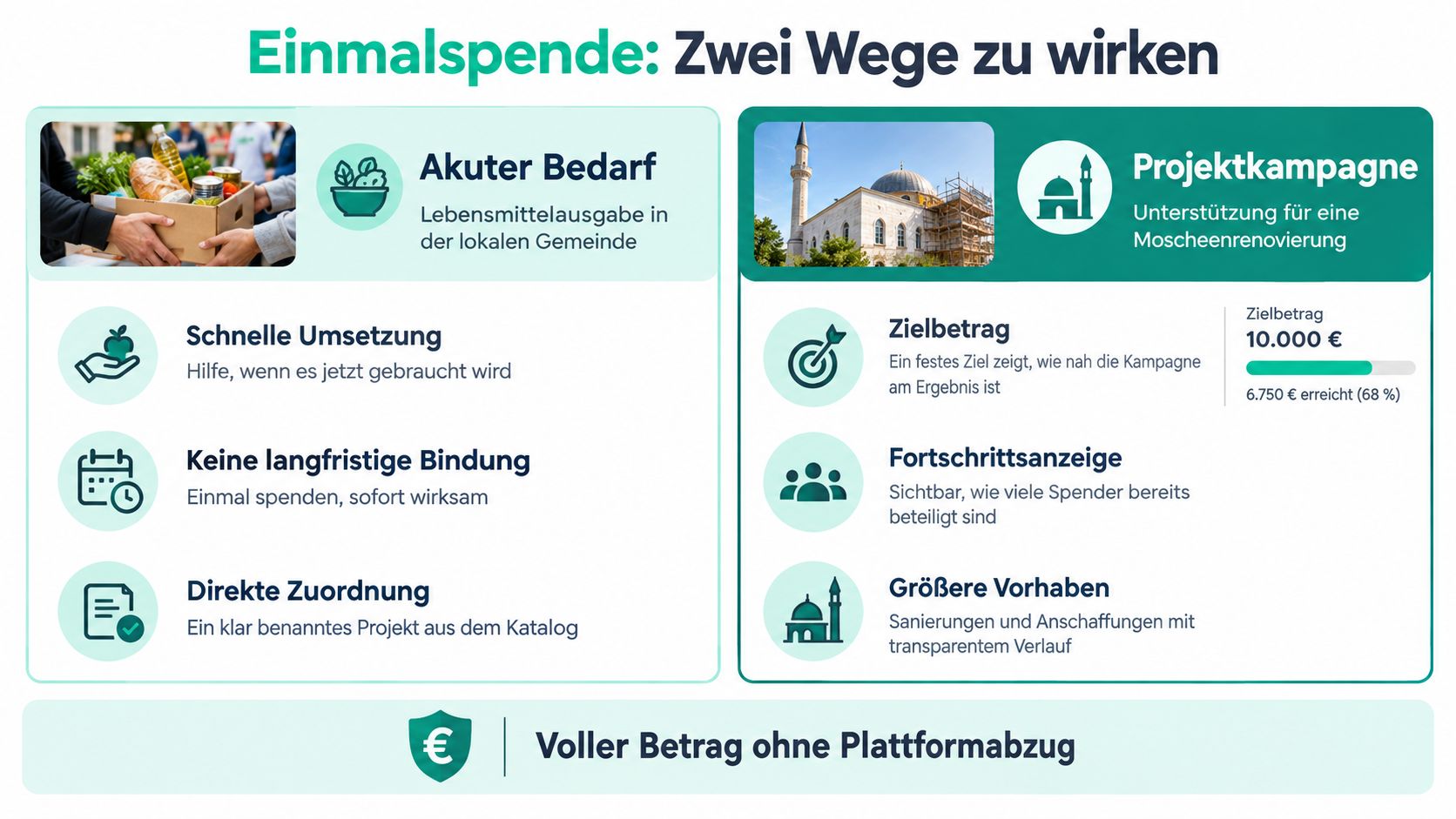
A one-time donation fits when the need exists now and is clearly defined. A community needs food for the next distribution day, a mosque has to repair a leaking roof, an aid project finances a specific purchase. You choose a freely determined amount and complete the payment without committing to a recurring rhythm. That is the strength of this form and at the same time its weakness, because it helps at a specific point but creates no planning security for ongoing costs.
On SadakaNow, donors choose a vetted mosque, aid organisation, or social initiative and pay by SEPA direct debit, PayPal, or credit card. Since no platform fee is charged, the entire amount reaches the project. Choose this route if the goal and the timing are closely linked, for example in emergency relief or a campaign with a fixed target amount. For care, rent, or regular food distributions, a single amount alone is usually too short-sighted.
Check routine before clicking
Open the project page and read not just the title but the goal, organisation, and progress indicator. A renovation project should show which part is already funded, what exactly the money is used for, and who is responsible. Then follow the progress, because a campaign without an update after reaching its goal leaves open questions, even if the intention was good.
Also keep the payment receipt. If the recipient is a registered non-profit, request a donation receipt and check whether the recipient's name and purpose of use match the project page. I recommend saving the screenshot, the confirmation, and the proof of payment in one folder. This takes two minutes and saves you search work later, when you want to prove the donation or explain to a family member where the money for a good cause went.
2. Recurring donation (regular Sadaqa)
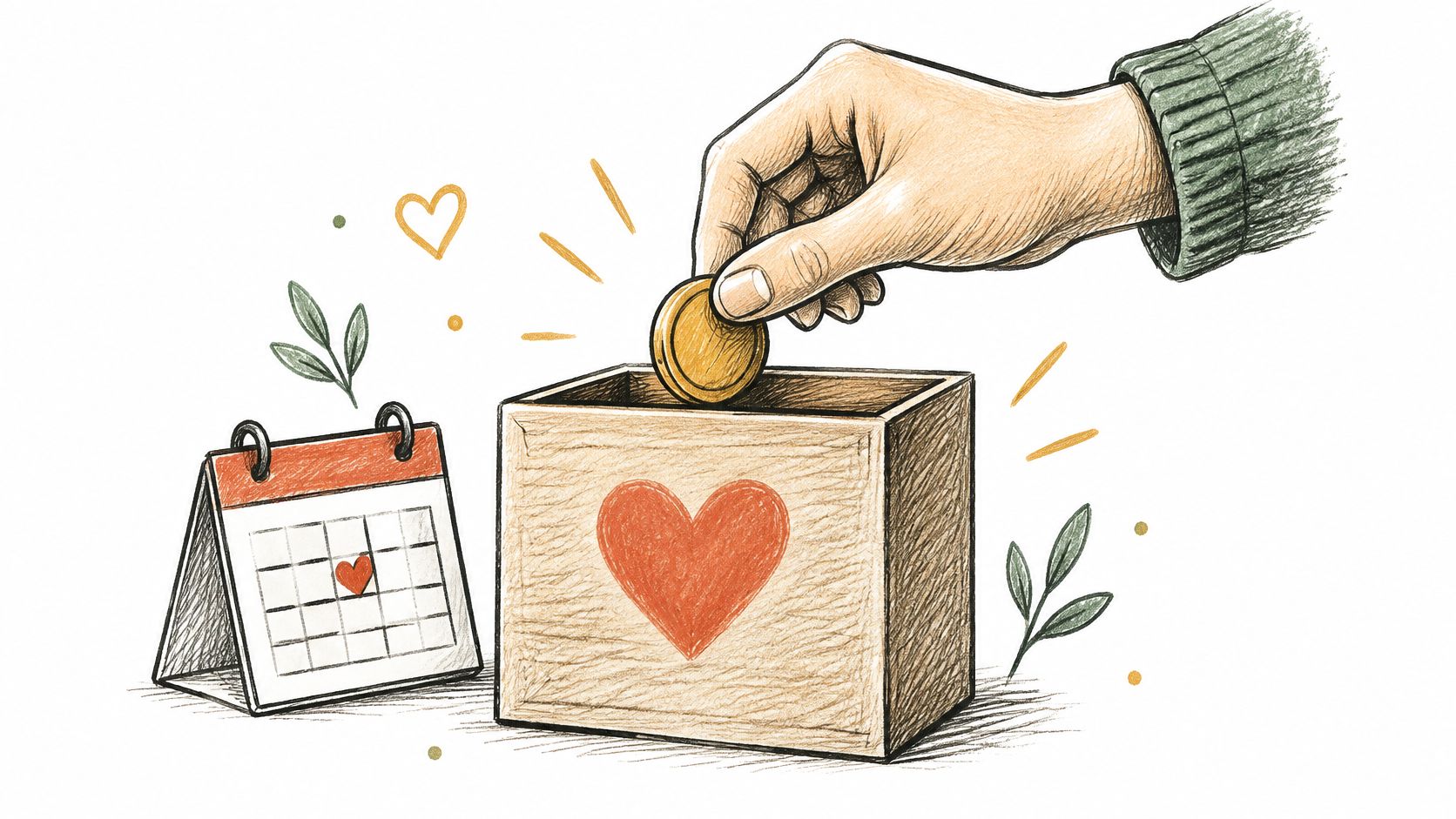
Ongoing work needs ongoing money. A recurring donation pays a fixed amount monthly, quarterly, or annually and is therefore often more valuable for projects with recurring costs than a larger one-time amount. A community uses it to finance care, teaching materials, or the weekly food distribution and can plan staff and purchases more reliably. SadakaNow lists recurring campaigns in its project catalogue, which you can support on an ongoing basis.
The example sounds unspectacular, and that is precisely what makes it work. 10 euros a month for a community's support programmes barely shows up in your own budget, but it gives the organisation a predictable base. An education project can continuously buy notebooks, printing costs and materials from it, instead of asking for a new collection every semester. Those who donate monthly shift the decision away from the mood of the day to a calm routine.
The best way to start is small and realistic. Choose an amount you would not want to cancel immediately even in an expensive month, and only increase it deliberately after a few months. How such a rhythm is practically set up is shown in the guide on monthly donating with a fixed routine. It is important that you find out about cancellation, pausing and changing the amount beforehand, not only once your situation changes.
Keep an annual overview of all recurring amounts and regularly check the standing donation against new project developments. Regularity does not replace oversight. If updates stop coming or the purpose shifts, it is better to pause and ask rather than keep paying out of habit. Conversely, a project that reports reliably deserves your loyalty more than a new appeal with louder advertising.
3. Zakat Payment (Zakat al-Mal)
Zakat is not a voluntary donation based on the mood of the day. It is an obligatory levy on wealth once the Nisab, meaning a certain minimum amount of wealth, has been reached and a lunar year has passed. As a rule, it amounts to 2.5 percent of the zakat-liable wealth. Distribution follows Surah at-Tauba, 9:60, to fixed groups of recipients, including the poor, the needy and debtors.
The difference from voluntary Sadaqa changes the entire review routine. With Sadaqa you can choose the purpose and recipient more freely, with Zakat the calculation and recipient group must be correct. An example: on the reference date you record savings and securities, deduct the relevant items according to the chosen calculation method, and forward the amount to a verified aid organisation, which distributes it for the designated purpose to eligible families. A mosque can organise this distribution, but should report it separately from general construction or operating costs.
Separating Calculation and Designated Use
Document your wealth on the reference date in such a way that you can still follow the calculation a year later. A short table with account balance, portfolio value, cash, liabilities and date is often enough for this. The practical step-by-step process is explained in the guide on calculating Zakat correctly. If in doubt, check the amount annually with an imam or a scholar, rather than taking percentage figures from a messaging group.
Review rule: Zakat needs a recognisable designated purpose. If the project page only mentions general help without a recipient group, ask in writing before making the payment.
Clarify tax questions in advance with a tax advisor, especially if larger amounts are passed through several organisations. Being religiously correct and being tax-recognised are two different checks. Whoever separates the two cleanly protects their own obligation from formal errors and avoids a well-intentioned amount ending up neither helping the right recipients nor being properly documented.
4. Sadaqa Jariya: Long-Term Endowment Projects
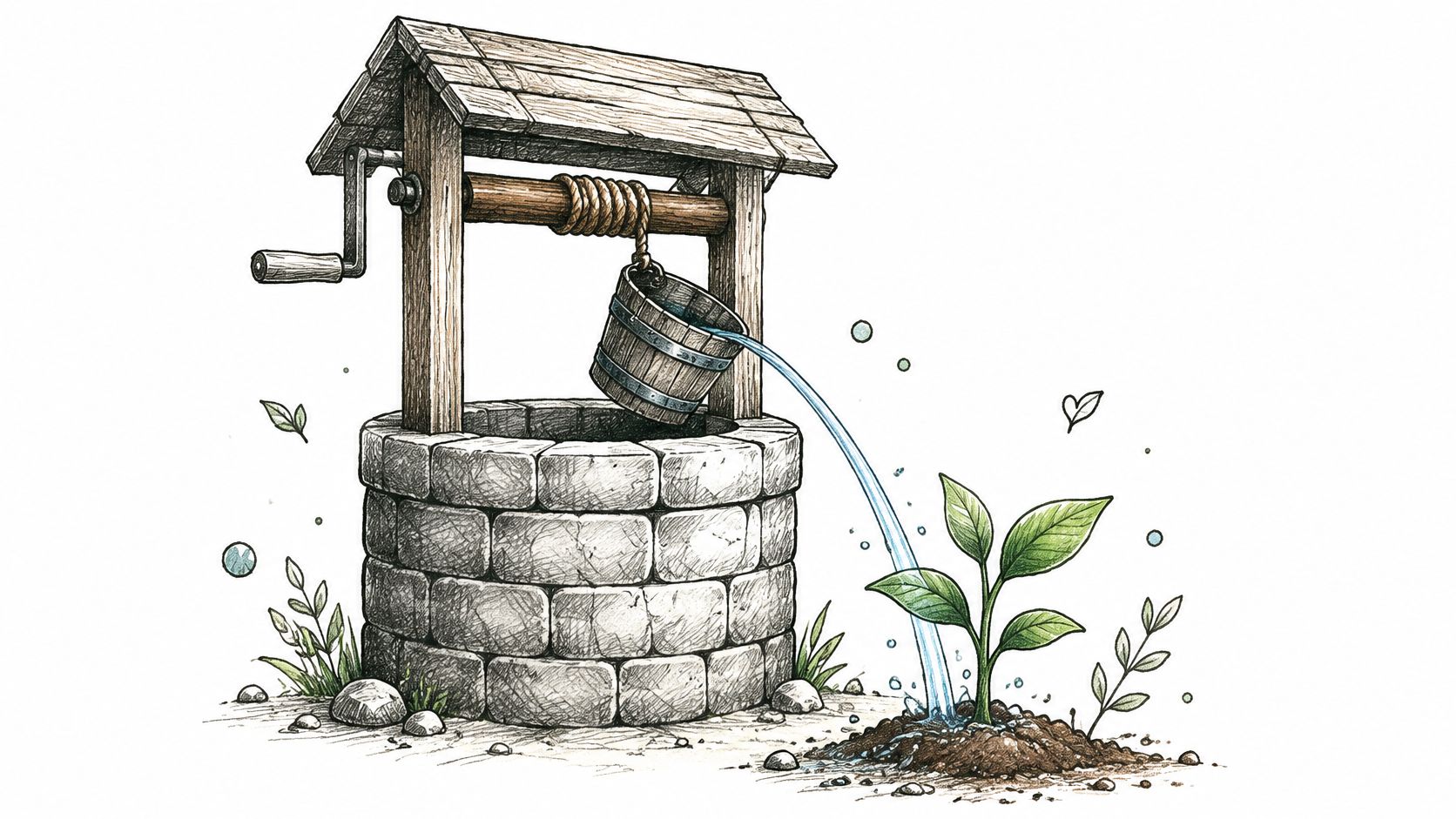
Some help ends with the expenditure, other help keeps working for years. Sadaqa Jariya refers to a donation with lasting benefit, such as a well, a school or an established learning space. In the Islamic understanding, its benefit continues even beyond the donor's death. It is related to the concept of Waqf, meaning an endowment whose assets permanently serve a good cause.
Imagine two projects. A well in a region with water shortage supplies people every day, but needs maintenance, spare parts and a responsible party on site. A learning space for children in a community looks less spectacular, but is easier to visit and monitor. Both can be meaningful, but the decisive question is not which image looks nicer, but who finances and documents operations after completion.
Such projects can be found through the project catalogues. Background and distinctions are summarised in the article on the meaning of Sadaqah Jariyah. I recommend clearly favouring projects with a clear description, timeline and progress report. A photo of the opening is not an operating plan, and a ceremonial handover does not yet prove usage after a year.
Clearly name your donation in the purpose of use so that it is assigned to the long-term project. For larger sums, legal advice on the form of endowment, designated use and succession arrangements is worthwhile. Here, patience is not a lack of generosity. Whoever wants to create lasting benefit must also secure the duration organisationally, otherwise they are only buying a one-time structure with an uncertain future.
5. Project Sponsorship for Targeted Support
With a project sponsorship, you take on a clearly defined part of a project. That can be a meal distribution, a package of school materials or a month of care. The appeal lies in the concrete unit, because you know exactly what service your money enables. At the same time, a personal connection arises that is often missing with a general donation pool.
An Iftar sponsorship during Ramadan makes this tangible. You are not financing abstract aid, but the cost of a specific meal for fasting people in a community. Taking on the cost of pens, notebooks and school bags for a family, organised through a mosque community, is similarly concrete. Such units also help families decide together on a good cause, because children can understand the contribution and grasp the result.
Check three points on the project page beforehand.
- Understand the unit of support: What exactly is included, who is it for, and over what period is it provided?
- Understand the price: Is the amount explained as a flat rate, and does it also cover purchasing, transport or supervision?
- Secure an update: Is there a report, a photo, a date or a confirmation that the unit has been carried out?
Subscribe to project updates or check back yourself at regular intervals. Spread several small sponsorships across different areas instead of tying your whole budget to a single project. This keeps your help personal without depending solely on one organisation, one season or one report. If a service fails to materialise, learn from it rather than losing trust in the whole approach.
6. Seasonal donations: Ramadan, Zakat al-Fitr and Qurbani
In the Islamic year, need and willingness to donate concentrate around certain dates. During Ramadan, communities need more food parcels and Iftar meals. Zakat al-Fitr is an obligatory contribution at the end of Ramadan intended to enable those in need to celebrate the festival. Qurbani, also called Udhiyya, is the sacrificial donation for the festival of sacrifice Eid al-Adha, whose meat is distributed to those in need. Platforms bundle these campaigns so that deadlines and purposes are visible in one place.
The season creates pressure, and pressure is a poor judge. Shortly before the festival, many people click quickly without checking whether the distribution will still happen in time. A mosque community that distributes Iftar parcels must arrange purchasing, helpers and rooms days in advance. A Zakat al-Fitr campaign must hand over the parcels before the festival prayer, as tradition dictates. Those who donate too late put their money into a campaign whose time window is practically already closed.
Set the date before the amount
Mark Ramadan, the last days of fasting and Eid al-Adha in your calendar early and note down campaigns in advance, rather than searching the night before. Find out by what point in time the organisation guarantees proper implementation. After this deadline, a general donation purpose is more honest than a seasonal label with no achievable outcome.
For Qurbani, I pay attention for practical reasons to vetted slaughterhouses, traceable distribution and a confirmation after implementation. Ask which country the slaughter takes place in, who receives the meat, and how leftovers or surpluses are handled. Seasonal aid can have a deep impact, because it reaches people at a time that matters to the community. But it fails if the organisation and the deadline are merely claimed.
7. Sharing campaigns and community fundraising
Reach is a resource in its own right. Those who can give little money may still reach the family group, the mosque, a sports club or colleagues. Sharing verified campaigns increases visibility considerably if you don't just forward a link but explain the purpose in your own words. A sentence like "Our community is raising funds for the roof renovation so the prayer room stays dry in winter" has more impact than a call without comment.
A community festival shows the next step. A cake sale, a bazaar or a small entrance fee generate proceeds that flow into the renovation through a campaign. A charity run works the same way, if participants pledge an amount per lap and the result is shown publicly in the project's progress. It is important to agree beforehand with the organisation on how cash is counted, paid in and allocated to the purpose. Without these rules, a good initiative later falls apart into follow-up questions.
Digital habits also play a role in whether attention turns into a donation. The Deutsche Spendenmonitor on the website of the Deutscher Fundraising Verband, with 5,049 internet users aged 16 to 70, shows that 39 percent of Generation Z use PayPal for donations and 9 percent use Apple Pay, Google Pay or Garmin Pay. So share links that work on mobile in a few steps, and never force anyone back to a bank transfer form.
Check the facts before every share and only use links to verified campaigns. Share the progress again when a goal gets closer or an update is available, because momentum comes from visible movement. Don't stop at saying thank you after the campaign — publish the final amount and how it was used. This feedback is the basis for your community trusting and joining in again next time.
8. Volunteering and donating time
Not every project fails primarily because of money. Sometimes what's missing is a person to manage registrations, sort food, translate a report, or look after visitors. Volunteering lowers costs and is often what makes many offers possible in the first place. For communities, reliable time on distribution days is often just as scarce as the purchasing itself, because tasks have to be done at fixed times.
A typical use case is the food distribution run by a mosque community. Volunteers receive goods, pack bags, keep order in the queue and tidy up afterwards. Professionals support in different ways, for example with accounting, design, public relations or translation of project reports. Anyone who offers their professional skill in a targeted way does not merely replace an arbitrary hour of work, but resolves a bottleneck that an organisation would otherwise have to pay dearly to cover.

Start with a small, fixed task, for example a monthly shift with a clear end time. Before you begin, clarify responsibility, the contact person, insurance, data protection and cover in case of illness. These questions may seem bureaucratic, but they prevent the most common conflicts when someone unexpectedly drops out or sensitive data about the families being supported is involved.
Anyone who gives their time for a good cause should bring the same reliability as they would with money. A promised afternoon that doesn't happen leaves a real gap.
After your first shifts, check whether the task, the team and the time suit you. Address being overburdened early, and rather switch tasks than quietly stop altogether. Well-organised time donations strengthen not only the project but also your bond with the community, because you experience the impact directly and recognise weaknesses that would never be visible from a donation report.
The eight ways to donate for a good cause compared
| Item | Frequency | Commitment | Best suited for |
|---|---|---|---|
| One-off donation to vetted Sadaka projects | One-off, repeatable as needed | Voluntary, without long-term commitment | Acute aid and clearly defined project goals |
| Recurring donation (regular Sadaka) | Monthly, quarterly or yearly | Voluntary, but intended to continue over time | Ongoing costs and plannable support |
| Zakat payment (Zakat al-Mal) | Annually after a lunar year has passed, provided the conditions are met | Religious duty once Nisab is reached | Fulfilling the Zakat obligation and supporting the intended recipient groups |
| Sadaka Jariya: Long-term endowment projects | Often one-off, with long-term impact | Voluntary donation; no ongoing commitment needed | Lasting undertakings such as wells, schools or learning spaces |
| Project sponsorship for targeted support | Depending on the project, possibly recurring | Voluntary and earmarked | Concrete provisions such as meals or school supplies |
| Seasonal donations: Ramadan, Zakat al-Fitr and Kurban | At specific times in the Islamic year | Voluntary or religiously obligatory, depending on the type of donation | Time-limited aid around Ramadan and the festive days |
| Sharing campaigns and community fundraising | As needed, often tied to a campaign | Voluntary; the organisation may require binding arrangements | Building reach and collecting donations together as a community |
| Volunteering and donating time | One-off or recurring, plannable | Voluntary, with agreed tasks and time commitment | Practical support through time, skills or expertise |
Choosing the right path and sticking with it
You don't have to pursue all eight paths at once. A sensible starting point is a vetted one-off donation, supplemented by a small recurring amount or a fixed volunteering commitment. The order matters. First determine the logic, then the recipient, then the amount. Anyone who starts the other way round, with a sum of money, often distributes it according to who is loudest rather than according to need, and afterwards does not know whether the help was acute, ongoing, obligatory, or only seasonally appropriate.
The breadth of willingness to donate supports this calm approach. In the 2024 Spendenmonitor of the Deutscher Fundraising Verband, around 50 percent of the population, or of the internet users surveyed aged 16 to 70, were recorded as donors, with 174 euros per donor over the past twelve months. Your individual decision is thus part of a larger pattern. All the more reason to turn occasional willingness to help into a habit through comprehensible goals, visible progress and recurring opportunities.
Muslim giving in particular carries its own weight here. According to the Maecenata Institute's account of Muslim philanthropy, Muslim donors gave to Islamic Relief an average of 452 euros per year, and 55 percent of Muslims in Germany donate to charitable causes. This intensity demands more than friendly thank-you notes. Vetting of the organisation, clear use of funds and regular updates are the counterpart by which you can recognise reputable projects. The total amount donated and the number of donors alone prove no impact if no one shows which people were reached, which measures were completed and which risks remain open.
Also keep the German documentation clean. The explanations from the Federal Ministry of Finance on Paragraph 10b make clear that donations generally require a donation receipt in the official format, while for smaller donations a simplified proof may be sufficient. So check the organisation's status, payment receipt, recipient and purpose of use before assuming a payment is deductible just because of a religious-sounding name. This short routine connects religious motivation with German tax law without mixing the two.
With us, every campaign is checked for charitable status before it goes live. We are operated by MoreDonate GmbH in Schloß Holte-Stukenbrock, and together with SadakaNow and Caliskan Media, over 30 million euros have already been raised. This does not replace your own due diligence, but it gives you an organised starting point with project goal, progress and donor count. Choose a project now, follow its development, and keep track of every donation in an annual overview. That way, giving for a good cause remains not a spontaneous gesture, but a reliable practice.
On SadakaNow you will find verified mosques, aid organisations and social initiatives with clear goals and visible progress, so you can compare one-time donations, recurring donations and seasonal campaigns in one place. Choose a project that matches your intention, pay securely via SEPA, PayPal or credit card, and then track what your Sadaka is actually achieving.