Fundraising Platform Germany in Comparison
A large reach is often considered the most important condition for success in fundraising. For Muslim communities in Germany, that view falls short. A campaign can reach many people and still fall short if donors do not trust the organisation behind it or cannot find their preferred payment method at checkout.
The German donation market is large enough to treat this question strategically. In 2024, 49% of the population in Germany donated money, meaning almost every second person, as reported by the Deutsche Fundraising Verband in the Spendenmonitor. At the same time, in 2025 the donation rate fell from 50.2% to 49.2%, while the average donation rose from 174 to 187 euros and the total volume reached 6.3 billion euros, according to the Spendenmonitor 2025. For communities, this means: not every click counts equally. Trust, clear project information and a suitable payment process determine whether attention turns into a Sadaka.
| Platform type | Strengths | Typical weaknesses | Suitable for Muslim communities if |
|---|---|---|---|
| General donation platform | Broad audience and easy campaign creation | Religious projects are not always presented in a way that suits the target audience | the organisation handles additional community communication itself |
| Large NGO fundraising suite | Reporting, automation and integrations | Higher setup effort and more complex administration | multiple campaigns, teams and data sources need to be managed centrally |
| Crowdfunding platform | Campaign logic and public project financing | Not every platform is geared towards Sadaka or mosque associations | a clearly defined project with a visible funding goal exists |
| Specialised platform for Islamic projects | Target audience fit, religious context and verified organisations | Dependence on the specific platform features | Sadaka, mosque projects or Islamic relief projects are the focus |
Table of Contents
- Why trust and checkout determine success
- Security standards and data protection in the German market
- Fee models and their impact on donation volume
- Payment methods as a key factor for conversion
- Verification processes and onboarding for communities
- Transparency features and the Sadaka Pulse live feed
- Situational recommendations for NGOs and mosque associations
Why trust and checkout determine success
Reach alone is not enough. A fundraising platform in Germany must solve two hurdles at the same time: it must be credible enough for people to entrust money to an unfamiliar campaign, and it must make the payment process simple enough that the donation is not abandoned just before completion.
This applies to all non-profit organisations, but especially to Sadaka and mosque campaigns. Donors want to recognise who is behind the project, what the money will be used for, and whether the religious or social objective is clearly described. An emotional campaign image replaces neither an imprint nor transparent organisational accountability.
Why more marketing is often not enough
Many communities start with additional social media posts, WhatsApp messages and flyers. These channels can create attention, but they don't fix an unclear checkout. If a person only wants to pay via PayPal, but the platform exclusively offers bank transfer, the campaign loses momentum at exactly the decisive moment.
A high number of visitors also says little about the quality of the fundraising. What matters is whether the donation method fits the behaviour of the target audience, whether the campaign page builds trust, and whether the organisation remains visible after payment. A public project page with progress, updates and the responsible organisation is therefore not a decorative extra.
Practical rule: Before a community puts more budget into advertising, it should test the complete donation path itself on a smartphone. The test begins at the campaign link and only ends with confirmation, receipt and understandable information on how the funds are used.
What Muslim communities specifically need
In a Sadaka campaign, religious context and operational clarity matter together. A mosque should not just "collect for the project", but explain purpose, organiser, time period and planned use in an understandable way. For further guidance on communicating social projects, the article Spenden für soziale Projekte is suitable.
My recommendation is clear: evaluate a platform first based on trust and checkout, then on reach. A large marketplace without suitable payment methods and without traceable project information is often less valuable to a local mosque association than a focused solution that cleanly represents the donation path.
Security standards and data protection in the German market
For religious donations, security is not a technical side issue. A payment for Sadaka or Zakat can allow conclusions to be drawn about a person's personal beliefs and social engagement. Communities and platforms must therefore show how payment and organisational data are protected.
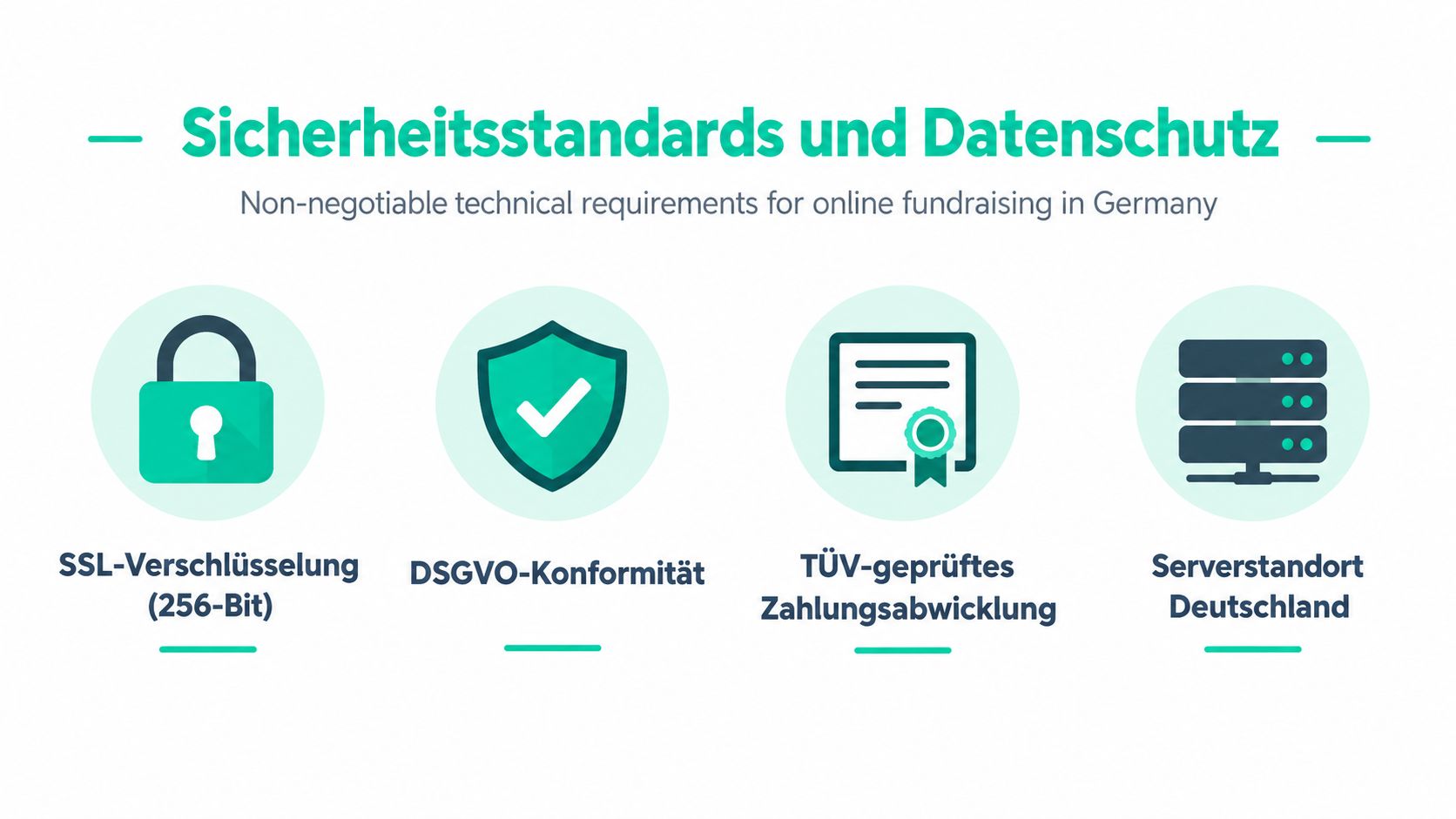
Reputable donation platforms in Germany are associated with SSL encryption, GDPR-compliant data storage and certified payment service providers. Payment data should be transmitted in encrypted form and not permanently stored on the platform. These requirements are also highlighted in the overview on security features of German donation platforms.
The minimum requirements for providers
SSL encryption protects the connection between browser and platform. A community should nevertheless check whether the domain is correctly secured and whether the payment process does not lead to an unclear third-party site.
GDPR compliance involves more than a privacy policy. Relevant factors are the purpose and scope of data collection, retention, deletion, consents, data processing agreements and handling of access requests. Organisations that want to systematically review their processes can use the guide to GDPR compliance as a practical orientation.
PCI-DSS Level 1 is an important signal for the processing of payment data. The standard concerns secure payment processing and should not be confused with a general data protection review. The platform must clearly explain which payment service provider is integrated and what data it processes itself.
What communities should check before launch
- Responsible party: The legal notice (Impressum) must identify the operator with a legally valid address.
- Data flow: The community should know which data it receives and which remain with the payment service provider.
- Payment receipts: Donors need an understandable confirmation and information on the further use of their data.
- Access rights: The association's board should have clear rules on who may edit campaigns and view donor data.
- Security communication: Statements on encryption, payment processing and data protection must be concrete and easy to find.
A platform that only mentions these points in marketing terms does not deserve automatic trust. Have the responsibilities explained to you before the first campaign goes live. Smaller communities in particular benefit from a clear process, since they often do not have their own data protection or IT department available.
Fee models and their impact on donation volume
Fees do not only affect the payout. They affect the credibility of the campaign. When a community asks for money for a specific Sadaka or a mosque construction, donors want to understand which share actually reaches the project and who bears the costs.
In the German crowdfunding market, a transaction volume of around 55 million euros was expected for 2024. The average funding was 8,840 euros per project. For 2028, a volume of 60.75 million euros is forecast, which corresponds to an annual growth of 2.43%, according to the classification of donations, sponsorship and crowdfunding in Germany. This development makes fee models a strategic question, not a footnote.
The most important models in direct comparison
| Model | Platform fee | Payout to project | Suitability for Sadaqa |
|---|---|---|---|
| Percentage platform fee | Fixed percentage share of every donation | Reduced by the platform fee, payment fees may also apply | Only suitable if the deduction is openly disclosed and factored in |
| Flat fee or monthly model | Fixed costs independent of the individual donation amount | Donations are not reduced by a platform commission, ongoing costs remain | More suitable for larger organisations with predictable volume |
| Tip model | Voluntary support from donors | Platform fee can be waived on the donation, payment fees must be checked separately | Well suited if the voluntary nature is clearly communicated |
| Mixed model | Combination of platform, payment, or service costs | Depends on payment method and contract terms | Only recommended after a complete cost review |
A percentage fee works the same for every donation, but the absolute deduction rises with the donation amount. For a mosque with many larger individual donations, this can be far more relevant than for a campaign made up mostly of small amounts. In addition, payment fees, payout charges, or costs for special features may apply.
My recommendation: Never compare only the visible platform fee. Calculate it per payment method, campaign type, and payout. What matters is the amount that reaches the project after all mandatory costs.
Transparency beats seemingly low prices
A tip model can make sense for a non-profit platform if the platform discloses its funding clearly and does not pressure donors. The community should not present the voluntary tip as a hidden obligation. Otherwise, exactly the loss of trust that the model is meant to avoid will occur.
Technological developments are also changing expectations around digital donation processes. Anyone looking into the Zukunft des Telefons quickly realises that mobile use and direct interaction are becoming increasingly important. For fundraising, this means that fee information must be understandable on small screens before someone selects the payment button.
For Muslim communities, a 0% platform fee is especially appealing if it actually means that the donation amount is passed on to the project in full. Nevertheless, payment and possible payout fees must be checked separately. Have every cost item confirmed in writing and publish the explanation on the campaign page.
Payment methods as a key factor for conversion
A checkout with lots of logos is not automatically a good checkout. What matters is whether the platform offers the payment methods that German donors actually use, and whether these options match the amount and frequency of the donation.
According to fundraising data, 93% of donations are processed via PayPal, direct debit, and credit card, as the Verbraucherinformationen zum richtigen Spenden show. These three payment methods therefore form the practical basis for a platform that wants to scale in Germany.
The right mix for Sadaqa and Zakat
PayPal suits spontaneous donations, mobile appeals, and small amounts. The payment decision is made quickly, especially if a person already uses a PayPal account and does not want to enter new data.
SEPA direct debit remains relevant for German non-profit setups. It suits donors who want to give regularly, and communities that want to offer recurring Sadaqa in a structured way. The mandate must be explained clearly and managed properly.
Credit card must not be missing, because it remains important for certain target groups, international supporters, and larger individual donations. A professional checkout should not assume that every donor has a German bank account.
More recent reports still rank classic bank transfer and SEPA as strong, while PayPal remains particularly important for smaller online donations. Wero and Bitcoin were recorded for the first time in 2025, but did not yet play a role at that point, as NGO-Dialog describes regarding online donations.
Checkout for mobile community communication
Mosque associations often spread campaigns via messenger apps, social networks, and QR codes. The link therefore often leads directly to a smartphone. Every additional selection, unclear error message, or redirect to an untrustworthy page can prevent the donation.
The platform should clearly separate the amount, the purpose, the payment method, and the recurring rhythm from one another. With a regular Sadaqa, the donor must not only realise in the small print that she is granting a recurring mandate. Transparent labelling builds trust and reduces support workload.
My clear priority is: PayPal, SEPA direct debit, and credit card first, and only then additional payment methods if they demonstrably provide meaningful added value for the target group. A small, understandable checkout converts better than an overloaded selection without clear user guidance.
Verification Processes and Onboarding for Communities
A mosque community rarely launches a campaign under ideal conditions. Perhaps an urgent repair is needed, a relief project requires short-term support, or the board wants to organise an existing fundraising effort more professionally. In such situations, the platform must review thoroughly without holding the association up in an unnecessarily long administrative process.
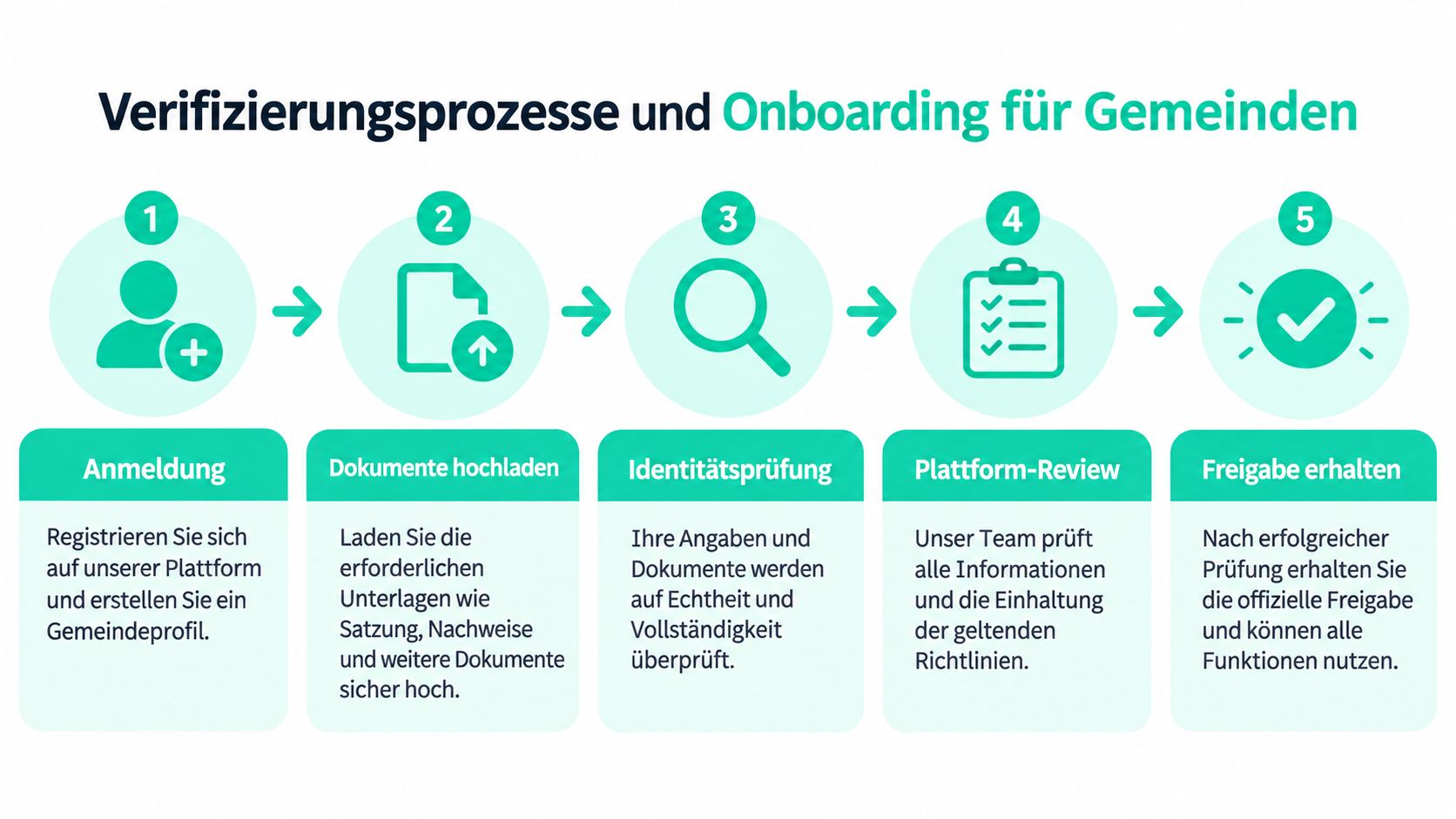
The process should begin with registration and end with a clear approval. The community must document its sponsorship, its legal identity, its bank details and its charitable status in a traceable way. A transparent legal notice (Impressum) and a responsible contact person protect not only donors but also the association itself.
The process from the perspective of a mosque association
The board should not treat registration as a mere formality. A cleanly prepared data set speeds up the review and prevents follow-up questions that delay the campaign launch.
- Registration: The association submits the organisation, contact person and basic project data.
- Uploading documents: The statutes, proof of charitable status, bank information and identity documents are submitted in full.
- Identity verification: The platform cross-checks the responsible persons and organisational details.
- Platform review: The project description, use of funds and legal information are checked for plausibility.
- Receiving approval: After confirmation, the community can publish the campaign and inform supporters.
Fast does not mean superficial
A fast start makes sense when the review is carried out systematically. SadakaNow describes supporting organisations in launching campaigns within 24 hours and requires a review of charitable status before activation. This is relevant for local associations, provided the necessary documents are complete.
At the same time, a community should not focus on speed alone. Ask how changes are handled, who is responsible in the event of complaints, and what information appears publicly on the project page. A platform that activates every sponsor without a traceable review creates a risk for all participating organisations.
For planning a campaign, the article Financing Social Projects is helpful, especially when the board, project team and communications staff coordinate their roles early on. Before uploading, determine who writes updates, checks incoming payments and answers donors' questions.
Transparency Features and the Sadaka Pulse Live Feed
Transparency is not created by a single progress chart. It is created when a donor can follow the path from the first project description to visible progress. This is especially important for recurring Sadaka, because people need to be kept informed on an ongoing basis, not just convinced once.
A good project page answers at least four questions: Who is acting, what problem is being solved, what is the money used for, and what has happened since the last update? A progress bar can show the current status, but it does not automatically explain whether the organisation is working reliably.
Why live information has an impact
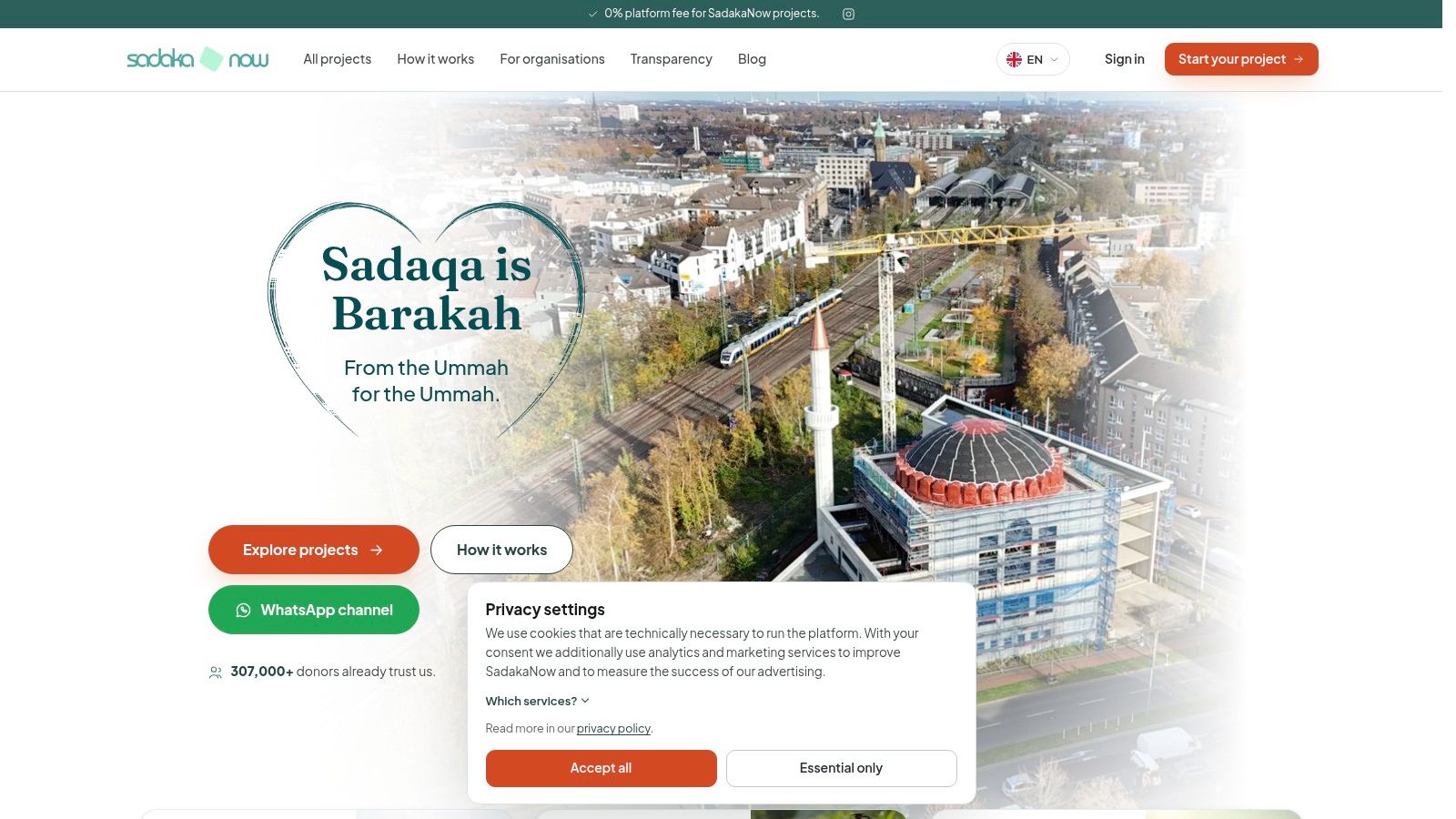
An anonymised live feed like Sadaka Pulse makes donations visible as a communal activity without disclosing individual people. The display can show that a campaign is being actively supported, and it conveys the impression of an ongoing project rather than a static donation page.
This does not replace financial documentation. A live feed must not suggest that every use of funds has already been reviewed or completed. It adds currency to the project information and should be combined with regular updates, clear sponsorship and traceable expenses.
A recurring donation rarely arises from a single emotional moment. It arises when the organisation keeps informing supporters after the first contribution and visibly fulfils its commitments.
Features communities should prioritise
- Public project page: The goal, description, sponsor and duration must be understandable without a complicated sign-up.
- Regular updates: Communities should openly communicate progress, delays and completed steps.
- Anonymised activity: A live feed can show community engagement but must not publish sensitive donor data.
- Traceable progress: Images and texts should explain what has concretely changed, rather than just repeating new calls to action.
- Contact option: Donors need a reachable contact person for questions about the campaign.
For projects with particularly high emotional relevance, such as supporting children without parents, communication should remain dignified and precise. The article Donating for Orphans shows why clear project information must be worded with particular care on sensitive topics.
My recommendation: Do not choose a platform that reduces transparency to a counter. Opt for a process that meaningfully combines the project page, updates, progress display and anonymised activity.
Situational Recommendations for NGOs and Mosque Associations
The question „Which fundraising platform Germany is the best?“ leads to an answer that is too broad. A nationwide NGO needs different features than a local mosque association. Decisive factors are campaign scope, internal resources, reporting requirements, payment methods and the desired degree of community closeness.
For larger NGOs
An NGO operating nationwide should choose a platform that can manage multiple campaigns, roles and data flows. Important are:
- Reporting: Donations, campaigns and recurring contributions must be evaluable.
- Integrations: CRM, accounting, email communication and payment processing should work together smoothly.
- Automation: Recurring donations, confirmations and target-group-specific communication must not be handled entirely manually.
- Brand management: The NGO needs consistent project pages and communication materials.
- Scalable administration: Multiple teams or regions should be able to work with clear permissions.
For such organisations, a comprehensive NGO fundraising suite may be more sensible than a strongly focused donation marketplace. However, the greater range of functions is only worthwhile if the organisation can operate the systems, maintain data and take permanent responsibility for processes.
For local mosque associations
A mosque association should prioritise differently. It usually doesn't need a complex international data architecture, but rather a quick campaign start, understandable project pages, verified sponsorship, suitable payment methods and fair fee logic.
The decision can be made in four steps:
- Define the project: Is it Sadaka, emergency social relief, an education initiative or a mosque project?
- Check costs: Which platform and payment fees are actually deducted from the donation amount?
- Test checkout: Do PayPal, SEPA direct debit and credit card work on a smartphone?
- Ensure transparency: Can the board and project team publish regular updates, progress and contact persons?
SadakaNow, as a German donation platform, is focused on Sadaka, mosques and verified social projects, operates with a 0% platform fee, offers SEPA, PayPal and credit card, and provides public project information as well as anonymised real-time donations. These features are particularly suited to communities that need a clear community connection and an uncomplicated campaign process.
The best choice is therefore not automatically the platform with the most features. For a large NGO, system depth counts. For a local mosque, trust, fee clarity, payment options and the ability to launch quickly and legally secure count.
Visit SadakaNow if your community wants to fund Sadaka or social projects with verified sponsorship, several German payment methods and transparent project communication. Before launching the campaign, check the fees, documents and updates together with the board so that donors can follow the entire process.