Paying Fidya: Amount, Calculation and Payment Method 2026
Ramadan is underway, and the family is discussing whether the grandmother can fast this year. She has to take medication permanently, and skipping meals would be risky. In the family chat, an amount from the country of origin is circulating, while the mosque names a different rate. In Germany there is no state-set Fidya amount; recommendations from aid organisations can differ from one another.
So note down the daily rate that is relevant to you at the time of payment. This way, you can later trace how you calculated the total amount and what the payment was intended for. The calculation is simple: multiply the number of days not fasted by the chosen daily rate.
Table of Contents
- Who must pay Fidya and when making up days applies
- Fidya amount based on days not fasted
- How to calculate and document Fidya step by step
- Payment methods for Fidya and SadakaNow compared
- Common mistakes and questions about payment
Who must pay Fidya and when making up days applies
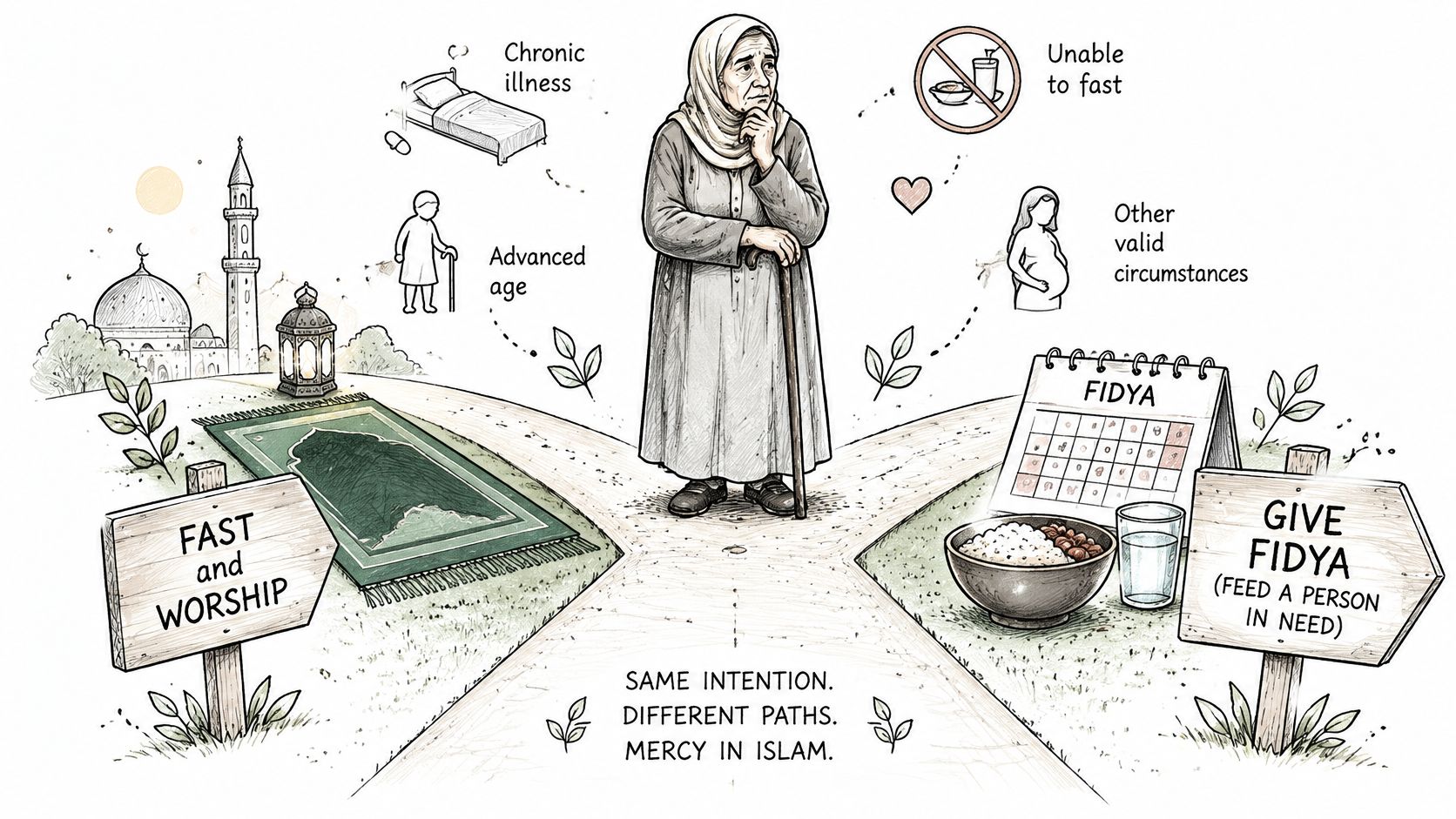
Fidya is a religious substitute payment for people who cannot fast due to permanent illness, old age, or comparable reasons. It is relevant above all during Ramadan, and it is not a flat annual levy.
The first decision, therefore, is not the amount but the reason. Permanent illness with no prospect of improvement and old age, where fasting is no longer possible, lead to Fidya. Temporary illness and travel usually lead to making up the fasting days later, depending on the religious assessment. In the case of pregnancy or breastfeeding, there is no uniform answer. You should clarify this case with the mosque community before anyone sets an amount.
| Case | Fidya or making up | Note |
|---|---|---|
| Permanent illness with no prospect of improvement | Fidya | Amount per day not fasted |
| Old age, fasting no longer possible | Fidya | Applies in cases of permanent inability |
| Temporary illness | Making up, depending on assessment | Check whether fasting days need to be made up |
| Travel | Making up (depending on interpretation) | Make up fasting days after Ramadan |
| Pregnancy or breastfeeding | Clarify with the community | Clarify the case with a mosque community |
What does not determine the amount
There is no uniform, state-set amount for Germany regarding the specific amount. The assessment is traditionally based on providing a needy person with a day's ration of basic foodstuffs per day not fasted. Many communities and aid organisations then convert this value in kind into euros. Interpretation, food prices, administrative models and recipient country therefore produce different recommendations. Before payment, you should check which religious basis and which daily amount are being used.
A reliable national statistic on the total volume, the number of Fidya payments, or average amounts is not separately listed in the available official German data, not even in the BAMF research report on Muslim life. This gap makes traceable information on the amount, calculation year, recipient group and transfer method all the more important.
Not to be confused with Zakat
Zakat is a mandatory wealth levy under certain conditions. Fidya is the substitute payment for fasting that permanently cannot be fulfilled. Anyone who owes both in the same Ramadan calculates and pays them separately. Another type of substitute payment, for example for a broken oath, is donating Kaffara, which does not follow the same daily rate.
Practical rule: Fidya is calculated per day not fasted and per needy person, not as a one-time annual payment.
As long as the reason is temporary, money does not replace making up the days. Only once the inability becomes permanent does an amount arise from the counted days.
Fidya amount based on days not fasted
You count seven days that were actually not fasted and want to note down the amount you transfer: at a daily rate of 13 €, that comes to 91 €. Islamic Relief Deutschland currently states 13 € per day and 390 € as an example for 30 days. For your own calculation, the daily rate that counts is the one you apply at the time of payment.
There is no state-defined amount. Organisations use different reference values. The following comparison rates serve as illustration; the appropriate rate depends on the calculation method used.
Three reference values in a table
| Days not fasted | Comparison calculation at 13 € | Comparison calculation at 10 € | Comparison calculation at 9 € |
|---|---|---|---|
| 1 day | 13 € | 10 € | 9 € |
| 7 days | 91 € | 70 € | 63 € |
| 10 days | 130 € | 100 € | 90 € |
| 30 days | 390 € | 300 € | 270 € |
The table shows how the total results from the number of days and the chosen daily rate. For seven days at 13 €, this is 7 × 13 € = 91 €. For ten days at 10 €, the result is 100 €. A different rate changes the total amount, not the number of days taken into account.
Fixing the rate on the day of payment
Before making the payment, note down three pieces of information:
- Days: the number of days actually not fasted for which Fidya is applied.
- Daily rate: the amount used and, if specified, its reference year and calculation basis.
- Payment: whether you pay as a lump sum or day by day.
This way, the total can be traced later. Note the date, number of days, and daily rate, for example in your records or in your banking app. The total payment can be made at the end of Ramadan, daily, or as a lump sum at the beginning.
How to calculate and document Fidya step by step
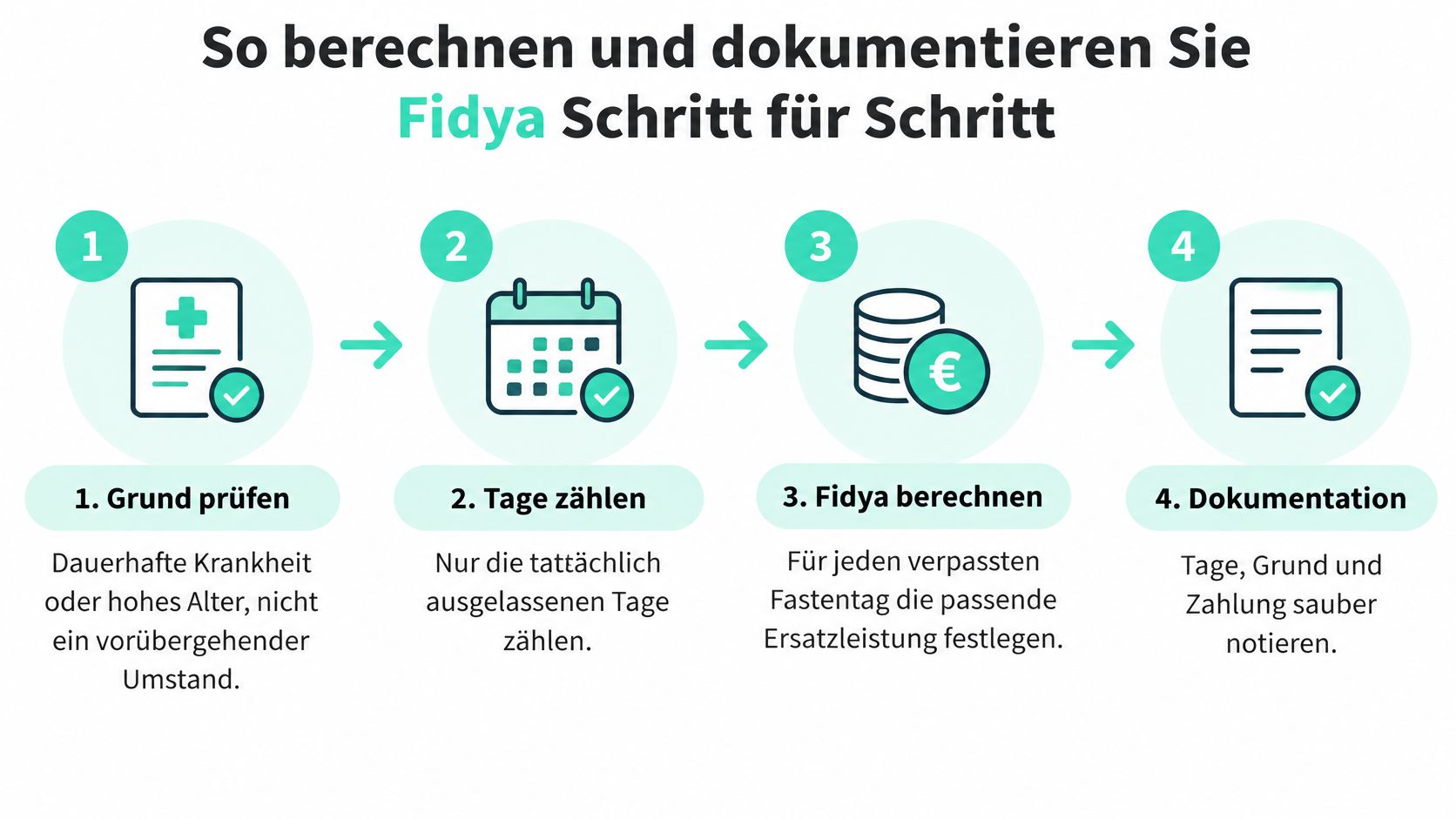
Fidya is not automatically applicable for every missed fasting situation. German specialist information describes it primarily for people who cannot fast due to permanent illness or advanced age. For temporary reasons, making up the missed days may be relevant instead, depending on the religious assessment.
According to the applicable case, one needy person is accounted for per day. The provision can be food or its monetary value. Historically, it consisted of fixed quantities of food; today it is often calculated based on the value of two filling meals, as Muslimehelfen explains in the FAQ. For Germany, local purchasing power is relevant. Islamic Relief Deutschland derives the amount from the cost of a meal in the country of residence and currently sets it at 13 €.
The six steps
- Check the reason. Permanent illness or advanced age must be present. An illness lasting only a few days or a journey does not replace fasting with money as long as making up the days remains possible.
- Count the days. Only days actually missed. A full Ramadan of 30 days is only the basis if truly no day was fasted.
- Note the reference rate at the time of payment. Write down the rate, for example 13 €, plus source and date. If the rate increases later, the value recorded at the time applies to this payment.
- Calculate the total. Days multiplied by the daily rate. Thirty days times 13 € equals 390 €. Seven days remain at the smaller sum, not at a monthly amount.
- Choose the timing and form. Daily, at the end of Ramadan, or as a lump sum at the start. Each daily rate remains allocated to one needy person, whether as food or as its monetary value.
- Secure the purpose and the receipt. The recipient's purpose is clearly “feeding those in need”. Keep the receipt, bank statement, or confirmation together with the note on days and rate.
The main pitfall is confusing it with Kaffara. Fidya is the daily compensation for legitimate permanent inability. A Kaffara does not replace it by simply multiplying missed days.
Anyone who cannot explain reason, days, rate, and purpose in one sentence has not yet finished the calculation.
Five questions before sending
- Reason checked: Is there permanent inability, not a temporary circumstance?
- Days counted: Is the exact number of missed days established?
- Reference rate noted: Are the rate, date, and source recorded?
- Purpose defined: Is feeding those in need stated as the intended use?
- Receipt saved: Is a confirmation kept with the family's records?
Only once all five answers are yes can the payment be verified later.
Payment methods for Fidya and SadakaNow compared
A community receipt, a confirmation from the aid organisation, or an online payment receipt can document the payment. The appropriate method depends on who verifies the recipients and how clearly the intended use is stated.
| Payment method | Proof | Who checks the recipient | When it makes sense |
|---|---|---|---|
| Collective payment to a mosque | Receipt from the community | Community board | When the community knows people in need |
| Aid organisation with a Fidya project | Donation confirmation | Organisation itself | When the use is documented |
| Directly to a person in need | Your own note or bank statement | You yourself | When you know the recipient personally |
| Online platform SadakaNow | Payment receipt and project page | Platform and aid organisation | When you choose the project and amount transparently |
With a collective payment, the community should confirm the purpose and issue a receipt. This makes it possible to trace the payment later. Without a written proof, only the verbal promise remains.
An aid organisation with a dedicated Fidya project can document its use within its own structure. Check whether the project clearly states its purpose. A general donation account makes it harder to attribute the payment to Fidya.
Direct help to a person in need is straightforward, but it requires you to keep your own record: note the date, amount and purpose, or keep the bank statement. Otherwise, the payment can later hardly be distinguished from a private gift.
Online in five steps
Choose a project whose use matches your Fidya. Enter the amount you calculated earlier, select an available payment method, and save the confirmation together with the daily rate, the number of days and the payment date. This keeps it clear how the total was made up.
On SadakaNow, donors choose a project, enter an amount and pay via SEPA, card or PayPal. SadakaNow never touches the donated funds. They are held in trust and paid out directly to the respective organisation. Fraud protection, anti-money-laundering checks under § 4 GWG, and SEPA mandate verification run automatically on every transaction, usually within seconds. The payment service provider's fees are shown in the donation form.
For digital payments and storing confirmations, the overview on donating online via SEPA, card or PayPal offers further guidance. Those sorting receipts in online banking can also take a look at the guide paying QR bills through the bank.
Choose your payment method based on recipient verification, purpose, and a traceable receipt.
Before submitting, check the amount and daily rate once more against your table. Keep the confirmation so that both pieces of information are available together later.
Common mistakes and questions about payment
Most follow-up questions don't arise from a lack of knowledge about fasting, but from taking a shortcut with the payment.
- Adopting a foreign amount without checking it. Use the German reference value and note the source, instead of copying a rate from a different price level.
- Setting the days as a flat rate. Count only the days actually missed. A full month is only correct if no day at all was fasted.
- Paying without a stated purpose. State a purpose such as feeding those in need, otherwise the transfer can't be traced later.
- Mixing Fidya and Zakat together. Both have a different trigger. Calculate and pay them separately, even if both fall due during Ramadan. For the gift due at the end of the month, the separate path for Zakat al-Fitr is more fitting.
- Mixing up Fidya and Kaffara. A Kaffara doesn't arise simply by multiplying missed days. Clarify this case with your mosque community.
- Paying for another person without arrangement. Clarify authorisation or a clear arrangement beforehand, especially when children transfer money on behalf of a parent.
Three questions from practice
What happens if the reference value rises during Ramadan? The rate at the time of payment applies. The date and reference value should go on the same receipt, so the amount remains traceable even if the rate rises later.
Can the amount be split among several people? One person in need is intended per day. The total can be distributed as long as each daily rate remains assigned to one person and doesn't disappear into an anonymous collective sum.
What to do if the payment doesn't arrive? Questions about donations and payment issues go to hilfe@sadakanow.de. Individual religious questions, such as pregnancy or a borderline case between making up and substitute payment, belong with the local mosque community, not in a payment form.
On SadakaNow you choose a verified aid project, enter the Fidya amount calculated from your days, and pay by SEPA, PayPal or card, while the full donation amount goes to the organisation. This way, the recorded daily rate stays linked to the project and confirmation, instead of disappearing into an unlabelled standing order. Once the days are counted and the purpose is clear, you can initiate the payment directly via SadakaNow.