Crowdfunding platform comparison
The most common piece of advice is: compare the platform fee first. For donation campaigns, this advice is often misleading. An advertised commission of 0% alone doesn't tell you how much actually reaches the project after payment processing, fixed costs and payout rules.
A reliable crowdfunding platform comparison therefore has to go further. What matters is not just reach and ease of use, but also transaction costs, verification, data protection, regulatory suitability and cultural fit. Especially for charitable projects and Sadaka donations, this second layer determines whether a platform builds trust or merely offers a technically simple donation page.
Table of contents
- Why the advertised platform fee obscures the real costs
- The development of the German crowdfunding market
- Key evaluation criteria for donation platforms
- Fee models and transparency in direct comparison
- Special requirements of Muslim communities and SadakaNow
- Practical decision guidance for different donation purposes
- Conclusion and concrete recommendation
Why the advertised platform fee obscures the real costs
Comparison sites, like the usual financial portals, list features side by side and then assign a ranking. For donation campaigns, this approach falls short: a platform with 0% commission may finance itself through payment fees, fixed amounts or voluntary contributions, while a visible success commission might disclose all costs more clearly.
The advertised fee is therefore not a reliable cost indicator. GoFundMe advertises a 0% platform fee in Germany. However, according to the GoFundMe fee model, a payment processing fee of 2.7% plus €0.35 per donation applies, as well as a voluntary contribution from donors. Startnext quotes a commission of 8% to 14% on project success depending on the service package, plus transaction costs. The Startnext service overview is therefore more informative for checking the specific model than a platform ranking. Another German crowdfunding overview from Gründerplattform classifies the various financing models.
Price information alone is not enough for a reliable assessment. Four questions reveal the actual economics:
- What is deducted? Platform commission, payment processing, fixed fee and any VAT must be clearly identifiable separately.
- Who bears the costs? The burden can fall on the organisation, on donors, or on both.
- When is the payout made? Delays or additional conditions can limit the practical availability of the funds.
- Who is allowed to start a campaign? Verification and charitable status checks say more about security than an appealing front end.
The purpose of the donation changes the assessment. A creative product idea, an association's activity, humanitarian emergency aid and a project-related Sadaka donation each require different documentation, payment methods and rules. For Muslim communities, what matters alongside technical processing is whether the platform is regulatorily and organisationally suited to the donation purpose. Rankings often only touch on this cultural and legal dimension in passing.
| Evaluation Area | Superficial Comparison | Robust Analysis |
|---|---|---|
| Fees | Platform commission | Platform, payment and fixed costs combined |
| Reach | Size of the platform | Fit with one's own community |
| Trust | Reviews and design | Verification, updates and fund transparency |
| Payment | Available payment methods | Costs, security and payout logic |
| Purpose | General campaign categories | Charitable status, association purpose or Sadaka suitability |
Analyst's rule: What matters is not the fee shown in the banner, but the traceable net proceeds of a specific donation.
The development of the German crowdfunding market
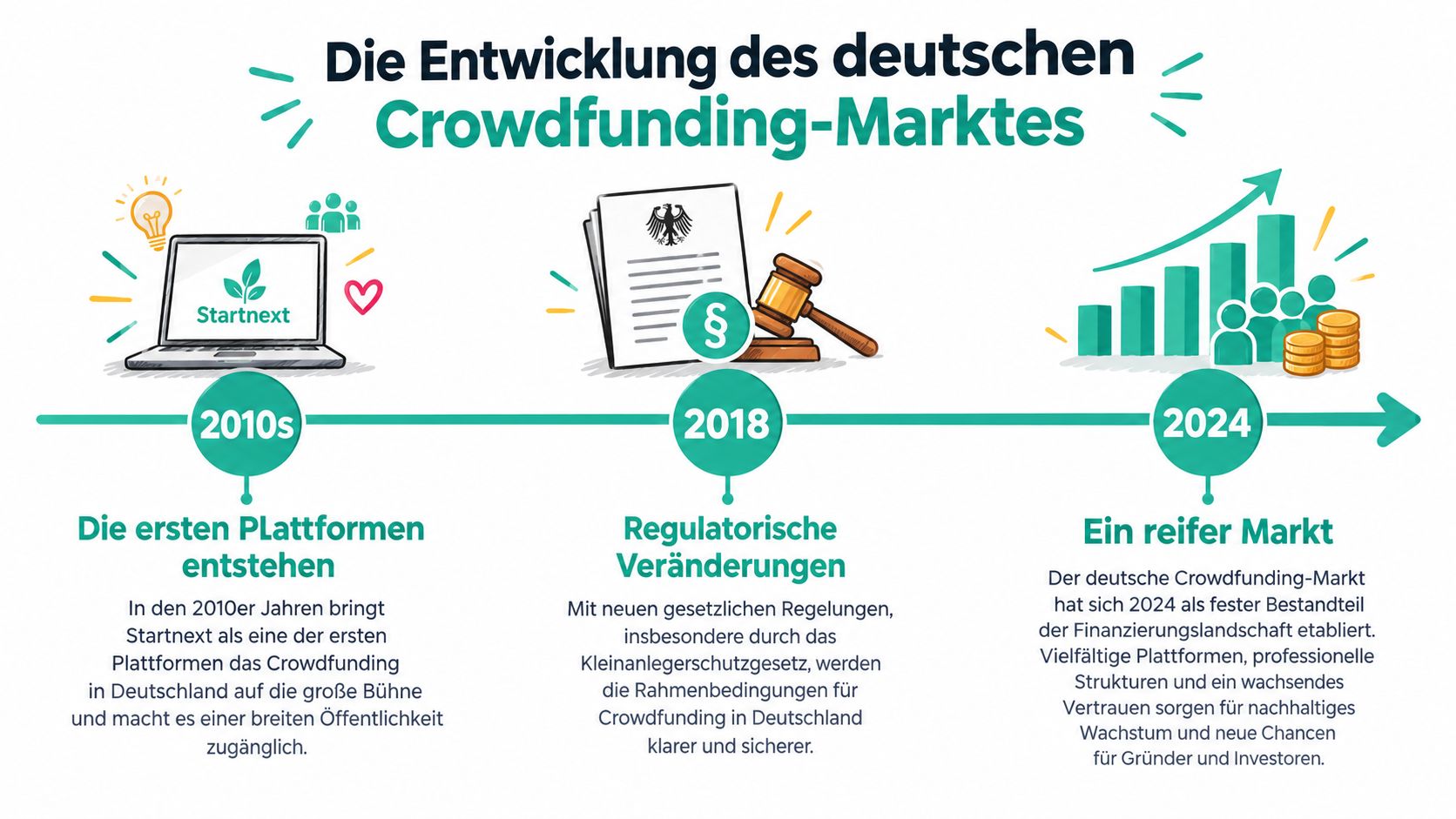
Crowdfunding in Germany has developed from a digital model that needed explaining into an established financing instrument. An early turning point was marked in 2011 by the film project „Stromberg“. The planned sum of 1 million euros was raised within a week, and after two days revenues already stood at over 150,000 euros (Chronicle of the German crowdfunding market).
This case shows which conditions support digital fundraising models: an activatable community, high visibility and a short financing cycle. Afterwards, platforms such as Startnext, VisionBakery, Inkubato, mysherpas and pling emerged in Germany. Today's market shape is thus the result of a development in which reach and community communication were initially at the center.
From niche model to a normal path of financing
The Crowdfunding Monitor documents the shift in public perception. Awareness and acceptance in Germany rose from 51.8% in 2015 to 67.4% in 2018. At the same time, only 7.3% of respondents had taken part in a crowdfunding project in 2015, while by 2018 this figure had risen to almost 12% (Crowdfunding Monitor 2018).
This development shows more than rising awareness. The more familiar people become with digital donation and financing models, the more closely they scrutinize how they are handled. A platform must therefore not only generate attention, but also disclose who receives the money, what costs are incurred, how a project is vetted and how progress is documented.
At the same time, the market remains highly fragmented. For the DACH region, around 150 crowdfunding, crowdlending or crowdinvesting platforms are cited, while some overviews acknowledge that no exact figures on the number of platforms in Germany are available (Market overview by the Federal Funding Program for Crowdfunding). This very uncertainty makes selection more demanding. Anyone comparing many providers needs a clear evaluation logic rather than an arbitrary ranking.
For donors and project initiators, a clear consequence follows. Reach remains important, but is no longer sufficient. Trust, transparent payment methods, data protection and traceable verification increasingly determine whether a campaign receives lasting support.
An additional insight into the development of digital financing models:
Key evaluation criteria for donation platforms
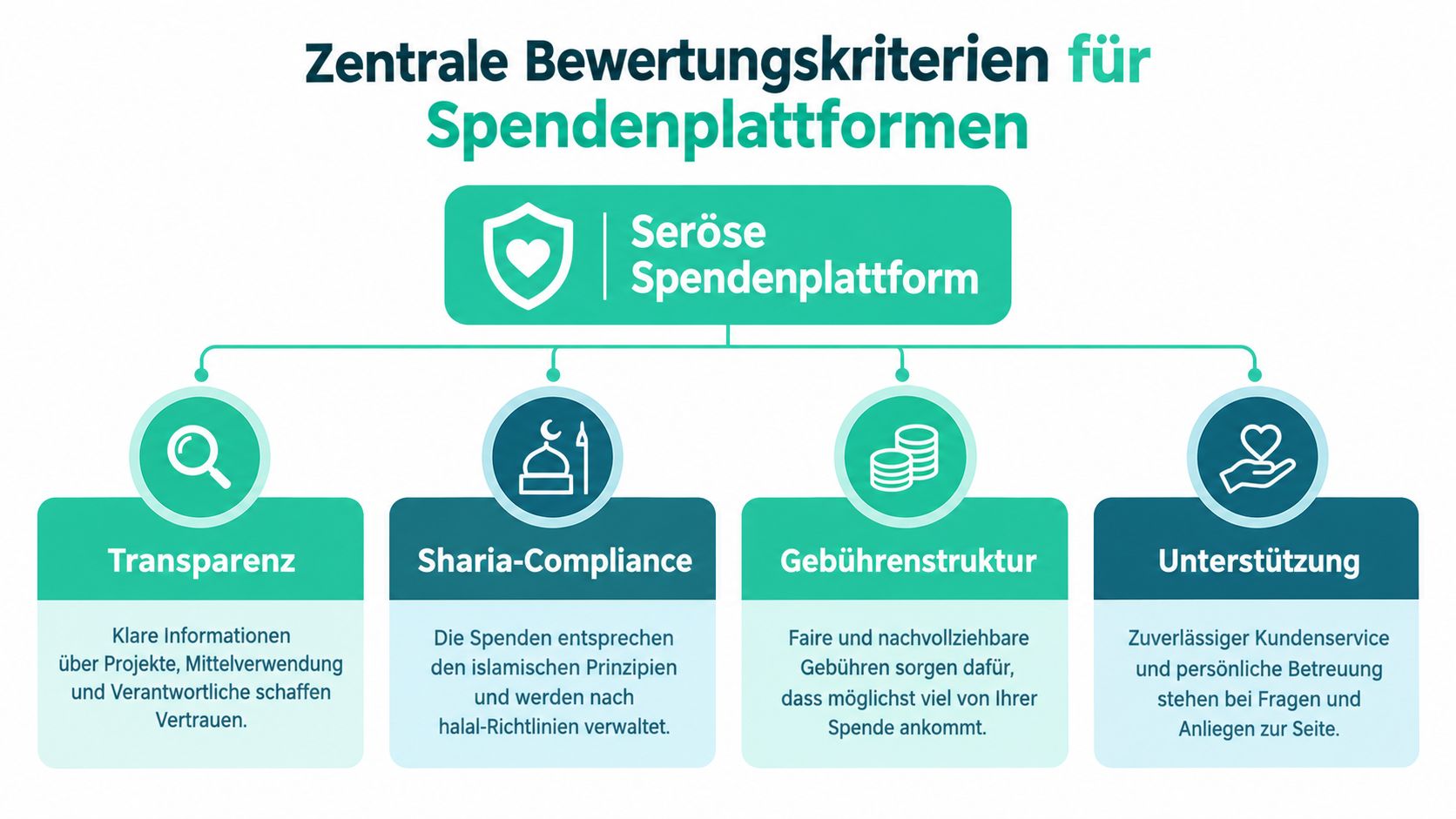
A reputable donation platform cannot be assessed on the basis of a single feature. What matters is the interplay of financial transparency, purpose fit, technical security and human review. Only when these levels align does an environment emerge in which donors can trace the path of their money.
Transparency begins after clicking Donate
A clear campaign page should present the purpose, the goal, the progress, the duration and the responsible organization in an understandable way. Regular updates show whether an organization actually communicates and uses funds for their intended purpose. Live progress alone is not proof of impact, but missing information makes any assessment harder.
Financial transparency includes a complete breakdown of costs. The platform should distinguish between platform fee, payment processing and possible voluntary contributions. Anyone who merely highlights „0%“ without making the actual deduction per payment method visible does not provide a sufficient basis for decision-making.
Purpose and charitable status must align
A general donation platform can technically accommodate many types of campaigns. This does not mean, however, that it is equally well suited to every donation purpose. Mosque associations, charitable aid organizations and private initiatives require different kinds of evidence, forms of communication and administrative processes.
Particularly relevant is the review carried out before activation. It should clarify whether an organization exists, whether its purpose is comprehensible, and whether the campaign matches the stated organization. For Sadaka donations, an additional cultural and religious classification is required. This must be described transparently rather than merely implied through terms in the campaign title.
Technology lays the foundation, trust arises through traceability
SSL encryption protects the connection between the browser and the platform. PCI-DSS Level 1 refers to a demanding security standard for processing card data. The GDPR concerns the handling of personal data, and this also includes donor profiles, payment information, and communication data.
These standards do not replace an organisational review. A technically secure payment process does not automatically indicate whether a project is legitimate. Conversely, good verification remains insufficient if payments are processed insecurely.
A useful evaluation framework therefore combines both sides:
- Financial clarity: Every cost item is clearly stated before the donation is made.
- Verified providers: Organisations and projects undergo a traceable review process.
- Secure payments: Payment data is processed according to recognised security standards.
- Reliable communication: Updates, support, and payout information are accessible.
- Local and cultural fit: Search, language, and purpose logic match the target audience.
Checkpoint: A platform is only transparent once donors can understand both the purpose and the flow of money.
Fee models and transparency in direct comparison
Cost comparisons become problematic as soon as platforms use different terminology. "No platform fee" does not necessarily mean that no costs arise. Payment service providers can charge percentage-based fees and fixed amounts, while some providers additionally offer voluntary contributions from donors.
For German campaigns, Startnext charges 8% to 14% commission on project success plus transaction costs, depending on the service package. GoFundMe advertises a 0% platform fee, but states 2.7% plus €0.35 per donation for payment processing. A German comparison source also lists a model for GoFundMe with 8.45% total fee plus €0.25 per donation. These differing presentations show why project organisers must always check the currently valid terms for their country and their specific payment method (German analysis of crowdfunding fees.
| Platform model | Advertised fee | Actual transaction costs | Impact on a €100 donation |
|---|---|---|---|
| Startnext, performance-based model | 8% to 14% commission | Plus transaction costs | The net proceeds are below the donation amount and depend on the service package |
| GoFundMe, Germany | 0% platform fee | 2.7% plus €0.35 per donation | The amount is reduced by payment processing and a fixed fee |
| Voluntary contribution model | 0% platform fee | Payment processing may apply | The deduction depends on the payment method and specific terms |
| Platform without a platform fee | 0% platform fee | Check payment service provider and possible fixed costs | Only the settlement shows the actual net proceeds |
Why the payment method changes the calculation
A SEPA direct debit, a PayPal payment, and a credit card transaction are not necessarily charged identically. Percentage-based costs affect larger donations more heavily, while fixed amounts weigh more on small individual donations. Anyone who only looks at the percentage therefore underestimates the significance of the donation amount and the transaction frequency.
The correct calculation is:
Net proceeds = gross donations minus platform fee, payment fee, and fixed costs.
For a reliable calculation, organisations should run through several scenarios. These include a single larger donation, many smaller donations, and recurring payments. Only then can it be assessed whether a voluntary contribution model or a fixed commission is more economically favourable.
The payout logic also belongs in the comparison. Is every donation processed individually or paid out in bulk? Are there minimum amounts? Are chargebacks taken into account? Such details determine whether a campaign can use its funds in time for a specific purpose.
For donation campaigns with a clear designated purpose, such as for orphans, the presentation of the project is just as important as the cost calculation. Readers can find a comprehensible project description, for example, in this article on donating for orphans.
Rule of thumb: Never just compare provider with provider. Compare the same donation amount, the same payment method, and the same payout logic.
Special requirements of Muslim communities and SadakaNow
A general platform ranking says little about whether a solution truly fits a mosque, an Islamic association, or a project-related Sadaqa campaign. Many comparisons weigh fees, reach, and standard features, but leave out regulatory fit and cultural expectations. This exact gap often remains in donation practice, as also shown by the study on building trust in online donations.
Muslim communities need more than just a donation page. They must be able to clearly demonstrate to their community who stands behind a campaign, what purpose the funds serve, and according to which criteria a project was approved. With Sadaka donations, there is also the added requirement that communication remains understandable and the religious purpose is not mixed up with other forms of financing.
Why standard platforms are often not enough
A large platform can offer fast campaign creation and broad sharing functions. However, this does not automatically resolve the trust questions of a religious community. A general category menu does not replace a review of charitable status, a clear presentation of the project organiser, or purpose-related communication.
Local discoverability also matters. A mosque association often wants to address supporters from its own city, the regional area, and the international community. A platform that primarily focuses on global reach is often less suitable for this than a solution with a thematic project catalogue, public updates, and clear community assignment.
What specialised infrastructure must deliver
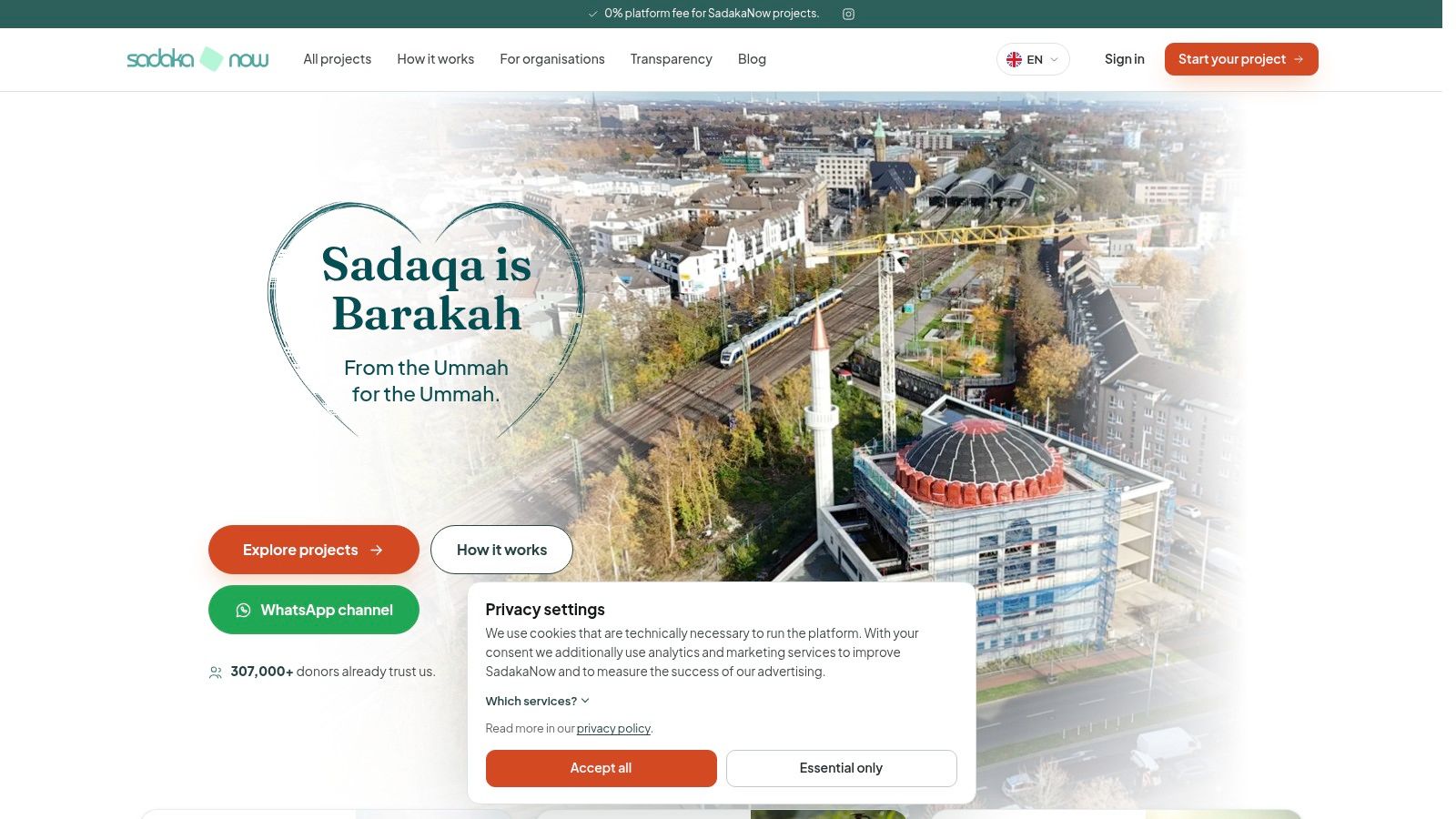
SadakaNow brings together campaigns from mosques, aid organisations, and social initiatives, and checks organisations for charitable status before activation. The platform forwards donations without a platform fee, finances itself through voluntary tips, and thereby reduces the cost question for project starters. SEPA direct debit, PayPal, and credit card are available to donors.
For traceability, the platform displays project information, progress, number of donors, and updates. The live feed "Sadaka Pulse" shows anonymised real-time donations. Technically, the service cites SSL encryption, PCI-DSS Level 1, and GDPR compliance. Organisations receive support when launching a campaign and can publish their projects after review.
This does not replace an organisation's own review of its statutes, donation receipts, use of funds, and internal approvals. However, it creates a more suitable basis for projects where charitable status review, secure payments, and cultural relevance need to come together.
Ramadan donations require different editorial planning than a long-term education initiative. The purpose, time period, and updates should be clear to donors. Practical guidance is provided in the article on donating during Ramadan.
Decision criterion: For Sadaka, what matters is not just whether a platform accepts payments. What's decisive is whether it clearly shows the religious purpose, the verified organiser, and the path the funds take.
Practical decision guidance for different donation purposes
The right platform depends first on the project and only then on the provider. An association with a regional target audience needs different infrastructure than private emergency aid or an NGO with regular reporting. The following guide therefore separates the key use cases.
Mosque association
A mosque association should choose a platform that reviews the organiser and supports both local and thematic discoverability. Before launching, the following questions belong on the internal checklist:
- Proof of organiser: Have charitable status, authority to represent, and association details been verified?
- Earmarking of funds: Does the campaign clearly describe whether funds are intended for construction, education, operations, or social aid?
- Payments: Can community members donate via SEPA, PayPal, and credit card?
- Reporting: Can progress and updates be documented publicly?
For association campaigns with a clear community connection, a specialised approach offers advantages over a purely global platform. Further organisational guidance can be found in the guide on crowdfunding for associations.
Private aid initiative
With a private initiative, speed matters, but speed must not replace verification. The campaign should explain the affected person, the specific need, and the planned use of funds in a comprehensible way. In sensitive cases, personal data must be protected and consent must be taken into account.
A voluntary contribution model can be interesting for cost planning, provided that payment processing is reported separately. Before sharing the link, the initiator should check how questions are answered, how updates are published, and how payouts are documented.
Charitable NGO
An NGO usually needs more than a single donation page. It should check whether the platform supports recurring donations, team access, project updates, and analysable administrative data. With multiple campaigns, it is also important whether donations can be clearly assigned to projects and documented internally.
The same principle applies to every target group: first check the net proceeds and the evidence, then assess the reach. A platform with less general visibility can be the better choice if it reaches the right community and credibly reflects the donation's purpose.
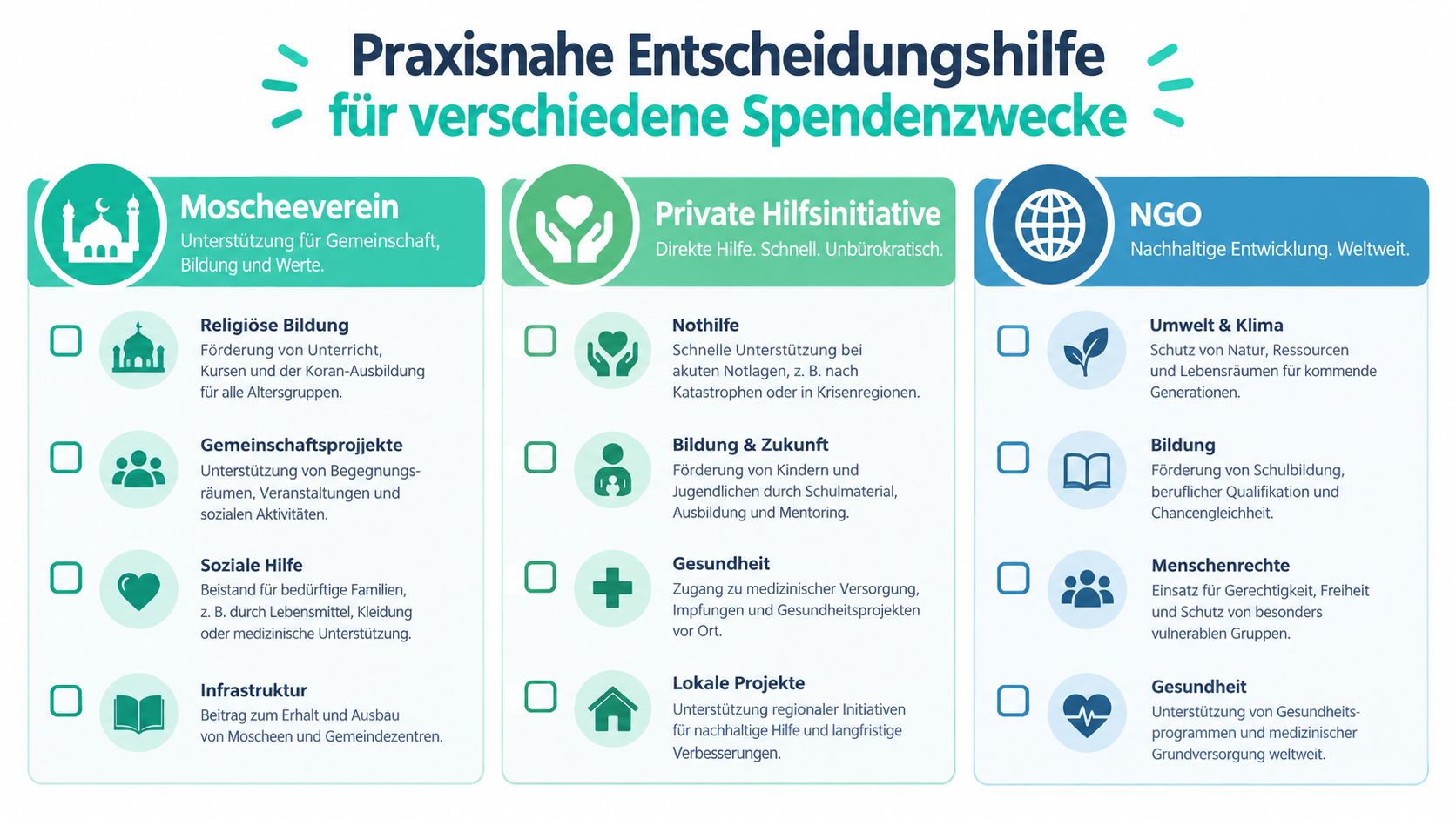
Before paying, donors should check three things: the responsible organiser, the specific use of funds, and the cost information. If any of this information is missing, caution is advisable, regardless of how professional the campaign page appears.
Conclusion and concrete recommendation for action
A credible crowdfunding platform comparison doesn't start with a ranking, but with the breakdown of costs. Check the advertised platform fee, the payment fees, any possible fixed costs and the payout logic together. Only this combination shows how much of a donation actually reaches the project.
For project organisers, three further checks are added: Is the organisation verified? Does the platform suit the donation purpose? Can progress and the use of funds be documented in an understandable way? For Muslim communities and Sadaka donations, it is additionally crucial whether the platform brings together cultural requirements, non-profit verification and secure payment methods.
Donors should read the project page, the responsible recipient and the fee information before every payment. Organisations should prepare a sample breakdown for different payment methods before launching a campaign and have their internal records ready. This way, crowdfunding becomes not only fast, but also transparent and impact-oriented.
SadakaNow provides verified mosques, aid projects and social initiatives with a donation infrastructure featuring a 0% platform fee, multiple payment methods and public project information. If you would like to start a Sadaka campaign or support a verified project directly, visit SadakaNow.