
Donation Receipt for Non-Profit Associations: Practical Guide
Shortly before Ramadan, the same scene plays out in many mosque associations. Someone transfers money via a platform for the Iftar collection, another member asks a few days later whether there is a certificate for the tax office, and the board members look at each other wondering who is actually allowed to sign it. This is exactly the point where a nice payment confirmation differs from a donation receipt for a non-profit association that actually holds up for tax purposes.
Anyone who documents such donations properly protects not only the donors. The association also protects itself, because the certificate is only reliable if the recipient, purpose, amount, and date match up and the correct issuer stands behind it. For readers who know the processes in small mosque communities, it also helps to look at the Helpers & Partners Guide Winterthurer Musikfestwochen, because organizational association questions are considered there in a similarly pragmatic way.
Table of Contents
- Why the donation receipt suddenly becomes important in the association
- What a donation receipt legally is and is not
- Mandatory details on the certificate in detail
- Thresholds and simplified proofs
- From payment receipt to finished certificate
- Platforms, pass-through donations, and who really confirms
- Common mistakes and how to avoid them
Why the donation receipt suddenly becomes important in the association
The moment is often unspectacular. After Friday prayer, the community collects donations online for the renovation of the prayer room, a sister donates by credit card, and the next day the question comes up: "Will I get a receipt for that?" That's exactly when the board realizes that the payment alone doesn't say anything yet about tax recognition. What matters is whether the association is allowed to issue a genuine donation receipt and whether it is formally correct.
In practice, confusion quickly arises here. Many members think that a PayPal payment or a bank statement is already the donation receipt. That is not automatically true, because for a non-profit organization, tax reliability depends on the correct assignment of recipient and purpose. For mosque associations, which often work with small teams, this is not just a bookkeeping issue, but a question of internal responsibility.
Practical rule: Whoever merely receives the donation is not automatically allowed to issue the tax confirmation. The legal recipient of the donation is responsible.
This is often overlooked especially online. A platform can process donations technically, but it does not automatically replace the association-related certificate. That's why boards need simple internal processes, so that when the first inquiry from the community comes in, there's no need for a laborious search for which amount went where and under which name it was recorded.
Anyone who would like a structured overview of donation processes in associations will find helpful background in the internal article Donations for non-profit associations. In practice, however, what counts in the end is not the nice explanation, but whether it is clearly established—at the counter, on the laptop, or after Jumu'ah—who confirms what.
What a donation receipt legally is and is not
The legal basis is clear. For the special expenses deduction under § 10b EStG, non-profit donations generally require the formal confirmation under § 50 EStDV. This certificate is therefore not merely a friendly acknowledgment of receipt, but the proof on which the tax deduction is based. Without it, the formal basis is usually missing.
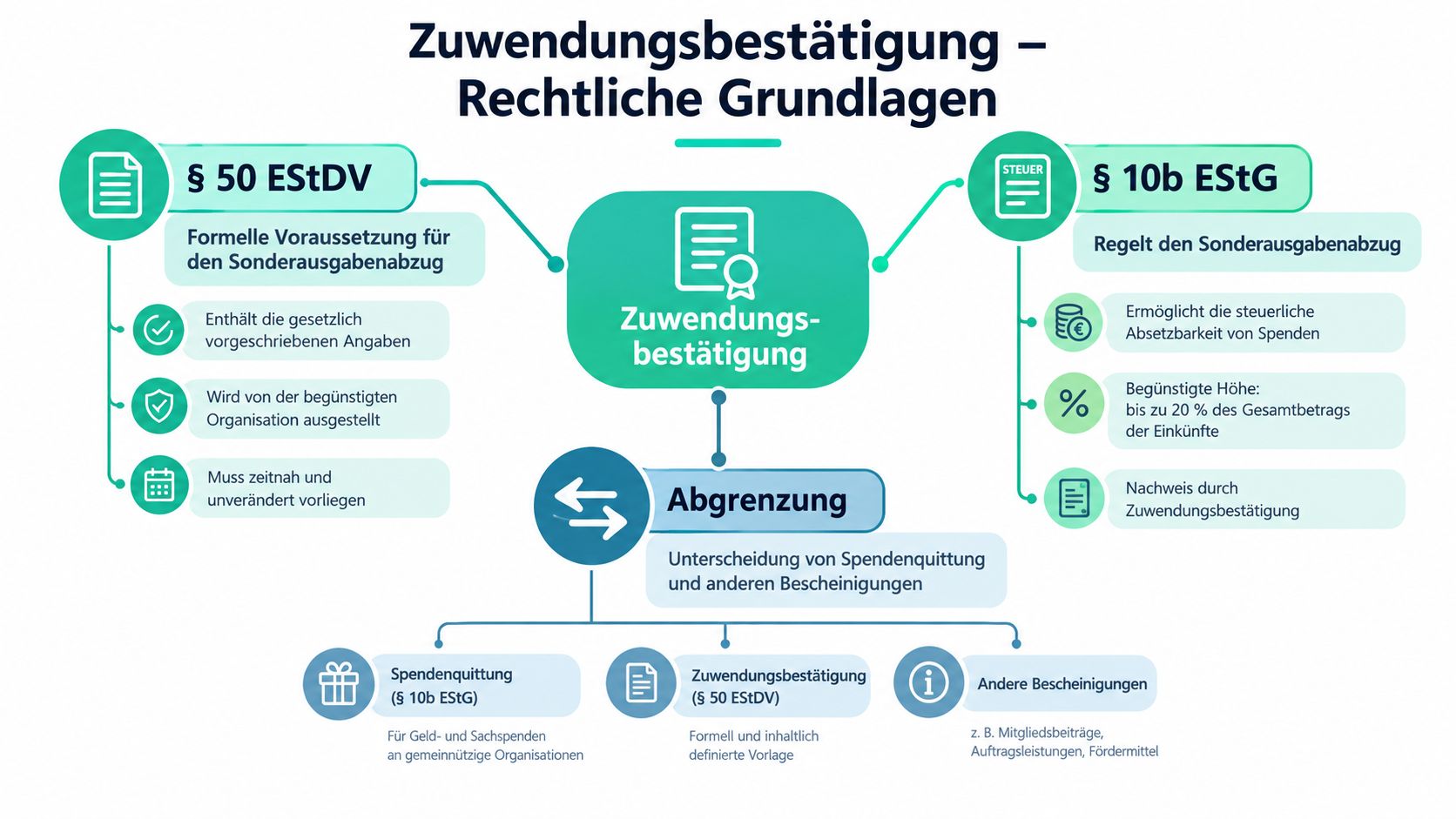
The distinction is important. A donation receipt is something different from a mere payment receipt, a tax exemption notice, or a simple thank-you letter from the association. The receipt only transfers money, the non-profit status proof only shows the organization's status, and the donation certificate combines payment, purpose, and recipient into a document that is usable for tax purposes. The Federal Ministry of Finance declares the templates to be binding, but allows the association to generate them technically, as long as all mandatory details are adopted unchanged.
For everyday practice, this means: not every organisation that is non-profit may automatically issue every kind of donation receipt. The association must correctly state the tax-privileged purpose and may not freely redesign the official framework. This is exactly why clean form practice is so important, especially for small communities that have to manage their administration alongside volunteer work, teaching, and community life.
A good receipt is not creative, but complete.
Those who use digital donation processes should also set up the internal workflow so that every confirmation remains tied to the correct payment transaction. The technical side is useful, but it does not replace the legal attribution.
Mandatory information on the receipt in detail
The formal details are not decorative extras. They determine whether the receipt is even taken seriously by the tax office. Especially at mosque associations, errors often arise not out of ill will, but because the treasurer has to quickly switch between several types of donations and overlooks a field in the process.
The details that really have to be correct
- Name and address of the association. This makes clear which legal recipient received the contribution. A common mistake is using outdated contact details or a short name instead of the full designation.
- Tax-privileged purpose. The specific purpose must be recognisable, not just a general reference to "non-profit work". If the purpose attribution is missing, the receipt loses its precision.
- Amount and date of the contribution. Both details must match. Incorrect dates often occur when donations are booked at the end of the month but issued later.
- Type of contribution. Money, goods, or expense. Whoever confuses these ends up stating the wrong type of donation.
- Date of issue and signature. The receipt needs a traceable issuance and a responsible person authorised to sign.
The purpose of each piece of information is simple. The tax office wants to recognise who received the funds, what they were intended for, and whether the transaction is consistent in terms of timing and content. For contributions in kind and expense contributions, it also applies that the documentation of the valuation or the waiver must be cleanly traceable.
| Mandatory information | Purpose | Typical error |
|---|---|---|
| Name and address of the association | Clear identification of the recipient | Short name or old address |
| Tax-privileged purpose | Proof of the use of funds | Too general a wording of the purpose |
| Amount and date of the contribution | Attribution of payment and period | Booking date instead of donation date |
| Type of contribution | Distinction between money, goods, and expense | Wrong type of donation selected |
| Date of issue | Traceability of the issuance | Missing or implausible date of issue |
| Signature of the authorised person | Accountability of the association | Signature by an unauthorised person |
For mosque associations, it is worth treating these details as a fixed checklist. Anyone confirming, for example, a Ramadan donation for the purchase of food should not have to think afterwards about whether it was actually processed as a monetary or an in-kind contribution. The receipt must reflect the actual transaction, not the later recollection of it.
Thresholds and simplified proof
Not every donation immediately requires the full form. For smaller amounts, the simplified proof is generally sufficient, such as a bank statement or a booking receipt together with a document from the recipient confirming the authorisation to accept donations. For associations, this is practical, because many small individual donations would otherwise trigger unnecessarily heavy administrative work.
When the simple receipt is enough
For donations up to 300 euros, the payment or booking receipt is generally sufficient. This can be a bank statement, a direct debit confirmation, or another clear proof of payment, as long as it is combined with a document from the recipient. For the community, this means: not every small donation has to be immediately converted into a full individual receipt.
When the formal confirmation becomes necessary
As soon as the donation exceeds this simplified treatment, the formal donation confirmation following the official template is required. Even though many donors wish for a receipt even for smaller amounts, the minimum tax logic is clear. It is not the payment method alone that decides, but the proof of who legally received the contribution.
For disaster relief and fundraising collections, exemptions may apply, but the organisational question remains the same. An association should not only look at the amount of the donation, but also at the type of collection, the number of participants, and the proof of the recipient. Especially with online payments via PayPal or card, the proof of the transaction is therefore important, but not automatically sufficient.
The short sentence "up to 300 euros, the receipt is enough" is helpful, but it does not solve the question of responsibility.
Anyone mapping such processes in the association with a platform or internal administration should always match the payment method with the recipient. A clean overview saves later discussions with donors, the board, and the tax office.
From payment receipt to finished confirmation
A reliable process does not begin only at the point of signing. It begins with the receipt of payment and ends only with the archiving of the duplicate. For small mosque associations, this exact sequence is crucial, because several people often collect money, check accounts, and request receipts at the same time.
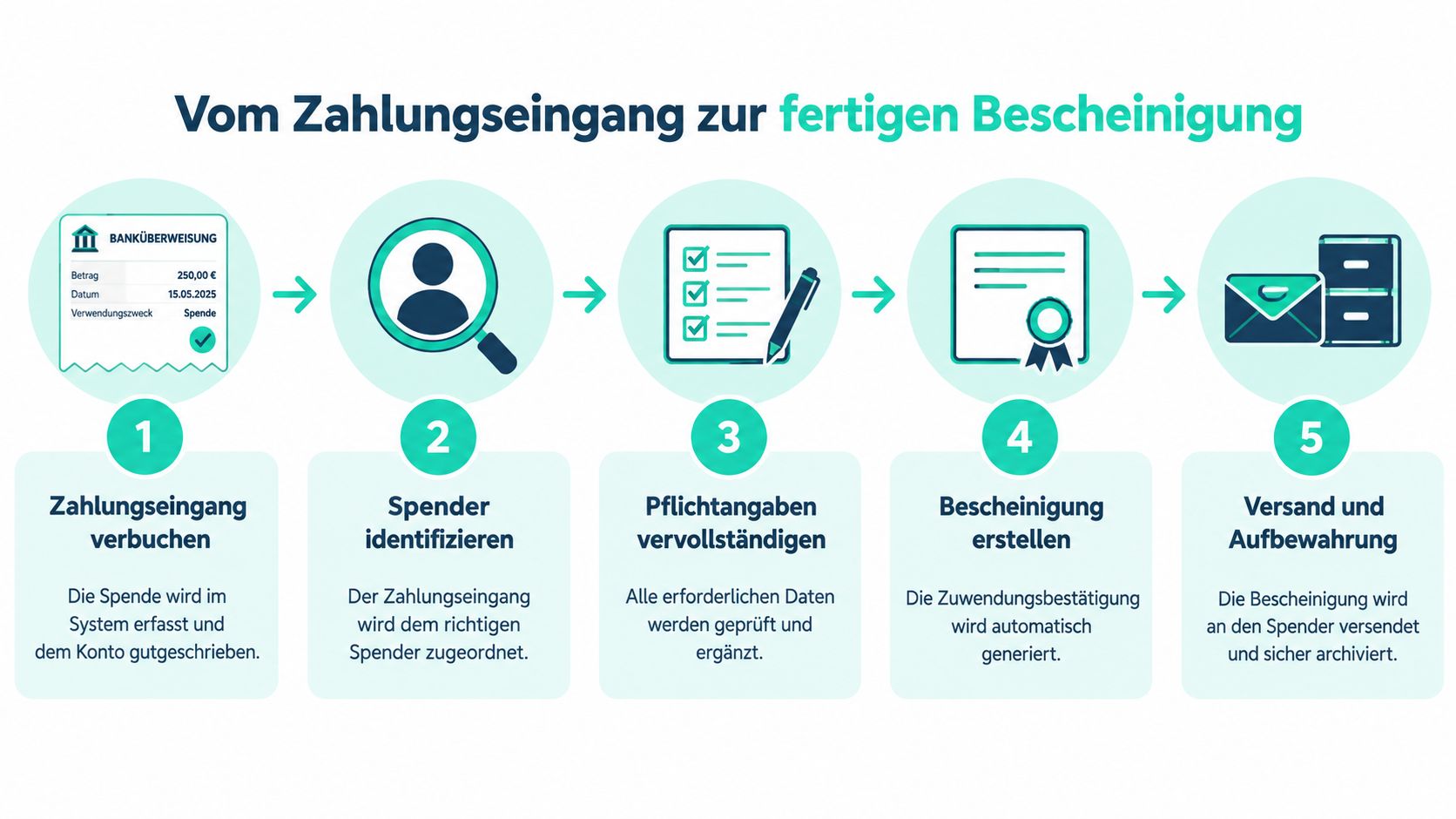
The process in practice
- Record the incoming payment. The treasurer or the cashier's office assigns the payment to the correct account and the correct purpose.
- Identify the donor. Name, address and, if available, tax ID must match the payment transaction.
- Complete the mandatory information. Amount, date, purpose and type of donation are added based on the actual transaction.
- Create the certificate. The association uses an approved form and adopts the mandatory passages unchanged.
- Sending and storage. A copy remains with the association so that later inquiries or audits remain possible.
For electronic certificates, an additional control point applies. Specialist information on the electronic donation receipt describes that the association notifies the tax office of the automated issuance, processes the tax ID, and issues a PDF confirmation with the same mandatory information as the paper version. This is useful, but it shifts the effort to data quality, responsibilities and archiving.
For internal work, a clear division of roles helps. The board sets the direction, the treasurer maintains the data, and the audit of accounts spot-checks completeness and plausibility. Anyone who wants to additionally orient themselves toward an administration-related structure can use the internal overview Prices & Administration as a conceptual model for clean processes.
A sensible control rule for the association is: no receipt without assignment, no assignment without mandatory information, no certificate without an archive. Working this way reduces duplicates and avoids the same donation being accidentally confirmed twice.
Platforms, pass-through donations, and who really confirms
The most common misconception is: whoever technically processes the money is also allowed to issue the certificate. That is not correct. What matters is who legally receives the donation as the recipient of the contribution and uses it for their own tax-privileged purposes. A platform can assist with this, but it does not replace the recipient.
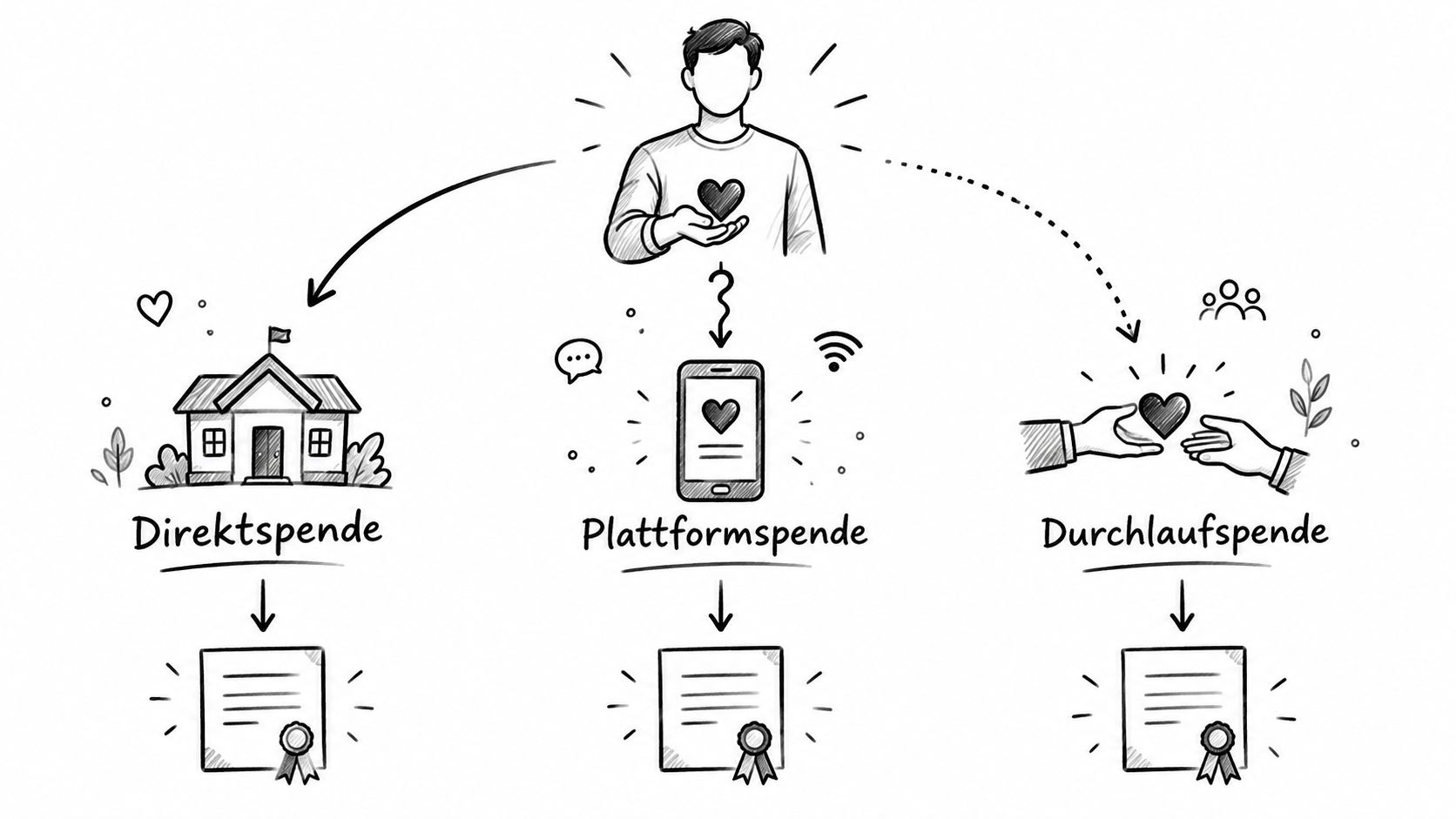
The three typical cases
- Direct donation to the association. The association is itself the recipient. It may issue the certificate if all formal conditions are met.
- Platform donation with a clearly assigned recipient. The platform handles the processing, but the legal contribution goes to the association. In this case, the assignment must be documented without gaps.
- Pass-through donation. If another body merely forwards the donation, it must be checked who is legally the recipient and who is not.
For mosque associations, this is especially important when donation campaigns run in parallel across several channels. An amount in the association's account is only properly assigned if the records clearly show whether it came from a platform campaign, a direct transfer, or a collection drive. The decision therefore does not depend on the payment method, but on the documentation of the recipient.
SadakaNow is, in this context, an example of a platform that technically bundles donations but does not automatically replace the association-related confirmation. For organisations, the correct data chain is therefore decisive, not the attractive checkout alone. Anyone who wants to learn more about the organisational side for providers will find the relevant starting point in the internal section for organisations.
Key point: Payment processing is no substitute for legally sound recipient documentation.
Especially with online donations, the association should therefore record which purpose, which amount, and which recipient belong together. Only this way does the certificate remain comprehensible to the tax office.
Common mistakes and how to avoid them
The typical mistakes repeat themselves remarkably often. They usually do not arise at the point of donation, but at the interface between accepting the donation, booking it, and issuing the receipt. For volunteer boards, this is good news and bad news at the same time, because much of it can be caught with a fixed routine.
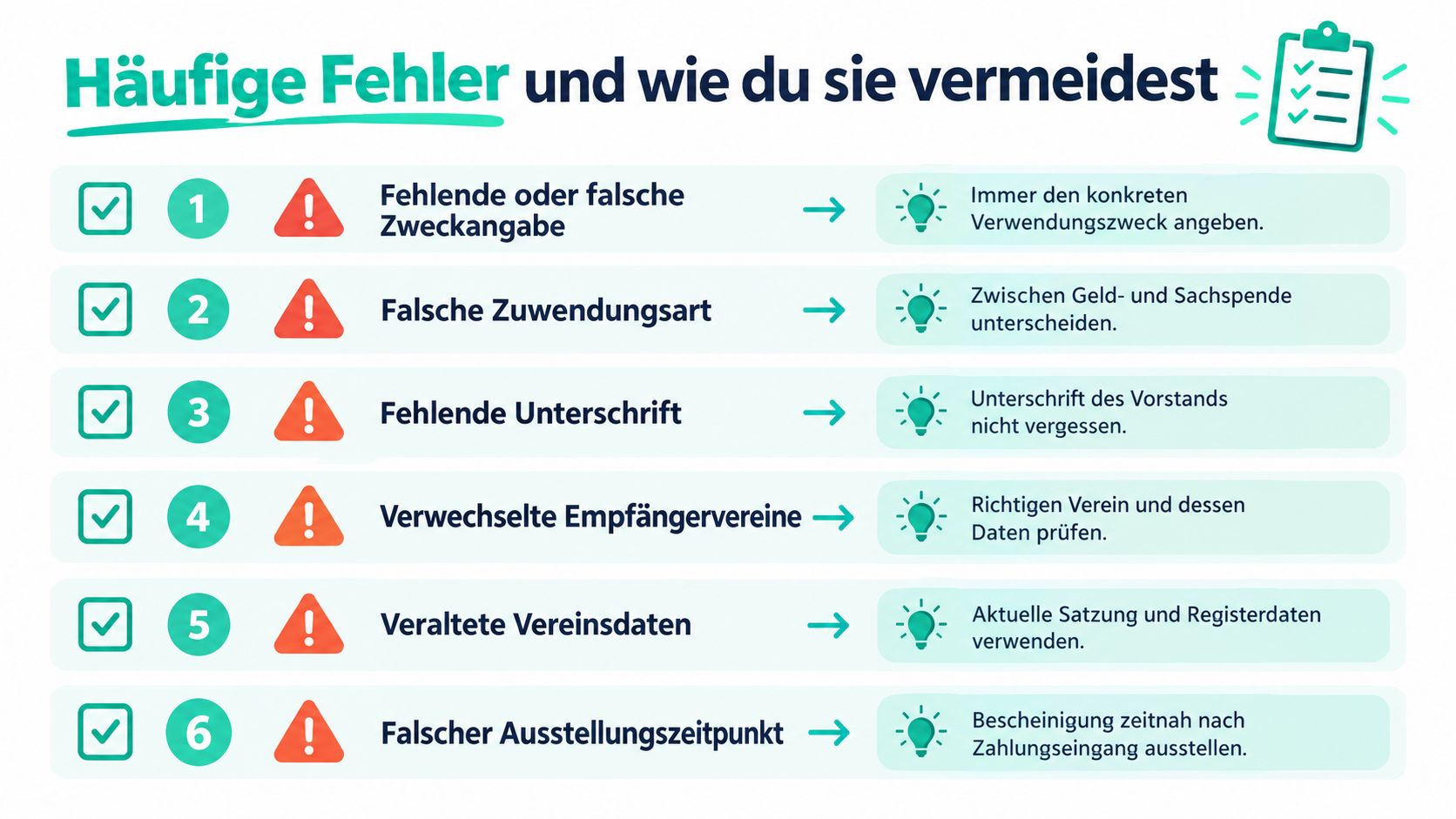
The error checklist for a quick association check
- Missing or incorrect purpose statement. Always enter the specific intended use, not just a general community text.
- Incorrect type of donation. Distinguish cleanly between cash, in-kind, and expense donations.
- Missing signature. The certificate needs the responsible person, otherwise it remains contestable.
- Confused recipient associations. Check the correct association and its details before sending.
- Outdated association data. Use the current register and master data, not old templates.
- Incorrect issuance date. Issue the certificate promptly after the payment is received, not only when the tax return deadline is pressing.
If a receipt is incorrect, the association should not simply ignore it. Depending on the error, a correction may be necessary so that donors and the tax office see the same data. An incorrect or duplicate receipt must be corrected, and an unsuitable certificate should be withdrawn before it is used further.
For practice in mosque associations, this means: a brief internal second check before sending saves a lot of explanation work later. Anyone who consistently works with a checklist reduces queries from the community and protects the association's tax credibility.
If your association wants to organise online donations, platform campaigns and receipts without chaos, take a look at SadakaNow. There you will find a transparent donation platform with clear processes for organisations that need to document their contributions properly. For mosque associations and non-profit organisations, this is a good next step if a donation is also meant to become a solid proof later on.