
Calculating Zakat Made Easy – Step by Step
You're sitting at the kitchen table, the banking app is open, and next to it lie the documents for your installment loan. There's money in the savings account, some gold in the jewelry box, and maybe a brokerage account belongs to it too. You want to calculate your Zakat, enter the same figures into different calculators, and get different results. Which amount can you trust?
Table of Contents
- Why calculating Zakat is more than a formula
- Nisab, Hawl, and the rate of 2.5 percent
- Which assets belong in the calculation
- Correctly deducting debts, installment loans, and mortgage loans
- A worked example from everyday life in the DACH region
- Common misconceptions and methodological pitfalls
- Checklist, documentation, and next steps
Why calculating Zakat is more than a formula
An online calculator can do the math for you. However, it cannot simply decide which religious valuation method fits your situation. For that, you need to know which assumptions lie behind its input fields.
For a family with savings, gold jewelry, and an ongoing loan, the difficulty therefore begins even before the addition. Is the jewelry taken into account? Which loan liabilities may be deducted? And by what standard does the calculator even check whether Zakat is due?
What you should clarify before entering data
For orientation, you first need a few terms. Nisab refers to the relevant asset threshold, Hawl the relevant holding period. Only once these conditions and the eligible asset items have been clarified can the payment rate be meaningfully applied.
So don't think of the calculation as merely checking an account balance. You're examining both your financial situation and the rules by which it is assessed. A precise payout amount is only helpful if these rules are comprehensible.
Advisory note: Don't just accept a calculator's result. Also note the method by which it arrives at that result.
The practical significance of choosing a method is especially evident with the Nisab: under the silver standard, a person may already be liable for Zakat, while under the gold standard they may still be below the threshold. This difference in starting position is described in the overview of gold and silver Nisab.
Different results are therefore not automatically calculation errors. First compare the metal standard, then the treatment of debts and unclear asset types. Only after that is it worth checking individual entries for transposed figures.
For your own review, a simple distinction helps: which figures can you prove with bank statements or contracts, and which figures depend on a religious classification? You gather the verifiable values yourself. For the classification, ask specific questions rather than silently accepting an unknown default setting of the calculator.
Nisab, Hawl, and the rate of 2.5 percent
Two Zakat calculators can show different results for the same person without either one calculating incorrectly. Often this is because they use different metal standards or valuation dates for the Nisab. For comparison purposes, what matters is not just the result but also the method behind it.
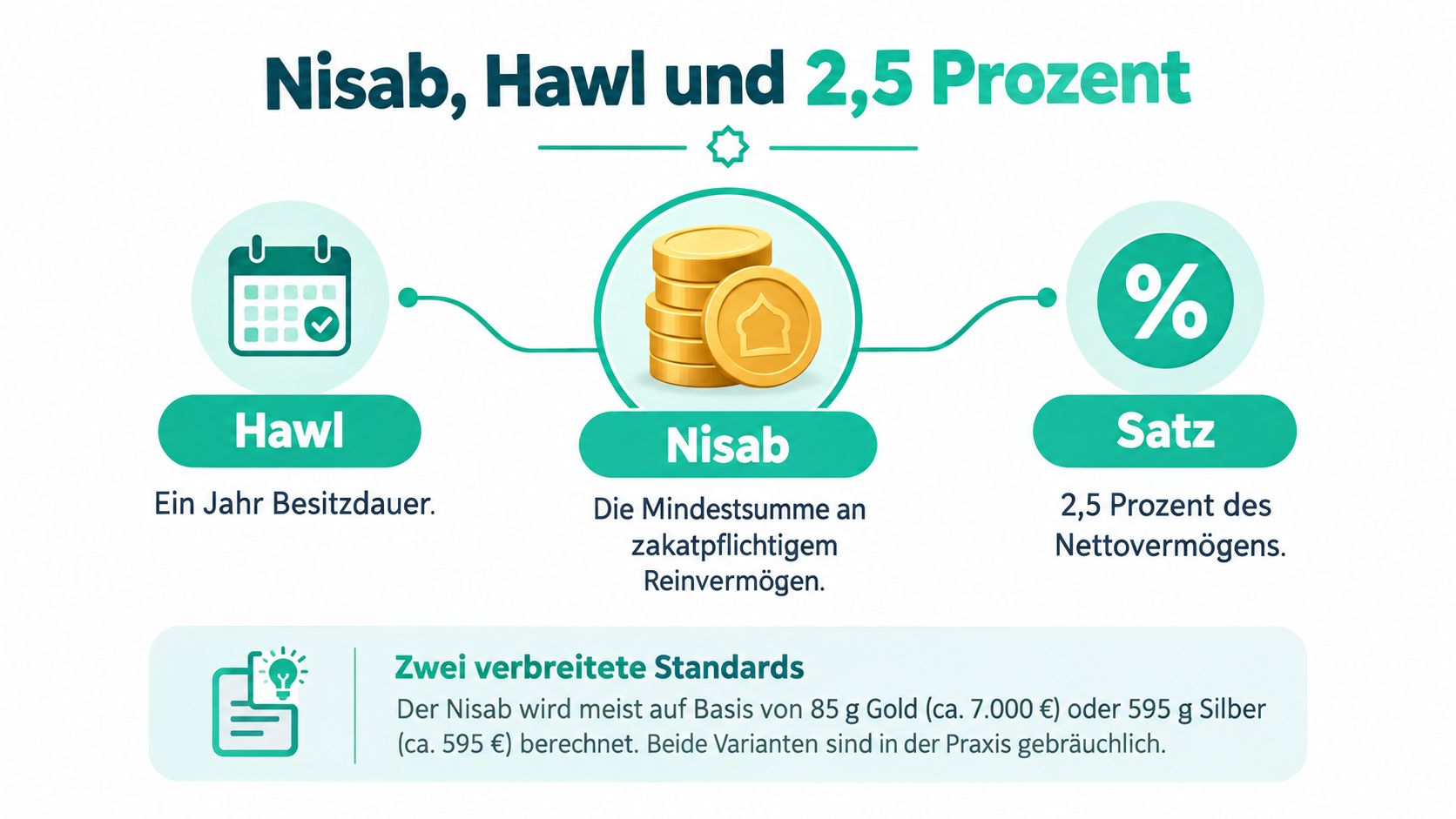
The Nisab is the minimum threshold of Zakat-liable net assets. The traditional references are 85 grams of gold or 595 grams of silver. Anyone consulting the guide to calculating Zakat should check which standard it is based on. The value in euros changes with the metal price; an old threshold value therefore cannot simply be reused.
The Hawl refers to the relevant period of possession, usually about 354 to 355 days. For money assets, balances, precious metals and trade goods, a rate of 2.5 percent is regularly applied. The duration and the calculation date are two separate checks: a bank statement proves the account balance on a given day, but not by itself that the Hawl has been fulfilled.
Determining the Euro Nisab comprehensibly
The following calculation shows the method, not a current rate. At an example rate of 80 euros per gram, the gold Nisab would correspond to 85 g × 80 €/g = 6,800 euros. Replace the example rate with the documented price on the chosen valuation date.
| Metal standard | Reference weight | Example calculation | Example value |
|---|---|---|---|
| Gold | 85 g | 85 g × 80 €/g | 6,800 € |
| Silver | 595 g | 595 g × 1 €/g | 595 € |
The rates in the table are calculation examples, not current price information. Note down the rate used and the metal standard. There can be differing views between schools of law and advisory bodies as to which standard should be applied. This decision can explain why two reputable calculators produce different results.
Also record the start of your personal Zakat year and the planned review date. If your assets fall below the Nisab in the meantime or change, ask a qualified advisory body how this affects the period of possession instead of deriving a rule yourself. A donation around Ramadan does not automatically change your personal Zakat date. For planning purposes, you will find guidance under Donating during Ramadan.
Which assets belong in the calculation
Don't open the calculator right away. First create an asset list in which each item is given a name, a verifiable value and a valuation status. This prevents unclear asset types from either being forgotten or unknowingly treated like cash.
A clean inventory is not yet a religious decision. You can reliably document a portfolio balance without having already determined which portion is subject to Zakat according to the chosen methodology. This separation is particularly helpful for investments and jewellery.
The graphic offers an initial orientation on different asset types:

Record clear values, mark open valuations
| Asset type | Documents for your inventory | Valuation question |
|---|---|---|
| Cash and account balances | Cash holdings and bank statements as of the chosen date | Are all accounts recorded and transfers not counted twice? |
| Gold and silver | Weight, if applicable fineness, and price used | Which components are taken into account according to your methodology? |
| Stocks and ETFs | Portfolio statement with valuation date | Which approach applies to the specific type of investment? |
| Private loan receivables | Agreement and status of repayment | How is the expected repayment treated? |
| Trade goods and business reserves | Inventory overview and business records | Which items belong in the calculation basis? |
For cash and account balances, the documented euro balance can be recorded as the starting value. For precious metals, however, you need additional information on the holdings and the price used. A previous purchase receipt alone does not answer the current valuation question.
For stocks, ETFs and private receivables, you should not make a blanket equation with freely available account money. First record the portfolio value or the receivable in full and mark the religious valuation as open. This allows the advisory body to check your information without having to first reconstruct the entire holding.
For real estate, the shortened statements in the graphic should not be understood as a universally valid decision. In your records, distinguish between personal use, renting out and intended sale, and list related income separately. For cars, insurance claims and business equipment as well, you should explain the purpose of use and actual availability instead of deciding solely by the name of the asset.
Correctly deducting debts, instalment loans and mortgage loans
The remaining debt on a loan contract and the amount due immediately are different figures. This is exactly where a generic input mask can distort the calculation: a field labelled "debts" does not yet reveal which liabilities are meant by it.
For short-term obligations, instalment loans, student loans and property financing, different valuation assumptions can lead to differing results. The practical questions regarding debts and variable assets are addressed in the Zakat calculator and calculation overview of German Doctors.
Document due date and remaining debt separately
For an overdrawn current account or a credit card balance, you need the current balance and the due date. For an instalment loan, the payment schedule and the remaining term are also helpful. A student loan may have different repayment terms, which is why the contract matters more than the mere product name.
A real estate loan deserves its own line in your overview. Note which payments are currently due and which property the loan is connected to. Do not independently deduct the entire financing from the rest of your assets just because the calculator technically allows it.
| Calculation approach | What you compare | What you need to clarify |
|---|---|---|
| Full debt deduction | Asset holdings and total remaining debt | Does your advisory body accept this approach for the respective loans? |
| Deduction of short-term liabilities | Asset holdings and obligations due in the near term | Which due dates are taken into account? |
| Asset-related view | Liabilities and the corresponding asset positions | How is it ensured that positions are not offset inappropriately? |
This comparison is a review tool, not a selection based on the most favourable result. Only work through different approaches as scenarios and label them accordingly. Your decision should be based on a traceable methodology.
Question for the community advisory service: Which of my concretely documented obligations may I deduct, and does this apply to the remaining debt or to the payments due?
Your debt serviceability also belongs in the advisory conversation. Show which funds are actually available and which contractual payments are due. This does not automatically lead to a separate deduction rule, but the advisory body gets a realistic picture of your situation.
A worked example from everyday life in the DACH region
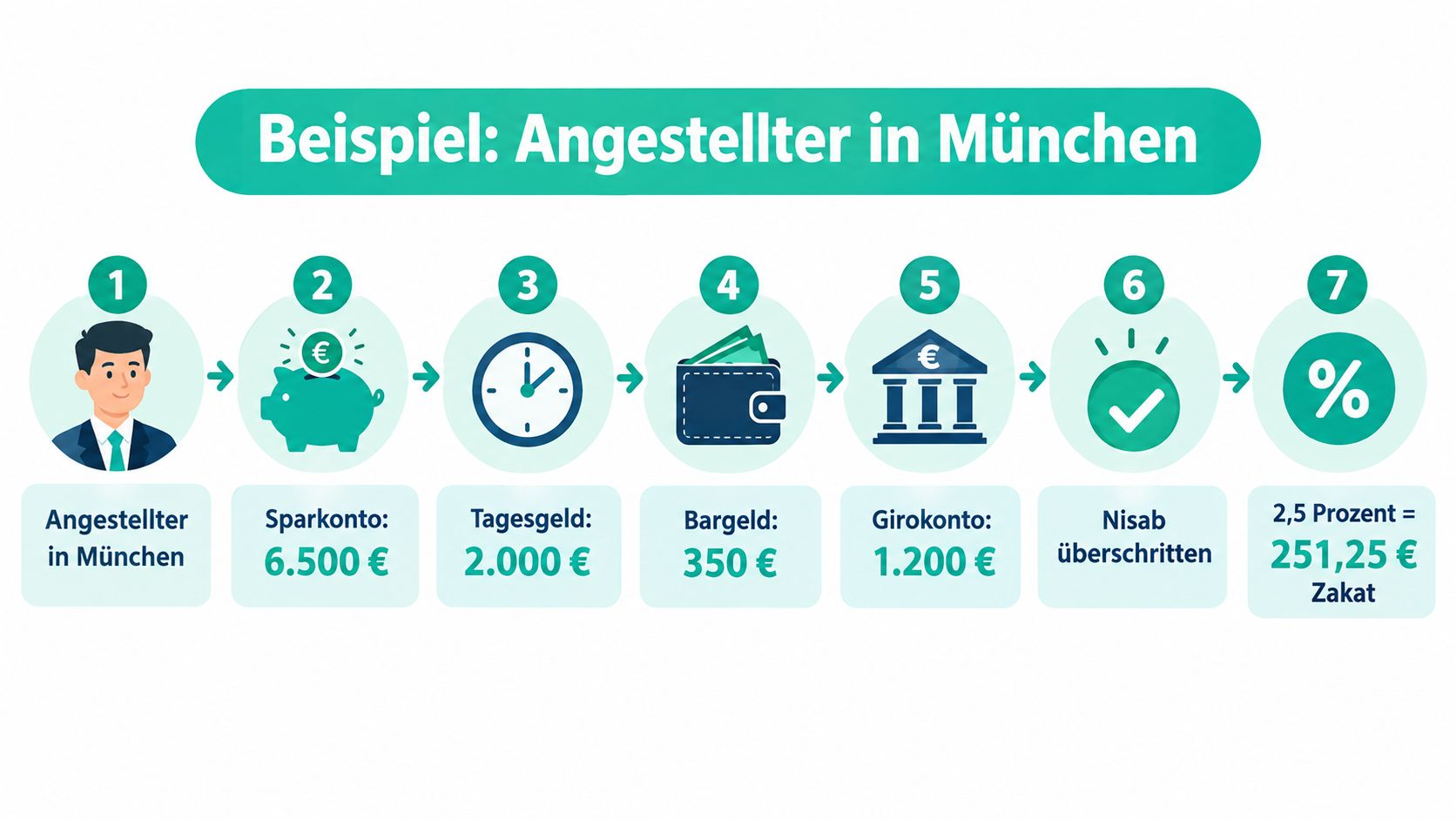
An employee in Munich reviews their assets on the same reporting date. The savings account holds 6,000 euros, the call money account 2,500 euros. Gold worth 2,500 euros is added. This brings the recorded holdings to 11,000 euros. If, according to the chosen method, 1,000 euros in due liabilities are deductible, 10,000 euros of eligible net assets remain.
From net assets to the amount owed
If this amount reaches the relevant Nisab and the required holding period is fulfilled, the following calculation results at a rate of 2.5 percent: 10,000 euros × 0.025 = 250 euros Zakat. These figures are an example, not an actual donation case.
The crux lies in the word eligible. Whether jewellery counts as Zakat-liable assets and which liabilities may be deducted can be assessed differently depending on the school of law and advisory source. Two reputable calculators can therefore arrive at different results for the same account balances.
For a traceable calculation, align bank statements and gold holding details to the same valuation date. Clarify disputed assets and debts according to the method you follow, rather than silently including or excluding them. Also note whether Nisab and Hawl are fulfilled. This way every step can be checked.
A video illustrates one possible process. Compare the assumptions used in it with your own calculation.
Why different results are possible
If the jewellery is valued differently or a different debt deduction is applied, the net assets change. Without clarified details, however, a second figure would only be guessed. If anything is unclear, ask which items the advisory body includes and why.
Alongside the result, also keep the method used and the underlying records. If a calculation turns out differently, you can then identify whether the difference comes from the valuation, the debt deduction, or the Nisab check, without having to gather all the documents again.
Common misconceptions and methodological pitfalls
A calculator result is not a justification. Anyone who only saves the final amount will later struggle to trace whether the inputs were classified correctly. Fields whose help text is missing or whose calculation method is not explained are particularly problematic.
Even familiar types of assets can raise questions. With gold jewellery, it's not just about whether gold is present, but also about the treatment chosen. With a portfolio, the documented market value and the religious valuation approach must be kept separate.
The image shows typical areas where a closer review is worthwhile:
Replacing blanket statements with concrete questions
- "All jewellery counts the same": Ask about the treatment of your specific jewellery holdings and the valuation approach used.
- "All debts are deducted": Have it explained which obligations the calculator actually takes into account.
- "An expected payout is already available money": Separate existing claims from amounts actually received and clarify the classification.
- "A rented property counts in full": Ask separately about the property, its income, and the purpose of your asset holding.
- "The portfolio must constantly be recalculated": Agree on a traceable valuation date and the matching methodology.
Don't choose a calculation solely because it produces the lower amount. What matters is whether you can trace and stand behind its assumptions.
Another stumbling block is the lack of separation between the calculated Zakat and other donation intentions. Keep a record in your donation planning of which amount you have earmarked for which purpose. The article on the meaning of Sadaqah Jariyah offers additional guidance for donations with a long-term focus.
If different calculators produce different results, ask for the respective basis of calculation. A helpful answer names the rules applied and the open questions. The mere statement that the tool calculates automatically and correctly is not sufficient.
Checklist, documentation and next steps
Good documentation doesn't need to be complicated. A table, the corresponding receipts and a brief note on the methodology used are enough as a practical working basis. What matters is that you still understand later on how your result came about.
Don't just keep the amount paid. Also note down the questions you clarified with a community or advisory body. This way, at your next review, you can distinguish which decisions still apply and which need to be discussed again due to changed circumstances.
Your documents for a traceable review
- Nisab documented: Metal standard, price reference and valuation date are recorded.
- Hawl traceable: Start date and review date are noted, unclear changes have been addressed.
- Assets complete: Accounts, precious metals, investments, receivables and business items are recorded.
- Debts separated: Remaining debts and due payments are not mixed together in one field.
- Methodology clarified: Open valuations have not been replaced by uncommented estimates.
- Result secured: Calculation, receipts and advisory notes are kept together.
Visit your local mosque or an Islamic advisory body especially when you need to include securities, business assets or larger financing arrangements. For a specific donation option, you can also ask the respective aid organisation how they accept and use Zakat donations.
The calculation and the choice of project are separate decisions. A transparently presented aid project is not automatically suitable for every Zakat payment. Have the suitability and the intended use of the funds confirmed before you transfer the amount.
When choosing a project, pay attention to named bodies, traceable goals and information on the use of funds. The guide to finding suitable donation projects helps you review these questions systematically. This way, your donation decision stays just as traceable as your calculation.
SadakaNow offers a Zakat calculator and brings together donation options from mosques, aid organisations and social initiatives. Visit the platform to calculate using your prepared figures and review suitable projects; before making a Zakat payment, confirm with the respective body that it is intended for that purpose.