
Donation Receipt for Associations: How It Works in 2026
The donation receipt for an association is legally an official donation confirmation under § 50 EStDV. From 300 euros onward, the donor generally needs it if they want to claim the amount for tax purposes.
When the first transfers come in at the mosque after Friday prayers, the real question is not whether you write a confirmation "somehow." The question is whether you use the official form correctly, name the recipient properly, and, in the case of online donations, correctly document the actual payee.
Table of Contents
- What a donation receipt for an association actually is
- Mandatory information for a correct donation confirmation
- Simplified versus detailed donation confirmation compared
- Process for associations and digital donations via platforms
- Sample text and concrete wording for practice
- Common mistakes and risky assumptions
- Checklist for mosque associations and treasurers
- Frequently asked questions about the donation receipt
What a donation receipt for an association actually is
A donation receipt is not a nice extra for the files in everyday association life. Legally, it is the official donation confirmation under § 10b EStG and § 50 EStDV. Only a tax-privileged organisation may issue it, and only for contributions that have actually reached the association. Anyone collecting donations via a platform must therefore clearly clarify who is legally the recipient and who later issues the receipt. More on how donations to non-profit associations are classified
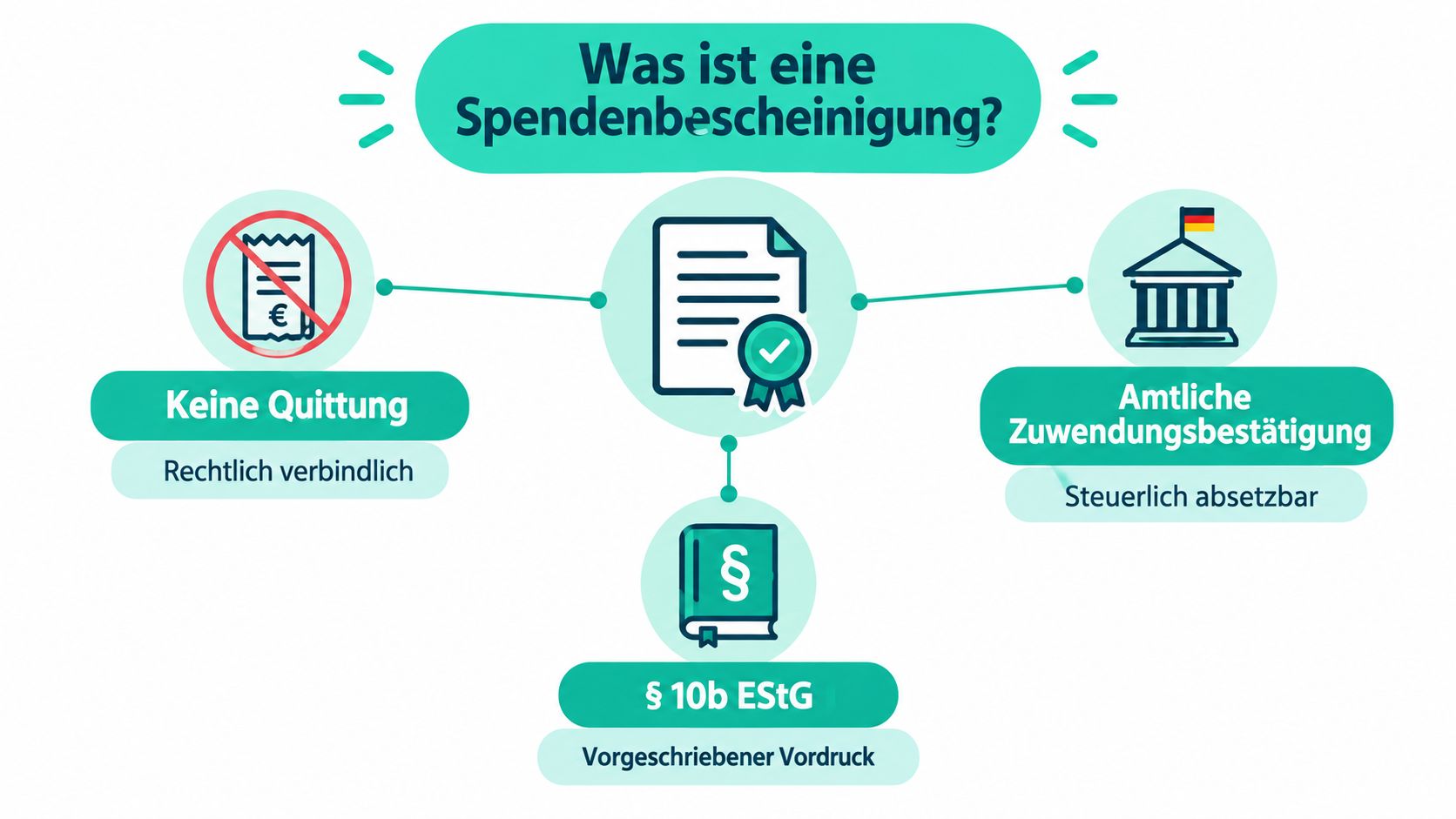
In practice, the 300-euro threshold determines the amount of effort required. Below that, for tax-privileged associations, a payment receipt is usually sufficient; above it, the formal receipt is required. Anyone who instead sends a freely worded confirmation produces a document that cannot be used cleanly for tax purposes.
Practical rule: A transfer confirmation is not automatically a donation receipt. Only the official content makes it usable for tax purposes.
The tax office only checks whether the amount, purpose, recipient and type of contribution match up. Especially in mosque associations, where donations come in for the prayer house, social work or Ramadan projects, it must be clearly established which tax-privileged body received the money and what it was intended for.
An incorrect issuer risks more than trouble with the bookkeeping. Under § 10b EStG, the issuer can generally be held liable for 30 percent of the wrongly certified donation amount if the confirmation is incorrect. That is a real risk for the board. Legal basis for liability and donation confirmation
Mandatory information for a correct donation confirmation
The official form is not negotiable. The wording and order of the prescribed text passages may not be freely rewritten, and the association must fully include the mandatory information. This is exactly where most mistakes happen in practice, because board members want to create a nice-looking letter instead of consistently reproducing the official content. Official requirements for the form
What belongs in every receipt
- Name and address of the association, so the issuer is clearly identified.
- Name of the donor, so the contribution can be assigned.
- Amount and date, so the payment transaction remains verifiable.
- Type of contribution, i.e. monetary donation, donation in kind, or membership fee.
- Tax-privileged purpose, so it is clear what the funds were intended for.
- Exemption or assessment notice, so the non-profit status can be proven.
For mosque associations, clean master data management is half the battle. If the association's name sometimes appears in short form, sometimes in Arabic transliteration, and sometimes with an old address, things get messy. The donation management system should therefore cleanly link, per transaction, at least the recipient details, type of contribution, amount, date, purpose and notice.
For donations in kind, the usual monetary logic is not enough. Then you need additional valuation data, namely item, age, condition and historical purchase price. A carpet for the prayer room, a laptop for youth work or a printer for administration are therefore not simply "random items", but assets subject to documentation requirements.
The best time to check is before shipping, not after the donor's follow-up question.
Those who work internally with Excel should not name the fields creatively. Use clear columns, record the receipt number, and cleanly separate donor data, payment service provider and actual recipient of the donation. Otherwise, in the end, the right amount ends up on the wrong certificate.
Simplified and detailed donation receipt in comparison
Below 300 euros, the situation is simpler, but not sloppy. The proof of payment regularly suffices, such as the bank statement, the booking confirmation from the credit institution or the cash deposit receipt. Nevertheless, it must be evident from this that the recipient is tax-privileged and that the purpose fits. For regular Sadaka donations, this is important because many small payments together can quickly exceed the threshold.
| Criterion | Up to 300 euros | From 300 euros |
|---|---|---|
| Proof | Payment receipt is regularly sufficient | Official donation receipt required |
| Form | No separate form mandatory | Properly formatted template required |
| Details | Recipient, purpose, tax privilege recognisable | Complete mandatory information required |
| Practice in the association | Record small donations cleanly internally | Issue certificate specifically |
From 300 euros, the simple proof becomes a matter of formality. The donor then needs the official confirmation if they want to use the amount for tax purposes. Especially with Ramadan campaigns, collections or project appeals spanning several months, the treasurer should not wait until the sum "feels still small".
The tax framework is additionally limited. Donations and certain membership fees can be taken into account as special expenses up to 20 percent of the total amount of income; for corporations, the alternative limit of 4 per mille of total turnover plus wages and salaries paid during the calendar year applies instead. BMF overview on donations and the small-amount rule
Those who systematically collect donations within an association should therefore not think in terms of "receipt yes or no", but in terms of thresholds, recipients and proofs. This saves rework and prevents incorrect certificates from having to be corrected at the end of the year.
Process for associations and digital donations via platforms
For digital donations, the most important question is not technical, but legal: Who is the recipient? For an online donation via a platform such as SadakaNow, the platform is generally only the payment channel. The receipt may only be issued by the tax-privileged organisation for the donation actually received. Practical guide to digital fundraising platforms
How it works correctly
- Check receipt of payment. The certification process only begins once the money has been credited to the association's account or to the clearly designated donation account.
- Assign donor data. Name, address and amount must match the payment transaction.
- Document the purpose. For earmarked campaigns, it must be clear whether the donation was intended for the mosque, youth work or a relief project.
- Generate the certificate. The details must follow the official template.
- Archive a copy. The association needs its own documentation to be complete and traceable.
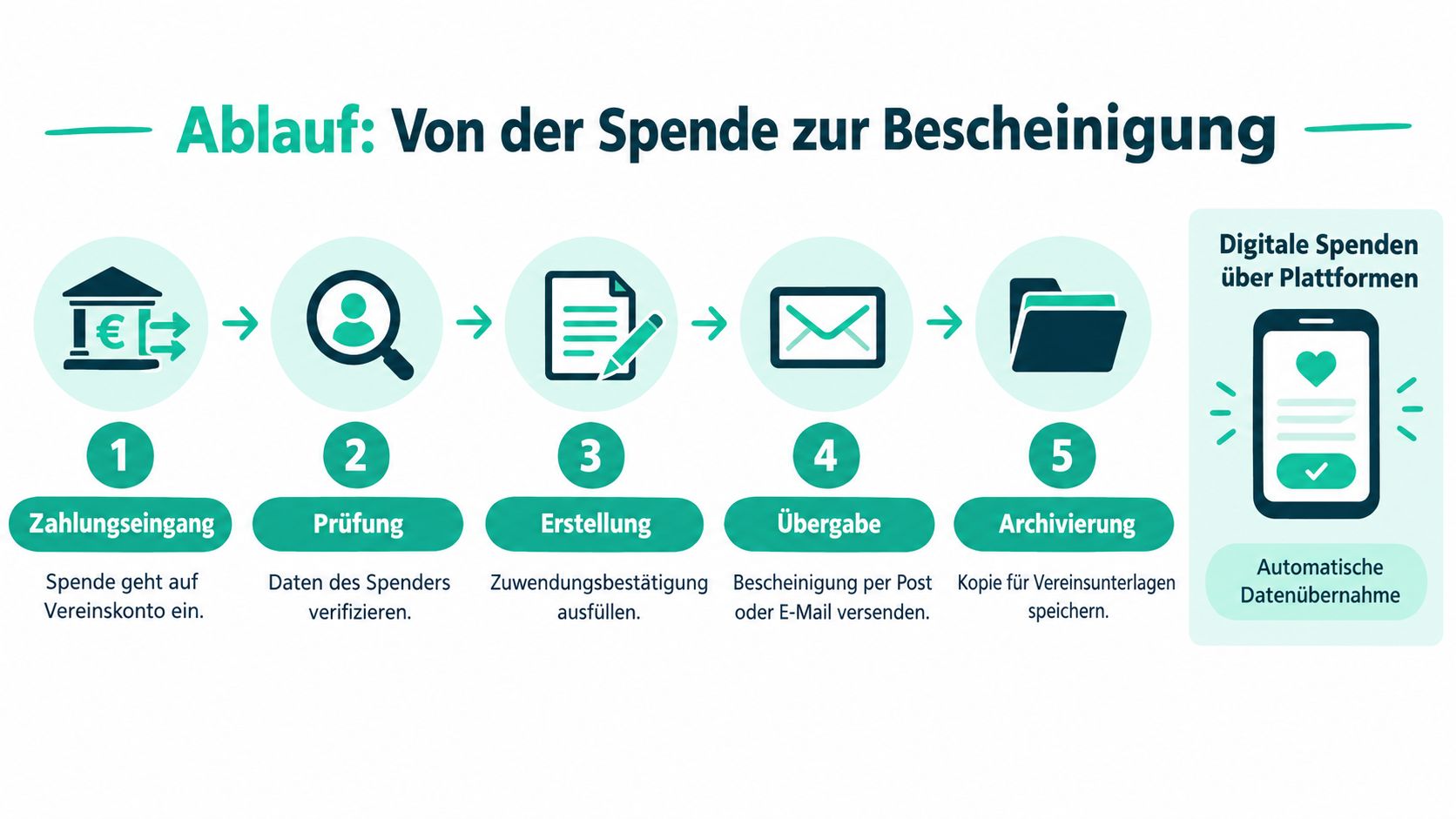
With platform campaigns, there is the additional control problem that not every forwarding automatically justifies its own certificate. If money is passed on to another project, the forwarding must be documented, and the issuing association needs a valid exemption or determination notice. If a determination notice under Section 60a AO is more than three years old, or an exemption notice more than five years old, no donation receipt may be issued for the time being. Notes from the Finanzamt NRW on deadlines and recipient verification
Machine-generated certificates are permissible under certain conditions. This is particularly practical for associations that receive many donations through digital channels. A person authorised to accept payments should sign the confirmation so that the process remains legally secure even when sent by email or generated automatically.
A clean digital process saves time, but only if the recipient, the notice and the type of donation are correct beforehand.
Sample text and concrete wording for practice
Many associations do not fail because of the law, but because of the wording. The official text may not be freely invented, but around it you still need clear, calm language for internal processes and cover letters. This is exactly where a clean standard text helps, one that does not add unnecessary extras.
Wording that fits into practice
“Dear donor” is unproblematic as a salutation. After that comes the actual confirmation with the official content, for example the note that the contribution went to the non-profit association and was used exclusively for the specified purpose. It is important that such sentences only supplement the mandatory content, not replace it.
For donations in kind, the text should remain precise. A laptop is not a generic “item,” but a specific asset with condition, age, and purchase price. Anyone who remains vague here risks issuing a certificate that may not hold up in case of doubt.
Useful in the cover letter
- Thanks and allocation of the donation to the specific project
- Reference to the official certificate
- Reference to the possibility of correction, if the name or address is incorrect
Not suitable in the certificate
- Free paraphrasing of the official template
- Promotional statements about the non-profit status
- Vague collective terms such as “for good causes”
Anyone using a digital solution can neatly pre-fill wording and master data. Systems like the donation management from SadakaNow are one possible building block here, as they structure the allocation of campaigns and payments. What ultimately remains decisive, however, is the association that issues the legally correct confirmation.
Common mistakes and risky assumptions
The most dangerous misconception is: “A payment receipt plus the association's name is always enough.” That is not true. Below 300 euros, proof of payment may suffice, but above that, the official donation receipt is required. Anyone who confuses this provides donors with a document that will not hold up in a tax case.
A second misconception concerns platforms. Many think the payment service provider is automatically the recipient. That is wrong. The recipient is the tax-privileged entity, i.e. the association or organization that actually receives the contribution and certifies it. The platform is merely the technical or organizational path in between.
The third classic mistake is the belief that an old notice remains valid forever. It does not. If the assessment notice under § 60a AO is too old or the exemption notice has expired, the association may not issue certificates for the time being. This is exactly where board members stumble, when documents sit in a folder for years and are never reviewed.
What often goes wrong in practice
- Wrong amount: A transposed digit quickly turns a correct certificate into a problem.
- Wrong purpose: A designated donation is certified as a general contribution.
- Wrong association details: An outdated address or old association name weakens traceability.
- Missing notice assignment: The notice is not stored in the system.
The consequences affect the donor first. The tax office cannot recognize the donation if the certificate is incorrect or incomplete. The association must then immediately correct the certificate and give the donor the corrected version. If the error remains in circulation, a dispute over the tax return may well arise, and the entire process drags on unnecessarily.
Anyone advising mosque associations should therefore enforce a simple rule: check first, then certify. Not the other way around.
Checklist for mosque associations and treasurers
- Check the current exemption or assessment notice. No certificate without valid proof.
- Use the official form. No self-made creations, no freely worded substitute texts.
- Keep association data complete. Name, address, and assignment must be exactly correct.
- Document the purpose clearly. Ramadan, youth, mosque renovation, or social fund must not be mixed up.
- Match amount and date. The certificate must correspond to the incoming payment.
- Classify the type of contribution correctly. Keep money, donations in kind, or membership fees clearly separated.
- Value donations in kind. Record the item, age, condition, and purchase price.
- Document the incoming payment internally. Keep bank statements, platform data, or booking confirmations on file.
- Choose secure digital transmission. Encrypted email, donor portal, or post are better than loose PDF attachments.
- Archive a copy. Every issued certificate needs a traceable association file.
Guidance for Islamic communities in Germany fits well with this practice, because the same basic questions arise there, just with more volunteer reality and less administrative time.
Hang this list up in the association office. If a point remains open, it does not get signed.
Frequently asked questions about donation certificates
How long is a donation receipt valid?
It is relevant for the donor's tax return as soon as it is issued correctly. The association should keep it internally together with the payment documents and archive it in a traceable manner, so that a later review remains possible. Above all, it is important that the certificate matches the association's valid notice.
Can donations in kind be certified for a mosque association?
Yes, if they are correctly documented. For donations in kind, besides the item and its value, you also need the age, condition, and original purchase price. These exact details secure the valuation and prevent the amount from being set arbitrarily.
Is email sufficient, or does the certificate have to come by post?
Email is permissible if the process is cleanly organised and the certificate can be clearly attributed to the donor. Machine-generated confirmations are also possible under certain conditions. What matters is not the paper, but the legally secure attribution and the correct content.
What should be done if a certificate has been lost?
In that case, the association should issue a copy or duplicate and mark it internally as a copy. The original data must remain unchanged. For the donor, what counts is that the name, amount, date, and purpose are identical to the original certificate.
If you really want to set up donation processes cleanly, you don't need mountains of paper, but a clear structure for incoming payments, review of decisions, and certification. SadakaNow can map the payment flow and project allocation as a digital donation platform for this purpose, while the association issues the legally correct donation receipt. Take a look at SadakaNow if you want to organise donations for your community or your project transparently, traceably, and with clean documentation.