Fundraising Platform: How to Find the Right One
Why do so many donation platforms lose trust right when a campaign is supposed to be running, because they look at fees, payment methods and security separately, even though donors and communities actually need a single decision path?
| Platform type | Fee logic | Strong payment methods | Especially suited for |
|---|---|---|---|
| 0% platform with a focus on transparency | No platform fee, clear forwarding, separate tip model | SEPA, PayPal, credit card | Regular Sadaqa, mosques, small to medium campaigns |
| Classic commission platform | Percentage model on campaign total, often with extra costs | Often broad, depending on provider | Larger, marketing-driven campaigns |
| Community or association solution | Flat rate or management model instead of per-donation commission | Often designed for recurring payments | Associations, organisations, long-term projects |
| Crowdfunding with a target amount | Fees tied to milestones or success | Mostly digitally strong, but unevenly distributed | Single campaigns with a clear story |
| Donation platform for a niche target group | Strongly dependent on transparency and target group | Payment methods should suit the community | Islamic communities, Sadaqa, social initiatives |
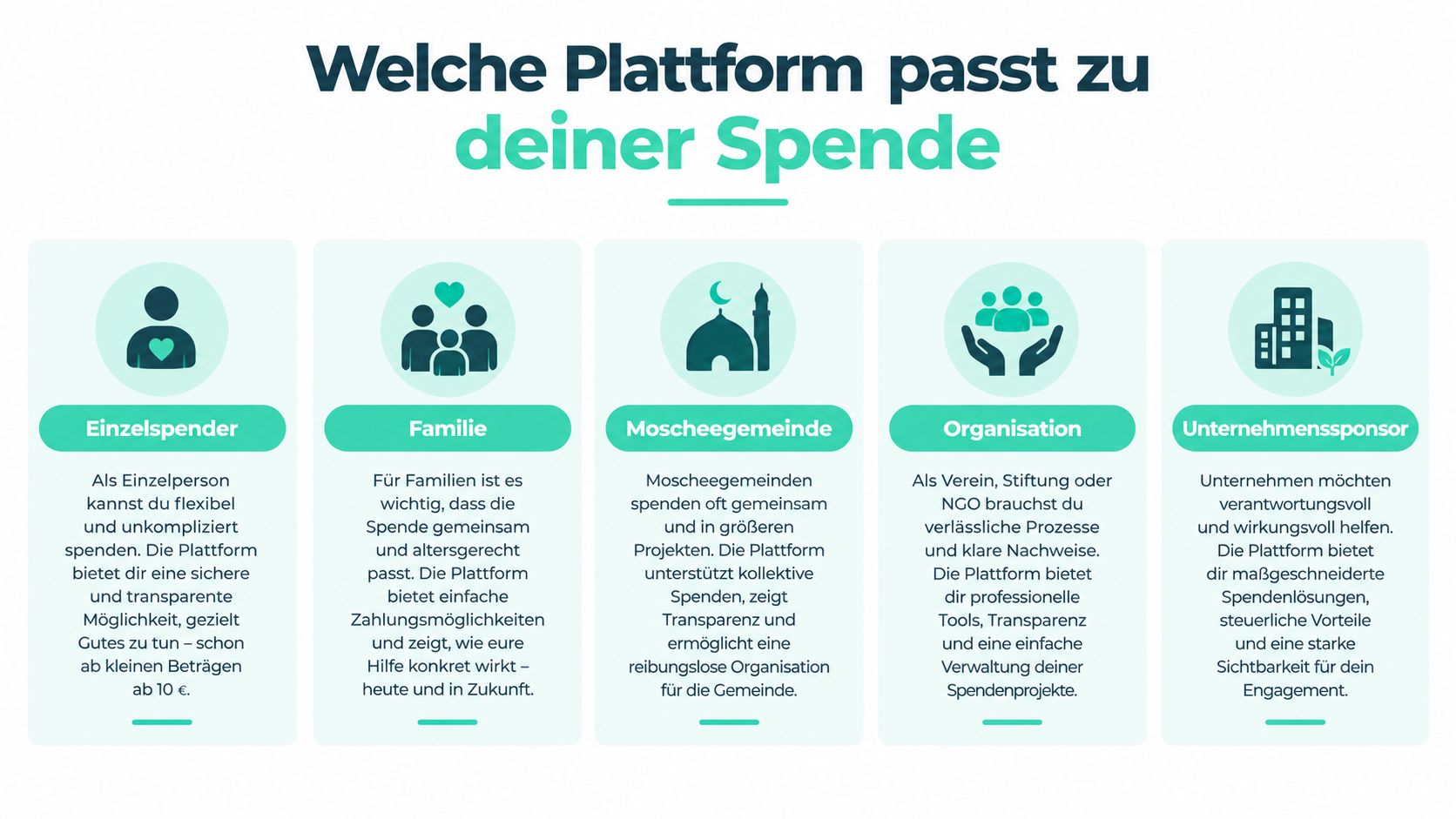
Table of contents
- Which platform suits your donation
- The German donation market 2024 as a basis for decisions
- Fee models and payment methods compared
- Verification, security and data protection explained in a verifiable way
- Which platform suits which type of user
- Making a donation's impact path verifiable
- Recommendation by situation and next steps
Which platform suits your donation
The first question is not which platform has the most features. The first question is who is donating, who is managing, and how often money should flow. This is exactly where many comparisons fail, because they show technology but don't provide a decision.
For a fundraising platform, five things matter: fee model, payment methods, verification, transparency, and target-group fit. Anyone collecting for a mosque, a Sadaqa campaign, or a social project in the DACH region needs different priorities than a private individual running a one-off campaign. A comparison without this classification is nice, but not reliable.
Practical rule: First clarify the donation logic, then choose the platform. Otherwise you end up paying for features your target group doesn't even use.
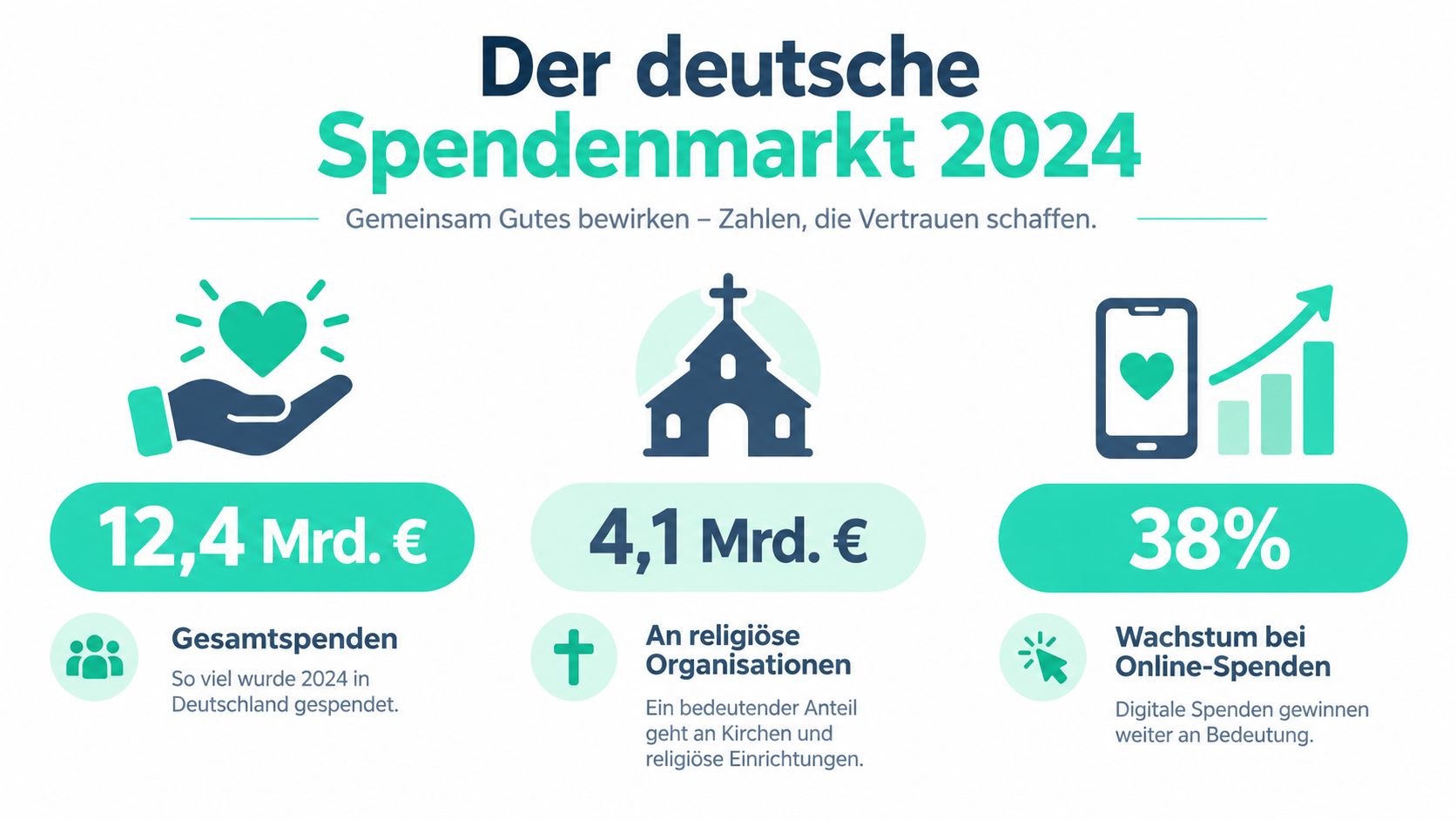
The market situation in Germany shows why this matters. In 2024, around 5.1 billion euros were donated, 16.7 million people donated at least once, and the average donation was 43 euros source. This is not a market where you win trust with unclear processes. Here, clear procedures, fast payments, and traceable project pages are what count.
For Islamic communities, there is a second point as well. Many Sadaqa donations run through social media, QR codes, or messaging apps — channels in which the organisation behind them is quickly overlooked. Anyone who wants to work cleanly here doesn't need a loud platform, but one that makes trust visible.
The German donation market 2024 as a basis for decisions
The German market is large enough to force selection, but not so large that weak processes would be forgiven. In 2024, the donation volume continued to rise, while the number of donors declined slightly. For platforms, this is a clear signal, because more money comes from a limited, active base and not from random reach.
Religious purposes are not a marginal topic here. Donations for church and religious purposes rose in 2024 by 138 million euros to a total of 901 million euros Source. For Islamic communities and Sadaka initiatives, that is the real news: religious donations are marketable, visible, and relevant. Anyone setting up a platform for this is therefore not competing with a niche topic, but with a genuine market segment.
What the numbers mean for platforms
The consequence is simple. Trust beats reach, and recurring donations beat one-time attention. If the average donation is not huge, the platform must not let unnecessary hurdles eat into what the community actually wants to give.
This is exactly why transparent project information is so important. Donors don't just want to know that the money arrives. They want to see who the organiser is, what is being collected for, and how progress is documented. This is especially true in communities where donations are often arranged personally, and the digital platform must first establish credibility.
Anyone who reads the market soberly arrives at a clear assessment: a platform doesn't need to do as much as possible, it needs to work for the actual donor base. For Germany, that means keeping fees small, building trust big, and coordinating payment methods cleanly. Anyone who wants to dive deeper into the German comparison logic can find an additional breakdown at Spendenplattform Deutschland.
Comparing fee models and payment methods
Fees are not just a cost question. They determine whether a campaign feels psychologically credible and how much of the donation amount actually reaches the project. Especially with small donations, even small deductions make a difference, because many small contributions add up quickly.
The logic behind the price
A 0% model usually feels more transparent to donors than a commission model, as long as it remains clear how payment service providers and voluntary tips are treated separately. A classic percentage model can make sense for larger campaigns if it comes with marketing, support, or additional campaign features in return. What matters is not the headline on the pricing page, but the amount that is actually passed on in the end.
The payment method has to match the target audience. According to the Deutscher Spendenmonitor 2023, 39 percent of Generation Z used PayPal to donate, compared to 18 percent of baby boomers. Conversely, 58 percent of baby boomers used bank transfer, compared to 35 percent of Generation Z Source. This is directly relevant for mosques and Sadaka campaigns, since several generations are often addressed in parallel there.
Clear recommendation: SEPA for older and recurring donors, PayPal for faster online completions, and test mobile wallets where younger target groups dominate.
| Model | Platform fee | Typical payment methods | Especially suited for |
|---|---|---|---|
| 0% platform | No platform fee, payment service provider costs remain separate | SEPA, PayPal, credit card | Communities, Sadaka, regular small donations |
| Commission model | Percentage of the donation amount | Often broad, depending on the provider | Campaigns with marketing focus |
| Subscription or administration model | Monthly or administrative price | Mostly designed for the long term | Organisations with ongoing donation management |
| Target campaign with fixed logic | Fees often tied to success or payout | Frequently digitally focused | Individual campaigns with a clear target amount |
Anyone who wants to keep internal administration in view should always think of fees together with payout and reporting. For clean administration, it is also important to separate the donation amount, payment service provider costs, and internal transfer amount, as shown on the page about Preise und Verwaltung.
Verification, security, and data protection explained verifiably
Security is not a label, it's a process. Anyone collecting donations online must not only be able to accept money, but also prove that the organiser is genuine, the account is correct, and the data is processed cleanly. This is exactly where many platforms aren't transparent enough.
What must be documented properly
A reliable platform does not just display a seal, but an audit trail. This includes the legal operator, the charitable status, the donation account, the payout logic and a clear approach to refunds. Anyone who hides such information only in footnotes wants to reassure rather than inform.
The security question is not theoretical in the German market. In a representative PwC survey of 2,500 adults in Germany, around a third said they had already been a victim of fraud or attempted fraud, and only 51 percent felt well informed about fraud in digital payments Source. So anyone who wants to build trust with a donation platform must make the verification steps visible, not just claim security.
What you should specifically pay attention to
- Operator check: The name of the legal operator must match the legal notice and the campaign.
- Proof of charitable status: The platform should show how and when the status was verified.
- PSD2 and authentication: The checkout must be strongly secured, not just look clean visually.
- Data protection and accounting: Data minimisation, traceable storage and audit-ready allocation are mandatory.
Anyone who also needs a well-structured privacy policy as a reference can look at the privacy policy of Deeken.Technology. A clean privacy text does not replace a platform audit, but it shows how seriously a provider takes the handling of personal data.
The same standard is worth applying to your own platform. The suitable internal comparison page is Data protection at SadakaNow, because there the question of data processing is treated not as a footnote, but as part of the system.
Which platform suits which type of user
Not every donation platform is equally good for every organisation. A private individual needs speed and simple approval. A mosque community needs trust, low barriers and understandable administration. A larger aid organisation needs reporting and clean process chains.
Private individual and regular donor
If you want to give Sadaka regularly as a private individual, a smooth checkout matters most. SEPA and PayPal are often the cleanest combination for this, because they appeal to both older and younger donors. A platform with clear project pages is better than one with many side features you never use.
For small amounts, a transparent cost model is more important than a shiny campaign front end. If you donate every month or at short intervals, you want to see immediately where your money goes. You also want to know whether you will later get an overview that you can track.
Mosque association with a limited campaign
For a mosque association, the platform is good if it starts quickly and makes the operator visible. The community often doesn't check the platform itself, but the name of the congregation, the legal notice and the project page. That is why what matters most here is that verification is fast and publicly traceable.
A specialised solution like SadakaNow fits here as one of several options, because it is geared towards verified projects, transparent forwarding and simple payment methods. Anyone planning smaller, recurring Sadaka campaigns benefits more from clarity than from a broad marketing suite.
My advice: For mosque associations, a platform is only good if it doesn't just collect money but answers questions in advance. If the community has to ask about the operator, the system is too weak.
Aid organisation with greater reach
An Islamic aid organisation with several campaigns needs more than donation buttons. It needs clean reports, regular updates and a structure that can handle several projects in parallel. Here a classic commission-based platform or a professional organisational solution can make sense, if marketing and campaign management are included.
The mistake would be to automatically push every large organisation towards a 0% approach. If a platform really covers high-reach campaigns, teamwork and reporting well, a fee model with more service can make economic sense. The decision does not depend on ideology, but on process needs.
Making the impact path of a donation verifiable
Trust is not created by logos. It is created when a donor can trace the path of their money. That is exactly why it is not enough to just compare security and fees, you have to see the impact path.
What should be publicly visible
A good platform shows the project total, the payout stage, the next milestones and a brief explanation of what the funds were used for. If something stalls, a clear escalation path is needed. This is not only important for large campaigns, but especially for Sadaka, because emotional donations are often decided very quickly there.
The DZI donation monitor shows that the donor rate in Germany rose to 50.2 percent in 2024, up from 48.6 percent the previous year, while the number of donors fell slightly and the amount donated per donor increased Source. This is a strong argument for transparency, because those who donate less often but more generously want more proof and less marketing fog.
The separation every platform must get right
Technical payment security is not the same as impact control. PSD2, encryption and secure processing protect the payment path. But they say nothing about whether the project is well managed, whether funds flow as planned, or whether an organisation reports properly.
That is why every reputable donation platform should disclose at least these four things:
- Who the organisation is
- How payout works
- How progress is documented
- What happens in case of queries or suspicion
If a platform does not make this path visible, it is selling trust without proving it. That is exactly where the difference lies between a nice landing page and a reliable donation infrastructure.
Recommendation by situation and next steps
For a private individual, a platform is the right choice if it is quickly understandable, offers familiar payment methods and does not demand unnecessary steps. Anyone who wants to give Sadaka regularly should look for a clean overview, easy repetition and clear allocation. A complicated solution costs time and lowers the willingness to donate.
For a mosque association, a lean, transparent platform is the better choice over an overloaded system. The most important points are a verified organisation, a traceable project page and a checkout that does not exclude older or younger community members. If the campaign starts small but trust is high, it quickly turns into a usable donation channel.
For a relief organisation with greater reach, process quality matters more than the pure fee question. Reporting, recurring donations and project updates must run smoothly, otherwise administration eats up the benefit of good campaigns. A commission model can make sense here if the reach and campaign management are right in return.
The next steps are simple. Check the organisation's legal notice (Impressum), calculate the fee difference between the models, trigger a test donation and demand clarity on reporting and payout. If these four points check out, the platform is not just nice, but usable.
SadakaNow addresses exactly these points, with verified projects, 0% platform fee and clear payment paths for Sadaka and community donations. If you are looking for a donation platform that combines transparency, control and simple processes, take a direct look at SadakaNow and check whether the model fits your community or campaign.