
Donating to Charitable Associations – the Safe Way
Anyone donating in Germany should check the charitable status before making a transfer and make sure there is a clear donation receipt, so that the amount reaches the association and is recognised for tax purposes. In 2024, 5.1 billion euros were donated in Germany, even though the number of donors fell to around 16.7 million (Deutscher Spendenrat, Bilanz des Helfens 2024).
You might be sitting at your smartphone right now, having discovered a project and already opened the donate button. A mosque association is collecting for renovation work, a local initiative for educational offerings, an aid project for people in acute need. The amount is quickly entered. The harder question is: Who receives the money, how is it forwarded, and what proof do you get?
Donating to charitable associations works reliably when three things come together: a verified recipient, a clear purpose, and a traceable payment method. This applies to a classic bank transfer just as much as to a digital Sadaka donation. Checking these points is not a sign of mistrust, but of responsibility.
Table of Contents
- Why donating to charitable associations requires trust
- Recognising charitable status and finding reputable associations
- Comparing donation methods and payment types
- Taxes, proof, and the 200-euro rule explained clearly
- Transparency and security for online donations
- Sadaka as a plannable form of recurring donation
- Donation checklist and next steps
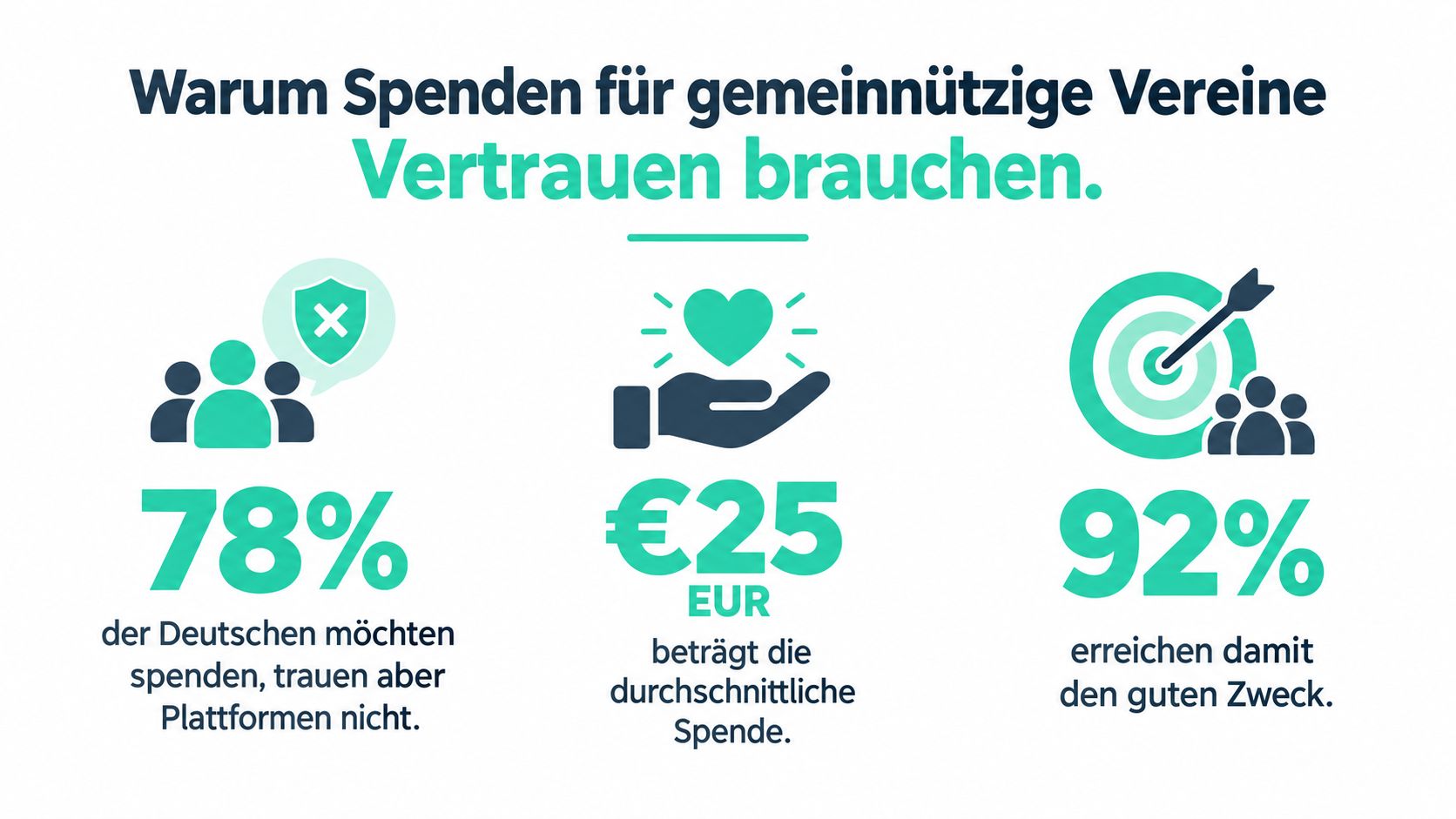
Why donating to charitable associations requires trust
Mariam wants to donate online. She opens the donation page of an association from her community, sees similar projects, and finds no clear statement about who legally receives the money and exactly what it is used for. Her hesitation is right. Stopping at this point protects her money and increases the chance that the donation really reaches a charitable purpose.
This exact problem is common in Germany. The ZiviZ Survey 2023 counted a total of 656,888 civil society organisations for 2022. 615,759 of these were registered associations, i.e. 93.7 percent. For donors, this means: the choice is large, and so are the differences between a reputable organisation, a locally known association, and an unclearly set-up donation page.
Trust arises from verifiable information
Verifiable trust is not a matter of feeling. A reputable association openly shows who receives donations, what purpose they serve, how the organisation can be reached, and whether the stated payment method matches the named recipient. On digital donation pages, an emotional image is not enough. You need a complete legal notice, an understandable project description, and traceable information on how funds are used.
This applies to classic association donations just as much as to digital Sadaka. Especially on platforms, it must be clearly stated whether the association itself is the recipient of the donation or whether another legal entity collects and forwards the payment. Even more important is the question of fees. If a platform works with a 0% fee model without any platform deduction, this must be explained transparently. Donors should immediately recognise whether the full amount reaches the stated purpose or whether deductions apply.
Practical rule: Only donate once the recipient, purpose, payment method, and proof are clearly recognisable on the same donation page or directly in the payment information.
Trust does not end after clicking the donation button. The Deutsche Spendenrat, Bilanz des Helfens 2024 shows a high volume of donations. This makes clear communication after payment all the more important. A good association or a verified platform reports what has happened with the money, what has already been implemented and what is still open. Especially with recurring Sadaka, this feedback determines whether a single donation becomes reliable support.
Recognising non-profit status and finding reputable associations
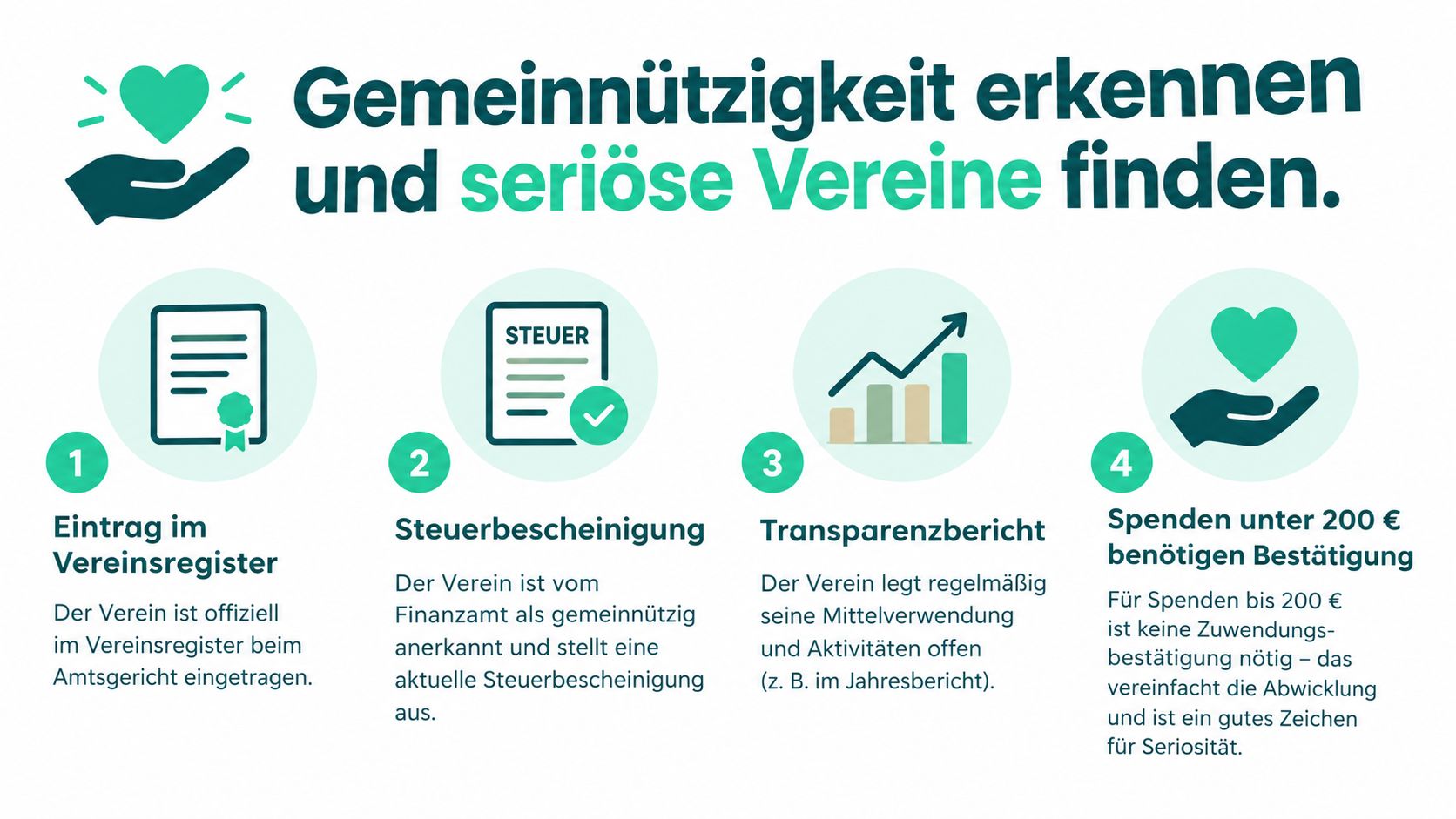
A registered association is not automatically tax-privileged. The register of associations confirms legal existence and registration, but only tax recognition entitles the organisation, under the legal requirements, to issue donation receipts. What matters therefore is not just the abbreviation "e.V.", but the current exemption or assessment notice.
The tax-privileged activity must serve a charitable, benevolent or ecclesiastical purpose under §§ 52 to 54 of the Fiscal Code (Abgabenordnung). The information from the Federal Portal on the tax treatment of donations shows that the tax deduction is tied to the recognition of the recipient and the actual use for tax-privileged purposes.
The check only takes a few minutes
Before every larger payment, proceed in this order:
- Check the legal entity: Look up the association's name in the register of associations and compare it with the name on the donation page.
- Request tax status: Look for a valid exemption or assessment notice. If there is no tax information at all, ask the association directly.
- Read the purpose: The project description should say what the money is used for. General wording without a comprehensible purpose is a warning sign.
- Compare the payment recipient: Account holder, platform notice and the recipient of the donation must match or be explained in an understandable way.
- Assess transparency: An association should provide contact details, a legal notice (Impressum), privacy information and regular project updates.
Mosque associations and Islamic initiatives deserve the same careful scrutiny as other organisations. Religious or social work alone does not automatically make an organisation tax-privileged. A comprehensible classification of Islamic communities in Germany can help to better understand association forms, responsibilities and organisational differences.
Warning signs that should make you stop
If there is no legal notice, if the provider pushes for payment with artificial urgency, or if it remains unclear who holds the account, you should not transfer money. An emotional appeal is also no substitute for information on the use of funds. If in doubt, ask about the notice, the specific project and the intended proof.
Also check whether your payment is actually a donation without consideration. A membership fee, a product purchase or a service paid for is classified differently for tax purposes. The association should openly explain these differences instead of labelling all payments as donations across the board.
Comparing donation channels and payment methods
The best payment method depends on whether you want to help once or support a project on an ongoing basis. For a spontaneous one-off donation, a bank transfer is often sufficient. For regular Sadaka donations, an automated payment method is more practical, since you don't have to remember it every month.
| Payment method | Costs | Speed | Convenience | Suitable for |
|---|---|---|---|---|
| Bank transfer | Depends on bank and association | Usually prompt, depending on bank processing time | Simple, but manual | One-off donations with personal control |
| SEPA direct debit | Depends on the provider | Predictable | High for recurring payments | Regular donations and Sadaka |
| PayPal | Provider-dependent fees possible | Usually fast | Very high | Mobile one-off donations |
| Credit card | Provider-dependent fees possible | Usually fast | High | Fast digital payments |
| Standing order | Depends on the bank | Regular and predictable | High after setup | Long-term support |
| Cash | No digital payment method | Can be handed over immediately | Personal, but harder to document | Donations on site |
One-off donation or recurring support
The classic bank transfer offers maximum control over the recipient and the purpose of use. However, it requires you to enter the account details carefully and archive the payment receipt yourself. With a SEPA direct debit, you should check who collects the mandate and how you can change or cancel the payment.
PayPal and credit card lower the barrier for mobile donations. In return, the platform must transparently explain whether fees apply and what amount is credited to the association. A 0 percent platform fee model only means a full pass-through amount if the platform does not reduce the donation amount by its own fees and openly discloses its funding, for example through voluntary tips.
For practical questions about personal provisions and important documents, the explanation of the organ donor card is a separate, helpful resource. It is not part of the donation process, but it shows why clear digital documents and traceable decisions matter in everyday life.
A digital platform such as SadakaNow as a fundraising platform in Germany can bundle several payment methods, project information and proof documents in one place. The decisive factor remains the concrete design. Before paying, check who the payment recipient is, how the forwarding takes place and what confirmation you will receive.
Taxes, proof documents and the 200-euro rule explained simply
You donate in the evening by bank transfer to an association or via a digital platform to a Sadaka project, and the next day you want to file the payment properly for tax purposes. That is exactly where convenient donating is separated from properly documented donating. Anyone who fails to secure the proof or supports the wrong recipient gives up tax advantages.
For private individuals, the general rule is: donations to tax-privileged recipients can be taken into account as special expenses up to 20 percent of the total amount of income. For companies, the alternative limit is 4 percent of total turnover plus wages and salaries paid during the calendar year. The classification as a special expense is also explained by the German lexicon of special expenses.
For tax purposes, it is not enough that money simply changed hands. What matters is that the payment went to a tax-privileged recipient, was voluntary and did not trigger any consideration in return. This applies to the classic association donation just as it does to Sadaka via digital platforms. Especially with platforms that use a 0 percent platform fee model, you should still check who is legally the recipient of the payment and what kind of receipt is ultimately issued.
What applies up to 200 euros
For a single donation up to 200 euros, a simplified proof is generally sufficient, such as a bank statement, transfer receipt or payment confirmation showing the recipient, amount and booking reference (Lohnsteuer kompakt, donations for tax-privileged purposes). Above that, you generally need an officially prescribed donation receipt.
For larger amounts, do not rely on an automatically generated transaction email. Ask the association or platform directly who issues the donation receipt and when it will arrive. This saves follow-up questions from the tax office.
These documents you should keep
Create a digital folder for every donation. It should contain the payment receipt, email confirmation, the stated purpose and, if necessary, the donation receipt. For PayPal, save the transaction page; for credit card payments, also keep the statement.
Important: A payment for a product, an event or a concrete service in return is not a donation. Ask the association to clearly explain how membership fees, purchase prices and voluntary contributions are kept separate.
The video explains how proof of donations and the donation receipt work in practice.
Transparency and security in online donations
A trustworthy online donation needs more than a familiar logo. Check whether the connection is encrypted, whether the platform names its operator and whether the privacy information clearly explains what data is processed. For professional payment processing, SSL encryption, data protection in line with the GDPR and established security standards such as PCI-DSS Level 1 are important points of reference.
Fees must be visible
With classic bank transfers, you usually see directly which amount leaves your own account. With platforms, however, payment or platform fees can be built into the process. Before confirming, check whether the association receives the full donation amount or whether a portion is withheld.
The 0 percent platform fee model works differently from a model with a flat deduction. The donation amount is forwarded in full to the project, while the platform finances itself through a voluntary tip. This is comprehensible for donors if the tip is clearly marked as voluntary, its amount can be changed, and the payment overview shows the donation amount separately.
Impact must remain visible
A trustworthy provider does not just show a payment button. Public project pages, descriptions of goals, progress updates and regular reports help donors trace how the funds are used. An anonymized live donation feed can additionally show that support is coming in, but it does not replace the reports of the respective association.
Watch out for these signals:
- Clear operator information: Name, address, legal notice and contact details must be easy to find.
- Verified organisations: The platform should explain how charitable status and campaigns are checked before activation.
- Unambiguous payment logic: You must be able to recognise who the recipient is and when the association receives the funds.
- Traceable updates: Project progress should be presented concretely and regularly.
- Voluntary tips: A tip must not appear as a hidden mandatory fee.
If this information is missing, switch providers. An emotional project image and a fast checkout are not proof of security.
Sadaka as a plannable form of recurring donation
Sadaka stands for voluntary help. In practice, it can become a very reliable form of support if donors don't just react to acute appeals, but plan a fixed contribution for a traceable project. For mosque associations, educational initiatives and social aid projects, this regularity is more valuable than financing that depends solely on individual occasions.
The Spendenrat data for 2025 shows that private individuals donated a total of 4.649 billion euros, around 9 percent or 463 million euros less than the previous year. At the same time, the Deutscher Spendenrat reported that people donated more per occasion than ever before, while the number of donating individuals declined (Bilanz des Helfens 2025). Associations should therefore not just ask for more individual donations. They need to build trust in a way that makes people want to support them less often, more specifically, and on a lasting basis.
Why recurring donations are easier to plan
A regular payment rhythm makes budget planning easier. The association can assess ongoing tasks more realistically, communicate project progress and inform supporters specifically about changes. For the donor, the effort decreases at the same time, because not every payment has to be researched anew.
The platform should make three pieces of information visible: which organisation has been verified, which project is being financed and what progress has been documented so far. A project catalogue with goal, progress, number of donors and duration creates a better basis for decision-making than a general donation appeal without an earmarked purpose.
For Sadaka donations in the DACH region, SEPA, PayPal and credit card are practical options. The payment should be accompanied by a clear confirmation, while public updates show how the project is progressing. It is precisely this combination of religious motivation, digital convenience and verifiable impact that makes recurring support sustainable.
A regular donation is not a blind standing order. It is an arrangement that you should regularly review based on purpose, recipient and impact.
Donation checklist and next steps
A brief check is enough before every payment. What matters is that you don't just set the amount, but also check the recipient, purpose and proof.
- Check charitable status: Is the association tax-privileged and is the recipient clearly named?
- Read the project description: Do you know what the money will be used for?
- Choose payment method: Does a bank transfer suit a one-time donation, or is SEPA more sensible for regular Sadaka?
- Check fees: Is the donation amount passed on in full, and is a tip voluntary?
- Archive proof: Save the payment receipt, confirmation and, for higher amounts, the donation receipt.
- Track impact: Check the association's updates and information later.
If you are donating for the first time, start with an amount whose recipient and purpose you have fully checked. If you already know a community, ask about the current tax assessment and the planned documentation. For monthly support, choose a specific project and set yourself a fixed date on which you check the progress.
Anyone who has not yet found a suitable project can find donation projects for charitable initiatives and then carry out the same check. The platform does not replace your decision. It can make it easier through structured project information, verified organisations and multiple payment methods.
SadakaNow brings together verified mosque associations, aid organisations and social initiatives and forwards donations without a platform fee, while financing is covered through voluntary tips. Visit SadakaNow, choose a transparently described project and decide on a one-time or recurring Sadaka donation with traceable proof of payment.