
SEPA direct debit when is it collected explained
A SEPA direct debit basically debits your account on the stated due date. If this falls on a Saturday, Sunday or a public holiday, the debit takes place on the next business day.
You have just released a Sadaqa donation, received the confirmation and check your banking app. The debit is still missing there. Especially with a donation for an ongoing campaign, this can be unsettling: has the order arrived, or do you still need to do something?
The most important distinction is: the donation date and the due date are not the same. The click in the donation form documents your decision. When your bank actually collects the amount is shown in the payment notification.
Table of Contents
- When exactly the debit happens due date weekend and public holiday
- Advance notice with amount and due date
- First and subsequent direct debit process from mandate to second payment
- Eight weeks and thirteen months return
- Insufficient funds direct debit return and who bears the costs
- Five steps for coverage and direct debit return
When exactly the debit happens due date weekend and public holiday
A donor releases a Sadaqa on Saturday. Her payment notification states Monday as the due date, and on Monday the debit appears on the account. As long as Monday is a business day and the collection was submitted in time, this is a normal process, not a disruption.
When the SEPA direct debit is visibly collected
| Desired date | Bank status | Visible debit | Funds required by | Submission to the bank by |
|---|---|---|---|---|
| Business day, for example Friday | Open, business day | Friday | Friday | Thursday |
| Saturday | Not a business day | Following Monday | Monday | Friday |
| Sunday | Not a business day | Following Monday | Monday | Friday |
| Public holiday as the desired date | Not a business day | Next bank business day | This bank business day | Last business day before it |
| Monday is a public holiday, desired date is a weekend | Closed, not a business day | Tuesday | Tuesday | Friday before |
| Regular payment, for example on the 3rd of the month | Business day or not | Announced or following business day | Same day | One business day before |
The table assumes that the execution days stated are business days and that no further public holidays fall in between. By “open” we mean processing in payment transactions, not the opening hours of a bank branch.
The Deutsche Bundesbank on the SEPA Hausbank procedure describes the booking on the due date and requires that the direct debit reach the payer's payment service provider at least one business day beforehand; this is the basis for the submission deadlines in the table, including the example of a regular payment on the third day of the month.
Which date actually counts
With a donation, you may come across several dates. The form shows the time of your release, an email shows the confirmation date, and the payment notification shows the planned collection. For your account coverage, the last date is decisive.
The date the mandate was granted does not determine the booking day either. With the mandate, you authorise the collection. The recipient must then prepare the specific payment and submit it with a due date.
Likewise, an already created direct debit file does not mean that your account has already been debited. The organisation can prepare the collection while the announced payment date is still ahead.
Calendar rule: Go by the announced due date, not by the date you authorised your donation.
The technical specifications of the Deutsche Bundesbank for SEPA direct debits describe processing on business days. This means that a missing account debit over the weekend alone is not yet a sign of a failed order.
Monday is not always the next banking business day
Let's assume a collection is announced for Sunday. If the following Monday is a business day, the Monday row of the table applies. If, on the other hand, Monday is a public holiday relevant to processing, the next business day applies instead.
However, a regional public holiday does not automatically mean that all SEPA processing stops. What matters is the business day calendar of the payment service provider involved. If anything is unclear, check the announced execution date and ask your bank, rather than relying only on a closed branch.
For account coverage, what counts is the available amount on the debited current account. Money in another account only helps once it is available there in time. So don't plan the transfer only for the moment you expect the direct debit to appear in the app.
At what time is the amount debited
There is no general time that applies to all banks. Your bank processes bookings according to its own procedures; that's why a collection may still be missing in the morning and only become visible later.
Also, don't confuse a provisionally noted booking with a final debit. Banking apps display announced and executed payments differently. Check the booking status before complaining about a supposedly duplicate or delayed collection.
Anyone searching for "SEPA direct debit, when is it debited?" therefore doesn't need a blanket waiting period from the moment of the click. Check the specific due date in your payment confirmation and have the amount ready for that execution day.
Advance notice with amount and due date
You donate on Tuesday, yet the debit only appears in your account later. For your planning, what matters is not just the day of the donation, but the announced due date: it indicates when the collection is scheduled.
A confirmation of the SEPA mandate granted shows that you have authorised the collection. However, it does not automatically state which amount will be collected on which date. For that, you need an advance notice.
The announcement must be specific
The advance notice, also called pre-notification, announces an upcoming collection. It can appear in a separate message, an invoice, or a payment schedule. What matters is that it states the amount and the due date.
The advance notice must take into account any agreed shorter notice period. A quick confirmation of your donation therefore does not automatically mean that the money will be collected immediately.
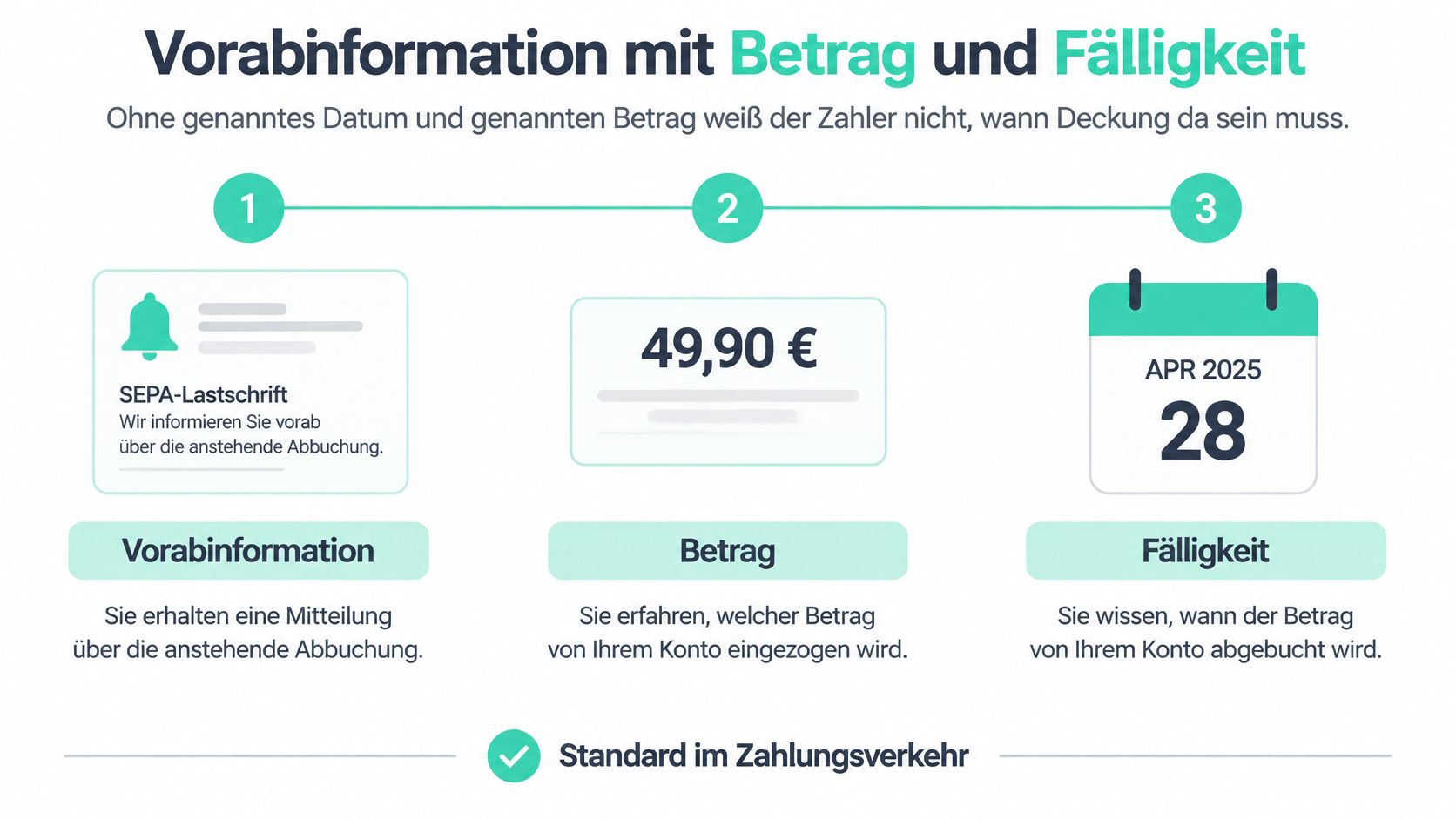
How to check a donation announcement
For a single Sadaka, the message should clearly identify the collection. This is especially helpful if you support several projects and expect different payments.
Check the following details:
- Amount: Is it clearly recognisable how much will be collected?
- Mandate reference: Can you match the payment to your collection authorisation?
- Due date: Does the message name a specific date or a clearly described payment rhythm?
- Business day notice: Does the announcement explain how a due date outside banking business days is handled?
A general mandate confirmation does not automatically replace the specific payment announcement. If the date is missing, look in the payment details and in your spam folder for another message.
For mosque associations, a clear subject line makes it easier to identify the announcement. The amount and due date should be clearly visible in the message text so that donors can quickly find them for their account planning.
First and recurring direct debit: the process from the mandate to the second payment
A one-off donation and a recurring collection can look technically similar. The difference lies in the scope of payment you have authorised. A stored mandate is not the same as freely usable access to your account.
The first direct debit is the initial collection under a new mandate. A recurring direct debit uses this mandate for a later payment, provided it covers recurring collections.
From the form to the first collection
First, you provide your account details and grant the collection authorisation. The mandate reference and the creditor identification number help to clearly match the mandate and the payee. These identifiers are not simply chosen freely by the donor.
If you want to know which fields belong to it, our guide to the SEPA direct debit form can help. Check in particular whether the form describes a one-time or a recurring payment.
The process can be broken down into individual actions:
- Grant permission: You confirm the mandate for the described payment scope.
- Check the announcement: The recipient communicates the planned payment.
- Have the collection carried out: The bank processes the submitted direct debit.
- Match further payment: With a recurring mandate, the later collection must match the agreed scope.
The graphic classifies the first direct debit, subsequent direct debit, and the technical identifier.
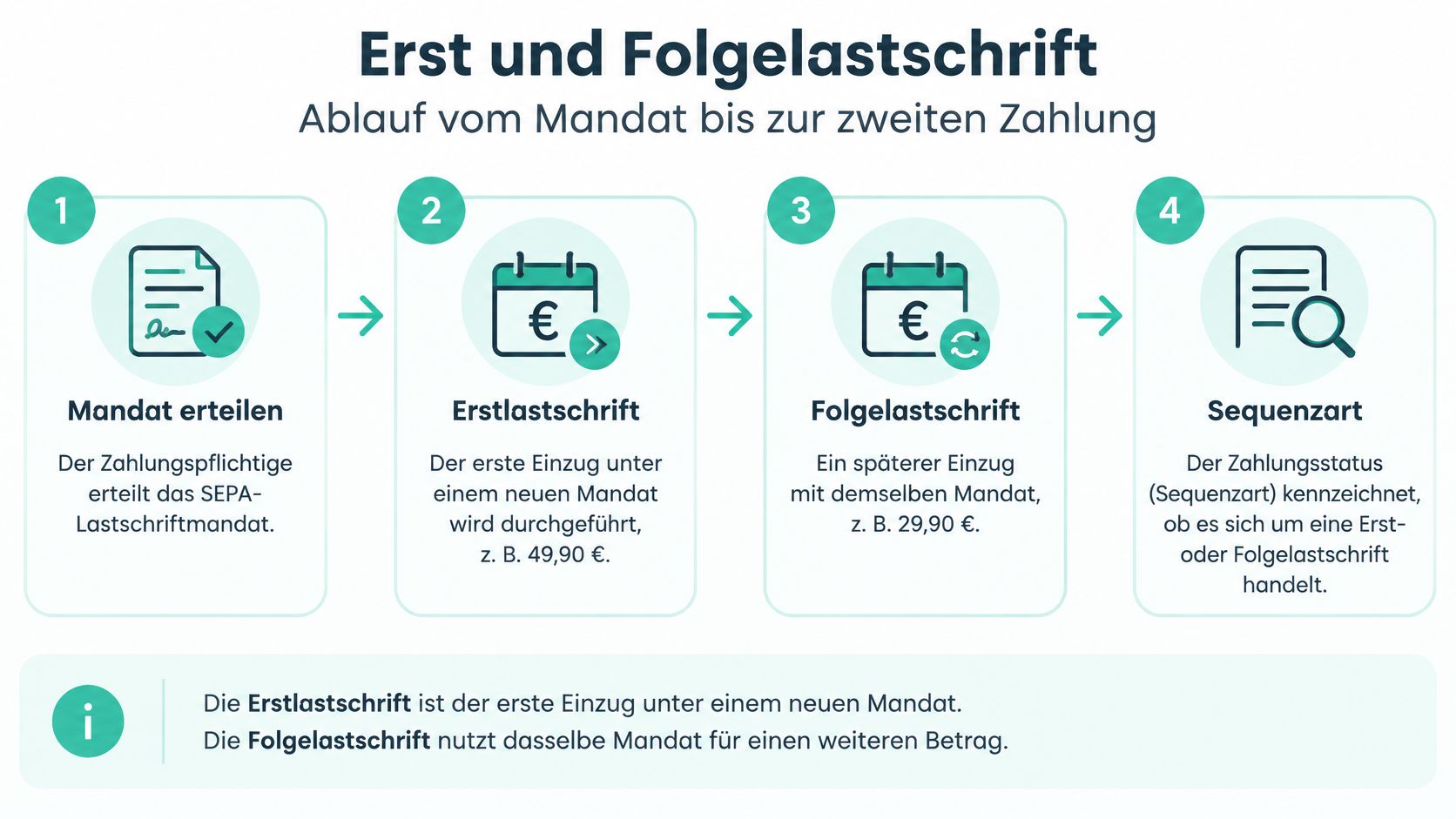
In payment transactions, the sequence type indicates whether a collection is one-off, first, recurring, or final. As a donor, what matters most to you is what you have agreed. A technical label alone does not explain whether you have committed to further donations.
What is different about a later payment
With a subsequent direct debit, a new mandate does not necessarily have to be created. The recipient uses the existing collection permission within its agreed scope. However, if the amount or rhythm changes, they may not silently derive a new donation agreement from it.
A standing order is triggered by you at your bank; with a direct debit, the recipient initiates the collection based on your mandate.
With us, fraud protection, anti-money-laundering compliance, and SEPA mandate verification run automatically for every transaction, usually within seconds. This check concerns the secure processing of the order. It is not a guarantee that your bank will debit the amount at the same moment.
SadakaNow does not use manipulative design patterns and does not offer subscriptions that donors might forget to cancel. What remains decisive, however, is that you read the description of your specific payment and keep the confirmation.
For the association's accounting, the mandate, the collection order, and the incoming payment should remain separately identifiable. A successful mandate check is not yet money received. If a collection is carried out later, the organisation must not accidentally create the order again just because the bank statement does not yet show an incoming payment.
Eight weeks and thirteen months for returns
Return deadlines after the account debit
| Case | Deadline from debit | Requirement | Consequence |
|---|---|---|---|
| Authorised basic direct debit | 8 weeks | Valid mandate, no reason required | Bank refunds, recipient receives a chargeback |
| Unauthorised direct debit | 13 months | No valid mandate for this collection | Dispute with your own bank |
| Deadline missed | No refund via the respective time-limited right | Corresponding deadline has expired | Individual clarification with recipient or bank |
The Verbraucherzentrale on SEPA payment transactions explains the return of an authorised basic direct debit within eight weeks without giving a reason, as well as disputing an unauthorised direct debit up to 13 months after the debit.
The Verbraucherzentrale's current account guide also states the dispute period for unauthorised direct debits in Germany as 13 months after the account debit. What is decisive, therefore, is the debit date of your account, not the date of a campaign or your donation decision.
What the return triggers at the recipient's end
After a return, the organisation can no longer count on the collected amount. It must match the returned item to the correct payment and correct its payment status. For a donation previously recorded as paid, it must be clarified whether you still wish to donate or are disputing the payment.
A chargeback by itself proves neither fraud nor an unwillingness to pay. Perhaps the booking text was unfamiliar to you, perhaps you noticed an incorrect amount. That is why the recipient needs a traceable way to make contact and a factual clarification.
A return corrects the account debit. Whether a valid obligation still exists alongside it is a separate question.
In the case of a voluntary donation, the organisation may not automatically treat a returned item like an outstanding invoice for goods. It must first check what agreement actually exists. The technical collection permission alone does not answer this question either.
Unclear booking text or missing mandate
A name unfamiliar to you on the bank statement does not necessarily mean you did not authorise the collection. The payment service provider and organisation may appear differently in the booking text than the project you supported. Therefore, compare the payment confirmation with the account details.
Particularly helpful are:
- Recipient identifier: Does the creditor identification number match the announced payment?
- Mandate reference: Can the collection be matched to your confirmation?
- Amount and debit: Do the payment details and bank statement match?
If you cannot identify the direct debit, contact your bank and have the transaction checked. Keep the confirmation and the relevant bank statement. An already expired return deadline does not automatically mean that every other way of clarifying the matter is ruled out.
Organisations should also factor returns into their liquidity planning. A booked incoming payment is not in every case finally available. For proper accounting, the returned item must match the original direct debit.
Insufficient funds, direct debit return, and who bears the costs
Suppose you want to donate 25 euros as a one-off. The announced direct debit is due, but your salary is not yet available in your current account. If even an agreed overdraft facility is not enough, your bank can reject the direct debit.
The graphic shows the difference between an announced payment and a direct debit that failed due to insufficient funds.
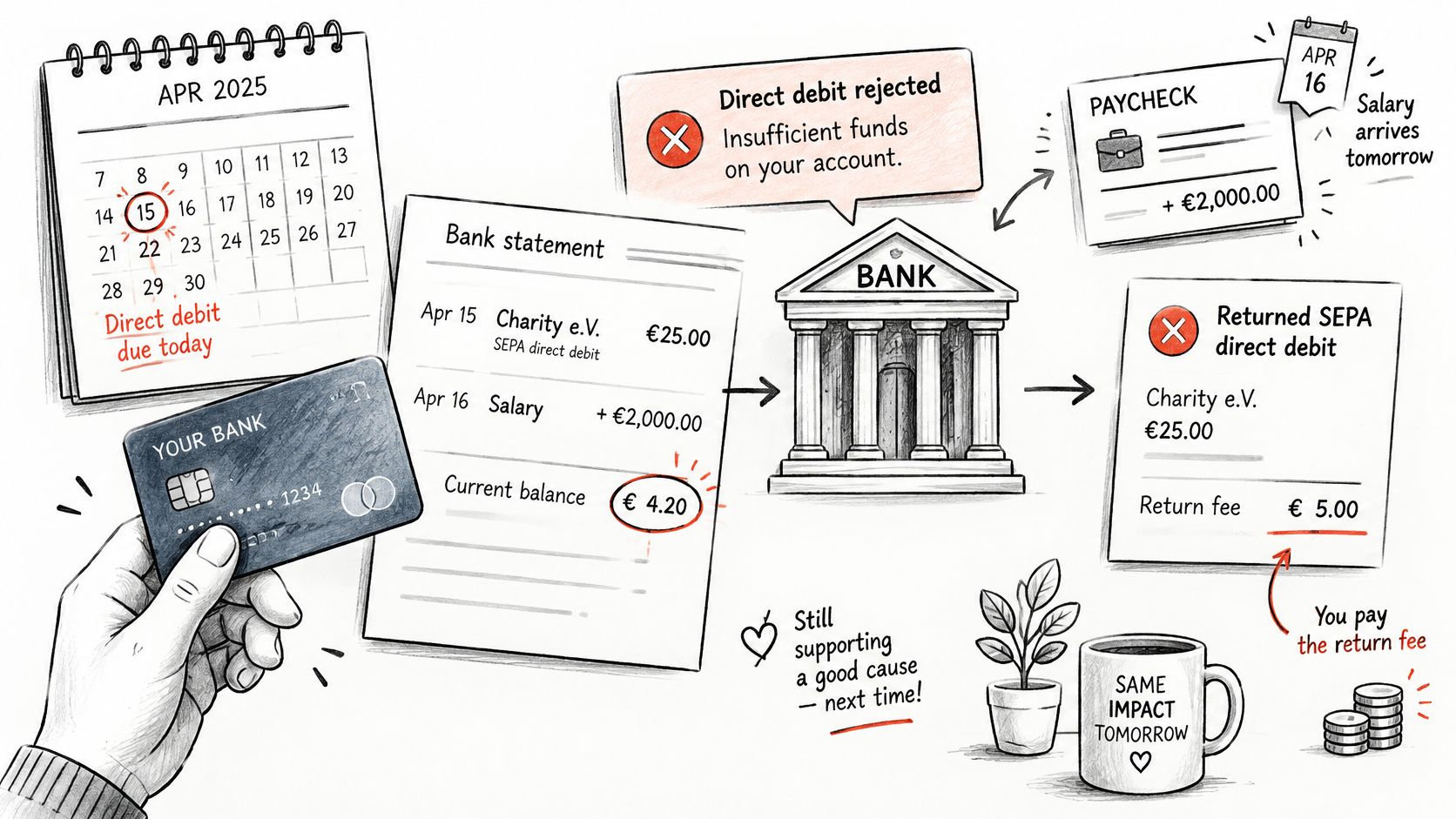
A later salary payment does not automatically repair this direct debit attempt. The organisation does not receive a successful payment from the rejected direct debit. In your banking app, you may also see a debit followed by a reversing entry, rather than the process remaining completely invisible.
What costs can arise
In the case of a valid direct debit and insufficient account funds, the associated costs can fall on the account holder. What matters is the specific transaction and the fees actually charged, not a flat-rate direct debit return fee that applies to all banks.
Check your bank's price and service list as well as any cost notice from the recipient. Bank fees, direct debit return costs, and an additional claim from the organisation are not automatically the same thing. Ask for an unclear item to be explained before you pay it.
For the donor, the most important distinction is simple: An empty account does not postpone the direct debit by the same rule as a weekend. It can cause it to fail. Once the bank has rejected the attempt, the further payment must be clarified separately.
For further context on the direct debit procedure, you can watch the following video.
Do not pay again without clarification
Do not transfer money prematurely if a new direct debit might already be in preparation at the same time. Otherwise there is a risk that you pay the same donation amount twice. First clarify the payment status and the intended settlement.
For the organisation, transparent handling of returns makes sense:
- Notification: Communicate that the direct debit was not successful.
- Identification: State the affected amount and the mandate reference.
- Next attempt: Announce a planned new direct debit in a clear way.
- Alternative payment: Offer a clearly identifiable way to settle the amount.
A silent repetition creates unnecessary uncertainty. Donors then neither know when they need to have sufficient funds, nor whether a payment they made themselves will additionally be collected by direct debit. A new attempt should therefore not be treated as an invisible continuation of the failed transaction.
If you have questions about a donation or a payment problem, you can reach us at hilfe@sadakanow.de. Describe the transaction and state the details from your payment confirmation. Login credentials for your online banking do not belong in a support message.
Five steps for sufficient funds and direct debit returns
You do not need to know the technical banking processes in detail to reliably plan a direct debit. It is enough to compare the payment announcement with your available account balance and, later, with the bank statement. This also lets you recognise when a follow-up query is needed.
At SadakaNow, you choose a project, enter your amount, and pay by SEPA, card, or PayPal. With a direct debit, the confirmation helps you find the order again later. Keep it until the payment has been clarified.
Distinguishing the payment decision from the flow of money
SadakaNow never takes possession of donated funds itself. The money is held in trust and paid out directly to the respective organisation. You should therefore not confuse a confirmation of your donation decision with an already completed bank direct debit.
For mosque associations, this means: do not record a pledged or planned donation as a final payment received without reconciliation. Mark failed direct debits clearly and avoid duplicate payment requests. A clear, understandable message helps more than a mere status label from accounting software.
In practice: Plan with the available account balance, not with an expected incoming payment.
These actions prevent avoidable follow-up queries
Read the due date in the confirmation. Look for the announced collection date. The release date in the donation form is not the appropriate basis for your account planning.
Check the corresponding bank business day. If the date falls outside the processing days, enter the relevant execution day in your calendar. If a holiday is unclear, your bank's information desk can help.
Keep the announced amount available in the current account to be debited. Also take into account other upcoming debits, so that an earlier payment does not use up the required cover.
Compare the amount and the mandate reference. If the announcement and the account statement do not match, clarify the discrepancy. For questions about our donation payments, you can contact us at hilfe@sadakanow.de; for unknown account debits, your bank is the first point of contact.
After a failed direct debit, do not wait for an unclear repeat attempt. Ask about the payment status, arrange the settlement, and keep any proof of fees. Only pay again once it is clear that this will not result in a duplicate collection.
Mark the announced due date, or the resulting bank business day, as the day on which the donation amount must be available in your current account.
At SadakaNow, you can support verified projects and donate via SEPA, card, or PayPal. Choose a suitable project, and for a SEPA donation, check the announced due date so that your payment can be executed with sufficient account cover.