
Filling Out a SEPA Direct Debit Form Correctly
A treasurer of an association is preparing to collect regular Sadaqa. A donor wants to support the mosque association with 15 euros every month and asks what her signature actually permits. The answer matters: the SEPA direct debit form is not just bank details on paper, but the explicit consent to a direct debit collection.
Table of Contents
- What the SEPA direct debit form is for
- Mandatory fields in the sample form
- Collection date and return deadlines
- How to fill out the form
- Giving a direct debit mandate online instead of sending paper
What the SEPA direct debit form is for

The association wants to collect the agreed 15 euros of Sadaqa from the donor's account every month. For this, it needs her consent in the form of a SEPA direct debit mandate. With it, the person owing payment authorizes the payee to collect the agreed euro amount, and at the same time authorizes her bank to execute the direct debit. BaFin explains the SEPA mandate and the basics of transfers and direct debits.
For private donations and regular association fees, the SEPA Core Direct Debit is usually the applicable option in Germany. It is intended for consumer payments. The business-to-business direct debit, on the other hand, is not the right route when an association collects a donation from a private individual.
A thank-you letter, a donation receipt, or a checked donation purpose is not authorization for a direct debit collection.
The payee needs a creditor identification number. The mandate must also contain the details of the payer's account and clearly show that the person consents to the direct debit collection. The signature is not mere decoration here: without a valid, verifiable mandate, the association may not collect the amount as a direct debit.
Revocation is part of understanding the mandate
The donor can revoke her mandate at any time. So that future collections are no longer authorized, she should notify both the association and her bank of the revocation in text form. The association should record the receipt and mark the mandate data as revoked in its own process.
This also matters for communication. Anyone asking for a regular donation should explain which amount will be collected, who collects it, and how the consent can be ended. For associations wanting to structure their donation organization, there is further guidance on donations for non-profit associations.
In the end, it should be clear which document underlies the collection: a complete mandate with the required details and a traceable consent. The donation receipt does not prove this consent, and the project name alone does not either.
Mandatory fields in the sample form
A usable sample form can be structured around the following fields. The examples show a monthly association collection. Details such as name and address are fictional; account data and creditor ID must be replaced with the actual data in a real form.
| Field | Required | Content | Example |
|---|---|---|---|
| Heading | yes | SEPA Direct Debit Mandate, the word SEPA is mandatory | SEPA-Lastschriftmandat |
| Payee | yes | Name and address | Moscheeverein Beispiel e.V., Musterstraße 1, 33758 Schloß Holte-Stukenbrock |
| Creditor identification number | yes | Creditor ID of the current recipient, DE plus digits and check digit | DE… (enter the association's creditor ID) |
| Debtor | yes | Name and address | Amina Beispiel, Beispielweg 2, 33758 Schloß Holte-Stukenbrock |
| IBAN | yes | Account of the paying person | DE•• •••• •••• •••• •••• •• |
| BIC | only if the bank requires it | Bank identifier | COBADEFFXXX |
| Mandate reference | yes | Unique per person and payment agreement | SPENDE-2026-00418 |
| Payment type | yes | One-off or recurring | recurring, monthly |
| Amount | only for a fixed agreement | Fixed amount or reference to the pre-notification | 15 euros monthly |
| Authorisation text | yes | Collection by the recipient and debiting by the bank | Authorisation to collect and debit the account |
| Signature and date | yes | Handwritten or verifiably electronic with timestamp and form version | Place, date, signature |
Filling in the fields correctly
The heading should read „SEPA-Lastschriftmandat“. For compliant presentation, the English heading „SEPA Direct Debit Mandate“ is also provided for; the word „SEPA“ must be included. The rulebook of the European Payments Council for the SEPA direct debit scheme describes the required mandate information and the heading.
In the details of the payee, the association's name and address belong together. The creditor ID must match the association that is actually collecting today. If the responsible body has changed or an association has been merged with another, the old ID does not automatically belong on the new form. Check which recipient is named in the mandate and whether their creditor details are correct.
The mandate reference distinguishes the individual agreement. An internal identifier such as „SPENDE-2026-00418“ is more informative than simply the name of a project, because several people may support the same project. Assign the reference so that the association can reliably match it to the donor and the respective mandate.
Regarding the amount: if a fixed monthly amount has been agreed, enter it clearly. If the amount is not fixed, the form must not give the impression that an agreed fixed amount exists. Instead, the donor must be informed of the amount and due date before each respective collection.
Important: Donation purpose, project name and donation receipt do not replace any of the mandate fields.
The authorisation text must cover both sides of the consent: the payee is permitted to collect, and the bank is permitted to debit the account. In a Ramadan campaign, the project name may be clearly stated on the sheet. But if the authorisation sentence is missing, the intention to donate does not thereby become a direct debit mandate.
For record-keeping, it is not enough to just save the amount and the name in a donation list. Also keep a record of the mandate reference, the status, the consent and the form version. Submitting a direct debit requires a signed or verifiably authorised mandate. In the case of electronic consent, the association should therefore document in a traceable way who gave consent and which version of the form applied at the time.
Collection date and return periods
An authorised SEPA core direct debit can be returned without justification within eight weeks after the debit. For the association, this means: a submitted direct debit is not yet a reliably available donation. The rules of the European Payments Council on the SEPA core direct debit describe this return option and the other deadlines.
| Situation | Deadline | Consequence |
|---|---|---|
| Pre-notification before the first collection | before the debit | communicate amount, due date and mandate reference |
| Submission to the bank | in good time before the due date | booking on the due date |
| Return of an authorised core direct debit | 8 weeks after the debit | possible without justification |
| Collection without a valid mandate | up to 13 months | unauthorised direct debit |
| Refund by the payment institution | 10 business days | refund in full or provide reasons for refusal |
| Revocation of the mandate | at any time | in text form to the recipient and the bank |
If a valid mandate is missing, the return period can generally be up to 13 months. After a refund request, the payment institution must generally refund the full amount within 10 business days or provide reasons for a refusal. For this reason, a form should neither promise "payment guaranteed" nor "non-cancellable".
Planning the donation amount carefully
The association should submit the direct debits to its bank in good time before the due date. The direct debit is booked on the due date. Beforehand, the paying person must receive advance notice with amount, due date and mandate reference. Follow the bank's submission deadlines, as these determine the specific internal timeline.
A simple separation is helpful for accounting: pending direct debits are reported separately, and the public donation total only includes amounts that have been adjusted for returns. This way, the board, project team and donors don't accidentally see a submitted order as a final receipt of funds.
Check every mandate before submission and exclude duplicates. Then mark returns in the donation records, contact the person concerned and clarify whether there is a data error, a revocation or another problem. If direct debits are returned repeatedly, the association can agree on a different payment method with the person. Anyone offering regular support will find additional information on monthly donations.
How to fill out the form
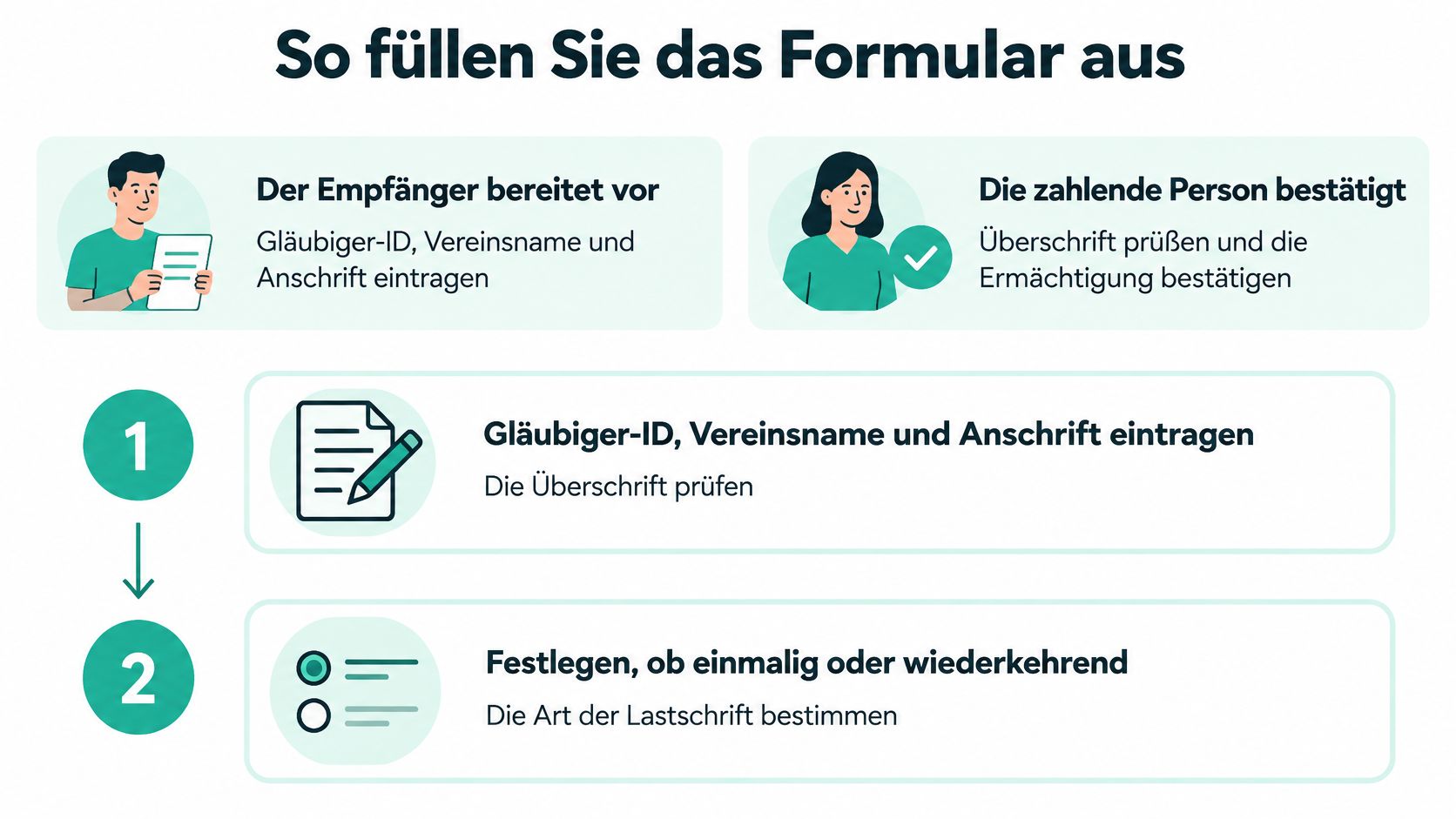
The association prepares the details about the recipient and the direct debit. The paying person confirms their details and the authorisation. Proceed in this order so that no bank file is based on an unconfirmed intention.
The association enters the creditor ID, name and address. First check the heading "SEPA Direct Debit Mandate" and assign the creditor ID to today's payment recipient. The typical slip-up is reusing an old form with details from a previous organisation.
The association determines the type of direct debit. Indicate whether the mandate applies to a one-time or a recurring direct debit. For a regular Sadaqa, the agreed frequency, for example monthly, clearly belongs in the process; do not continue using an old mandate reference for a new agreement.
The association assigns a unique mandate reference. A new identifier such as "SPENDE-2026-00418" must be assignable to the person and the specific payment agreement. The typical mistake is entering only the project name, even though several people support the same project.
The paying person enters their name and IBAN or confirms the pre-printed details. A pre-filled form is convenient, but it does not replace verification by the person providing the account. Have changes confirmed directly instead of transferring an unverified IBAN into the submission.
The paying person reads the authorisation text. It must clearly state that the recipient may collect the amount and that the bank may debit the account. A checked box labelled "donation" is not sufficient if the actual consent is missing.
The paying person signs or authorises electronically. For the paper form, this includes place, date and signature. For electronic consent, save a traceable record with a timestamp and form version; the common slip-up is logging only a click without being able to assign it to the person and the mandate.
The association announces the first direct debit and files the records. Before the first debit, communicate the amount, due date and mandate reference. Keep the mandate, submission and any later returns so that they can be found together if a query arises. Only after the advance notice does the bank file enter the submission process.
Paper remains suitable for mail campaigns or membership meetings, as long as the association archives the mandate itself in an orderly manner. Electronic consent can simplify the process if the stored record is clearly assigned to the person, the mandate and the form version used.
The explainer video can further illustrate the individual roles and steps:
The timing of the submission is important: advance notice, mandate and account details must match before the association sends the bank file. Even afterwards, the possibility of a return remains, which is why a submitted amount does not become final income on the day of submission.
Setting up a direct debit online instead of sending paper
Paper is suitable if the association manages and archives the mandate itself. Online is suitable if the amount, project and consent are to be recorded in one coherent form. What matters is not the interface, but whether the association can store the consent traceably and correctly assign the direct debit details.
For an online donation, the paying person should be able to select the project, enter the amount and recognise the intended payment method. On SadakaNow, donations can be made via SEPA, PayPal or credit card. For every transaction, fraud protection, the check related to the anti-money-laundering obligations under §4 GWG, and the SEPA mandate verification run automatically, usually within seconds. The website is SSL-encrypted and GDPR-compliant.
What also matters for an association is what remains findable after the click. Donor questions and problems with a payment can be directed to hilfe@sadakanow.de. The platform only passes on the costs of the payment service provider, which are transparently listed in the donation form. Anyone comparing a platform for their own fundraising can learn more via platforms for collecting donations.
If you use a form online, still check the mandate data, the announced due date, and the assignment of the reference before the first collection. An automatic check supports the process, but does not replace clear information to the donating person or careful planning of refunds.
SadakaNow offers verified projects a donation form with SEPA, PayPal, and credit card, as well as an automatic check of the SEPA mandate. If your association wants to record donations clearly and organise collection in a traceable way, visit SadakaNow and discover the projects and options for organisations.