Creative Offerings for People with Disabilities: 8 Examples
A community is planning a creative workshop. The room is booked, materials are ready, but only shortly before the start does anyone notice: the entrance has a step, the invitation is hard for some participants to understand, and sign language interpretation was not planned. Such barriers decide whether an offering is actually open to everyone or only inclusive on paper.
Creative offerings for people with disabilities can look very different: theatre, art, dance, music, photography or a museum visit. What matters is not the format alone, but how organisers arrange access, communication, assistance and participation in decision-making. In Germany, cultural participation is anchored as a human right: Article 30 of the UN Convention on the Rights of Persons with Disabilities covers equal participation in cultural life. For associations and communities, this means thinking about accessibility from the planning stage onwards, rather than treating it as an afterthought. The Federal Government explains the implementation of the UN Convention on the Rights of Persons with Disabilities in Germany.
The following eight formats show which measures make a difference, where typical costs arise, and how communities, associations or donation projects can approach implementation.
Table of Contents
- 1. Inclusive theatre with audio description and sign language
- 2. Accessible art studios for people with cognitive and physical disabilities
- 3. Inclusive dance companies with mixed bodies and abilities
- 4. Tactile and audio-descriptive museum tours
- 5. Low-barrier calligraphy and writing workshops
- 6. Eye-tracking control and digital art with assistive technologies
- 7. Inclusive music and drumming workshops with adaptive instruments
- 8. Inclusive photography and video workshops using the Photovoice method
- Overview
- From offering to implementation: how to start your first inclusive project
1. Inclusive theatre with audio description and sign language
On stage, people with and without disabilities perform together, not as a symbolic addition, but as an ensemble that co-develops content and performance. This also changes the audience's perspective: a performance can offer an artistic experience while also showing whose stories get a place on stage. The Theater Thikwa in Berlin is an example of a professional inclusive ensemble. The Deaf West Theatre in Los Angeles also combines spoken language and American Sign Language in its productions.
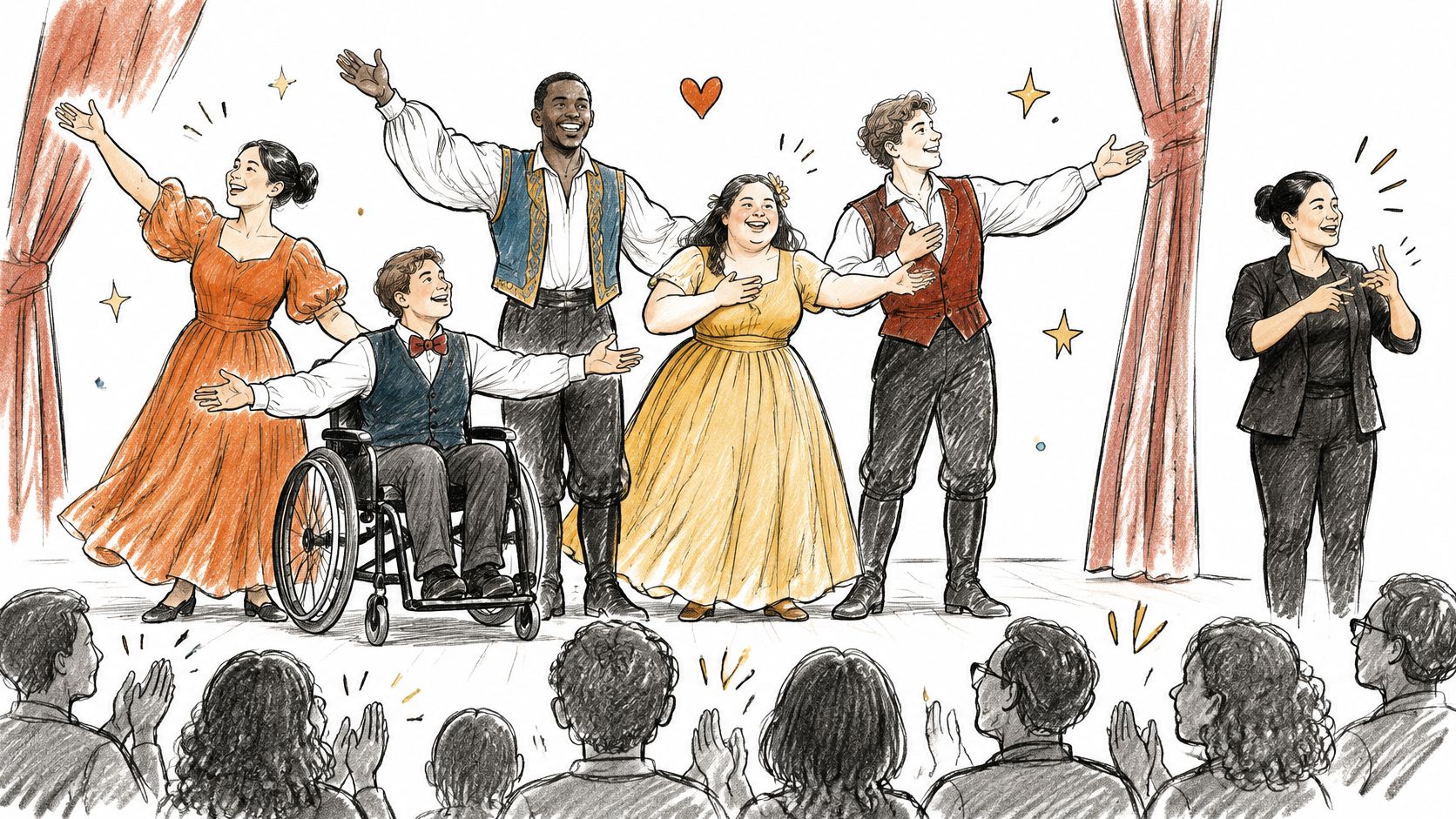
Audio description, sign language interpretation, subtitles and induction loops can improve access for different visitors. However, the right combination depends on the piece, the venue and the needs of the audience. A technical check alone is not enough: blind consultants should help review the audio description, and deaf people should give feedback on the placement and visibility of the translation.
What matters in planning and budget
Accessibility creates extra work when interpretation, technology, consultation or additional rehearsal time are needed. Anyone who only considers these items after funding has been approved may have to cut back on content or accessibility. That is why organisers should list them in the budget and in the funding application from the very beginning.
- Inform in advance: Describe travel, parking options, restrooms and existing access aids concretely, instead of just writing “accessible”.
- Make access experienceable: A touch tour or rehearsal visit can help people get to know the stage, costumes and space.
- Develop together: Involve disabled artists in artistic decisions and agree on fair fees.
For a community, a theatre project can take shape with a professional stage, an independent ensemble, or an inclusive association. A purpose-bound donation campaign can make individual costs such as interpreting, assistance, or low-barrier materials visible. This is more tangible for supporters than a general pledge to promote “inclusion”.
2. Accessible art studios for people with cognitive and physical disabilities
In the studio, artistic work should be the focus. People with disabilities can develop their own visual ideas, try out techniques and present works without the offering automatically being classified as therapy or occupation. The Creative Growth Art Center in Oakland is a well-known example of a studio where artists with disabilities work. The artist Judith Scott, who lived with Down syndrome, worked there and was later exhibited internationally.
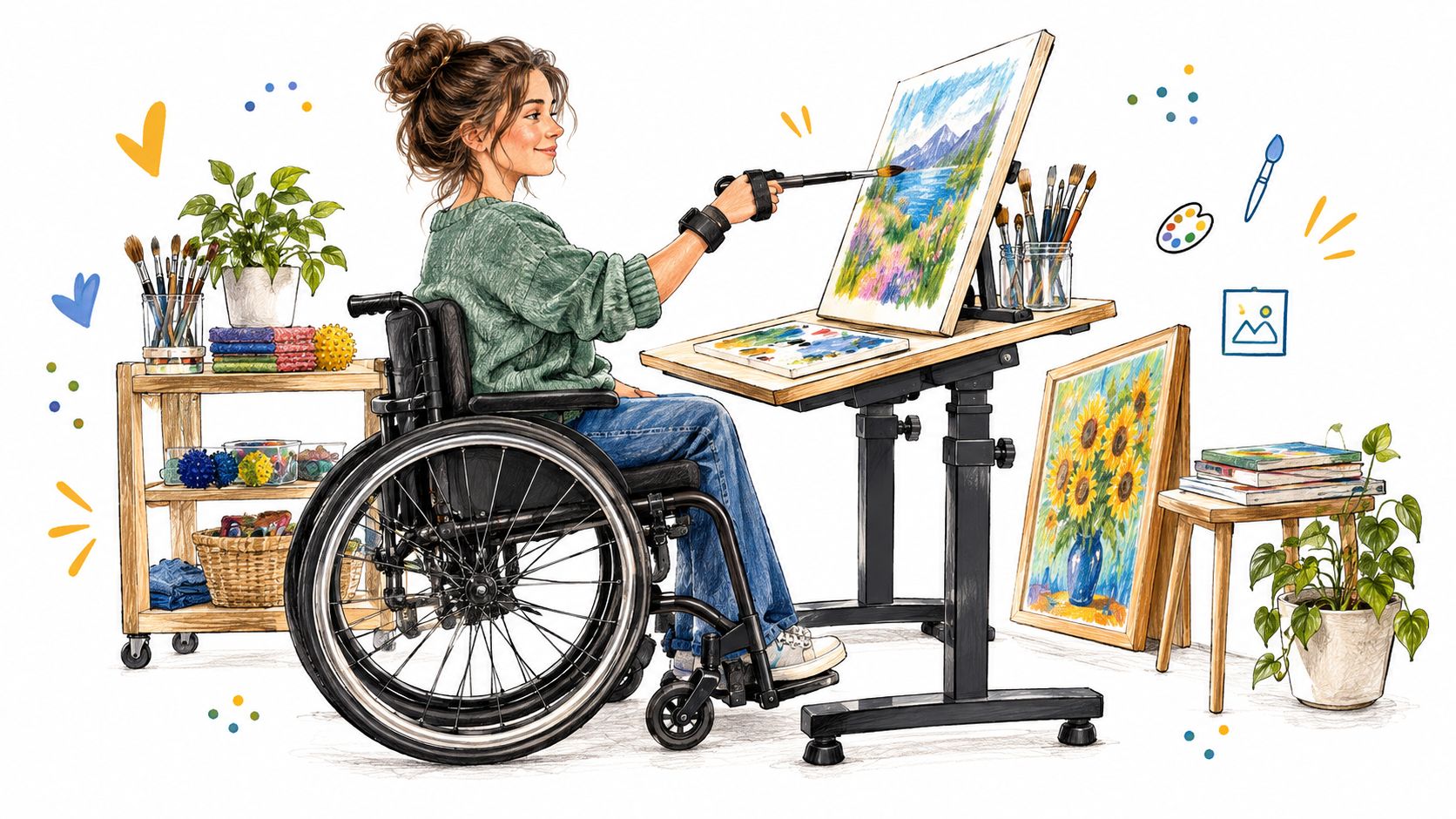
An accessible studio needs more than a step-free entrance. Wheelchair-accessible workstations, easily reachable materials and ergonomic tools can be crucial. Tactile materials and alternative tools also help when participants need different sensory or motor access. Test the equipment with the people who are meant to use it. A tool that seems suitable on paper can be impractical in actual use.
From purchasing materials to fair presentation
Costs arise among other things from consumable materials, workplace adaptations and professional support. A small start with jointly tested materials can be more sensible than a large purchase that misses the actual need. For material costs, a donation project can be clearly described: what equipment is to be acquired, who uses it, and how is it used in the studio?
Self-determination matters in presentation: Publish works with the name of the artist, not with a diagnosis as a label.
If works are sold, a prior agreement on prices, copyrights and proceeds is also needed. This keeps the artistic achievement visible and the participation transparent. An exhibition in a community facility or library can give the studio additional public visibility, but should be planned together with the artists.
3. Inclusive dance companies with mixed bodies and abilities
A wheelchair or walking aid does not have to be hidden in the choreography. Dancers can use different movement possibilities as material for movement, rhythm and spatial design. The AXIS Dance Company in Oakland and the British Candoco Dance Company are examples of professional ensembles in which dancers with and without disabilities perform together.
For a community project, an open workshop can be a good starting point. In this, leaders should not sort movements in advance as “correct” or “incorrect”. Instead, they develop tasks that each person can respond to with their own abilities. Short instructions and visual support are often more helpful than long explanations, especially when the group has different communication needs.
The rehearsal space is part of the artistic concept
Don't just check the space at the entrance. Dancers need enough movement area, accessible changing rooms and suitable showers. Travel to and from the venue also count, as do break options and the question of whether an assistant can stay during the rehearsal.
The biggest costs can lie in room rental, artistic direction, assistance and adaptations to rehearsal conditions. A donation model can keep participation free of charge, but should not assume that artists work unpaid. For a community, cooperation with a dance school or a cultural centre is practical, provided the management is willing to develop the choreography and rehearsal process together with the dancers.
An inclusive choreography emerges with the people on stage, not through adaptation done alone.
Alongside performances, workshops for people without dance experience can create low-threshold access. Clarify before registration which forms of movement, spaces and support are available, and ask participants what accommodations they need. This way organisers can align expectations without equating a specific disability across the board with a fixed need.
4. Tactile and audio-described museum tours
An artwork does not have to be accessible exclusively through sight. Touch models, reliefs, factual descriptions and audio offerings enable blind and visually impaired visitors to have their own access. Tactile mediation can also be helpful for people with learning difficulties or dementia, provided the pace, language and content suit the group. The Louvre in Paris offers tactile tours and touch models.
Museums should not select tactile objects and descriptions without consultation. Work together with blind people and advisory services, and systematically gather feedback after the tour. A description should remain factual and not prescribe what a work "means". This allows visitors to form their own impression instead of having to adopt someone else's interpretation.
Clarifying mediation before the visit
Materials in large print and Easy Language can complement access. Equally important is a clear announcement of whether touching originals is allowed, which tactile models are available, and how long the tour lasts. Where originals may not be touched, alternatives must be available.
The costs often lie in developing or acquiring tactile materials, in preparing the mediation team, and in working together with advisors. A smaller offering can start with existing objects and a cooperative tour, but should not claim that the whole museum is accessible when only a part of it has been made so. For communities, cooperation with a local museum or a blind and visually impaired people's advisory service is a good option. Funding or donations can then be directed toward specific tactile materials, audio description, or low-barrier information sheets.
5. Low-barrier calligraphy and writing workshops
Calligraphy combines script design, concentration, and shared creative work. In a community, a workshop can take up Arabic or Turkish script art, making the cultural interests of participants visible. The format requires no prior knowledge if the facilitators offer simple entry points and allow for different outcomes.
For people with motor impairments, ergonomic pens or writing aids can make handling easier. Large print and high contrast support participants with visual impairments. Anyone preparing templates should not just check them on screen but try them out with the intended users. Short working phases with breaks help manage concentration, without requiring everyone to keep the same working rhythm.
Choosing suitable materials
A workshop can start with simple writing materials before the association invests in special equipment. This shows which adaptations are actually needed. In addition to material costs, consider accessible tables, suitable lighting, and an understandable introduction. If participants hold the script in particular esteem for religious or cultural reasons, the facilitators should handle the choice of text and its meaning sensitively, rather than assuming decorative use is self-evident.
A city library, a cultural association, or a mosque can provide the space and organise the workshop together with a calligrapher or an experienced course leader. For fundraising purposes, the need can be named specifically: for example, writing aids, high-contrast templates, or the fee for an inclusive course leader. It is important not to tie participation to the ability to produce a finished work based on a template. The creative process should leave room for different forms of expression.
6. Eye control and digital art with assistive technologies
Digital tools can open up new ways of drawing, painting, or making music for people with severe motor impairments. Eye tracking, switch control, and adapted touchscreens make it possible to give input through various movements or gaze control. Tobii Dynavox offers eye control systems that can be used in creative projects. The technology is not merely an aid here, but can itself shape the artistic method.
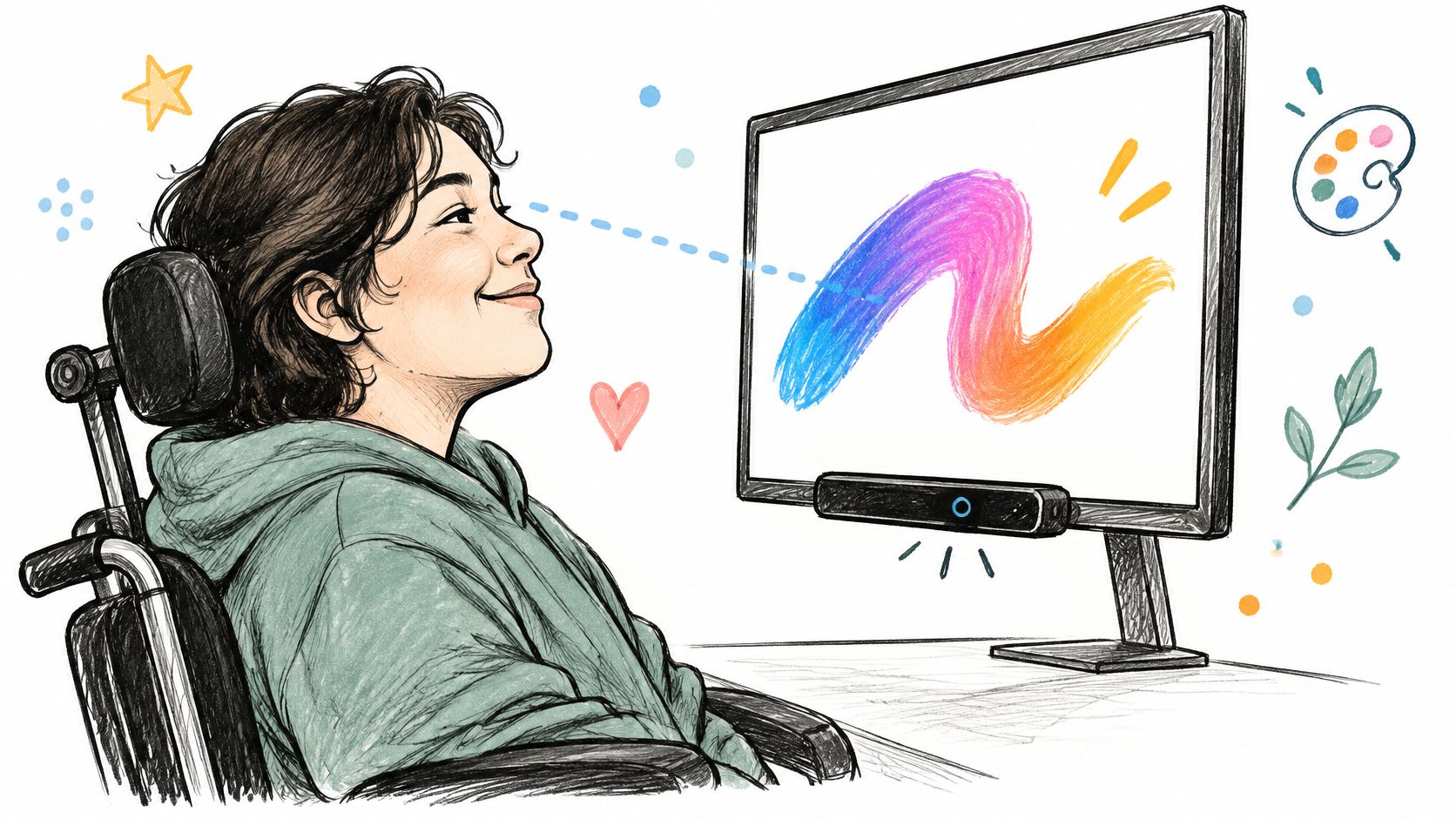
Do not buy devices based solely on a product description. Organise a trial phase and involve the users early in the choice of software. A system can be technically powerful and still not suit the preferred input methods, the available support, or the planned artistic process.
Technology needs support
Besides devices, setup, adaptation, software, and an assistant can incur costs. Also plan time for trial and error. If the technology is only set up during a single workshop, there is often little room left for creative work. Working together with an assistive device advisory service or a rehabilitation centre can clarify what equipment is already available and what adaptations are needed for the project.
Health insurers, long-term care insurers, or foundations can be examined as possible funding routes. Whether a specific service is covered, however, depends on the individual case and the particular purpose. For a donation campaign, a transparent cost plan is therefore useful, one that distinguishes between equipment, support, and ongoing material needs. This helps supporters understand what a contribution makes possible, without promising a cost coverage that has not yet been clarified.
7. Inclusive music and drumming workshops with adaptive instruments
Making music together can start with hand drums, adapted instruments, digital sound generators, or visible rhythm signals. People with different physical, sensory, or cognitive abilities can take part each in their own suitable way. The deaf percussionist Evelyn Glennie uses vibration and bodily perception in her musical work. Systems such as SoundBeam translate movements into sounds and offer another way to make music physically perceptible.
The choice of instruments should be guided by the participants. Some prefer strong sounds, while others need less volume or clear pauses. Visual conducting cues can help coordinate entrances together. Anyone using a music room should check the room acoustics and retreat options before the group begins.
The setting matters too
Volume, level of stimulation, and duration are key planning questions. A quiet-zone option can be important, but should not be treated as a way to opt out of the shared activity. Participants can step back for a while and return later if the routines allow for it.
Cost drivers include adaptive instruments, technical equipment, course leadership, and assistance. A donation project can initially fund instruments or the leadership of a workshop; for regular meetings, the community must also clarify space, storage, and reliable responsibilities. Start with a manageable selection of instruments and ask the group about their preferences instead of acquiring as many devices as possible. This keeps the activity practically manageable and allows it to be developed further as needed.
8. Inclusive photography and video workshops using the Photovoice method
Using a smartphone or camera, participants capture what they experience in their surroundings. In Photovoice, they develop images and stories that can make their perspective visible. A workshop can, for example, document barriers in public spaces and present the results to a community or city administration. Photo and video projects in workshops for people with disabilities can also result in exhibitions, provided those involved decide for themselves on the presentation and publication.
Smartphones offer features such as voice control and magnification that can make individual steps easier. Course leaders should test the devices together with participants rather than assuming everyone prefers the same way of operating them. An oral explanation may also be necessary alongside written materials.
Consent and publication are part of the workshop
Before taking photos, clarify which images may be taken and how they will be used later. Obtain consent in writing or verbally in a clear, understandable form. Participants should be able to decide whether and where their images are published, and be able to review their decision later.
Publication is not an automatic consequence of participation. The decision about image selection and public use must lie with the people depicted and creating the work.
For the association, printing, exhibition design, equipment, and low-barrier support can incur costs. If a donation project is meant to make the exhibition possible, specify concretely whether funds are needed for rental equipment, printing, or accessible presentation, for example. Invite local decision-makers to view the results without pressuring participants into publicly presenting their personal experiences.
Overview
| Activity | Target group | Accessibility focus | Typical cost driver | Possible without prior experience |
|---|---|---|---|---|
| Inclusive theatre with audio description and sign language | Performers and audience with and without disabilities | Audio description, sign language, subtitles, and wheelchair-accessible spaces | Interpretation and audio description | Yes as audience; stage participation usually requires experience |
| Accessible art studios | Artists with cognitive or physical disabilities | Adapted tools, work surfaces, and tactile materials | Studio operation and material costs | Yes, with professional support |
| Inclusive dance companies | Dancers with and without disabilities; including amateurs | Mixed movement options and accessible rehearsal spaces | Spaces, transport, and additional rehearsal planning | Yes, especially in workshops |
| Tactile and audio-descriptive museum tours | Mainly blind and visually impaired people | Tactile models, audio description, and trained guides | Production and maintenance of tactile models | Yes |
| Low-barrier calligraphy and writing workshops | People with motor, visual, or cognitive impairments | Writing aids, tactile templates, and accessible spaces | Expert guidance and suitable spaces | Yes |
| Eye control and digital art | People with severe motor impairments | Eye control, switches, and adapted software | Assistive technology and setup | Yes, with training |
| Inclusive music and drumming workshops | People with physical, sensory, or cognitive impairments | Adaptive instruments, vibration, and visual signals | Special instruments and trained guidance | Yes |
| Inclusive photography and video workshops using the Photovoice method | People with and without disabilities | Adapted operation, audio commentary, and subtitles | Exhibition costs and protection of personal content | Yes |
From activity to implementation: how to start your first inclusive project
An art association is planning a drumming workshop. Before ordering instruments, it sits down with the future participants and asks: Who wants to take part, what access needs are there, and who should decide on content and success? This is exactly where you should start. Choose a format that fits the interests of the people in your community and the capabilities of your institution, and begin with conversations rather than with a list of supposedly suitable activities. People with disabilities belong in planning, implementation, and evaluation from the very start. The inclusive art practice programme "pik" shows what a structural approach can achieve: it combined mentoring for Disabled Leadership, a network for performing arts, and consulting and training for cultural institutions. The Kulturstiftung des Bundes describes the programme and its components.
Check spaces, access, and communication before ordering materials. Clarify whether the journey there, the entrance, workspaces, and restrooms are suitable for the intended participants. Before registration, describe concretely what support is available and which conditions are still missing. A sentence like "our building is accessible" helps no one who needs to know whether a wheelchair fits through the door or whether there is a quiet room. Also provide information on assistance, breaks, sensory load, and costs.
Plan accessibility into your budget and schedule from the very beginning. Depending on the format, this may include interpretation, audio description, assistance, adapted materials, technical equipment, or additional preparation time. These items are the typical cost drivers, and they vary depending on the space, the activity, and the wishes of the participants. A pilot offering can help test procedures. Limit: a pilot must never turn unpaid work or lack of accessibility into a permanent state.
Your team is also allowed to learn. In the evaluation of the Berlin model cohort "FSJ Kultur und Inklusion" 2022/23, by the end of the pilot year roughly two-fifths of all placement sites reported a gain in knowledge about inclusion, including institutions that were not directly involved at all. The evaluation with recommendations for action shows how strongly preparation and clear responsibilities work. Before you start, record which barriers are known and how confident the team feels. After completion, review together what needs to improve and whether participants actually helped shape things.
A clearly defined donation campaign with a concrete goal is well suited for financing — for example for materials, interpretation, assistance, or an accessible renovation. Describe what the donations make possible, how the project takes in feedback, and how results will later be shared. Anyone planning a campaign on SadakaNow can reach the team at partner@sadakanow.de; all campaigns are checked for charitable status before being activated.
SadakaNow bundles donation campaigns for vetted charitable projects. If your community wants to fund concrete costs for inclusive creative activities, visit SadakaNow and check whether your own campaign fits your project.