
Nonviolent into the Future: Concept, Methods, Projects
The Federal Situation Report on gender-specific crimes against women in 2023 shows: roughly every three days a woman is killed through partnership violence. A further statistic concerns the frequency of physical or sexualised violence by current or former partners. Gewaltfrei in die Zukunft points here to studies summarised by the Berlin Senate Administration: in Germany, roughly one in three women is affected. If psychological, social, economic and digital violence are counted as well, the actual number affected is even higher.
These findings make visible why nonviolent means more than preventing a single assault. Like a house with several entrances, help must also take different experiences into account. Control, isolation and fear can exist for a long time before physical violence becomes visible.
Table of Contents
- Why nonviolent must be rethought today
- What nonviolent really means
- How an idea became a support service
- Nonviolent conflict culture in education and school
- Who is reached and who is still left out
- The example of Gewaltfrei in die Zukunft in everyday life
- Measuring impact and getting involved yourself
Why nonviolent must be rethought today
Partnership violence rarely happens in the open street. It takes place in the kitchen, the bedroom and chat conversations, often over years. Neighbours hear an argument and hesitate. Those affected tell themselves that the next day will be calmer. It is precisely this invisibility that makes the issue socially urgent, not just private.
Nonviolent therefore means more than the absence of blows. It includes early prevention, reliable information and a path to help that forces no one to reveal themselves immediately to an authority or a trusted person. Anyone who only acts once the police are already at the door comes too late for many situations.
Three levels that belong together
A helpful analogy is a bicycle light. It does not prevent the accident on its own, but it makes the path visible before the bend comes.
- Prevention: People recognise control, threats and isolation before injuries become visible.
- Information: Legal and psychosocial guidance is available, without an appointment and without having to come out.
- Access: Regional counselling and protection remain reachable, even if the first step has to be quiet.
Silence only appears to protect domestic peace. It does not protect the person who pays the price for it.
Education, neighbourhood and support systems carry the same task. At school, children practise naming a conflict without belittling the other person. In the community, it is decided whether someone knows a counselling centre before the situation escalates. Digital services such as Gewaltfrei in die Zukunft start exactly where classic help often fails to reach: at the place where it happens, unobtrusively and early.
Anyone who wants to rethink the concept asks three questions. What does nonviolent mean in concrete action? How does an idea become a public support service? And how does a municipality know whether people are really being reached? The following sections go through these questions in order, from the term itself through school and reach to the question of how impact can be measured.
What nonviolent really means
Imagine an argument at the kitchen table. One person comes home late, the other is angry. Nonviolent here does not mean swallowing the issue. It means expressing the anger without insults, without threats and without slamming the door. “I've been waiting for an hour and I need reliability” is something different from “You're always like that.”
Attitude, action and framework
The term rests on three levels, and none of them carries it alone.
Personal attitude begins with the decision not to treat pressure as a normal means. Respect here is not a polite tone of voice but the refusal to hurt the other person in order to be right oneself.
Concrete action shows up in the next sentence. Listening, naming your own need, offering a pause when a voice starts to break. Within a family, that can look like this: both put their phones away, each person speaks for two minutes, and afterwards only one thing is agreed for the next evening.
The structural framework decides whether this kind of action is possible at all. Laws, school culture, counselling centres and shelters are the load-bearing walls. Without them, a friendly attitude stands alone in an emergency.
Memory aid: Nonviolence is a house. Attitude is the roof, action is the door, structures are the walls. If a wall is missing, the roof won't hold.
This does not mean mere conflict avoidance. Someone who always gives in just to keep things calm is not practising nonviolence. That person is practising submission. Silence can be protection when danger is looming. But it is no proof that a relationship is free of violence.
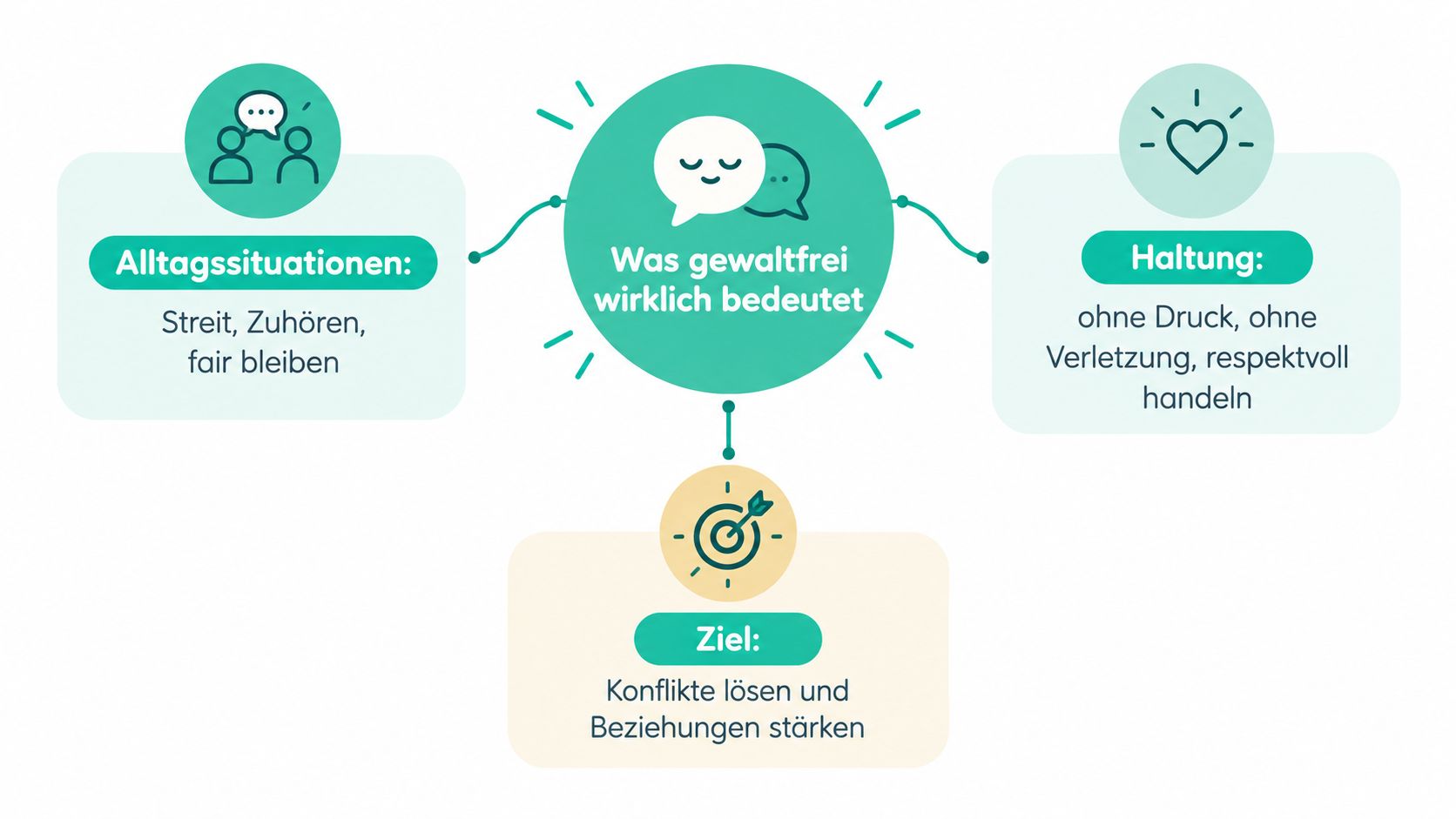
In educational work, the same distinction becomes tangible. A class that only hands conflicts over to the teacher learns obedience. A class that observes, names things, and looks for a fair solution learns responsibility. Anyone looking for a compact introduction to this will find a practical overview of nonviolent communication at Konflikte im Schulalltag gewaltfrei lösen.
The goal is not harmony at any price. The goal is to resolve conflicts in a way that keeps relationships sustainable, without anyone trading their safety for peace and quiet. This model can later be transferred to school, app, and community, without having to redefine the concept every single time.
How an idea became a support service
The idea for a protected app emerged in 2017. Three years later, the concept won the Hackathon der Bundesregierung. In the same year, Gewaltfrei in die Zukunft e.V. was founded as the host association. The project page of the host association describes the association and its work. No claim is made here of a state mandate for developing and distributing the app.
The path it took resembles a relay race: one person picks up the problem, the next carries the work forward. For those affected, even an open phone call can be risky. The hackathon gave the concept a development push; with the founding of the association, a supporting structure emerged that could carry the project forward beyond the competition. That is how, step by step, an idea became a support service.
From reaction to early help
The first project phase ran from April 2021 to September 2023. The project page attributes it to funding from the Bundesministerium der Justiz. The approach bundles legal and psychosocial information, contacts to regional support services, and a protected violence diary. Those affected can document incidents in it and secure records for possible court proceedings.
In Berlin, the app was tested together with the Senatsverwaltung für Inneres und Sport. Authorities, administrations, and civil society organisations are being involved in its implementation. Social, legal, and criminological research is meant to examine how the service works. The current funding period foresees implementing the app in several federal states by 2026.
This changes the role of a support service: instead of becoming available only after someone makes contact, a digital tool can already be on hand in the home, disguised and linked to existing services. An app alone, however, does not yet create reliable help. For that, the contacts to counselling centres and authorities must work, and the federal states must integrate the service into their structures. The accompanying research can check whether these connections hold.
Nonviolent conflict culture in education and schools
Schools are often the first place where children learn to handle disputes with rules rather than volume. Three building blocks keep appearing in practice: peer mediation, jointly written class rules, and short trainings in nonviolent communication. They work not because a poster hangs in the hallway, but because someone practises the process while nothing has yet escalated.
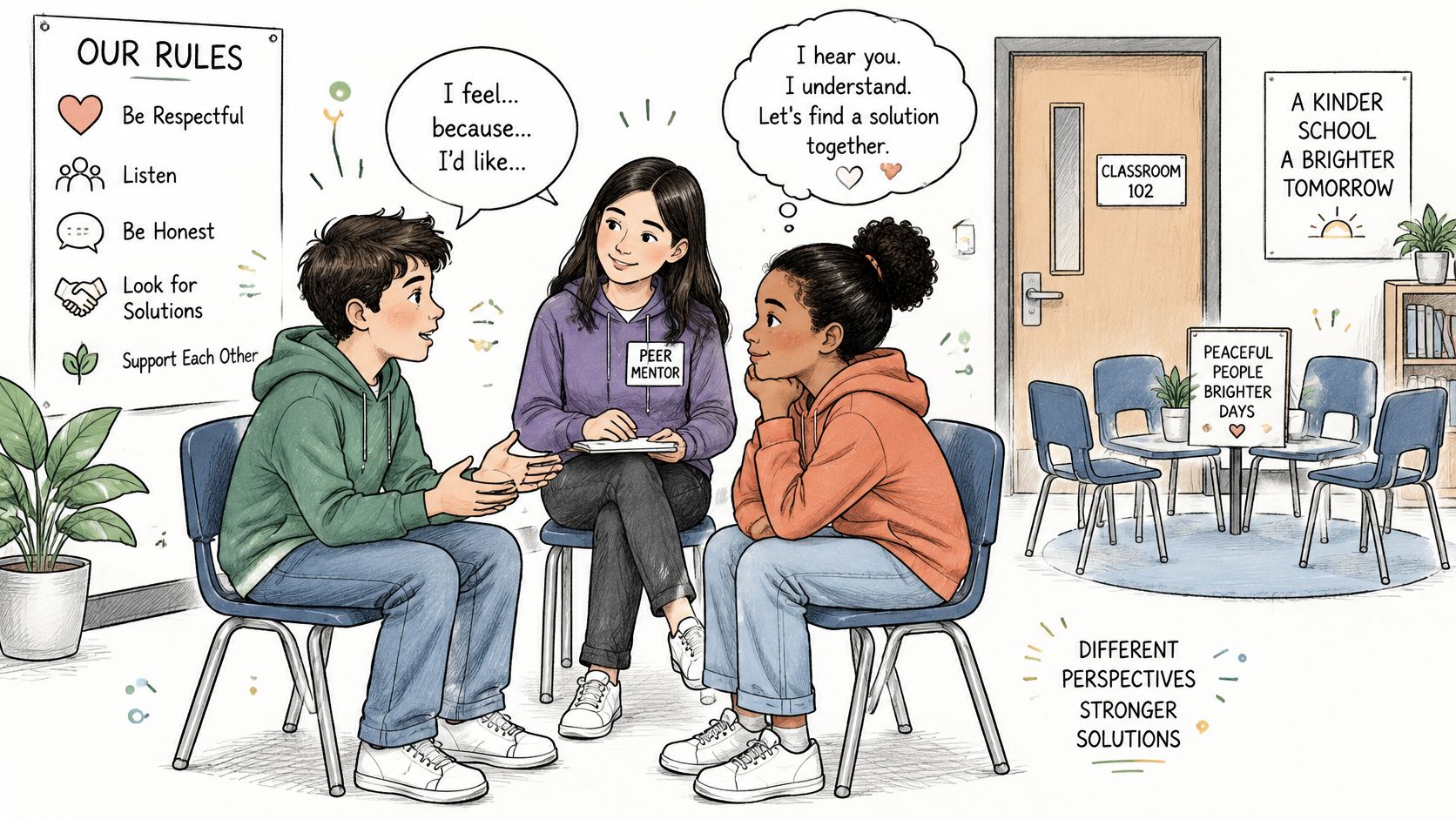
Three building blocks, three scenes
Peer mediation relies on mediation among peers. Two students argue over a spot in group work. A trained classmate listens to both, summarises, and asks for a proposal both can accept. The teacher stays in the room but does not intervene right away. The learning gain lies in the class seeing: conflict can be resolved without anyone losing.
Shared class rules do not come about as a dictate written on the blackboard. The group collects what disrupts the lesson and agrees on a few sentences, such as "We let each other finish speaking" and "We don't laugh at anyone." If a comment later hurts someone, the teacher points to the rule, not to the person's character. That takes the pressure off, because the boundary was already in place beforehand.
Trainings in nonviolent communication break the conflict down into four phases. In class, it sounds like this:
- Observing: What happened, without judgement? "You took my pen."
- Naming: What feeling is attached to it? "I'm annoyed."
- Clarifying the need: What is missing? "I need my things for the task."
- Seeking a solution: What is the next concrete step? "Give it back, then we'll share the spare pen."
Why this order? Anyone who demands a solution right away skips over what the other person is actually concerned about. Anyone who only names the feeling ends up without an agreement. The four phases hold both together.
A rule that the class did not write down together quickly becomes the teacher's idea in a conflict. A rule that was written down together can be recalled by the group itself.
The same building blocks can be scaled down for youth groups and families. At the dinner table, often just this question is enough: What did you see, what do you need, what can we change by tomorrow? Anyone who has practiced the process out loud once does not need to reinvent it in the heat of the moment.
Who is reached and who is still left out
An offer only works if the person can find it, understand it, and use it safely. The Berlin project description is aimed at adult women and additionally describes the usability for people with diverse gender identities. How access looks nationwide for other affected groups is not answered there in detail.
Open questions instead of innovation rhetoric
The interesting question is therefore not just how new the technology is. It is: which measurable gaps in care does the offer close in each federal state?
- Language: Is content available in languages that migrant communities use in everyday life, or does the help remain tied to German?
- Device and skills: What happens in cases of low digital literacy, without one's own smartphone, or with a disability that makes operation and readability harder?
- Other groups: How are men, queer people, and young people referred to suitable services without diluting the actual target group?
- Acute danger: In which cases is the app not enough, and is the path to police and protection clear enough?
Lower Saxony is introducing the disguised app statewide, while the project is meant to be offered nationwide in the long run. This is not a uniform care network, but a structure that differs from state to state. One state can closely involve authorities, another stays at a technical launch.
Meaningful metrics would be activations, safe referrals to specialist services, usage by language and accessibility, and cases in which the app was not enough due to acute danger. Downloads alone say nothing about who is left out.
Neighbourly networks close part of this gap when specialist services are not yet known. Anyone who wants to know how private help can be organised without overriding the affected person will find guidance at Freunde in der Not.
An app that only reaches the already well-informed person confirms the existing provision of care. It does not close it.
The example of Gewaltfrei in die Zukunft in everyday life
Gewaltfrei in die Zukunft is designed as a protected disguised app for adult victims of gender-specific violence in relationships. The project website describes three functions within a low-threshold access: legal information, psychosocial guidance, and contacts to regional support services.
Imagine a person who stays in the apartment in the evening because a conversation outside would attract attention. She does not open a visibly labelled help page. The individually customisable disguise ensures that use of the app cannot be clearly recognised from outside as a help service. The first step requires neither a counselling centre nor a person of trust. That is precisely what lowers the barrier.
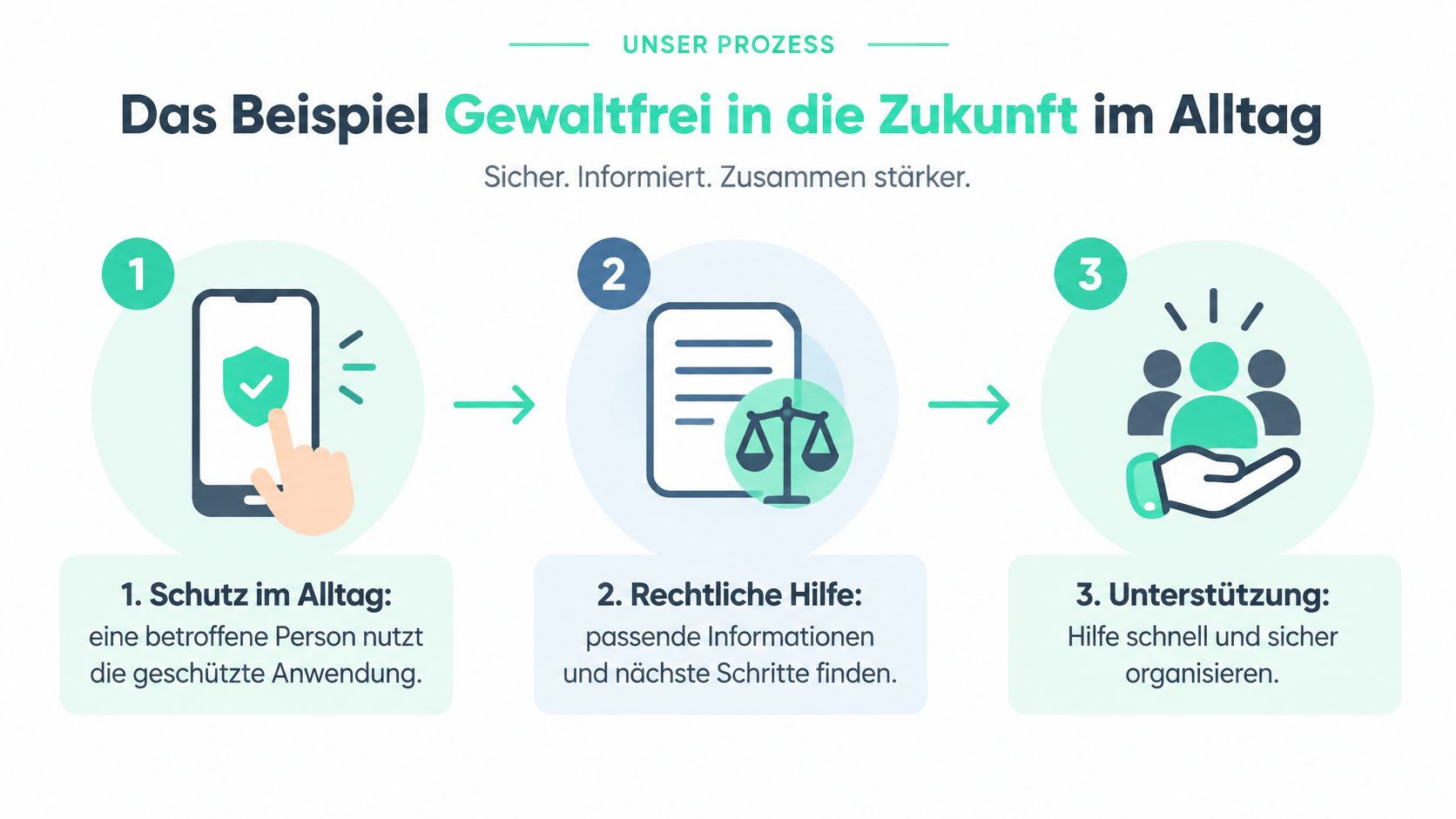
What the three functions actually do in the evening
The legal information answers questions that would otherwise have to wait until the next counselling appointment. The psychosocial guidance helps to make sense of what was experienced without downplaying it. The regional contacts connect the person with existing counselling and protection structures, rather than remaining an isolated digital offer. Berlin explicitly describes this embedding as a sustainability goal.
The protected violence diary records incidents in a structured, chronological way. This serves the person's own orientation and can be relevant for documentation supporting court proceedings. However, it does not replace police evidence collection or legal advice. Anyone who mistakes the notes for an official record overestimates the app and underestimates the legal process.
For communication or funding purposes, process indicators can be derived from this that say more than installation numbers: completed information modules, accessed regional help contacts, documentation entries created, and successful referrals to specialist services.
| Function | Everyday benefit | Clear limit |
|---|---|---|
| Information | Orientation without immediate outing | No substitute for legal advice |
| Regional contacts | Connection to existing services | No automatic on-site protection |
| Violence diary | Chronology for one's own clarity | No police evidence collection |
Anyone who wants to support such offerings in the long term looks not only at the technology, but at the organisations behind it. An overview of ongoing social projects shows how differently communities already organise help.
Measuring impact and getting involved yourself
Downloads are a convenient but weak benchmark. An installed app can sit unused on a device. The project logic of Gewaltfrei in die Zukunft is therefore designed in several stages, as the general project information shows.
The first funding phase ran from April 2021 to September 2023 and was financed with 1.7 million euros by the Bundesministerium der Justiz on the basis of a Bundestag resolution. In 2022 and 2023, the app was piloted in two major German cities. The technical and content finalisation was carried out with the involvement of 15 affected persons. From October 2023 to December 2026, the application is being implemented in several federal states and accompanied by scientific research.
Participation is meant to increase usability and safety. The piloting examines whether the approach holds up under real conditions. The multi-perspective accompanying research is meant to evaluate its effectiveness. Niedersachsen also documented a process evaluation of the rollout at the Polizeidirektion Hannover up to 29 July 2024. The actual impact on combating domestic violence should be examined separately afterward.
Metrics that say something
Separate metrics for reach, usage, implementation quality and outcomes are more reliable than a single download number. These include active usage, referrals, documented safety planning, and changes in access to help.
What each person can contribute is smaller, yet still concrete:
- Pass it on: Mention a counselling address within your own circle, without pressuring the affected person.
- Know it: Look up local protection and counselling structures once yourself before an emergency occurs.
- Suggest it: Propose a short practice evening on conflict culture at school, in an association, or in the community.
- Fund it: Don't just approve of educational and support offerings — support the organisations behind them. The article Funding social projects explains how this can be done without opaque deductions.
The next step fits into one evening. Look up your local counselling centre, save the number, and tell someone that you know it. This doesn't make Gewaltfrei complete. But it turns an attitude into a reachable structure.
SadakaNow forwards Sadaqa donations without a platform fee to vetted social projects and aid initiatives, including efforts that strengthen protection, education and community work. If you want to not just understand nonviolent structures but also support them, you will find transparent campaigns on SadakaNow and can contribute directly via SEPA, PayPal or credit card. Take a look at a project that matches your community, and put the next contribution into action today.