Verified donation organisations: 7 reputable providers
You've opened a donation appeal on your phone. The project sounds urgent, the images move you, and the payment button is just one click away. But before you send your next Sadaqa, one question remains: Who actually checks whom?
Maybe you know the mosque association personally. Maybe an international aid organisation advertises with a seal, while a platform marks its campaigns as verified. These are different foundations of trust. Verified donation organisations are not automatically verified according to the same criteria, and proof of charitable status answers different questions than a financial report or a current project report.
For your decision, it's worth separating external reviews, for example by the DZI or the Deutscher Spendenrat, from internal approvals, such as those carried out by a platform like SadakaNow. What matters is not how convincing a badge looks, but what documentation stands behind it and what remains unclear.
The following selection combines concrete donation options with a research tool. My recommendation: first choose the right cause, then check the provider and payment method, and only then decide on the amount. For Zakat, you should also request an explicit statement on the intended use, rather than relying solely on a provider's Muslim orientation.
Table of contents
- 1. SadakaNow
- 2. DZI donation seal as a research tool
- 3. Kindernothilfe e.V.
- 4. German Doctors e.V.
- 5. Save the Children Deutschland e.V.
- 6. ADRA Deutschland e.V.
- 7. Islamic Relief Deutschland e.V.
- Comparison of 7 verified donation organisations
- Taking the review logic to your next donation click
1. SadakaNow
SadakaNow is especially suited to people who want to give Sadaqa for mosques, aid projects and social initiatives through a shared platform. The focus on Muslim communities makes the thematic selection easier. However, it does not replace your own look at the specific provider and individual project.
Before approving submitted campaigns, SadakaNow checks their charitable status. Public project pages, progress updates and the live donation feed Sadaka Pulse then offer different insights: project pages describe the undertaking, updates document developments, and the donation feed shows ongoing support. You should not confuse these functions with one another.
What really builds trust in a profile
A convincing profile should answer who is responsible, what is to be financed, and how those responsible report on it. Look for a clearly named provider, an understandable project goal, and updates that refer back to earlier information. An emotional appeal alone is not enough.
- Strength: SadakaNow bundles offers that are thematically suited to Muslim donors and communities.
- Fee model: For SadakaNow projects, the platform describes a pass-through without a platform deduction and financing through voluntary tips. Check whether your selected campaign falls under this and what additional amount is set during checkout.
- Payment methods: SEPA, PayPal and credit card enable different payment methods. Only use the campaign's official checkout.
- Friction point: An internal approval is not an external donation seal. Regular donations in the live feed also do not yet prove completed project delivery.
My recommendation: Use Sadaka Pulse as insight into the support a campaign receives. Judge the use of funds based on the project reports, not on the activity in the feed.
For mosque associations and initiatives, personal support when launching a campaign is helpful. Nevertheless, prepare your statutes, tax documentation, responsibilities and a comprehensible budget description. Quick publication must not become more important than a solid profile.
My verdict: SadakaNow is a suitable point of contact for community-based Sadaqa. Donate there specifically to campaigns whose verification status and project description you can follow, and treat missing information as a reason to ask follow-up questions, not as an invitation to extend unwarranted trust.
2. DZI donation seal as a research tool
You check an organisation before you donate. The DZI helps you assess its tasks, funding, structure, as well as advertising and administrative expenses. Read the profile instead of relying solely on a seal on the donation page.
Around 230 organisations carry the DZI donation seal. The review considers, among other things, truthful public relations, economical use of funds, financial reports and internal controls, as the DZI explains about the donation seal. This review framework goes beyond simply establishing non-profit status.
Clear strength, clear limit
Around 30 percent of initial applications are not successfully completed. This is shown in the impact report of the DZI donation advisory service. The seal requires a demanding external review. However, it is not a ranking of the most effective projects.
A reviewed organisational profile does not automatically prove that every initiative achieves its goals. You should therefore not rule out a smaller initiative without a DZI seal solely because the badge is missing. Instead, request verifiable documentation and check whether it matches your donation purpose.
Use external seals as a first checkpoint. A platform like SadakaNow complements this perspective with internal details about a campaign's profile. Pay attention to whether the verification status, project description and reports are specific enough to follow how the funds are used. For a structured comparison, you will find further guidance in the detailed comparison of verified donation organisations by review criteria.
My verdict: The DZI is a good point of contact if you prioritise external review and organisational transparency. Then make your decision based on the specific project and its evidence, not on the seal alone.
3. Kindernothilfe e.V.
Children's rights are at the centre of Kindernothilfe's work. Its work includes development support, humanitarian aid and political advocacy for children. Check the areas of work and donation options of Kindernothilfe before deciding on a purpose.
This approach is suitable if you also want to fund education and advocacy. If you are specifically looking for an immediately visible in-kind contribution, choose the donation purpose carefully and check what the organisation or its partners actually implement.
- Strength: The clear focus helps you choose if children's rights are your main concern.
- Fit question: The Christian orientation may matter for your personal decision. On its own, it does not prove project quality.
- Checkpoint: Organisation-wide financial information does not automatically show how a single measure is implemented.
What I would read before making another donation
Place a current project description next to the activity or annual report. Do the tasks match? Is it clear which services Kindernothilfe provides itself and which are handled by partners?
Also check the earmarking. Clarify whether you are supporting the general work or selecting a specific initiative, and read the conditions for the use of your donation. A general donation can make sense if you want to give the organisation flexibility. In that case, do not expect your contribution to be attributed to a single measure.
My verdict: Kindernothilfe suits you if you want to support children's rights as a comprehensive task. Choose its work because the approach matches your concern and the published reports answer your questions, not merely because of familiar images of children in need.
4. German Doctors e.V.
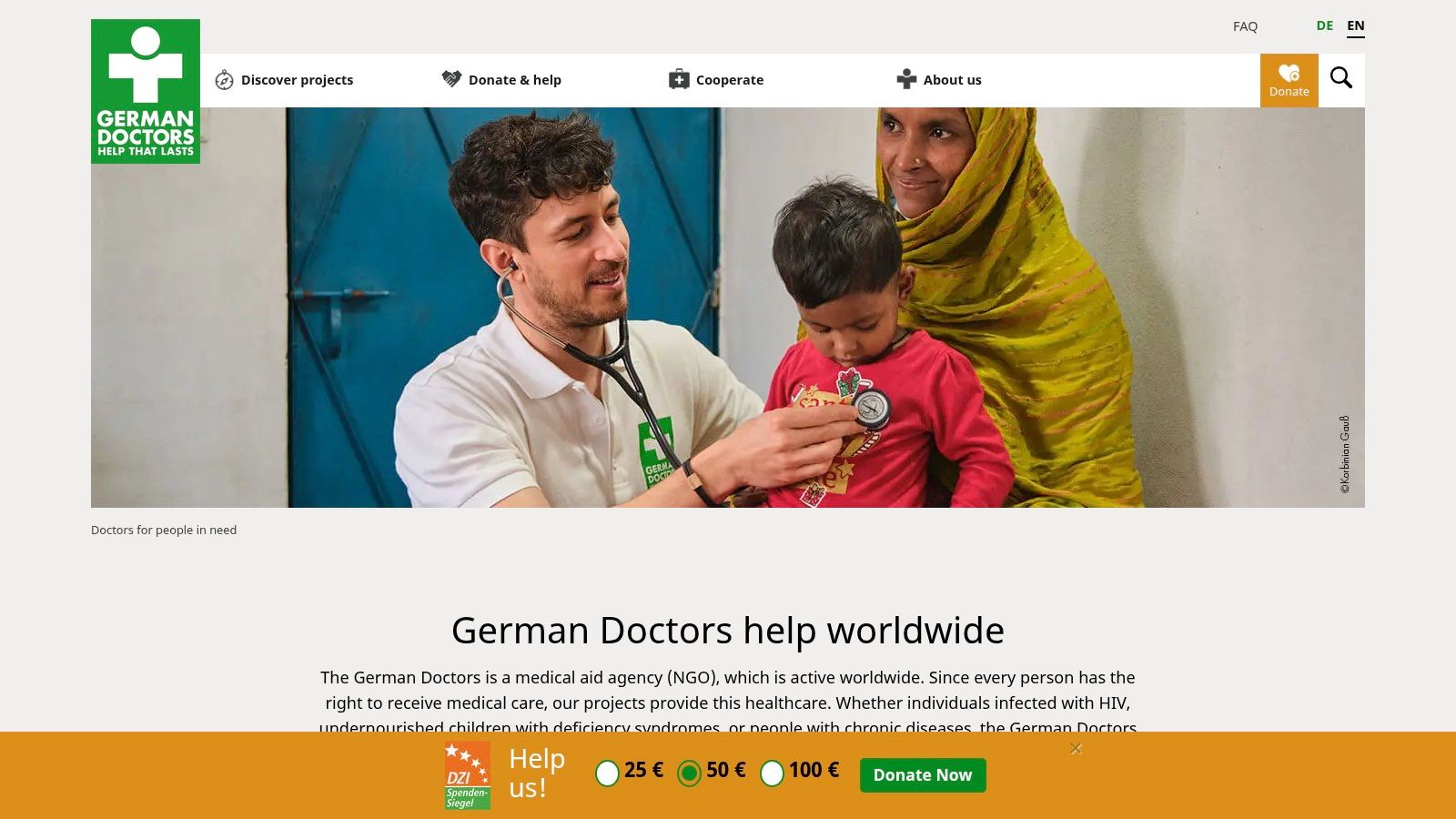
A donation for medical aid is only as transparent as the information about who implements it on the ground. German Doctors focuses on healthcare provision in underserved regions and works with local partner organisations. The German Doctors website describes medical missions, specialist advice and the training of local staff.
The clear focus is an advantage if you want to support healthcare provision. For mosque work, general education programmes or other social tasks, the organisation is less suitable. So first check whether its area of work matches your donation concern.
Making partner work understandable
When reviewing a donation profile internally, what matters to me is whether the responsibilities are clear: who organises the care, who works on the ground, and which tasks does the German organisation take on? A partner's name alone is not enough. The description should show which services are provided and what changes are intended.
Before your next payment: Read a project report alongside the description of the initiative. This makes it easier to recognise whether it reports on specific missions or also on longer-term care.
Collaboration among several parties can make traceability more difficult. Pay attention to a clear presentation of the roles, the work done so far, and the difficulties encountered. I rate an open report about limitations higher than a blanket promise of success.
Also check in the donation form whether your payment is used generally or is tied to a specific purpose. Align your expectations for later reports accordingly.
My verdict: German Doctors fits well if you have a clear focus on health. Decide based on the medical approach and the transparently described partner work. Don't expect a donation to come without organisational costs.
5. Save the Children Deutschland e.V.
When a crisis affects children, you have to decide whether your donation should support acute aid or longer-term work in health, education, and protection. Save the Children Deutschland works in these areas as well as in emergency and reconstruction aid. On the Save the Children Deutschland website you can check current programmes and donation appeals.
The thematic breadth is an advantage if you want to support children specifically. Before making a payment, choose whether you want to fund a particular appeal or the organisation's work in general. An emotional project story alone does not prove that your payment benefits exclusively that project.
- Strength: You can check acute emergency aid and longer-term child aid at the same organisation.
- Limitation: For a local community project, the clear focus on children may not be a good fit.
- Checkpoint: Read the information on earmarking and note at which level the use of funds is reported.
Checking reports beyond emergency aid
Before making another donation, I would consult earlier reports. Is it explained how the project has developed? Are open tasks and the connection to the current donation appeal recognisable? Clear answers build more trust than general promises of success.
If you want to support refugees, the article on donating for refugees can help you define your focus more precisely. Decide whether you want to support child aid, the care of families, or another goal.
My verdict: Save the Children is a good fit if you specifically want to support child aid. The well-known name does not replace a check. Read the project purpose, the reporting status, and the payment conditions before donating again.
6. ADRA Deutschland e.V.
Do you want to help after a disaster while also supporting a project that runs over several years? You'll find both at ADRA Deutschland. The organisation presents projects and current donation appeals on the ADRA website and works as part of an international network.
This range is only useful to you if you define your focus beforehand. Otherwise you'll be comparing projects meant to fulfil completely different tasks. A strongly narrated emergency aid appeal does not answer questions about a multi-year development project.
Checking what the profile reveals in the project directory
The external audit assesses the organisation, the project profile assesses the individual project. Check in the ADRA project directory whether the chosen project states a fixed target budget and a named implementation partner before you choose the earmarking. You should see exactly this information in the profile of a donation platform like SadakaNow too: Who is implementing the project, what budget is planned, at what level is the use of funds reported? If one of these fields is missing, that is a reason to ask further questions.
- Strength: You can research acute aid and longer-term support at the same organisation.
- Friction point: With a broad range of projects, you need to pay closer attention to earmarking, responsibilities, and the respective reporting status.
- Personal fit: Consider the Christian background if the ideological orientation matters for your donation decision.
For Muslim donors, a clear distinction applies. Whether you want to support a Christian-affiliated organisation is a personal decision. Whether an offer is suitable for a particular religious giving occasion is something you check based on the stated recipient groups and channels of use.
My verdict: ADRA belongs on your shortlist if you want to compare development work and humanitarian aid based on concrete projects. Before donating, decide which cause you want to support, and request the budget, implementation partner, and reporting path for exactly that project.
7. Islamic Relief Deutschland e.V.
Islamic Relief Deutschland is the obvious choice if you want to donate to a Muslim organisation and fulfil Islamic occasions such as Zakat or Sadaqa. Humanitarian aid and development cooperation round out the range. You can check the specific offer and organisational data on the Islamic Relief Deutschland website.
Religious closeness lowers the barrier to research. However, it must not replace your scrutiny, because a Muslim organisation must disclose budget, recipient groups, and channels of distribution just like any other association.
Deutscher Spendenrat is not DZI
The certification mentioned by the Deutscher Spendenrat is its own review process and not a DZI donation seal. Check with the provider to see which criteria were reviewed and for what period the proof is valid. Anyone expecting a DZI seal should know the difference before treating the certification as an equivalent form of proof.
A Muslim organisation should answer your questions about the use of funds just as concretely as any other organisation. Familiarity with the cause doesn't make these questions unnecessary.
For Zakat, I expect an explicit description of the recipient groups and the intended use. For Sadaqa, I want to be able to see which project is being supported and how it's reported on. For projects abroad, the recipient country, implementation partner and the channel of transfer belong on my list of follow-up questions. A verified campaign profile on SadakaNow should disclose exactly these points: who is carrying out the work, what the money is intended for, and at what level the use of funds is reported. An external seal tells you that something has been checked. The profile shows you what you can check yourself.
The overview of Muslim aid organisations helps you assess religious fit and organisational transparency separately.
My verdict: Islamic Relief is a good fit if you want to place Islamic donation causes with a correspondingly aligned organisation. Choose a concretely described offer with a traceable review status, not just the familiar religious framework.
Comparison of 7 vetted donation organisations
Seven offers, three different review paths: internal platform approval, external seals, and a research tool. Read the table like this: the "Review & Transparency" column shows who has checked. The "Effort" column shows what remains for you to do.
| Offer | Focus | Review & Transparency | 🔄 Effort for donors | 💡 Particularly suited for |
|---|---|---|---|---|
| SadakaNow (donation platform) | Sadaqa, mosques, aid organisations and social initiatives | Internal review of each campaign's charitable status; project pages show the organisation, intended use, and a live donation feed. For SadakaNow projects: 0% platform fee, voluntary tips. | ⚡ Donate via SEPA, PayPal or credit card; organisations can get started with support within 24 hours. | ⭐ Muslim donation causes and targeted support of vetted campaigns |
| DZI donation seal (research resource) | Comparison of organisations by field of work and organisational data | Review of use of funds, oversight and transparency; seal valid for one year at a time. Voluntary, so not every reputable organisation has one. | 🔄 Free research; the choice of organisation is up to you. | 💡 Anyone who wants to compare organisations and financial information |
| Kindernothilfe e.V. (aid organisation) | Children's rights, child protection, development support and disaster relief | DZI donation seal; advertising and administrative expenses rated "appropriate" by DZI for 2024. | 🔄 General donations are not necessarily tied to a single project; individual donation appeals allow for a narrower earmarking. | ⭐ Donations for children and combining project work with advocacy |
| German Doctors e.V. (aid organisation) | Medical care in underserved regions, local partners and professional training | DZI donation seal; audited financial data and the classification of administrative costs can be viewed in the DZI profile. | 🔄 Earmarking for individual countries of operation possible; reports on local partner work available, though predictability in crisis areas remains limited. | 💡 Medical aid and strengthening local healthcare |
| Save the Children Deutschland e.V. (aid organisation) | Children's rights, health, education, protection as well as emergency relief and reconstruction | DZI donation seal; advertising and administrative expenses rated "justifiable" by DZI for 2024. International network in around 120 countries. | 🔄 General donations are available to the entire network; thematic appeals, for example on emergency relief or education, set the direction. | ⭐ Child aid in crisis and non-crisis regions |
| ADRA Deutschland e.V. (aid organisation) | Development cooperation and humanitarian aid | Listed in the DZI's list of donation-seal organisations; projects and donation appeals can be researched. | 🔄 Given the broad range of projects, it's worth choosing a specific focus. | 💡 Supporting long-term development work or acute emergency relief |
| Islamic Relief Deutschland e.V. (aid organisation) | Humanitarian aid, development cooperation, Zakat and Sadaqa | Renewed certification by the Deutscher Spendenrat reported for 2026; a different form of proof than the DZI donation seal. | 🔄 For international projects, it's worth taking a look at the project, recipient country and transfer channel. | ⭐ Muslim donation causes such as Ramadan and Kurban Bayram, as well as humanitarian aid |
Short on time? The DZI directory filters reputable providers in minutes. Anyone donating specifically for Muslim causes will find the review information on SadakaNow directly on the project itself rather than in a separate register.
Taking this review logic with you to your next donation click
You can't recognise verified donation organisations by a single trust signal. You need a coherent overall picture made up of identity, verification status, project description and reporting. Non-profit status, financial transparency and documented project impact should be considered separately.
According to the German country report Giving in Germany, missing information on the use of funds and limited trust in nationwide organisations are among the barriers to donating. My conclusion from this: don't give more money despite open questions — clarify them before your next payment.
- Check seal status: Look for current proof and identify the body conducting the review. Clarify whether you're looking at an external certification or an internal platform approval.
- Read the project description: Require a named organisation, an understandable goal and an explanation of the planned use of funds. Ask follow-up questions if responsibilities or budget logic remain unclear.
- Understand the fee model: Distinguish between the platform deduction, a voluntary tip and the recipient's expenses. Check the actually selected total amount before confirming.
- Compare reports: Place current updates alongside earlier announcements. Pay attention to whether those responsible explain progress, changes and open tasks in a comprehensible way.
- Verify the payment route: Match the organisation, contact person and payment destination. Do not follow a different payment request from private messages without confirming it through the official contact.
- Clarify personal fit: Decide whether you want to support Sadaka, Zakat, emergency aid or community work. For each specific purpose, require a matching description rather than a blanket assurance of trust.
This check also concerns the identity behind an appeal. The CISPA study on donation-related abuse on social media platforms covers corresponding forms of fraud. A technically secure payment completion does not automatically answer whether the person promoting it actually belongs to the project.
SadakaNow translates part of this verification path into the approval of campaigns by checking non-profit status. Public project pages and updates supplement this initial check; Sadaka Pulse makes ongoing support visible. The decisive standard remains the traceable use of funds, not merely the fact that others have already donated.
On SadakaNow you'll find Sadaka campaigns from mosques, aid organisations and social initiatives that are checked for non-profit status before being activated. Open a suitable project, read the description and updates, and check the fee model before completing your next donation.